For centuries, believers around the world have embraced a powerful spiritual practice that brings the final moments of Jesus’ journey to life. Rooted in ancient traditions, this devotional walk combines prayer, reflection, and vivid imagery to create a bridge between past and present faith experiences.
The practice originated with early Christians retracing Christ’s path in Jerusalem. Today, it guides participants through 14 pivotal moments – from trial to burial – using artwork or symbolic markers. Each step invites personal connection with themes of sacrifice, love, and redemption.
What makes this tradition special is its ability to transform quiet meditation into an active participation in sacred history. As you move from station to station, you’re not just remembering events – you’re walking alongside the Savior in His ultimate act of love. This journey offers fresh perspectives on suffering, forgiveness, and hope that resonate deeply in modern life.
Key Takeaways
- Connects believers with Christ’s sacrifice through physical and spiritual engagement
- Uses visual elements to make biblical events feel immediate and personal
- Offers structured reflection points for spiritual growth
- Blends historical tradition with contemporary worship practices
- Creates meaningful parallels between ancient suffering and modern challenges
Introduction to the Devotional Journey
This meditative practice turns quiet reflection into an active dialogue with sacred history. Many find it especially meaningful during Lent or on Fridays, moments when believers seek deeper connections with their faith roots. Whether alone or with others, participants walk through pivotal scenes that reshape their understanding of divine love.
Why This Practice Transforms Hearts
Regular engagement nurtures empathy and spiritual resilience. By contemplating Christ’s suffering, you develop fresh perspectives on personal challenges. The rhythm of moving between moments creates space for heart-changing insights that linger long after the prayer ends.
A Journey Through Sacred Moments
Fourteen markers guide participants from trial to tomb. Each stop invites reflection on themes like forgiveness, perseverance, and sacrifice. Here’s a glimpse at key stages:
| Theme | Focus | Impact |
|---|---|---|
| Compassion | Helping others carry burdens | Strengthens community bonds |
| Sacrifice | Ultimate act of love | Deepens gratitude |
| Renewal | Empty tomb promise | Inspires hope |
This structured approach helps believers slow down amid busy days. Many discover their prayer life becoming richer and more focused through regular practice.
Historical Background and Evolution
The roots of this sacred devotion stretch back to believers walking Jerusalem’s dusty paths. Early followers journeyed across the ancient world to visit sites linked to Jesus’ final hours. Their footsteps laid the groundwork for a practice that would span continents and centuries.
From Holy Land to Hometowns
Ancient tradition suggests Mary marked her own prayer route near Jerusalem. These stone memorials let her relive her son’s sacrifice. When medieval conflicts made Holy Land trips dangerous, creative solutions emerged. European communities built local versions of Jerusalem’s sacred path, keeping the tradition alive.
Standardizing Sacred Steps
The Franciscans became key players in shaping this practice. Their work reached a milestone in 1505 Belgium, where Leuven’s landmark installation established the 14-step format we recognize today. By the 1700s, they’d brought this structure back to Jerusalem itself, creating consistency across the Christian world.
“A living bridge between eras – that’s what these markers became.”
| Period | Development | Significance |
|---|---|---|
| 1st-4th C. | Pilgrims visit Jerusalem sites | Physical connection to events |
| Middle Ages | Local replicas in Europe | Democratized access |
| 16th-18th C. | Franciscan standardization | Global uniformity |
This evolution shows how faith traditions adapt while preserving core meaning. What began as risky pilgrimages became accessible spiritual tools, meeting believers’ needs through changing times.
Understanding the Symbolism Behind Each Station
Hidden within this devotional path lie powerful lessons about human connection and divine purpose. Ordinary individuals became part of salvation history through simple acts of courage and kindness.
When Strangers Become Sacred Helpers
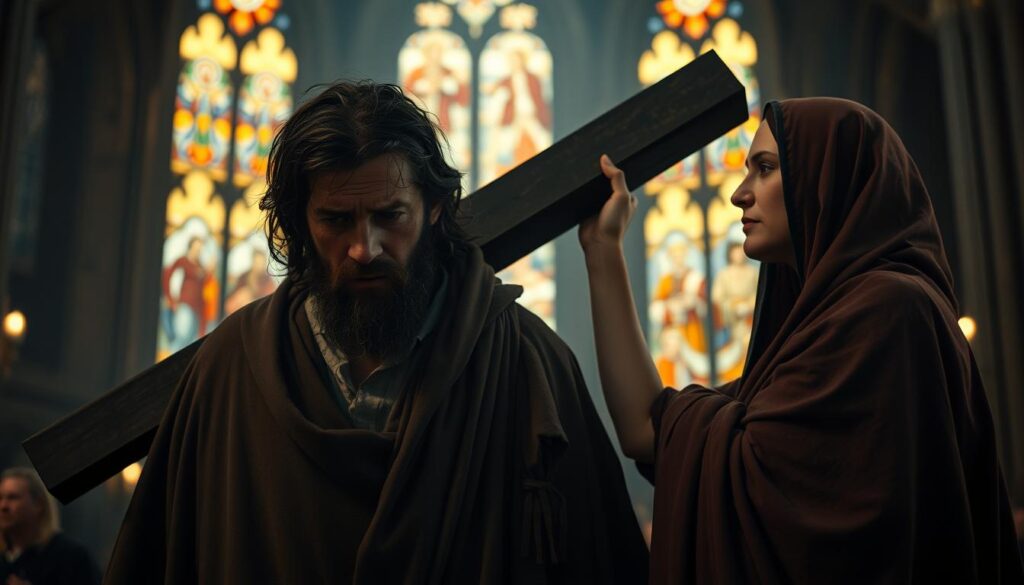
Simon Cyrene’s story teaches us about reluctant service. Though forced to carry the cross, his assistance became a transformative act of solidarity. This moment reminds us that grace often appears through unexpected partnerships.
Small Acts With Eternal Impact
Veronica’s choice to wipe a bleeding face shows how brief actions create lasting meaning. Her towel became a canvas for Christ’s image – proof that compassion leaves imprints beyond momentary suffering. This encounter challenges us to engage actively with others’ pain.
| Figure | Action | Symbolic Meaning |
|---|---|---|
| Simon | Carrying the cross | Shared burdens strengthen community |
| Veronica | Wiping Jesus’ face | Kindness preserves dignity |
| Women | Weeping together | Collective grief fuels hope |
The mother of Jesus appears throughout these moments as a model of quiet strength. Her presence underscores how love endures even when words fail. Together, these figures show faith’s power to transform bystanders into active participants.
Exploring the Religious Significance
At the heart of this spiritual journey lies a profound truth that reshapes how believers view suffering and redemption. Every step reveals layers of meaning that go beyond retelling events – they unlock understanding of divine love’s transformative power.
Linking the Stations to the Passion Narrative
The sequence of events mirrors Gospel accounts of Christ’s final hours. When Jesus extended his hands on the cross, this wasn’t just physical suffering – it symbolized embracing humanity’s brokenness. His words “Father, into your hands I commit my spirit” show perfect trust even in agony.
Three hours of anguish on the wooden beam carried cosmic weight. Each moment fulfilled ancient prophecies while bridging heaven and earth. As believers walk through these scenes, they see how every choice Jesus made – from trial to final breath – served a greater purpose.
Meditation on these events helps people grasp their role in the story. The weight that caused the Savior’s collapse wasn’t just wood – it represented the spiritual burden of human failings. This realization turns abstract concepts like forgiveness into personal encounters.
| Gospel Event | Spiritual Lesson | Modern Impact |
|---|---|---|
| Condemnation | Unjust suffering | Builds empathy |
| Carrying the cross | Accepting life’s burdens | Strengthens resilience |
| Final breath | Ultimate surrender | Inspires trust |
Through this lens, the cross transforms from ancient torture tool to enduring hope symbol. It challenges believers to see their struggles as part of a larger tapestry woven by the Father’s love. What once meant death now offers endless life.
How to Practice the catholic 14 stations of the cross
To truly benefit from this journey, one must approach it with intentionality and openness. The practice becomes most meaningful when you create space for both structured guidance and personal reflection.
Preparing Mentally and Spiritually
Begin by choosing a calm environment – perhaps a chapel with artwork or a quiet corner at home. Settle your thoughts with deep breaths, inviting focus on the sacred story you’re about to walk through. Many find lighting a candle helpful to symbolize Christ’s enduring presence.
Step-by-Step Guide to the Devotion
Each marker follows a rhythm of prayer and contemplation. Start with the traditional words: “We adore you, O Christ…” to center your heart. Follow with scripture passages that make ancient events feel immediate.
When meditating on moments like Jesus falls, imagine the weight he carried – both physical and spiritual. As St. Alphonsus wrote:
“In every stumble, see the strength to rise again.”
| Step | Action | Purpose |
|---|---|---|
| 1 | Opening prayer | Focus the heart |
| 2 | Scripture reading | Ground in truth |
| 3 | Silent reflection | Personal connection |
| 4 | Hail Mary/Our Father | Communal unity |
Most complete the journey in 30-45 minutes, but don’t rush. If time is limited, focus on 3-4 markers deeply. The prayer format adapts – some whisper rote words, others journal responses. What matters is authentic engagement with each sacred moment.
Incorporating Daily Prayer and Reflection
Weaving sacred moments into ordinary days creates a rhythm of spiritual connection. Morning routines transform when paired with intentional meditation, turning coffee sips into communion with divine purpose.
Small Steps With Big Impact
Start by linking brief reflections to existing habits. Pair your first cup of tea with a moment from Christ’s journey. These micro-meditations plant seeds of grace that blossom through your day.
Struggling with a difficult task? Recall Simon’s unexpected role in salvation history. As one pastor notes:
“Our daily crosses become lighter when carried in solidarity with the Savior.”
| Time | Practice | Benefit |
|---|---|---|
| Morning | Reflect on one station | Sets spiritual tone |
| Noon | Silent gratitude prayer | Renews perspective |
| Evening | Examen with station theme | Deepens self-awareness |
Combine traditional prayers like the Hail Mary with station themes for layered meaning. A whispered “Holy Mary” while waiting in traffic becomes an anchor to sacred story.
Your heart becomes the true chapel. No need for elaborate rituals – just willingness to pause and connect. Over time, these moments rewire how you experience both joy and struggle, revealing hidden grace in ordinary life.
Connecting the Devotion to Holy Week Observances
Among the most solemn days in the Christian calendar, Good Friday stands apart as a time of profound reflection. This sacred observance transforms ancient traditions into living acts of remembrance, inviting participants to walk with renewed awareness of divine love’s ultimate expression.
The Spiritual Importance of Good Friday
Many communities gather on this holy day to retrace the path of sacrifice through shared prayer. As voices unite in hymns and whispered petitions, the cross Jesus carried becomes more than historical artifact – it mirrors the burdens we help carry through compassionate action.
Consider the moment when Jesus falls first under the crushing weight. A pastor recently shared:
“That initial stumble cracks open our hearts – it shows God entering fully into human frailty to redeem it.”
Special services often blend traditional elements with modern touches:
| Element | Purpose | Impact |
|---|---|---|
| Communal hymns | Unite voices | Strengthens shared purpose |
| Extended silence | Personal reflection | Deepens self-awareness |
| Symbolic gestures | Physical engagement | Makes prayer tangible |
Through these practices, believers discover fresh meaning in ancient truths. The falls first moment becomes a mirror – revealing how daily choices contribute to collective healing or brokenness. This sacred day offers space to grieve imperfections while embracing transformative grace.
Modern Reflections on an Ancient Tradition
Across changing eras, this spiritual pathway continues finding fresh resonance. New expressions honor its roots while speaking to current realities. A 20th-century innovation called Via Lucis now walks alongside the traditional journey, shifting focus to resurrection hope.
Personal Meditations and Contemporary Relevance
Today’s practitioners blend time-honored patterns with personal creativity. Some visualize modern parallels – seeing Christ’s body in refugee struggles or environmental crises. Others find the weight of daily challenges mirrored in the sacred narrative.
The Via Lucis expansion highlights Easter’s transformative power. Its 14 resurrection moments remind believers that light always conquers darkness. This dual approach – honoring pain while celebrating victory – meets our world’s complex spiritual needs.
Personal journals reveal surprising connections. A nurse wrote: “Wiping patients’ brows becomes my Veronica moment.” A teacher shares how helping students carry life’s burdens echoes Simon’s story. These lived experiences keep the tradition beating in modern hearts.
As our world evolves, so does this practice. Yet its core remains – a timeless invitation to walk with love through suffering into hope. Whether using apps or rosaries, believers keep finding their hearts reshaped by this enduring journey.
FAQ
What’s the significance of the 14 stations?
Each station represents a pivotal moment in Jesus’ final journey, from condemnation to burial. These stops invite reflection on sacrifice, love, and resilience, deepening one’s connection to His Passion.
How do figures like Simon of Cyrene and Veronica enhance the devotion?
Simon’s act of carrying the cross and Veronica wiping Jesus’ face highlight compassion amid suffering. Their roles remind us to serve others selflessly, even in challenging times.
Can this practice be done outside of Lent?
Absolutely! While often linked to Lent and Good Friday, the devotion offers year-round spiritual growth. Many find daily prayer with the stations fosters peace and mindfulness.
Why is Good Friday central to this tradition?
Good Friday marks Jesus’ crucifixion, making it a focal point for meditating on His sacrifice. The stations guide believers through His suffering, enriching Holy Week observances.
How can beginners start incorporating this devotion?
Begin with short prayers at one or two stations, focusing on their meaning. Use simple reflections or artwork to visualize each moment. Gradually build consistency as comfort grows.
What moments from Jesus’ journey are emphasized?
Key events include His three falls, meeting His mother, and being nailed to the cross. These moments emphasize humanity, endurance, and the weight of sacrifice.
Are there modern ways to engage with this ancient practice?
Yes! Many use digital guides, community walks, or artistic interpretations. Personal meditations on overcoming struggles today can also bridge the ancient and contemporary.