Have you ever wondered how one of the world’s oldest institutions stays connected across continents and cultures? The answer lies in its carefully structured system of leadership, designed to guide over a billion followers. This framework isn’t just about titles—it’s a living network that balances tradition with modern-day needs.
At its core, the structure revolves around three main roles: bishops, priests, and deacons. Each serves distinct purposes, from overseeing regions to leading local congregations. With 2,903 dioceses worldwide, this system ensures every community receives spiritual support while maintaining unity.
You’ll discover how these roles collaborate to spread teachings, address challenges, and adapt to cultural differences. Whether you’re curious about the Pope’s global influence or your neighborhood priest’s daily responsibilities, this guide breaks down the layers in simple terms.
Key Takeaways
- The Church’s organizational structure spans 2,903 dioceses globally.
- Three primary roles—bishops, priests, and deacons—form the foundation of leadership.
- This system balances centralized authority with local flexibility.
- Every level focuses on spiritual care and community support.
- The hierarchy has evolved over centuries to address modern challenges.
Understanding the Catholic Church Hierarchy
How does a 2,000-year-old organization maintain order among 1.3 billion members? The answer lies in a three-tiered leadership model that combines spiritual guidance with practical governance. This system connects local parishes to global decision-making through clearly defined roles.
Key Terms and Definitions
Let’s break down essential concepts. The term “hierarchy” originates from Greek words meaning “sacred order”. In church context, it describes how spiritual leadership flows from bishops to local communities. A bishop’s authority comes from apostolic succession – the belief that their role continues an unbroken chain from Jesus’ original apostles.
Three primary positions form this structure:
| Role | Key Responsibility | Geographic Scope |
|---|---|---|
| Bishop | Oversees multiple parishes | Diocese (regional) |
| Priest | Leads individual church | Parish (local) |
| Deacon | Assists with sacraments | Community-level |
The Episcopal Structure Explained
Bishops form the backbone of this system. Each leads a diocese – there are 2,903 worldwide. They ordain priests, confirm members, and make key decisions. What makes their role unique? Only bishops can trace their spiritual authority through centuries of succession.
This structure ensures consistency while allowing cultural adaptation. For example, a bishop in Manila and another in Milan follow the same core principles but address different community needs. It’s like having local managers report to regional directors in a global company.
Historical Origins of Catholic Ranks
Long before smartphones or printing presses, early Christian communities needed ways to stay united. Leaders emerged naturally as followers spread across the Mediterranean world. A letter from Saint Ignatius of Antioch around 110 AD reveals something surprising: the same three roles we recognize today were already in place.
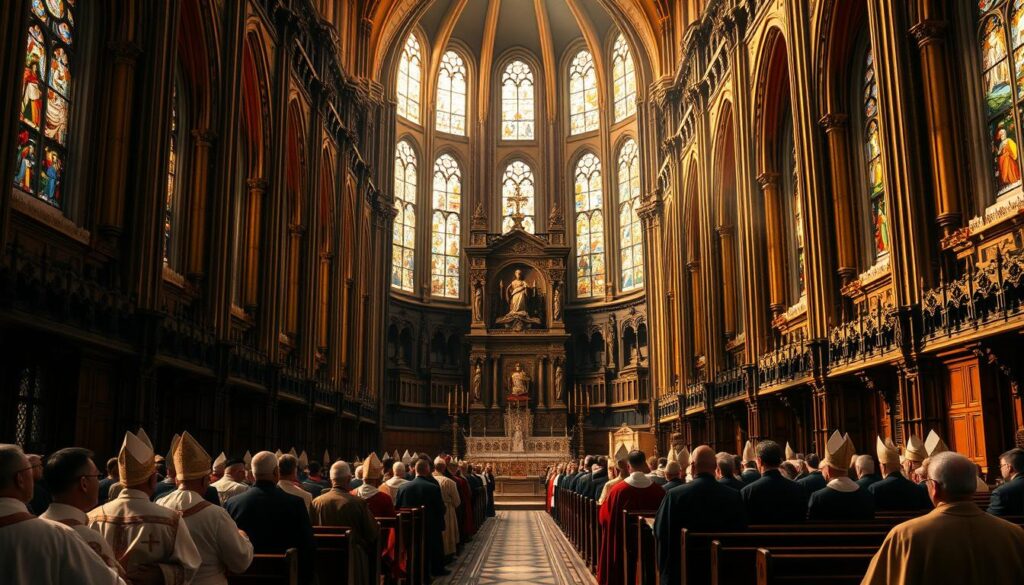
Imagine bishops being called “pope” like we use “pastor” today. That’s exactly what happened until the 500s! The title originally showed respect for any senior bishop. Rome’s bishop gradually became unique as disputes over teachings needed final arbitration.
Early leaders blended Jewish synagogue traditions with Roman governance. Bishops oversaw regions like provincial governors. Priests managed local gatherings, while deacons handled community needs. This mix created a flexible spiritual-administrative hybrid that could scale.
What kept this system working for 1,900 years? Adaptability. The core trio of roles stayed constant, but how they operated shifted with cultures and technologies. From handwritten letters to video conferences, the essential chain of spiritual authority remains unbroken.
Overview of Canon Law’s Influence on Church Structure
Every organization needs rules to function smoothly, and the Church is no exception. Canon law acts as its legal backbone, shaping how communities operate worldwide. Think of it as the playbook that keeps everything from local parishes to global councils aligned.
Evolution from the 1917 Code to the 1983 Code
The 1917 code canon law marked a turning point. For the first time, centuries of scattered regulations became one unified system. Imagine trying to navigate 2,000 years of decisions – this code brought order to complexity.
Everything changed after Vatican II. The 1983 code canon law emerged with fresh priorities:
| Aspect | 1917 Code | 1983 Code |
|---|---|---|
| Leadership Focus | Centralized authority | Collaborative governance |
| Lay Participation | Limited roles | Expanded responsibilities |
| Cultural Adaptation | Strict uniformity | Local flexibility |
This shift wasn’t about rewriting rules. It clarified how leaders serve communities better. The newer code canon emphasizes transparency – like requiring financial councils in every diocese.
Eastern Catholic churches got their parallel system in 1990. This acknowledges diverse traditions while maintaining unity. Both codes prove that structure isn’t restrictive when designed to empower.
Through these changes, canon law remains rooted in core values. It’s like updating a smartphone’s OS – new features enhance functionality without changing the brand’s identity.
Defining Catholic Ranks in the Church Hierarchy
Understanding spiritual leadership requires clarity about who does what. The Church’s structure assigns specific duties through three interconnected roles, each building on the last. This system balances shared responsibilities with unique sacramental authority.
Sacred Duties at Every Level
Ordination marks a permanent commitment to serve. Deacons form the foundation – they baptize, perform weddings, and lead outreach programs. Many work regular jobs while serving their parishes part-time.
Priests take on deeper sacramental roles. They celebrate Mass daily and guide communities through life’s milestones. “A priest becomes the spiritual heartbeat of his parish,” notes the 1983 code canon, emphasizing their pastoral care duties.
| Role | Sacraments Administered | Primary Duties |
|---|---|---|
| Deacon | Baptism, Matrimony | Charitable work, liturgy assistance |
| Priest | Eucharist, Reconciliation | Parish leadership, spiritual guidance |
| Bishop | Confirmation, Holy Orders | Diocese oversight, ordinations |
Bishops hold the highest authority through apostolic succession. They confirm members’ faith journeys and appoint new ministers. Only they can ordain priests and deacons, ensuring continuity across generations.
This tiered approach allows flexibility. A deacon might organize food drives while a bishop addresses regional needs. Together, they create a network supporting 1.3 billion members through shared spiritual goals.
The Papacy: Leadership and Authority
What does it take to guide one of the world’s largest religious communities through changing times? The answer lies in a role that combines spiritual vision with practical governance. As both Bishop of Rome and global spiritual leader, the pope holds eight distinct titles reflecting his multifaceted responsibilities.
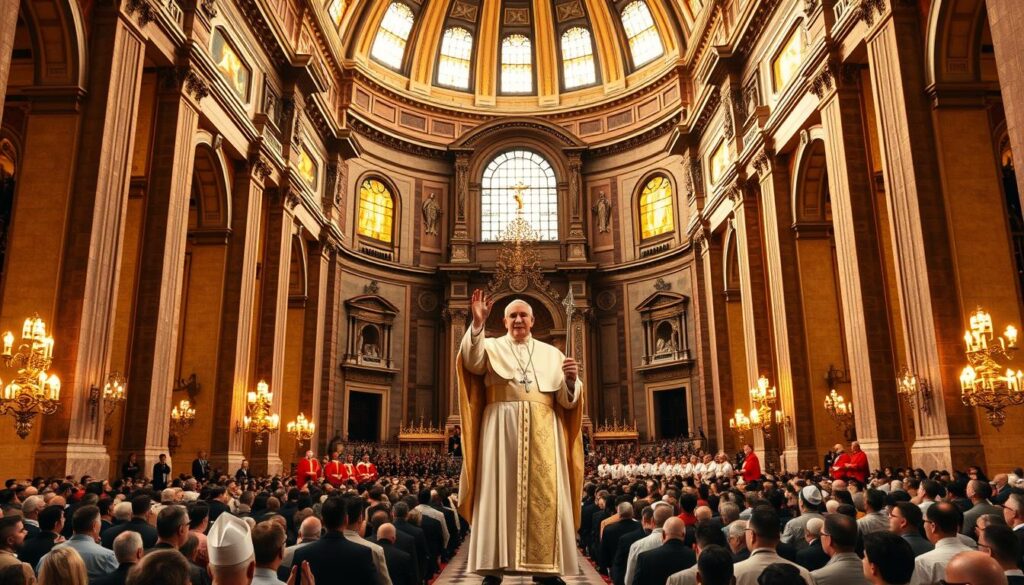
The Pope’s Multifaceted Role
This leader serves as more than a religious figurehead. As Supreme Pontiff, he oversees doctrinal unity across continents. His role as Sovereign of Vatican City adds diplomatic duties, managing relationships with 183 nations. The title Servant of the servants of God reminds everyone that leadership here means putting others first.
Three key areas define daily operations:
- Teaching moral principles through encyclicals
- Presiding over major sacraments
- Guiding the Holy See’s administrative work
Election and Succession Process
When a papacy ends, cardinals under age 80 gather in Rome. The conclave follows strict rules from Universi Dominici Gregis. Votes happen in the Sistine Chapel until one candidate earns two-thirds support. White smoke from the chimney signals a new pope to the world.
This system ensures stability. Since 1447, every elected leader has accepted the role without dispute. The process blends ancient rituals with modern security measures—even electronic jamming devices prevent outside influence during voting.
The College of Cardinals: Advisors and Electors
When global decisions need spiritual guidance, a select group steps forward. These leaders combine decades of experience with deep connections to communities worldwide. Their bright red vestments aren’t just ceremonial—they signal readiness to face challenges head-on.
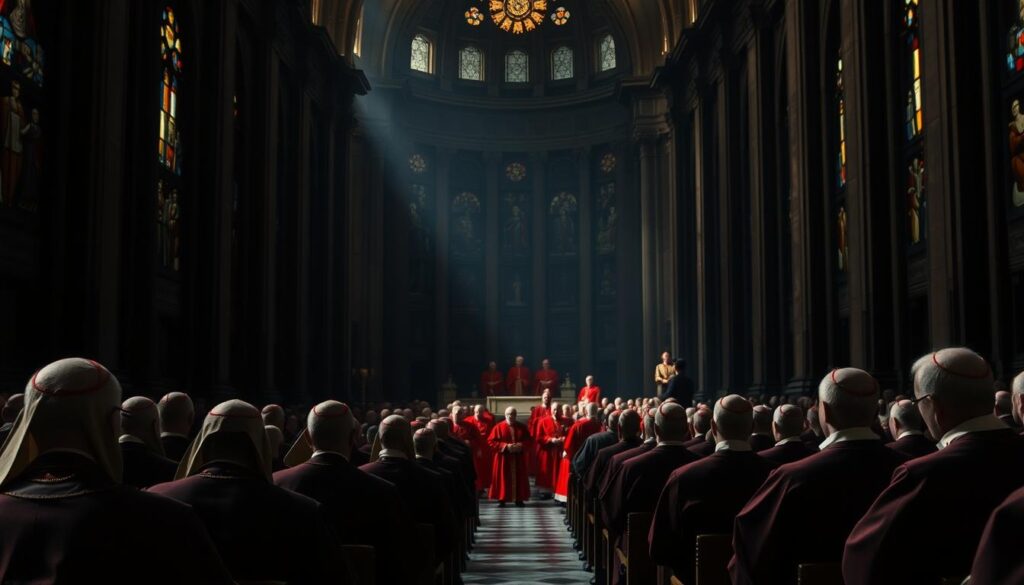
Members come from diverse backgrounds. Some lead major archdioceses like Los Angeles or Mumbai. Others manage Vatican offices overseeing education or saint approvals. About one-third work directly in Rome, while the rest serve locally.
Three Pillars of Influence
The College organizes into distinct groups:
| Order | Members | Primary Focus |
|---|---|---|
| Cardinal Bishops | 6 leaders near Rome | Liturgical traditions |
| Cardinal Priests | Active archbishops | Diocese leadership |
| Cardinal Deacons | Vatican officials | Administrative tasks |
During papal transitions, these advisors become temporary stewards. Those under 80 gather in the Sistine Chapel for conclave—a process unchanged since 1274. Their votes shape the Church’s future direction.
Beyond elections, cardinals bridge global and local needs. They mediate conflicts, represent the Holy See at UN events, and ensure dioceses align with central teachings. This dual role keeps the institution both unified and adaptable.
Bishops and Archbishops: Pastoral Guardians
Spiritual leadership takes tangible form through those who guide regional communities. A bishop’s role combines ancient traditions with modern responsibilities, serving as both teacher and administrator. Their authority flows from apostolic succession, creating an unbroken chain of guidance stretching back centuries.
Diocesan bishops oversee all aspects of faith practice within their territories. They approve parish budgets, assign priests, and ensure schools follow religious teachings. Every decision aims to strengthen community connections while preserving core values.
Archbishops manage larger archdioceses and often mentor neighboring bishops. Though their sacramental powers match other bishops, their influence extends further. They coordinate regional initiatives like disaster relief or interfaith dialogues.
| Role | Jurisdiction | Key Symbols |
|---|---|---|
| Bishop | Single diocese | Ring, mitre, crosier |
| Archbishop | Archdiocese + province | Pallium, metropolitan cross |
These leaders balance visible duties with quiet spiritual work. You might see them confirming teens one day and negotiating hospital partnerships the next. Their staff’s curved top reminds communities they’re always gathering people closer.
Episcopal rings aren’t just jewelry – they symbolize lifelong commitment to serve. When a bishop wears his mitre during Mass, it visually reinforces his teaching authority. These traditions help members feel connected to something enduring yet responsive.
Diocesan Organization and Local Church Governance
Local communities form the heartbeat of spiritual life across the globe. At the center stands the diocese, a self-contained network of worship and service. This structure connects neighborhoods to broader spiritual goals while addressing unique local needs.
Building Blocks of Community
Parishes act as neighborhood hubs within each diocese. Most are led by a pastor who coordinates sacraments and outreach. But nearly 20% operate without a resident priest—1,948 parishes globally rely on deacons or trained lay ministers.
These teams adapt to changing circumstances. A retired teacher might lead Bible study, while a deacon organizes food pantries. Flexibility keeps communities thriving even when clergy numbers shift.
Overseeing it all, the diocesan bishop ensures unity across parishes. He approves leadership appointments and allocates resources. Like a mayor guiding city districts, he balances individual needs with shared mission.
This system proves effective—2,903 dioceses worldwide maintain both local identity and global connection. From Sunday Mass to disaster relief, every layer works to uplift members.
FAQ
How does the hierarchy function within the Church?
The structure operates through three main tiers: bishops overseeing dioceses, priests serving parishes, and deacons assisting in ministries. Authority flows from the Holy See, with roles defined by Canon Law and regional practices like episcopal conferences.
What’s the difference between a bishop and an archbishop?
An archbishop leads a metropolitan see and coordinates nearby dioceses, while a diocesan bishop governs a single diocese. Both hold sacramental authority, but archbishops have broader administrative duties.
How did the 1983 Code of Canon Law reshape governance?
It modernized practices after Vatican II, emphasizing collaboration with lay ecclesial ministers and simplifying procedures. Unlike the 1917 Code, it clarified roles for diocesan bishops and streamlined tribunal processes.
What role do cardinals play beyond electing the pope?
They advise the Holy See on global issues, manage Vatican departments like the Dicastery for Doctrine, and serve as papal legates in diplomatic missions. Many lead major archdioceses like New York or Manila.
How are dioceses organized locally?
A diocese includes parishes, schools, and ministries overseen by a bishop. Episcopal vicars handle specific areas like education or finance, while priests and deacons work directly with communities under the bishop’s guidance.
Can women hold leadership roles in the Church?
While ordination is reserved for men, women serve as chancellors, theologians, or heads of religious orders. Lay ecclesial ministers, regardless of gender, lead ministries like catechesis or social outreach.
What’s the purpose of honorary titles like “monsignor”?
These titles recognize exceptional service by priests, often in administrative or diplomatic roles. They don’t grant extra authority but signify papal honor, such as Chaplain of His Holiness.