Understanding faith traditions that shaped global history opens doors to appreciating art, culture, and modern society. For nearly 2,000 years, one spiritual force has influenced laws, inspired masterpieces, and united over a billion people across continents. Let’s explore how this tradition became a cornerstone of Western civilization.
Emerging from ancient roots, this branch of faith developed distinct practices and governance. Its central leadership—guided by a single spiritual figure—created a unified structure unmatched in scale. Today, it remains the largest religious group worldwide, surpassing other major belief systems in followers.
Why does this matter? From medieval cathedrals to symphonies echoing sacred themes, its imprint on world culture is undeniable. Recognizing its role helps decode historical conflicts, literary symbolism, and even modern social movements. Whether you’re studying philosophy or traveling through Europe, these insights enrich your perspective.
Key Takeaways
- One of three primary branches within its broader faith family
- Boasts over 1.3 billion followers globally
- Centralized leadership under a single spiritual authority
- Shaped Western art, music, and architecture for centuries
- Provides framework for understanding historical events
- Differences from other groups go beyond surface practices
Historical Foundations and Early Developments
What transformed a small group of followers into a global spiritual force? The answer lies in foundational moments that shaped religious history across continents. Let’s unpack how ancient decisions still influence millions today.
Origins in the New Testament and Apostolic Era
The New Testament reveals how early believers built communities after Jesus Christ‘s teachings. Acts of the Apostles shows leaders like Peter creating standards for authentic faith practices. By 200 AD, St. Irenaeus codified three pillars:
- Scriptures as divine guidance
- Bishops maintaining apostolic ties
- Sacred tradition preserving core beliefs
This framework helped the church expand beyond Jerusalem. Missionaries carried teachings to Rome, blending Jewish roots with Gentile cultures. Key figures like Charlemagne later unified spiritual and political authority across Europe.
Key Schisms and the Evolution of the Church
Major splits reshaped the religious landscape. The 1054 East-West Schism divided Roman Catholicism from Orthodox groups over leadership disputes. Centuries later, Martin Luther’s protests sparked the Protestant Reformation.
These divisions created distinct branches:
- Papal-centered Catholic Church
- Orthodox traditions
- Reformation-born denominations
Modern reforms under figures like St. John XXIII show how the church adapts while honoring its history. Understanding these shifts helps explain today’s diverse spiritual practices.
Core Beliefs and Doctrinal Differences
How do foundational teachings shape spiritual identity? This question sits at the heart of understanding key distinctions between major faith groups. Let’s unpack two pillars that define these differences.
Scripture Versus Tradition
Catholic teaching uniquely values both written texts and oral traditions. While Protestant Bibles contain 66 books, Catholic versions include 73—a difference tracing back to Martin Luther’s 16th-century reforms. Protestants follow Sola Scriptura, viewing the Bible as God’s complete revelation.
Catholics believe divine truth flows through Scripture and Sacred Tradition. They maintain that Jesus empowered the Church to interpret both sources authoritatively. This dual approach creates distinct frameworks for understanding spiritual matters.
Doctrine of Sin, Salvation, and Justification
Views on human nature differ sharply. Some Protestant traditions see original sin as total corruption, while Catholics view it as weakened human capacity. This shapes their concepts of redemption.
Salvation presents another contrast. Many Protestants see it as a one-time event through faith alone. Catholics perceive it as an ongoing journey requiring active participation in sacraments and moral choices. They also categorize sins as mortal (grave offenses) or venial (lesser missteps)—a distinction most Protestant groups reject.
These doctrinal differences influence everything from worship practices to life philosophies. Understanding them reveals why communities sharing core beliefs develop unique spiritual paths.
Organizational Structures and Leadership Dynamics
How does a 2,000-year-old institution maintain global unity? The answer lies in a carefully designed system of leadership that blends spiritual authority with administrative precision. This structure ensures consistent practices across 1.3 billion followers while adapting to modern challenges.
The Role of the Pope and Apostolic Succession
At the head stands the Pope, considered Peter’s direct successor through apostolic succession. Catholics trace this concept to Jesus’ declaration: “You are Peter, and on this rock I will build my church” (Matthew 16:18). Each new pontiff inherits what believers see as an unbroken chain of spiritual authority dating to the first century.
The Roman Curia acts as the Pope’s operational team. This administrative network handles everything from doctrinal clarifications to global charity work. Cardinals—appointed directly by the Pope—serve as his closest advisors and elect new leaders when needed.
Hierarchical Comparisons: Clergy, Cardinals, and Laity
Below the Pope, a clear order governs roles:
| Role | Catholic Practice | Protestant Practice |
|---|---|---|
| Leadership Selection | Papal appointment | Congregational vote |
| Clergy Requirements | Celibate males only | Married/women allowed |
| Governance Model | Centralized hierarchy | Local autonomy |
| Apostolic Succession | Required for validity | Generally rejected |
This structure creates stark contrasts with Protestant denominations. While Catholic priesthood requires lifelong celibacy, many Protestant groups ordain married clergy and women. These differences stem from conflicting views about historical authority and scriptural interpretation.
The Second Vatican Council (1962-1965) reaffirmed the importance of lay participation while maintaining the essential hierarchy. This balance helps the Catholic Church preserve traditions while addressing contemporary needs.
Sacraments, Worship, and Ritual Practices
What unites a global community across time and space? For many believers, sacred rituals form invisible threads connecting personal faith with ancient traditions. These practices aren’t mere formalities—they’re seen as channels of divine grace shaping spiritual life from birth to death.
The Eucharist: Symbolic Versus Substantial Presence
At the heart of Catholic worship lies a profound mystery. During Mass, believers affirm that ordinary bread and wine become Christ’s body and blood through transubstantiation. “This is my body given for you,” Jesus declared—words Catholics take literally during communion.
Most Protestant groups view these elements differently. They see communion as symbolic remembrance rather than physical transformation. This distinction shapes worship styles: while some prioritize sermons and music, Catholics center practice around sacramental rituals.
The Seven Sacraments and Their Significance
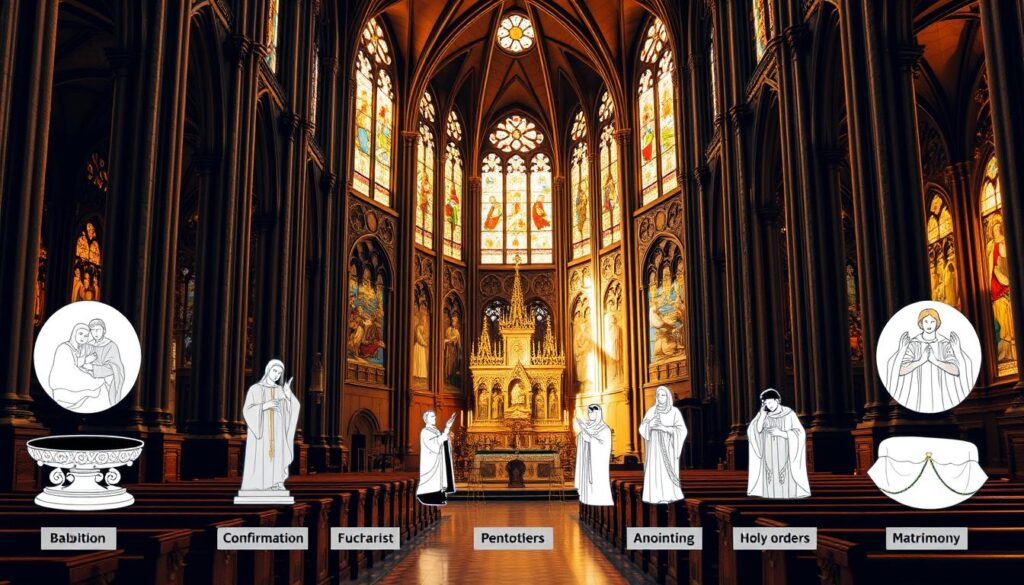
From cradle to grave, seven sacred rites mark key moments:
- Baptism (spiritual rebirth)
- Confirmation (adult commitment)
- Eucharist (ongoing nourishment)
- Reconciliation (forgiveness)
- Marriage (lifelong union)
- Holy Orders (ministry calling)
- Anointing the Sick (healing)
Each sacrament serves as a divine encounter. Unlike Protestant emphasis on personal Bible study, the Catholic Church teaches that grace flows through these tangible acts. This system creates rhythm and structure for spiritual growth—a lifelong journey supported by communal worship.
Exploring “catholicism christianity”: Doctrinal and Cultural Nuances
Where do shared beliefs diverge into distinct spiritual paths? Roman Catholics and Protestant groups agree on core teachings like Christ’s divinity and resurrection. Yet their practices reveal fascinating contrasts in approaching sacred mysteries.
Comparative Perspectives on Sacramental Life
Roman Catholic teachings elevate Mary’s role beyond typical maternal reverence. They honor her as sinless from conception—a view most Protestants see as unsupported by Scripture. This difference shapes devotional practices, from rosary prayers to artwork in sacred spaces.
Another distinction lies in spiritual mediation. Many Roman Catholics ask saints to intercede, viewing heaven and earth as connected through prayer. Most Protestant traditions avoid this, focusing solely on direct appeals to God.
The concept of afterlife purification creates further contrast. Catholics believe in Purgatory’s cleansing process before entering paradise—a “middle way” rejected by reformers who emphasized salvation through faith alone.
These differences extend to daily spiritual life:
- Sacraments vs personal Bible study
- Liturgical rituals vs contemporary worship
- Church-guided faith vs individual interpretation
Despite variations, both traditions share a deep sense of connection to divine truth. Whether through structured sacraments or heartfelt prayer, they seek the same ultimate goal—a transformative relationship with the sacred.
Social Impact and Contemporary Issues
From soaring cathedrals to chart-topping hymns, this faith tradition shapes how millions experience beauty and meaning. Its fingerprints appear in unexpected places—from courtroom ethics to climate change debates. Let’s explore how ancient wisdom meets modern world challenges.
Influence on Art, Music, and Western Culture
Gothic arches and Renaissance frescoes tell stories without words. Composers like Mozart and Bach drew inspiration from sacred texts, blending music with spiritual themes. Even today, holiday carols and wedding marches carry echoes of these traditions.
Literature thrives on its symbols too. Dante’s Divine Comedy mapped the afterlife using medieval theology. Modern films like The Lord of the Rings borrow imagery from its rich symbolic language. These creations remind us how faith fuels imagination across generations.
Modern Social Teachings and Global Challenges
Leaders today tackle issues from inequality to artificial intelligence. Recent councils emphasize human dignity, urging action on poverty and environmental care. Their teachings shape policies on immigration and healthcare worldwide.
Younger generations ask tough questions about gender roles and scientific ethics. How does a 2,000-year-old institution stay relevant? Through dialogue—mixing timeless principles with fresh perspectives. This balancing act defines its role in our rapidly changing world.
FAQ
What caused the split between Roman Catholicism and other Christian denominations?
Major divisions, like the Great Schism of 1054 and the Protestant Reformation, arose from disagreements over papal authority, theological interpretations, and practices like indulgences. Martin Luther’s critiques in 1517 notably reshaped Western Christianity.
Why does the Catholic Church emphasize tradition alongside the Bible?
Roman Catholics believe sacred tradition and Scripture form a single deposit of faith. Teachings passed down from the apostles, like the sacraments, complement biblical truths to guide belief and practice.
How does the Pope’s role differ from other Christian leaders?
The Pope is considered the successor of St. Peter and the visible head of the Church. Unlike Protestant pastors, he holds teaching authority (Magisterium) to define doctrine, as seen in documents like Dei Verbum from Vatican II.
Do Catholics believe the Eucharist is literally Jesus’ body?
Yes. Through transubstantiation, the bread and wine become Christ’s real presence. This differs from Protestant views, which often see Communion as symbolic or memorial.
What’s the purpose of the seven sacraments?
Sacraments like Baptism and Confession mark spiritual milestones and impart grace. They’re seen as essential for salvation, reflecting Jesus’ ministry and fostering unity within the Church.
How does apostolic succession shape Catholic identity?
Bishops trace their authority back to the apostles, ensuring doctrinal continuity. This unbroken lineage validates teachings and rituals, distinguishing Catholicism from denominations without historical ties to early Christianity.
Why do Catholics venerate saints and Mary?
Saints are seen as intercessors who model holiness. Mary, as the Mother of God, holds a unique role in salvation history. This practice differs from some Protestant groups that prioritize direct prayer to God.
How does Catholic social teaching address modern issues?
Documents like Laudato Si’ address climate change, poverty, and human dignity. The Church advocates for justice through principles like solidarity, reflecting Christ’s call to serve marginalized communities.
Are works necessary for salvation in Catholic theology?
Catholics hold that faith and works together express God’s grace. James 2:24 emphasizes action, contrasting with some Protestant views on faith alone (sola fide), though both affirm grace as foundational.
How has Catholic art influenced global culture?
From Michelangelo’s Sistine Chapel to Gregorian chant, the Church shaped Western art and music. These works aimed to glorify God, teach biblical narratives, and inspire worship through beauty.