How does the world’s largest Christian denomination address questions of identity and inclusion in modern society? With over 70 million members in the United States alone, the Catholic Church remains a cornerstone of spiritual guidance for many. Its teachings on human dignity and relationships continue to spark conversations worldwide.
Rooted in traditions dating back centuries, the Church’s structure includes 195 dioceses across America, each led by bishops. While its leadership remains exclusively male, everyday believers reflect diverse viewpoints. Many parishioners now seek ways to reconcile faith with contemporary understandings of love and belonging.
Recent years have seen growing dialogue about how religious teachings intersect with lived experiences. Surveys show increasing support among U.S. Catholics for broader inclusion, even as official doctrine remains unchanged. This tension highlights the complexity of balancing ancient traditions with modern values.
This guide explores these dynamics through historical context, current debates, and personal stories. We’ll provide clear information to help you navigate this sensitive topic with nuance. Whether you’re seeking understanding or clarity, our balanced approach respects all perspectives.
Key Takeaways
- The Catholic Church serves over 70 million members in the U.S. through 33 provinces and 195 dioceses
- Traditional teachings on relationships coexist with evolving societal views among followers
- Leadership roles remain restricted to men, influencing decision-making processes
- Many American Catholics advocate for more inclusive interpretations of doctrine
- Understanding requires examining both historical roots and modern cultural shifts
Historical Context of Catholic Teachings on Homosexuality
Tracing the roots of religious teachings reveals how ancient texts shaped modern beliefs. Early Christian communities built their views using biblical stories and letters from apostles. These sources became the foundation for moral guidelines still referenced today.
Foundational Biblical Narratives and Early Church Traditions
The story of Sodom in Genesis 19 influenced early views on sin. Leviticus later called same-gender relations an “abomination,” framing them as violations of divine law. Early theologians like Augustine saw these texts as clear moral boundaries.
Paul’s New Testament letters added new layers. He wrote that “unnatural” acts stemmed from rejecting God’s design (Romans 1:26-27). First Corinthians 6:9 listed specific behaviors that conflicted with spiritual inheritance.
Evolution of Doctrine in Response to Societal Changes
Over centuries, leaders adapted teachings while keeping core principles. Medieval scholars connected sexual ethics to natural law – the idea that moral truths exist in creation itself. This philosophy became central to Church arguments.
By the 20th century, official statements balanced condemnation of acts with calls for respect. A 1986 document stressed: “Every human being deserves dignity, regardless of tendencies.” This approach remains part of modern dialogues.
| Biblical Reference | Historical Interpretation | Doctrinal Impact |
|---|---|---|
| Genesis 19 | Divine punishment for sexual immorality | Established framework for sin classification |
| Leviticus 18:22 | Prohibition under Mosaic law | Basis for moral absolutes |
| Romans 1:26-27 | Natural order argument | Shaped theology of human design |
| 1 Corinthians 6:9 | Exclusion from salvation | Influenced sacramental requirements |
Understanding the Catechism: Views on Homosexual Acts and Inclinations
Central to Catholic doctrine is the distinction between human inclinations and chosen actions. The Catechism Catholic Church teachings outline this difference clearly, shaping how communities address moral questions today.
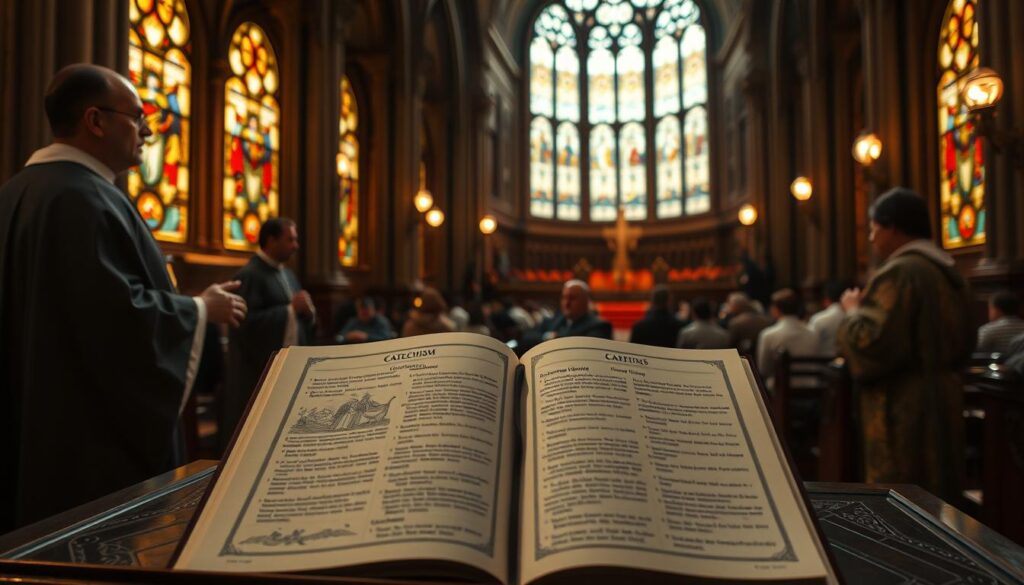
Catechism Catholic Church Teachings on Moral Behavior
The official text states:
“Homosexual acts are intrinsically disordered under natural law.”
This classification focuses on behavior rather than identity. While same-gender attraction isn’t considered sinful, acting on it conflicts with Church doctrine.
Three key principles guide this approach:
- Inclinations differ from intentional actions
- Chastity remains essential for unmarried members
- Dignity applies to all people regardless of orientation
Balancing Divine Law with Compassion and Respect
Leaders emphasize avoiding unjust discrimination regard while upholding traditional values. A 1986 letter clarifies:
“The inclination itself isn’t sinful but directs toward moral challenges.”
This creates pastoral complexities. Many parishes now focus on:
| Teaching | Application | Pastoral Guidance |
|---|---|---|
| Natural law principles | Moral evaluation of acts | Support groups for celibacy |
| Human dignity | Anti-bullying initiatives | Inclusive worship practices |
| Chastity calls | Universal standard | Confidential counseling |
Local interpretations vary widely. Some dioceses host LGBTQ+ outreach programs, while others maintain stricter adherence to traditional teachings. This patchwork reflects ongoing efforts to balance compassion with doctrinal consistency.
Modern Perspectives on catholicism homosexuality in the United States
In the past decade, a quiet revolution has unfolded in pews across the United States. Recent surveys show 70% of American Catholics now support marriage equality – a 13% jump since 2015. This shift makes them the largest Christian group backing LGBTQ+ rights, alongside mainline Protestants.
Shifts in Public Attitudes and Debate Among the Laity
Three factors drive this change:
- Younger generations bringing progressive views into parishes
- Personal connections with LGBTQ+ family members or friends
- Lay groups like Catholics for Marriage Equality shaping public discourse
These developments create unique challenges. Many Catholic communities now balance traditional teachings with members’ lived experiences. “Our faith calls us to love first,” explains a Chicago parish council member.
Leadership Statements and the Impact of Pope Francis
The pontiff’s 2013 remark reshaped conversations worldwide:
“If someone is gay and seeks God, who am I to judge?”
While not altering official position, this pastoral tone influenced local practices. Compare two approaches:
| Progressive Parishes | Traditional Parishes |
|---|---|
| LGBTQ+ support groups | Strict adherence to doctrinal texts |
| Blessing ceremonies | Employment restrictions |
This patchwork reality shows how cultural shifts continue testing institutional boundaries. As more people seek inclusive spaces, American Catholicism faces evolving questions about belonging and authenticity.
The Role of Natural Law in Catholic Moral Teachings
What makes certain actions right or wrong? For centuries, thinkers have turned to natural law theory to answer this question. This philosophy shapes how religious communities evaluate human behavior – especially in matters of relationships.
Philosophical Foundations from Aristotle and Aquinas
The idea that everything has a purpose dates back to Aristotle. He believed acorns grow into oaks because that’s their natural end. St. Thomas Aquinas later adapted this concept for Christian theology, arguing:
“The light of natural reason shows us what we must do and avoid.”
Three key principles emerge:
- Human actions should align with our created purpose
- Sexual acts aim for unity and procreation
- Behaviors opposing these goals disrupt natural law
Application to Human Relationships Today
Modern teachings apply these ideas through a specific lens. The Church states sexual acts must remain “open to the gift of life.” This means:
| Traditional View | Contemporary Challenge |
|---|---|
| Partners must be male-female | Same-sex couples can’t biologically conceive |
| Acts require complementarity | New understandings of gender identity |
Critics argue this framework overlooks modern science. Recent studies show same-sex pairings occur naturally in over 1,500 animal species. Still, leaders maintain that contrary natural law arguments protect human dignity by preserving traditional family structures.
As debates continue, many wonder: Can ancient philosophies address 21st-century realities? The answer may shape future religious dialogues about love and morality.
Challenges and Controversies within Church Policies
How do religious institutions navigate modern ethical dilemmas while honoring ancient traditions? Recent debates reveal deep divisions over leadership roles and sacramental participation. These conflicts often center on interpretations of human identity and moral responsibility.
Debates Over Ordination and Same-Sex Marriage
A 2005 Vatican directive states:
“Those with deep-seated homosexual tendencies cannot be ordained.”
This position creates practical challenges. Some dioceses focus on celibacy commitments rather than orientation, while others strictly enforce the ban. Key differences emerge:
| Progressive Approach | Traditional Approach |
|---|---|
| Evaluate individual chastity vows | Bar candidates with same-sex attractions |
| Allow LGBTQ+ parish leadership roles | Restrict non-ordained ministry positions |
Recent cases highlight these tensions. Spanish authorities denied a transgender man the right to be a godparent, citing “failure to live according to faith.” Such decisions spark heated discussions about inclusion versus doctrine.
Internal Tensions Between Tradition and Modern Ethics
Church leaders face complex questions:
- How to apply teachings about sexual complementarity to modern relationships
- Whether gender identity affects sacramental participation
- How to proceed genuine affective pastoral care for marginalized members
Many parishes now develop local solutions despite unclear guidelines. Some host support groups emphasizing chastity, while others quietly bless same-sex unions. These variations show the struggle to balance ancient teachings with contemporary facts about human diversity.
As debates continue, the Church wrestles with fundamental questions. Can traditions evolve without compromising core beliefs? How does faith community address the woman or man seeking both spiritual belonging and personal authenticity? The answers may shape religious practice for generations.
Interfaith and Intra-faith Perspectives on LGBTQ+ Inclusion
Faith communities worldwide are reexamining their approaches to belonging and identity. Within Christianity, responses range from full affirmation to strict adherence to traditional teachings. This diversity creates both opportunities for dialogue and challenges for unity.
Comparative Analysis with Other Christian Denominations
Mainline Protestant groups like the Episcopal Church now ordain openly LGBTQ+ clergy and perform same-sex marriages. Evangelical denominations typically maintain stricter views, often citing New Testament passages about sexual acts. Key differences appear in three areas:
- Leadership roles for LGBTQ+ individuals
- Recognition of committed relationships
- Approaches to biblical interpretation
| Denomination | Ordination Policy | Marriage Stance |
|---|---|---|
| Episcopal | Allowed since 2015 | Full sacramental recognition |
| Southern Baptist | Prohibited | Traditional marriage only |
| United Methodist | Varies by region | Split over same-sex blessings |
Real-Life Impact on LGBTQ+ Catholic Communities
Many parishes now host groups like Fortunate Families, helping parents support LGBTQ+ children. Others rely on ministries emphasizing chastity, such as Courage. A mother from Ohio shares:
“Our parish became our lifeline when our son came out – they showed us how to love without conditions.”
Recent studies reveal 1-2% of the U.S. population identifies as homosexual. Despite this small percentage, over 50 Catholic organizations now advocate for inclusion. DignityUSA’s mission statement captures this shift:
“We work for respect and justice through education and advocacy.”
These efforts face challenges when local policies conflict with personal experiences. Some dioceses welcome LGBTQ+ members in ministry roles, while others enforce strict boundaries. This patchwork reality leaves many navigating faith and identity alone.
Conclusion
Navigating faith and identity remains a deeply personal journey for millions within the Catholic Church. The institution’s teachings on human relationships, rooted in natural law, continue to guide members while sparking thoughtful debate. Many believers emphasize that respect for individual dignity forms the heart of these discussions.
Communities nationwide showcase creative approaches to balancing tradition with compassion. Some parishes host open dialogues about modern relationships, while others focus on upholding doctrinal consistency. This diversity reflects the Church’s vast reach across different cultures and generations.
Recent surveys highlight an important truth: most American Catholics value both spiritual heritage and inclusive practices. As leadership and laity collaborate on pastoral care solutions, the focus remains on nurturing unity without compromising core values.
The path forward lies in maintaining open-hearted dialogue – honoring ancient wisdom while recognizing contemporary realities. Through empathy and understanding, faith communities can create spaces where all members feel valued on their spiritual journeys.
FAQ
What does the Catholic Church teach about homosexual acts?
The Catechism of the Catholic Church states that homosexual acts are considered “contrary to natural law” and cannot be approved. However, it emphasizes that individuals with same-sex tendencies deserve respect and compassion, avoiding unjust discrimination.
How has Pope Francis influenced the Church’s approach to LGBTQ+ issues?
Pope Francis has encouraged a tone of mercy, famously saying, “Who am I to judge?” regarding individuals with homosexual tendencies. While upholding traditional teachings, he advocates for pastoral care that prioritizes dignity and inclusion.
Why does the Church reference natural law in discussions about sexuality?
Rooted in thinkers like Aquinas and Aristotle, natural law theory views human purpose as tied to biological and moral design. The Church teaches that sexual acts must align with procreation and the unitive bond between a man and woman.
Are there debates within the Church about same-sex relationships today?
Yes. Many lay Catholics, especially in the United States, advocate for greater acceptance, while leadership often reaffirms traditional doctrines. Topics like same-sex marriage and ordination remain deeply divisive.
How do Catholic teachings on homosexuality compare to other Christian denominations?
Some Protestant groups, like the Episcopal Church, allow same-sex unions and clergy. The Catholic Church maintains stricter adherence to historical teachings, though dialogue continues about balancing doctrine with modern pastoral needs.
Can someone LGBTQ+ participate fully in Catholic life?
The Church teaches that everyone is welcome to worship and participate. However, openly LGBTQ+ individuals may face restrictions in roles like ministry, depending on local practices and interpretations of doctrine.
What’s the difference between “inclination” and “action” in Church teaching?
The Church distinguishes between same-sex attraction (seen as a trial) and engaging in homosexual acts (considered sinful). It urges support for those navigating their inclinations while calling them to chastity.