Since the first successful in vitro fertilization procedure in 1978, modern medicine has helped millions of families grow. Over eight million children worldwide now owe their existence to this technology. Yet for those following Catholic teachings, these scientific advances present complex moral questions.
The Church’s perspective centers on protecting human life from its earliest stages. Three official documents published between 1987 and 2008 outline clear concerns about common fertility treatments. These teachings emphasize the sacred bond between marriage and natural conception while addressing ethical challenges posed by laboratory-created embryos.
Many couples face heartbreaking choices when struggling with infertility. This guide explores how religious principles intersect with medical realities. We’ll break down the Church’s key objections, examine statistical outcomes of fertility procedures, and highlight alternative paths supported by Catholic doctrine.
Key Takeaways
- The Catholic Church formally opposes most assisted reproductive technologies
- Major concerns focus on embryo loss and marital unity
- Church teachings developed through three key documents over 30 years
- Over 8 million children have been born via IVF worldwide
- Faith-based support exists for couples facing infertility
- Medical advances require careful ethical evaluation
Introduction to Catholic Perspectives on IVF
Over 1 in 6 American couples now face fertility struggles, driving a $8 billion industry for solutions. Religious teachings approach this crisis with empathy, recognizing the raw ache of unfulfilled desire for parenthood. Ancient texts echo modern pain—from Rachel’s desperate plea “Give me children!” to Sarah’s decades-long wait for Isaac.
Infertility Challenges and the Desire for a Child
The inability to conceive often feels like a physical and spiritual wound. Scripture honors this struggle through figures like Hannah, who wept through years of empty arms before bearing Samuel. Today’s married couples similarly wrestle with grief that no amount of affection can erase.
Church leaders affirm the goodness of wanting a child, calling it “a natural expression of marriage.” However, they caution that longing doesn’t justify all medical interventions. Like choosing between poisoned water and thirst in a desert, the path forward requires wisdom.
The Role of Marital Love and Procreation
Sacred unions carry two purposes: bonding partners and creating life. Physical intimacy becomes a language speaking both love and openness to miracles. When conception happens in labs rather than bedrooms, this dual meaning fractures.
Imagine planting seeds in a community garden versus a corporate farm. Both grow plants, but one nurtures relationships while the other prioritizes results. Catholic teachings argue that how we welcome life matters as much as the life itself—a stance shaping their critique of common fertility treatments.
Historical Foundations: Scripture and Early Church Writings
Long before modern fertility clinics, sacred stories shaped how communities understood family-building. These narratives reveal timeless truths about patience, ethics, and the human person’s inherent value.
Biblical Narratives of Infertility and Hope
Sarah’s laughter turned to joy at age 90 when she bore Isaac. Hannah’s tearful prayers produced Samuel, a prophet who changed Israel. These women faced empty arms for decades before receiving their gift of motherhood.

Scripture also warns against manipulating conception. Lot’s daughters used deception to continue their family line—a choice condemned in Genesis. Their story shows that methods matter as much as outcomes.
| Biblical Figure | Time Period | Key Teaching |
|---|---|---|
| Sarah | 1800 BCE | Divine timing over human urgency |
| Hannah | 1100 BCE | Prayer as spiritual response to infertility |
| Lot’s Daughters | 1900 BCE | Ethical limits in pursuing parenthood |
Tradition of Marital Conception in Early Teachings
Early Christians saw childbirth as a sacred partnership between spouses and God. Saint Augustine wrote that children should be “begotten through loving union, not manufactured like pottery.” This teaching emphasized respect for life’s natural beginnings.
Church leaders consistently taught that every woman and child carries divine worth. As Clement of Alexandria noted: “The family mirrors heaven’s love when created through holy commitment.” These principles still guide moral evaluations of reproductive choices today.
Church Teachings and Magisterial Documents on IVF
Modern fertility treatments present complex ethical questions that religious authorities have addressed through detailed guidance. Three pivotal documents form the foundation of official teaching, offering clarity amid evolving medical possibilities.
Insights from Donum Vitae and Evangelium Vitae
The 1987 Donum Vitae introduced a critical distinction: medical help enabling natural conception aligns with moral principles, while methods replacing marital intimacy do not. This document compares ethical interventions to repairing a bridge versus building an entirely new structure.
Eight years later, Evangelium Vitae highlighted practical concerns. Standard techniques often create multiple human embryos, with many discarded or frozen. Imagine planting ten seeds knowing seven will be destroyed—this waste conflicts with beliefs about life’s sacredness.
Understanding Dignitas Personae on Bioethical Questions
The 2008 Dignitas Personae updated statistics, revealing stark realities. Even top clinics experience 80% embryo loss per vitro fertilization cycle. For every successful birth, numerous lives never progress beyond microscopic stages.
These documents collectively stress that good intentions don’t justify harmful methods. As one theologian noted: “We can’t build families through systems treating children as products.” The teaching invites couples to seek solutions honoring both love and life’s dignity.
Exploring “catholicism and ivf”: Key Doctrines and Ethical Dilemmas
Modern reproductive methods spark intense ethical debates about how life begins. At the heart lies a critical question: does medical intervention support or replace the sacred act of creating life? This distinction shapes religious evaluations of fertility treatments.
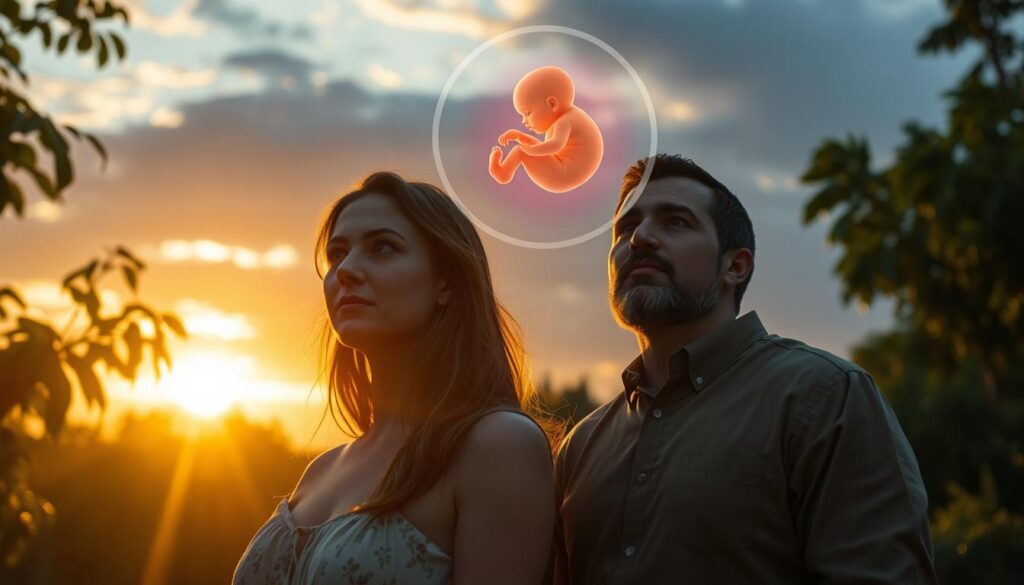
The Ethical Conflict Between Natural Conception and Technological Intervention
Faith traditions emphasize that becoming parents involves more than biological results. The marital act itself carries spiritual meaning—a physical expression of love open to life’s mystery. When laboratories handle conception, this deeply personal journey shifts to sterile environments managed by technicians.
Language reveals underlying values. Terms like “embryo selection” and “genetic material” reduce children to medical outcomes. One theologian observes: “We don’t manufacture souls.” This perspective argues that reproductive technology risks treating people as projects rather than gifts.
Ethical guidelines distinguish between aiding nature and overriding it. Fertility drugs that enhance natural cycles differ fundamentally from procedures that sidestep marital intimacy. The Church maintains that every person deserves respect from conception onward—a principle challenging methods involving discarded embryos.
Couples face tough choices between desire and doctrine. While science offers solutions, faith calls for reflection: Can we honor life’s sanctity while pursuing parenthood? The answer often lies in balancing compassion with timeless values.
Moral and Ethical Implications in the IVF Process
The journey from laboratory conception to childbirth involves hidden ethical crossroads. While medical advances offer hope, they also create complex dilemmas about human life’s intrinsic value. Let’s explore why certain practices clash with core moral principles.

Sanctity of Life and the Treatment of Human Embryos
Creating multiple embryos raises urgent questions. Fertility clinics often produce 10-15 potential lives per cycle, yet over 90% never implant or survive. This high attrition rate mirrors a harsh reality: most lab-created embryos become statistical casualties.
Selection processes intensify ethical concerns. Technicians grade embryos like products, choosing which to transfer based on viability scores. As one bioethicist notes: “We’ve turned life’s beginnings into a quality-control checklist.” This approach conflicts with beliefs that every human life holds equal worth from fertilization onward.
Issues Surrounding Embryo Disposition and Selective Reduction
Frozen storage compounds moral challenges. Over a million embryos sit in U.S. freezers—some abandoned, others destined for research. This suspended existence contradicts teachings about respecting life’s natural progression.
Selective reduction adds another layer. When multiple embryos implant successfully, doctors may terminate less-developed ones. The procedure—using potassium chloride injections—directly ends developing life. For many, this mirrors elective abortion’s ethical weight.
Even initial steps like sperm collection spark debate. Required methods often violate teachings about marital intimacy’s sacred context. These interconnected issues reveal why some view fertility treatments as conflicting with foundational values about life’s dignity.
The Impact of Scientific Advances and the Reproductive Technology Industry
Modern medicine’s race to solve fertility challenges has sparked a booming industry with complex consequences. In the U.S., reproductive technology operates with minimal oversight, creating ethical gaps between profit motives and family well-being.
Balancing Innovation with Traditional Values
Many clinics prioritize success rates over safety. Powerful fertility drugs frequently lead to risky multiple pregnancies—a case where medical ambition outpaces natural limits. Women face heightened health dangers while carrying four or more babies simultaneously.
The average $10,000 price tag per technology-driven attempt places financial strain on hopeful parents. This unregulated market often treats human life as a product line rather than a sacred journey. As one ethicist notes: “Assembly-line approaches to conception reduce miracles to transactions.”
Religious teachings caution against viewing technology as a cure-all. Life’s creation deserves reverence beyond industrial control. While innovation offers hope, it must respect timeless values about human dignity and natural processes.
FAQ
Why does the Catholic Church oppose IVF?
The Church teaches that life is sacred from conception and that procreation should arise from the loving union of spouses. IVF often involves creating multiple embryos outside the marital act, risking their destruction or manipulation, which conflicts with human dignity.
Are there alternatives to IVF for Catholic couples struggling with infertility?
Yes! Methods like NaProTechnology focus on identifying and treating underlying causes of infertility while aligning with Church teachings. Natural family planning and ethical medical treatments are also encouraged to support conception within marriage.
How does IVF impact the dignity of human embryos?
Embryos are viewed as unique human lives with inherent worth. IVF often results in surplus embryos being frozen, discarded, or used for research, which the Church sees as a violation of their right to life and protection.
Can IVF ever be morally acceptable in Catholicism?
No. Even with good intentions, the process separates procreation from the marital act and risks harming embryos. The Church emphasizes that the ends (having a child) do not justify means that disrespect life or marital unity.
What does the Church say about “selective reduction” in IVF pregnancies?
Reducing multiple embryos to one or two often involves ending lives, which the Church strongly condemns. This practice contradicts the belief that every life, regardless of circumstances, deserves protection.
How do documents like Donum Vitae address reproductive technology?
A: Donum Vitae clarifies that techniques replacing the marital act (like IVF) are morally unacceptable. It stresses that science must respect ethical boundaries, ensuring human life is never treated as an object.
Does the Church support fertility treatments that don’t involve IVF?
Absolutely. Treatments restoring a couple’s natural fertility, such as surgery or hormone therapy, are encouraged. These methods honor the connection between love and life without technological interference.
What if a Catholic undergoes IVF before understanding Church teaching?
The Church encourages seeking forgiveness through sacramental reconciliation. It also calls for compassion, recognizing the deep pain of infertility and the complexity of these decisions.