Imagine two ancient faiths sharing roots yet walking distinct paths for centuries. This story begins in the first century CE, when a spiritual movement emerged from Jewish traditions and evolved into what we now call Christianity. The bond between these religious communities remains unlike any other interfaith relationship—marked by both tension and profound connection.
For nearly 2,000 years, this partnership has shifted dramatically. Early conflicts gave way to modern efforts where leaders from both sides work toward mutual respect. A defining moment came in 1986 when Pope John Paul II visited Rome’s Great Synagogue, calling Jewish people “our dearly beloved brothers” and even “elder brothers” in faith. This gesture reshaped how these groups interact today.
Our journey will explore how shared history and theology create common ground despite differences. You’ll discover how ancient texts connect both traditions and see modern initiatives fostering cooperation. We’ll break down complex ideas into easy-to-grasp concepts, perfect for anyone curious about religion’s role in bridging divides.
Key Takeaways
- Christianity originated within Jewish traditions during the 1st century CE
- The Catholic-Jewish relationship has evolved from conflict to collaboration
- Pope John Paul II’s 1986 speech marked a historic shift in interfaith relations
- Shared scriptures and values continue to shape dialogue efforts
- Modern initiatives focus on education and joint social justice projects
Historical Foundations and Early Interactions
The story of two world religions began as a single spiritual family. In first-century Palestine, a group of Jewish teachers reinterpreted ancient prophecies while keeping traditional practices. These early believers saw themselves as part of their people’s ongoing journey, not founders of a new faith.
Roots in Common Ground
For decades, followers worshipped side-by-side in synagogues. They read the same scriptures and celebrated Passover together. The Jewish diaspora’s network of communities helped spread new teachings across Roman trade routes.
Paul’s dramatic shift from persecutor to preacher changed everything. His letters argued that non-Jewish converts didn’t need full ritual observance. This idea created both growth and friction as groups gradually separated.
Milestones That Shaped History
| Event | Time Period | Impact |
|---|---|---|
| Jesus’ ministry | 30-33 CE | Teaches within Jewish tradition |
| Paul’s missions | 50-60 CE | Spread teachings to Gentile cities |
| Temple destruction | 70 CE | Accelerates religious divergence |
| Council of Jamnia | 90 CE | Jewish leaders define official scriptures |
Over three centuries, what began as a local movement became a global faith. Yet shared roots in Hebrew tradition left permanent marks on both communities’ prayers, ethics, and sacred stories.
Foundational Beliefs and Theological Heritage
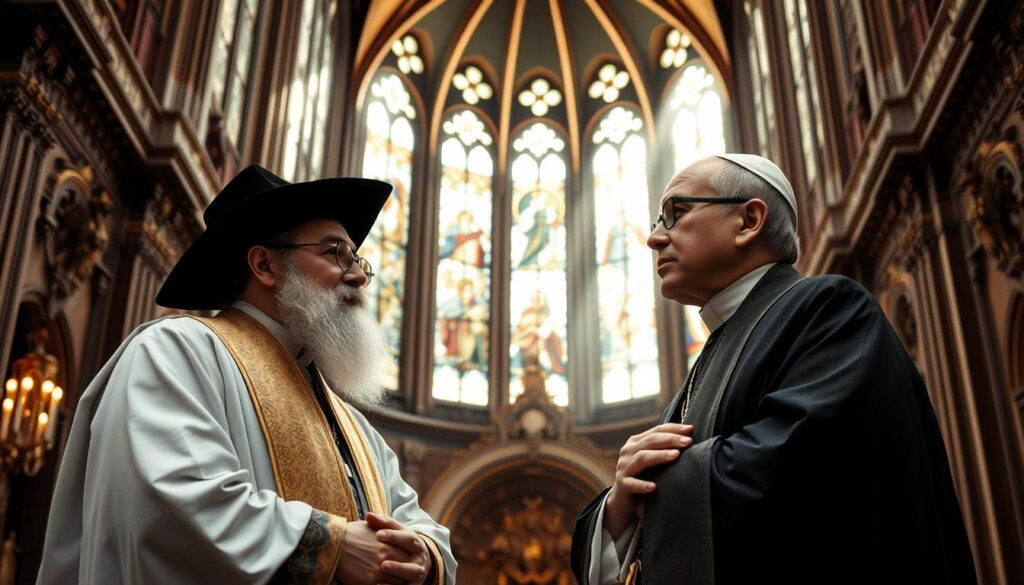
Two spiritual traditions share a library of sacred stories that shape their understanding of the divine. At the heart of this connection lies the Hebrew Bible – called the Old Testament by Christians – which provides shared narratives from Genesis to Malachi.
Scriptures That Bridge Traditions
The Torah and Prophets form a common language for both faiths. Stories of Abraham’s covenant and Moses’ teachings appear in weekly worship services across these communities. This literary heritage fuels ethical discussions about justice and compassion today.
From Roots to Branches
A groundbreaking 20th-century statement changed everything: “God’s covenant with Jewish people remains valid.” This declaration reversed centuries of assumption that one faith replaced the other. Church leaders now describe their tradition as “grafted branches” growing from ancient roots.
Paul’s olive tree metaphor captures this relationship perfectly. Wild shoots (Gentile believers) draw life from the cultivated tree (Jewish heritage). Modern dialogues explore how both religions uphold monotheism and messianic hope while differing on Jesus’ role.
One mystery remains unsolved: How divine salvation works across these sister faiths. As one official document states, “This truth stands unquestioned – the details belong to God.” This humility fuels ongoing conversations about shared values and respectful differences.
Evolution of Catholic-Jewish Relations Through the Ages
When Emperor Constantine embraced Christianity in 313 CE, he sparked a revolution that reshaped religious power across three continents. The Edict of Milan transformed a persecuted movement into an imperial favorite, creating ripple effects that still influence interfaith relations today.
From the Roman Empire to the Middle Ages
Roman emperors now wore crosses instead of laurels. By 380 CE, Christianity became the state religion, forcing Jewish communities into a new reality. The Catholic Church shifted from hiding in catacombs to influencing laws and social norms.
Pope Gregory the Great’s 598 decree captured this tension perfectly: “Protect their right to exist, but limit their influence.” His policies allowed Jewish worship while banning interfaith marriages and property ownership. This paradox defined relations for centuries – protection with strings attached.
| Event | Year | Impact |
|---|---|---|
| Edict of Milan | 313 | Legalized Christianity |
| Theodosian Code | 380 | Made Christianity official |
| Gregory’s Papal Bull | 598 | Established guarded coexistence |
Cultural Exchanges and Shifting Power Dynamics
Medieval markets buzzed with unexpected partnerships. Jewish doctors treated bishops, while Christian scholars studied Hebrew texts. These unofficial collaborations flourished despite official restrictions.
Three surprising areas where people bridged divides:
- Medical knowledge sharing in Spain’s translation schools
- Joint banking networks across Italian city-states
- Philosophical debates in French synagogues
Yet power imbalances persisted. Local rulers often ignored papal protections, creating patchwork policies across Europe. This era’s contradictions – cooperation amid control – still shape how faith communities work together in our modern world.
Impact of Persecution and Anti-Semitic Policies
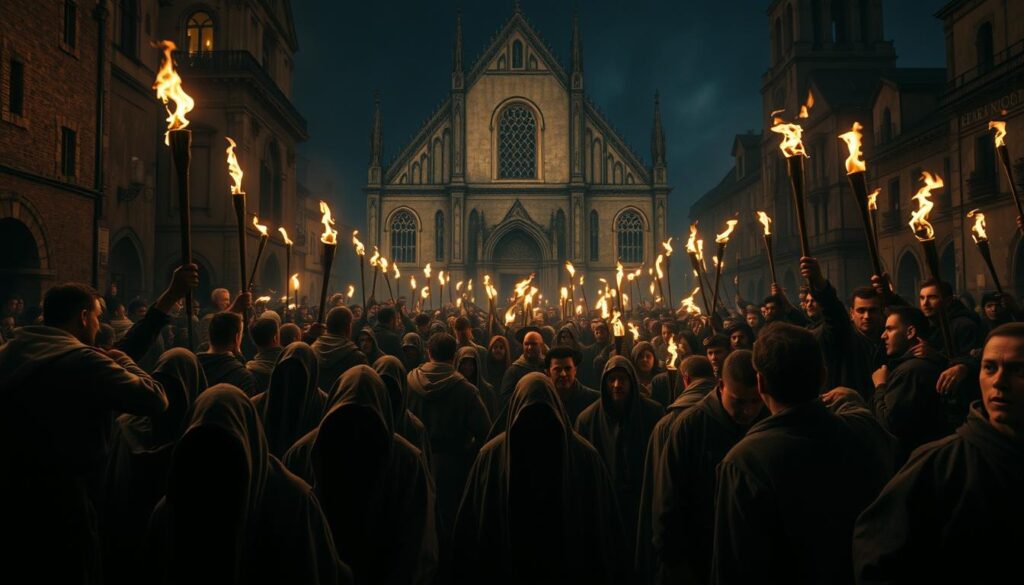
Dark chapters in religious history reveal patterns of oppression that shaped communities for centuries. The Catholic Church enforced policies during the Middle Ages that isolated Jewish populations through laws and violence. Mandatory badges imposed in 1215 marked individuals publicly, while economic bans pushed families into poverty.
Medieval Inquisition and Forced Conversions
Pope Sixtus IV’s 1478 approval of the Spanish Inquisition unleashed terror across Iberia. Agents targeted conversos—Jewish converts accused of secret practices—using torture to extract confessions. Thousands faced execution or property seizures in what became a time of widespread fear.
The 1492 expulsion order forced 160,000 Jews to abandon homes they’d built over generations. Many boarded ships without knowing their destination, creating refugee crises from North Africa to Italy. This scattering of Sephardic communities still influences cultural traditions today.
Understanding the Trauma of Expulsions and Ghettos
Pope Paul IV’s 1555 decree confined Jews to cramped urban quarters behind locked gates. Rome’s ghetto became a part of daily life for three centuries, with curfews and limited healthcare. Overcrowding turned these areas into firetraps during epidemics.
These policies created deep psychological wounds. As one historian notes, “Walls around neighborhoods became walls around memories.” Modern interfaith efforts address this legacy by acknowledging past wrongs while building trust through education and shared social projects.
Nostra Aetate and the Modern Shift in Attitudes
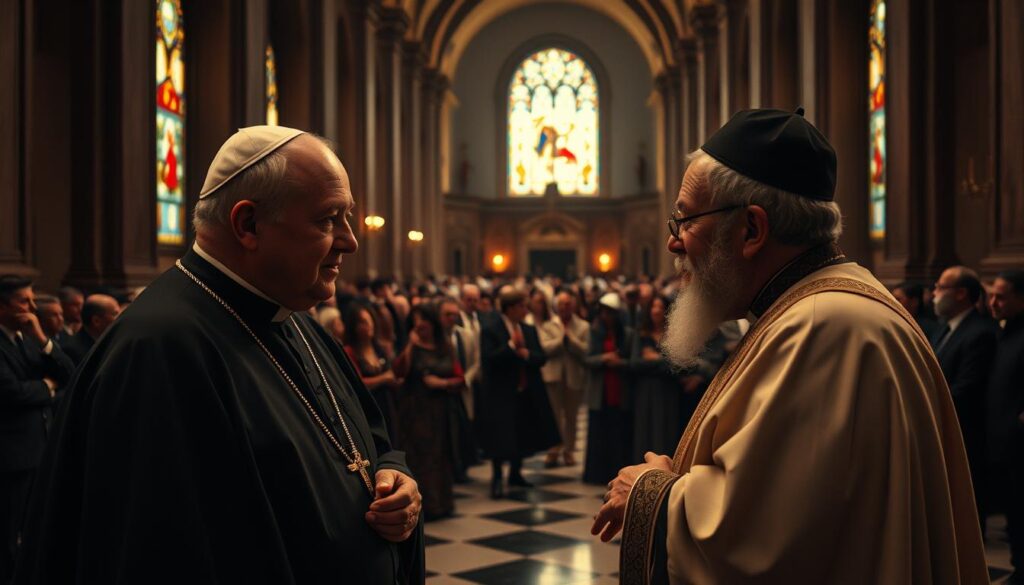
A 20th-century document rewrote 1,900 years of religious history in just 1,500 words. The Second Vatican Council’s 1965 Nostra Aetate declaration turned age-old assumptions upside down, creating new pathways for interfaith understanding.
The Significance of the 1965 Declaration
This groundbreaking statement did more than condemn antisemitism—it reshaped theological foundations. Church leaders declared: “What happened in [Christ’s] passion cannot be charged against all Jews… nor the Jews of today.” This erased the toxic deicide myth that fueled persecution for centuries.
The document’s boldest move? Recognizing God’s eternal covenant with Jewish people. No longer would teachings suggest one faith replaced the other. As one rabbi observed, “They stopped seeing us as museum pieces and started seeing us as living partners.”
Changing Narratives in Catechesis and Preaching
Religious education materials underwent dramatic revisions after 1965. Sunday school curricula removed phrases like “perfidious Jews,” while seminary training included Holocaust studies. The table below shows key changes mandated by Nostra Aetate:
| Aspect | Pre-1965 Approach | Post-1965 Reform |
|---|---|---|
| Scripture Interpretation | Blamed Jewish leaders for crucifixion | Emphasized Roman role & theological context |
| Interfaith Relations | Conversion-focused dialogue | Mutual learning partnerships |
| Liturgical Language | Good Friday prayers for “perfidious Jews” | Revised prayers emphasizing shared heritage |
These reforms sparked real-world collaboration. Joint food banks began appearing in urban centers, while interfaith couples found warmer welcomes. The Second Vatican Council’s vision continues shaping how communities work together on issues like immigration reform and climate action today.
Catholicism Judaism: Contemporary Interfaith Dialogue
In recent decades, catholic-jewish relations have blossomed into organized partnerships. What began as tentative conversations now thrives through formal committees and joint projects. These efforts turn shared values into real-world impact.
Foundations for Lasting Cooperation
The 1977 Secretariat for Catholic-Jewish Relations changed the game. This permanent office ensured ongoing dialogue between faith leaders. Its work led to three official discussion groups tackling theology, social issues, and education.
Action Beyond Words
Today, local communities team up on food drives and refugee support. Over 80% of interfaith programs now include Holocaust education. As one organizer notes, “Remembering history helps us protect human dignity today.”
These efforts prove that understanding grows when people work side-by-side. From classroom partnerships to disaster relief, ancient traditions find common ground in modern challenges.
FAQ
How do Catholicism and Judaism share historical roots?
Both faiths trace their origins to Abraham and the covenant with God. The Old Testament serves as a sacred text for Jews and a foundational part of Catholic teachings, emphasizing shared prophets, laws, and ethical traditions.
What role did the Second Vatican Council play in Catholic-Jewish relations?
The 1965 declaration Nostra Aetate transformed the relationship by rejecting antisemitism and affirming Judaism’s unique spiritual heritage. It encouraged dialogue and collaboration, setting a new tone for interfaith understanding.
How did medieval policies affect Jewish communities?
Forced conversions, expulsions, and ghettos during the Middle Ages caused lasting trauma. The Catholic Church has since acknowledged these injustices, working to address historical wounds through education and reconciliation efforts.
What modern initiatives strengthen Catholic-Jewish dialogue?
Interfaith committees like the Holy See’s Commission for Religious Relations with Jews promote joint projects, interfaith prayer services, and educational programs. In the U.S., partnerships often focus on social justice and Holocaust remembrance.
Why is the Old Testament important to both faiths?
It preserves the covenant between God and Israel, providing moral teachings and prophecies central to Jewish identity. Catholics view it as preparation for the New Testament, highlighting continuity in God’s plan for humanity.
How did Pope John Paul II influence interfaith relations?
He made historic gestures, like visiting Rome’s synagogue and recognizing the State of Israel. His teachings emphasized repentance for past persecution and celebrated Judaism as Christianity’s “elder brother” in faith.
What challenges remain in Catholic-Jewish dialogue today?
Issues include addressing lingering stereotypes, balancing theological differences, and fostering grassroots collaboration. Both communities prioritize education to combat prejudice and build mutual respect.