What does it mean to be saved? For many, this question sparks curiosity—and sometimes confusion—about how faith shapes our ultimate purpose. The Catholic Church offers a rich perspective on eternal life, blending ancient wisdom with timeless hope. Let’s explore what this journey looks like.
While some believe salvation comes through personal achievements, the Church clearly teaches otherwise. Centuries ago, it rejected the idea that humans can earn redemption alone. Instead, it emphasizes God’s grace as the starting point. As Pope Francis reminds us, divine love always makes the first move.
At the heart of this teaching is Jesus Christ. His life, death, and resurrection form the foundation of how believers understand their relationship with God. This isn’t about checking boxes but responding to an invitation with faith and trust.
The path forward involves both mystery and clarity. Traditions like the sacraments and prayer guide Catholics, while theologians continue to explore how divine love interacts with human freedom. It’s a journey of growing closer to God, not a race to perfection.
Key Takeaways
- The Church views salvation as a mystery rooted in God’s grace, not human effort.
- Self-reliance in spiritual matters conflicts with core teachings about divine initiative.
- Jesus’ sacrifice remains central to understanding redemption and eternal life.
- Sacraments and community help believers grow in their relationship with God.
- Balancing grace with human response shapes a vibrant, active faith life.
Exploring the Foundations of catholicism salvation
How does ancient wisdom shape modern understanding of divine love? The answer lies in events that changed history forever. At the center stands Jesus—the bridge between heaven and earth.
The Role of Christ’s Life, Death, and Resurrection
Jesus’ dual nature as fully human and divine makes his sacrifice unique. As theologian Peter Bouteneff notes, only someone “both God and man” could restore humanity’s broken relationship with the Creator. His death on the cross seemed like defeat but became victory.
First-century Jews expected a warrior messiah, not a suffering servant. Paul’s words capture this tension:
“We preach Christ crucified—a stumbling block to some, foolishness to others.”
Yet this brutal act became the ultimate expression of grace.
Scriptural Insights and Church Dogmas
The New Testament paints salvation as both present reality and future hope. Romans 8:1 declares “no condemnation for those in Christ Jesus,” while verse 23 admits we still “groan” awaiting full redemption. This tension shapes Catholic teaching.
| Event | Human Need Addressed | Divine Response |
|---|---|---|
| Incarnation | Separation from God | Emmanuel – “God with us” |
| Crucifixion | Sin’s consequences | Sacrificial love |
| Resurrection | Fear of death | Eternal life promise |
Church teachings evolved to protect these truths. The Catechism of the Catholic Church anchors beliefs in scripture while addressing new questions. Through sacraments like baptism, believers experience grace that transforms—not just pardons.
The Journey from Faith to Works in Catholic Teachings
Many wonder how belief translates into action within spiritual life. The Catholic Church views this as a dance—grace sparks faith, which then steps into loving works. This partnership shapes the believer’s path toward holiness.

Understanding Justification and Sanctification
Justification begins at baptism but continues through life. As James 2:21 explains, Abraham’s willingness to sacrifice Isaac showed how “faith works with deeds”. The Church teaches that initial forgiveness in baptism starts a lifelong process of transformation.
Sanctification grows through daily choices. Confession offers fresh starts, while acts of kindness strengthen spiritual muscles. These moments aren’t about earning favor—they’re responses to divine grace already given.
Faith, Obedience, and Lifelong Growth
True belief naturally overflows into action. Think of a tree: healthy roots (faith) produce fruit (works). The Catechism compares sacraments to rain nourishing that growth over time.
Obedience becomes joyful when rooted in love. As one theologian notes, “We don’t follow rules to reach God—we follow because He’s already reached us.” This journey isn’t solitary; the Church walks alongside believers through every season.
Diving into Church Traditions and Sacraments
How do ancient rituals shape modern spiritual journeys? The answer lies in two pillars of Catholic practice—sacraments that bridge heaven and earth through tangible grace.
The Eucharist: A Living Sacrifice
The Mass isn’t just a symbol. The Catechism of the Catholic Church teaches that Christ’s sacrifice becomes “present again” on every altar. As Vatican II explains, this work of redemption continues through time, connecting believers to the cross.
Imagine a meal where the bread and wine become more than food. The Catechism states:
“The same Christ who died once is offered in an unbloody manner.”
This mystery transforms ordinary moments into holy encounters.
Baptism and Its Connection to Justification
Water holds power here. Baptism washes away original sin and starts our act of faith. The Catechism calls it the “sacrament of justification”—a fresh start gifted by grace, not earned.
While baptism is necessary for salvation where possible, the Church acknowledges God’s mercy extends beyond visible rites. This sacrament plants seeds that grow through lifelong choices. Like roots feeding a tree, it supports our journey toward holiness.
Together, these sacraments form a rhythm—baptism as the one beginning, the Eucharist as ongoing nourishment. They remind us that divine love meets us where we are, inviting response at every step.
Debating Models of Salvation: Grace, Works, and The Mystery of Redemption
Why do some views of redemption feel more like courtroom drama than a father’s embrace? For centuries, believers have wrestled with how divine grace and human response work together. The answer lies not in formulas but in a love story written across time.
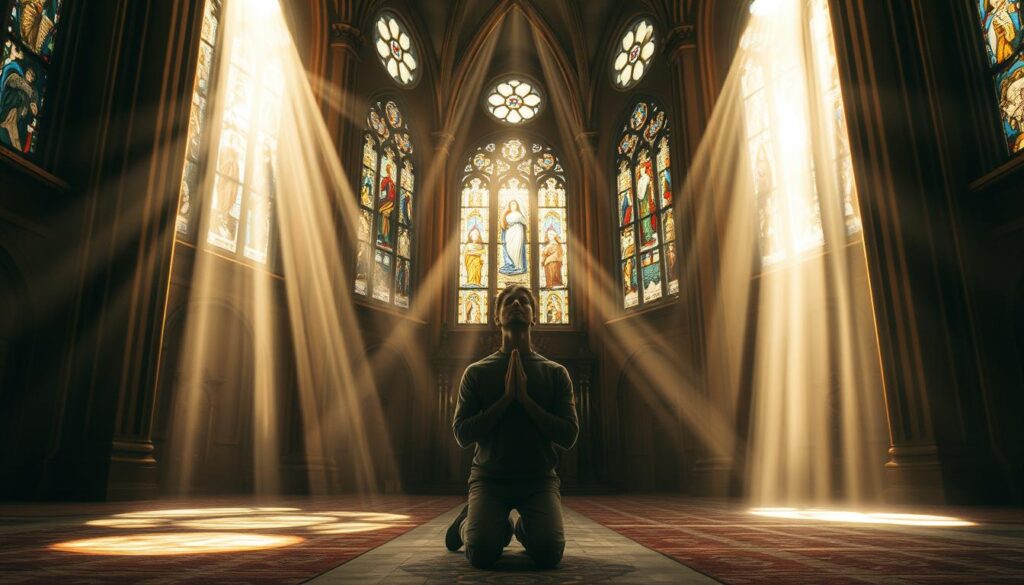
Rejecting Pelagianism and Embracing Divine Grace
Early Christians faced a critical question: Can we save ourselves through perfect behavior? The heresy of Pelagianism claimed human effort alone could earn redemption. The Church firmly rejected this view, teaching that all salvation starts with God’s initiative. As the Catechism states, even our desire to do good flows from divine grace.
| Model | Focus | Portrait of God |
|---|---|---|
| Penal Substitution | Legal payment for sins | Judge demanding punishment |
| Prodigal Son | Relational restoration | Father running to forgive |
The Central Message of Love in Catholic Doctrine
Jesus’ parables reveal a God who seeks us like a shepherd finding lost sheep. The story of the prodigal son shows mercy triumphing over merit. As 1 John 4:16 declares, “God is love”—not a scorekeeper. John 3:16-17 reinforces this, highlighting God’s gift of His Son to save the world, not condemn it.
While faith alone sparked Reformation debates, Catholic teaching weaves belief and action into one fabric. Love becomes both the way and the destination. As theologian Hans Urs von Balthasar wrote, “What finally remains is love.” This mystery invites wonder, not fear, shaping lives marked by joyful response.
Conclusion
What anchors the believer’s path toward eternal hope? St. Ignatius’s wisdom cuts through complexity: “Love shows itself more in deeds than words.” This truth captures the heart of Catholic teaching—a dance between divine grace and human response, never a transaction.
Salvation unfolds as a lifelong process, not a finish line. Through sacraments and daily choices, believers grow in holiness while resting in God’s initiating love. The cross and resurrection remind us redemption is both already won and not yet complete—a tension that fuels hope.
Every act of kindness, every prayer whispered, becomes part of this sacred exchange. As the New Testament reveals, Christ’s victory frees us to live with radical trust. Our faith isn’t about earning approval but responding to the One who first loved us.
Here lies the beautiful mystery: God’s gift meets our grateful obedience, weaving eternal promise into ordinary moments. In this dance, we find our purpose—and the path home.
FAQ
How does Christ’s resurrection impact the Catholic view of eternal life?
The resurrection of Jesus is central to Catholic teaching. It confirms His victory over sin and death, offering hope for eternal life to all who follow Him. Through His sacrifice, believers are invited into a renewed relationship with God.
Are good works necessary for salvation in Catholic doctrine?
Yes, the Church teaches that faith and works are inseparable. While grace is God’s free gift, our response through acts of love, mercy, and obedience reflects a living faith. This aligns with teachings in James 2:26: “Faith without works is dead.”
What role do sacraments like Baptism play in justification?
Baptism is seen as the first step in the journey of salvation. It cleanses original sin, unites believers with Christ’s death and resurrection, and initiates them into the Church. The Catechism emphasizes it as the “gateway to life in the Spirit” (CCC 1213).
How does the Eucharist connect to Catholic beliefs about redemption?
The Eucharist is considered the “source and summit” of Christian life. Catholics believe it re-presents Christ’s sacrifice on the cross, nourishing the soul and strengthening unity with God and others. It’s a tangible expression of grace at work.
Why does the Church reject Pelagianism?
Pelagianism claimed humans could achieve holiness through their own efforts. The Church rejects this, stressing that salvation begins with God’s grace, not human merit. As St. Paul writes, “By grace you have been saved through faith” (Ephesians 2:8).
How does love fit into the path to eternal life?
Love is the heart of Catholic teaching. Jesus called it the greatest commandment (Matthew 22:37–39). Loving God and neighbor isn’t optional—it’s the fulfillment of the law and a sign of genuine faith, guiding believers toward holiness.