Many Christians wonder about end-times events, but not all traditions share the same beliefs. This guide explores how one major faith tradition approaches topics like the millennium and tribulation differently than what’s often portrayed in modern media.
You might have heard about the rapture—a sudden event where believers vanish before global chaos. While this idea is popular in some circles, it’s not part of traditional teachings in certain ancient Christian communities. We’ll break down why these differences matter and where they come from.
Understanding these distinctions helps clarify why some groups avoid specific end-times timelines. Instead of focusing on escape theories, they emphasize preparation for final judgment and spiritual renewal. This perspective shapes how millions interpret biblical passages about humanity’s ultimate destiny.
Key Takeaways
- Major differences exist between ancient Christian traditions and modern rapture theories
- The concept of escaping tribulation first appeared in the 19th century
- Traditional teachings focus on Christ’s return rather than multiple secret comings
- Final judgment and resurrection remain central to historical beliefs
- Interpretations of Revelation vary significantly across Christian groups
Foundations of Catholic Eschatology
Time-tested beliefs about humanity’s ultimate destiny shape how one major faith tradition interprets prophecies. At the heart of this framework lies a blend of biblical analysis and centuries-old theological reflection.
Scriptural Interpretations and Church Tradition
The Catholic Church approaches Revelation’s vivid imagery as symbolic rather than chronological. Through Sacred Tradition, believers see Christ’s second coming as the final culmination of history – not a multi-stage event. This perspective emphasizes spiritual preparation over predicting specific dates.
St. Augustine’s City of God revolutionized early Christian thought by framing the millennium as the current Church age. His work established that good and evil coexist until the end times, with God’s kingdom already present through sacraments and community.
| Aspect | Catholic View | Premillennial View |
|---|---|---|
| Millennium Timing | Present spiritual reign | Future earthly kingdom |
| Revelation’s Purpose | Symbolic encouragement | Prophetic timeline |
| Church Role | Fulfillment of Israel | Temporary parenthesis |
Historical Development of End Times Beliefs
Church teachings show remarkable consistency across 20 centuries. While 19th-century Protestant groups developed new theories about escaping tribulation, Catholic doctrine maintained its focus on Christ’s return to judge all people.
The Holy Office clarified in 1944 that premillennial ideas “cannot safely be taught.” This stance reflects the Church’s preference for symbolic interpretations that nurture hope rather than fear about the day of judgment.
What is the Rapture? Historical Perspectives and Interpretations
The idea of believers vanishing before global chaos sparks curiosity, but its historical roots are surprisingly recent. While some modern groups treat this event as biblical certainty, earlier Christian thinkers never described such a phenomenon.
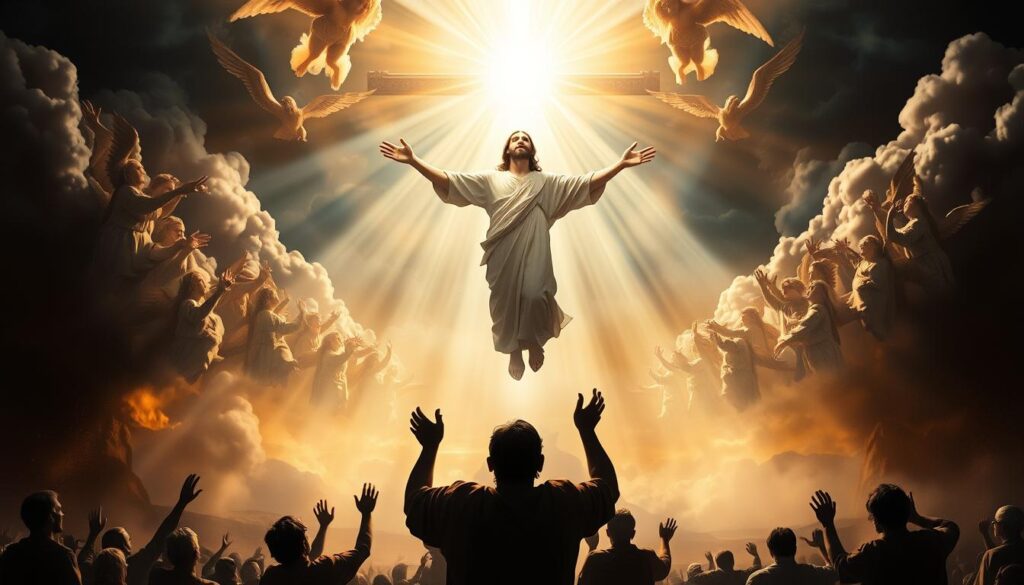
Dispensational Views Versus Traditional Teachings
John Nelson Darby reshaped end-times thinking in the 1830s by proposing two phases of Christ’s return. His dispensational system claimed believers would be caught up secretly before seven years of tribulation. This contrasted sharply with historic teachings about a single, visible second coming.
| Feature | Dispensational View | Traditional View |
|---|---|---|
| Timing | Before tribulation | At world’s end |
| Visibility | Secret event | Global appearance |
| Israel vs. Church | Separate plans | United in Christ |
Insights From Early Church Fathers
Ancient leaders like Irenaeus wrote about Christ’s return but never hinted at escape from hardship. Justin Martyr described a future millennium but saw the Church continuing Israel’s story. Their writings lack evidence for modern rapture theories.
C.I. Scofield’s 1909 Bible notes popularized Darby’s ideas, making them seem ancient. Yet no new testament commentary before 1830 taught a pre-tribulation vanishing act. This gap in history challenges claims about the belief’s biblical roots.
Exploring catholicism rapture: Catholic Views on the End Times
Biblical accounts of humanity’s final chapter spark intense interest across Christian traditions. While some focus on escape theories, others emphasize transformative encounters with the divine. Let’s examine how ancient texts shape contemporary expectations.
Understanding the Biblical Basis
The second coming described in 1 Thessalonians 4:17 uses vivid language: “We who are alive will be caught up together in the clouds to meet the Lord in the air.” This passage forms the basis for modern rapture theories but receives different interpretations.
Historical Christian teaching connects this event to Christ’s final return, not a secret disappearance. The trumpet blast and angelic shouts mentioned in the text contradict notions of a silent event. As one scholar notes, “The biblical narrative consistently portrays this meeting as earth-shaking revelation, not covert evacuation.”
The Catholic Church’s Position on Gathering Events
Church doctrine affirms believers will ultimately meet the Lord, but ties this to the end times climax. Official teachings reference Mark 13:27, where angels “gather the elect” after cosmic turmoil, not before hardship begins.
Three key differences emerge:
- Transformation occurs during Christ’s visible return
- Resurrection of the faithful precedes spiritual renewal
- All people witness the coming simultaneously
This perspective encourages spiritual readiness rather than speculative timelines. As Scripture reminds us, “About that day no one knows” (Matthew 24:36) – a call to constant preparation rather than fearful calculation.
Diverse Eschatological Views: Pre-Millennial, Post-Millennial, and Amillennial
Christian traditions have developed distinct frameworks for understanding humanity’s ultimate destiny. Three primary models shape how believers interpret biblical prophecies about the end world and Christ’s final work.
Comparative Analysis of Theological Models
Postmillennialism gained traction in the 1800s, envisioning a golden age where evangelism transforms nations before the second coming. Optimism faded after global conflicts exposed humanity’s enduring struggles.
Amillennialism, rooted in Augustine’s teachings, views Revelation’s millennium symbolically. It sees Christ ruling spiritually through His Church now, with good and evil coexisting until the final day. This view aligns with many historic Christian traditions.
| Aspect | Postmillennial | Amillennial | Premillennial |
|---|---|---|---|
| Millennium Timing | Before Christ returns | Present spiritual reign | After second coming |
| Scripture Approach | Optimistic progression | Symbolic fulfillment | Literal timeline |
| Historical Peak | 19th century | Ongoing | Modern popularity |
Premillennialism anticipates Christ establishing an earthly kingdom after His return. This belief requires separating the second coming into multiple events over a period of time.
Most ancient traditions favor symbolic interpretations that emphasize readiness rather than predictions. As one theologian notes, “Fixating on timelines risks missing the transformative call to live faithfully in every age.”
Dispelling Myths and Misconceptions about the Rapture
Modern storytelling often mixes fiction with theology, creating confusion about historical beliefs. Let’s separate popular imagination from faith traditions.
When Fiction Masquerades as Fact
The Left Behind series sold over 57 million copies, yet its portrayal of end-time events conflicts with ancient teachings. These books present the Church as an antagonist – a view rooted in 19th-century theories rather than New Testament foundations.
Tim LaHaye, co-author of the series, called the Catholic Church “apostate” and spread claims about worshipping Mary. Such statements reveal deeper theological divides. His work reflects dispensationalist views that emerged long after early Christian writings.
Rooted in History, Focused on Hope
The Church emphasizes Christ’s visible return over secret disappearances. As 1 Thessalonians 4:16 notes, the trumpet will sound for all people – not just a select group. This passage describes transformation during global revelation, not escape from hardship.
Three key clarifications stand out:
- Traditional teachings show no evidence of pre-tribulation vanishing acts
- Final judgment unites all humanity, not divides through multiple comings
- Spiritual preparation matters more than predicting timelines
Understanding these truths helps believers focus on living faithfully today rather than fearing tomorrow’s unknowns.
FAQ
How does the Catholic Church view events like being “caught up” compared to other Christian groups?
The Catholic Church emphasizes Christ’s Second Coming and final judgment rather than a sudden “disappearance” of believers. It interprets passages like 1 Thessalonians 4:17 as symbolic of unity with Christ, not a literal pre-tribulation event.
What does the Bible say about the End Times according to Catholic teaching?
Catholic teaching focuses on Scripture’s call to readiness (Matthew 24:36-44) and the ultimate triumph of God’s kingdom. The Book of Revelation is seen as symbolic, highlighting hope amid trials rather than a timeline of events.
Do Catholics believe in a pre-tribulation event?
No. The Church rejects the idea of a pre-tribulation “escape” for believers. Instead, it teaches that all will face trials before Christ’s return, emphasizing perseverance and trust in God’s plan.
How have beliefs about the End Times evolved in Church history?
Early Christians focused on Christ’s imminent return, but over time, teachings deepened to include themes like purification and the renewal of creation. The Catechism and councils later clarified these ideas for modern contexts.
What role do early Christian writers play in shaping these views?
Figures like Augustine and Irenaeus helped frame concepts such as the Antichrist and the resurrection. Their writings balanced urgency with patience, stressing moral preparation over speculative timelines.
How does the Church address popular myths about sudden vanishings in modern media?
The Church encourages focusing on Scripture and sacraments rather than sensationalized theories. It highlights unity in Christ’s body and warns against divisive or fear-driven interpretations.
What’s the difference between amillennial and premillennial views in theology?
Amillennialism sees Christ’s reign as spiritual and present, while premillennialism expects a literal 1,000-year earthly rule. The Catholic Church leans toward amillennialism, aligning with Augustine’s symbolic reading of Revelation.
Does the Church support the idea of a secret disappearance of believers?
No. The idea of a secret event contradicts the Church’s teaching that Christ’s return will be visible to all. It stresses communal hope and preparation rather than individual escape.