At the heart of Catholic worship lies a sacred practice that has shaped believers for centuries. This ritual centers on the bread and wine used during Mass—elements that hold extraordinary meaning for millions. Though often misunderstood, this ancient teaching remains foundational to how Catholics experience their faith today.
The concept we’re exploring goes beyond symbolic gestures. It touches on what many consider the “greatest mystery” of their spiritual journey. Through centuries of reflection and prayer, the Catholic Church has preserved this belief as a vital connection to divine presence.
Modern discussions about this topic often spark curiosity. Some wonder how ordinary items could carry such profound significance. Others seek clarity amid cultural shifts that challenge traditional views. Our exploration will address these questions while honoring the depth of this practice.
In the coming sections, we’ll trace this teaching’s roots in scripture and its development through history. We’ll also examine why understanding it matters now more than ever—both for personal growth and community unity. Let’s begin this journey with open minds and respectful hearts.
Key Takeaways
- Discover the historical roots of a central Catholic worship practice
- Understand the difference between symbolic and sacred meanings
- Learn how ancient traditions remain relevant in modern faith
- Explore common questions about Eucharistic beliefs
- Recognize the importance of ongoing religious education
Introduction: The Living Mystery of the Eucharist
What appears as simple bread and wine on the altar holds a truth that reshapes reality itself. This sacred meal isn’t just a reminder of ancient events—it’s a living encounter that feeds both soul and community.
Exploring the Sacramental Elements
Ordinary wheat and grapes become extraordinary through prayer. The Church teaches these elements become Christ’s body and blood while keeping their physical qualities. This change isn’t magic—it’s a sacrament, where visible signs convey invisible grace.
“The most blessed Eucharist contains the whole spiritual good of the Church, namely Christ Himself.”
The Role of Faith in the Celebration
Recognizing the real presence requires more than sight. As the Council noted, the Eucharist is the “source and summit” of Christian life. Believers approach not just with logic, but with faith that transforms how they receive this gift.
Preparation matters. Clean hearts and focused minds help people connect deeply with this mystery. It’s not about perfect understanding—it’s about trusting the love behind the invitation.
Understanding “catholicism transubstantiation” in the Catholic Faith
A core teaching reveals how ordinary elements become spiritually significant through prayer. During Mass, believers witness what appears as simple bread becoming something far greater. This sacred moment centers on a fundamental change recognized by faith rather than physical observation.
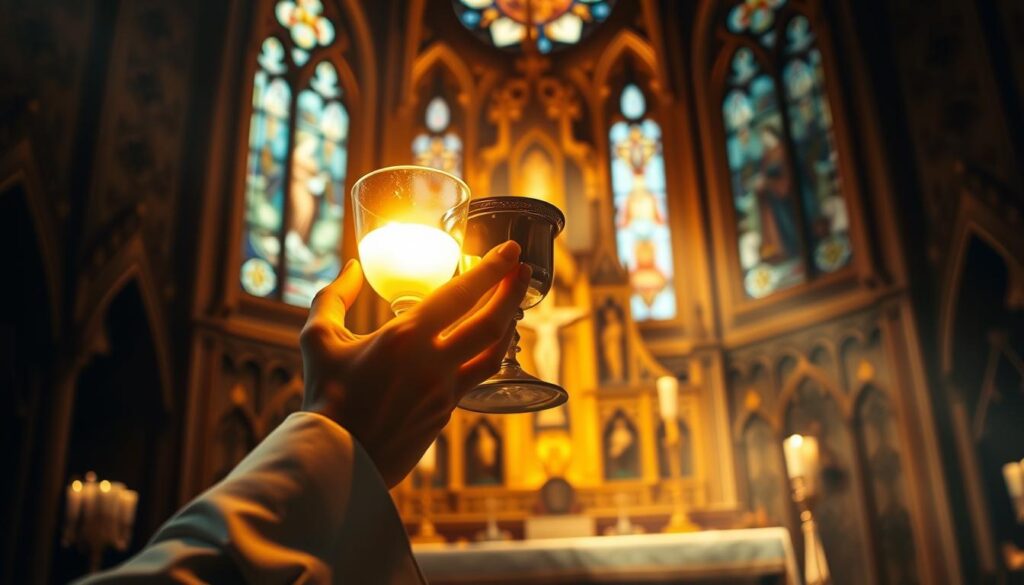
Definition and Theological Significance
The Church describes this transformation as a change of substance. While the bread’s appearance remains, its deepest reality becomes Christ’s body. Similarly, the wine’s essence transforms into his blood, though its taste and color stay unchanged.
“By the consecration, the whole substance of the bread becomes Christ’s body—this change the Church rightly calls transubstantiation.”
This teaching emphasizes spiritual reality over visible alteration. The term “substance” here refers to what something truly is, not just how it looks or feels. It’s like recognizing a friend’s voice on the phone—the form changes, but the person remains fully present.
Common questions often arise: Does the bread bleed? No—the change occurs at the level of substance, not physical properties. This belief strengthens the connection between Christ’s historical sacrifice and its living remembrance today. Through this mystery, worshipers experience divine closeness in a uniquely tangible way.
Biblical Foundations of the Real Presence of Christ
Jesus’ teachings about his presence in the bread and wine leave little room for symbolic interpretation. In John’s Gospel, he states plainly: “My flesh is real food, my blood real drink”. When listeners struggled with this concept, he doubled down rather than soften his words.
The Last Supper accounts reinforce this literal understanding. Matthew, Mark, and Luke all record Jesus holding unleavened bread saying: “This is my body”. He uses present-tense language—“is” rather than “represents”—establishing immediate connection between the elements and his sacrifice.
| Gospel | Event | Key Words |
|---|---|---|
| Matthew 26:26 | Bread Blessing | “This is my body” |
| Mark 14:23 | Cup Sharing | “This is my blood” |
| Luke 22:19 | Memorial Command | “Do this in remembrance” |
| 1 Cor 11:27 | Warning | “Guilty against body & blood” |
“Whoever eats my flesh and drinks my blood remains in me, and I in them.”
Paul’s letter to Corinth shows early Christians took these words seriously. He warns against unworthy reception, implying they understood the meal as more than metaphor. This matches Jesus’ call for total communion—feeding on rather than merely remembering.
These passages form a scriptural chain linking covenant promises to sacramental reality. Through flesh and drink blood imagery, they invite believers into transformative participation with divine life.
Insights from Early Church Fathers and Their Testimonies
Long before formal doctrines took shape, Christian leaders preserved sacred truths through their writings. Their words reveal a consistent teaching about the Eucharist’s profound change—a belief rooted in apostolic times.
Teachings of St. Justin Martyr and St. Ignatius
St. Justin Martyr’s second-century writings clarify how early Christians viewed the sacred meal. He explains: “The food becomes the flesh and blood of Jesus by the power of His words.” This wasn’t symbolic language—it reflected real nourishment for both body and soul.
“They abstain from the Eucharist… because they deny it is the flesh of our Savior.”
Ignatius, writing even earlier, treated Eucharistic faith as non-negotiable. His warnings against dissenters show how central this mystery was to Christian identity.
Perspectives from St. Cyril, Ambrose, and St. Gregory
Later thinkers deepened this foundation. St. Cyril of Jerusalem urged believers: “Don’t see just bread and wine—they’re Christ’s body and blood.” His words mirror Jesus’ own declarations at the Last Supper.
St. Ambrose used striking language: “Nature itself changes through blessing… This is Christ’s true Flesh.” Meanwhile, St. Gregory of Nyssa coined “metastoikeiosas”—a Greek term meaning elements are restructured at their core.
Together, these early church fathers built a bridge between biblical accounts and later theological clarity. Their shared emphasis on change shows this wasn’t medieval invention, but lived truth passed through generations.
The Council of Trent and Clarification of Eucharistic Dogma
Amid 16th-century religious upheaval, the Catholic Church faced urgent questions about its core teachings. Protestant reformers challenged traditional views of the Eucharist, prompting leaders to clarify beliefs through the Council of Trent. This gathering became a turning point for defining sacred practices.
| Reformer | View | Key Difference |
|---|---|---|
| Zwingli & Calvin | Symbolic presence | “In sign” only |
| Martin Luther | Consubstantiation | Christ coexists with elements |
| Melancthon | Temporary presence | Returns to bread/wine after Mass |
| Trent’s Response | Full substance change | “Whole reality” transformed |
Council Decisions and Official Declarations
The 1551 decree left no room for doubt: “Christ is truly, really, and substantially present” under the appearances of bread and wine. This teaching reaffirmed that consecration alters the elements’ deepest reality while keeping physical traits intact.
“That wonderful conversion of the whole substance—the species alone remaining—we call transubstantiation.”
By using precise terms like “substance”, Trent emphasized invisible transformation over visible signs. The council didn’t invent new ideas but codified centuries of reflection. Its language honored mystery while creating clear boundaries for belief.
Today, these definitions help Catholics navigate modern questions. They remind believers that the body and blood of Christ aren’t metaphors but living gifts—a truth worth preserving across generations.
The Evolution of Eucharistic Theology Through the Ages
The story of Eucharistic theology unfolds like a living conversation across centuries. As cultures shifted and new questions emerged, the Church refined its understanding while holding fast to sacred truths. This journey reveals both enduring belief and thoughtful adaptation to changing times.
Reformation Challenges and Diverse Interpretations
The 16th century brought seismic shifts in religious thought. Reformers like Martin Luther rejected traditional views of the bread and wine, calling them “Aristotelian word games.” England’s Test Act (1672-1828) even barred public office to those affirming this ancient teaching.
Yet these challenges sparked deeper reflection. The Church clarified that the change during Mass isn’t physical alteration but spiritual reality. As debates raged, ordinary worshippers continued approaching the altar with quiet reverence—a testament to lasting faith in Christ’s presence.
Modern Reflections on Ancient Teachings
Today’s believers inherit rich traditions while facing fresh questions. Some wonder how medieval terms apply to 21st-century spirituality. Others find new ways to connect with rituals first practiced in candlelit catacombs.
The core truth remains unchanged: what appears as simple bread and wine still nourishes communities worldwide. Through ongoing dialogue and prayer, this ancient practice continues shaping lives—proving timeless truths can thrive in any time.
FAQ
What does the Catholic Church teach about the Real Presence of Christ in the Eucharist?
The Church teaches that during Mass, the bread and wine truly become the body and blood of Jesus through consecration. This change in substance, while the appearance remains, allows believers to encounter Christ’s living presence in a unique way.
How does the Bible support the belief in Christ’s body and blood in Communion?
Passages like John 6:53-56, where Jesus says, “Unless you eat my flesh and drink my blood, you have no life in you,” highlight this truth. The Last Supper accounts in the Gospels also emphasize His command to repeat this sacred meal.
Did early Christians believe in the Real Presence before the term "transubstantiation" was used?
Yes! Writings from figures like St. Justin Martyr (2nd century) describe the Eucharist as the “flesh and blood” of Jesus. Early liturgies and teachings consistently affirmed this mystery, even before formal theological terms were established.
What role did the Council of Trent play in defining Eucharistic teachings?
The Council clarified doctrines in response to Reformation challenges, reaffirming that Christ’s body and blood are “truly, really, and substantially” present. It emphasized the priest’s role in the consecration and the importance of reverence for the sacrament.
How did the Reformation influence the Catholic Church’s understanding of the Eucharist?
Debates over symbolism versus literal presence led to deeper theological reflection. The Church reaffirmed ancient beliefs while addressing misunderstandings, stressing unity between Scripture, tradition, and sacramental life.
Why does the Eucharist still look like bread and wine if it becomes Christ’s body and blood?
The Church teaches that while the substance changes, the physical qualities (like taste or appearance) remain. This allows the mystery to be received in faith, not through physical senses alone—a gift inviting trust in God’s hidden work.