Welcome to a journey through one of humanity’s most enduring spiritual traditions. This guide offers a fresh look at how faith unites millions across borders while adapting to local customs. From bustling cities to remote villages, you’ll see how communities celebrate shared beliefs in strikingly different ways.
Did you know Brazil has more followers of this faith than any other nation? Or that the Philippines hosts Asia’s largest community? We’ll explore these demographic trends and uncover what makes each region’s practices unique. You’ll learn how colonial history shaped rituals in Latin America and why African nations are experiencing rapid growth.
Modern challenges like urbanization and shifting social values add new layers to ancient traditions. Yet annual events like Holy Week still draw massive crowds worldwide. This blend of timeless devotion and contemporary life makes the faith’s story endlessly fascinating.
Key Takeaways
- Brazil and Mexico lead in total followers, while Vatican City remains the spiritual hub
- Cultural fusion creates distinct celebrations, from Mexican Día de los Muertos to Italian feast days
- Over 40% of all Christians identify with this tradition globally
- Colonial history continues to influence religious practices across three continents
- Urban centers increasingly shape how younger generations engage with spiritual heritage
Overview of Global Catholicism
With roots stretching back two millennia, this spiritual tradition now connects 1.39 billion people worldwide. Its growth began when early missionaries planted seeds of belief in ancient Rome – a story written in courage and sacrifice.
Historical Foundations and Early Growth
The apostles Peter and Paul brought their message to Rome’s streets in the first century. Their martyrdom sparked a movement that would outlive emperors. Centuries later, a decisive partnership formed when Pope Leo III crowned Charlemagne in 800 AD. This union of crown and cross fueled the Holy Roman Empire’s expansion.
Church leaders adapted Roman roads and trade routes to spread their teachings. Monastic communities became hubs of learning and culture. By the 13th century, Gothic cathedrals rose skyward – stone testaments to growing influence.
Key Milestones in Church History
Four landmark events shaped modern practice:
- 325 AD: Council of Nicaea defined core beliefs
- 1054: East-West split created new branches
- 1545: Counter-Reformation addressed criticisms
- 1962: Vatican II updated rituals for modern times
These turning points show how the church balances tradition with change. As one historian noted: “Ancient rituals meet new challenges while keeping the essence intact.” Today’s global network reflects two thousand years of adaptation – and counting.
Exploring “catholicism by country”
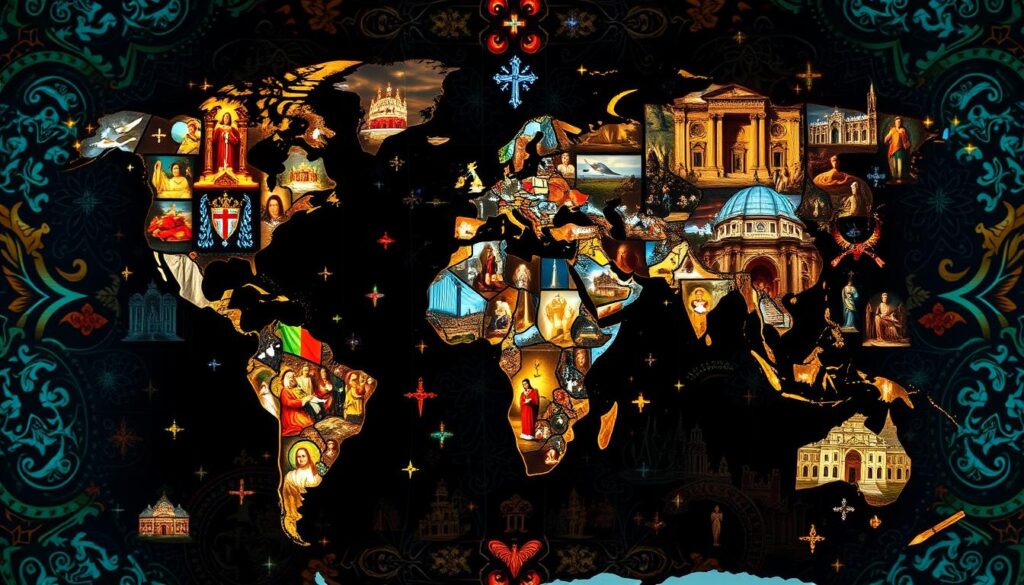
From adobe chapels in the American Southwest to royal courts in medieval Europe, faith traditions took unique shapes across borders. Let’s explore how geography and history created distinct spiritual landscapes.
Historical Milestones in Different Nations
Early Spanish settlers constructed San Miguel Chapel in 1610 – now the oldest standing church in the U.S. This adobe structure became a cornerstone for North American spiritual life. Meanwhile, Poland’s 966 AD conversion under King Mieszko I forged a national identity still visible today.
| Region | Key Event | Impact |
|---|---|---|
| Philippines | 1521 royal conversion | Asia’s largest Catholic population |
| Mexico | 16th-century missions | 90% Catholic majority today |
| DR Congo | 20th-century growth | 35 million+ followers |
Modern Demographic Shifts
While European church attendance declines, Africa’s faithful multiply rapidly. Nigeria gained 20 million adherents since 2000. Brazil remains a stronghold with 123 million followers, though Pentecostal groups now challenge this dominance.
Urbanization reshapes practices too. Younger generations blend ancient rituals with digital prayer groups. As one Vatican observer noted: “The faith survives not through rigidity, but by breathing with each culture it touches.”
Top Catholic Populations: Data and Trends
Numbers tell powerful stories about faith’s global footprint. Let’s explore where ancient traditions meet modern demographics through fresh statistics and surprising patterns.
National Figures That Define Faith
Brazil wears the crown with 105.3 million adherents – more people than Germany’s total population. Mexico follows closely with 91.2 million, while the Philippines completes the top trio at 86 million. These numbers reveal colonial history’s lasting impact:
- Italy maintains Europe’s strongest presence (42 million)
- Vatican City claims 100% affiliation
- Equatorial Guinea surprises with 93.52% adherence
Beyond Headcounts: Active Participation
Total numbers only paint part of the picture. Weekly Mass attendance shows where faith burns brightest:
| Nation | Weekly Attendees | % of Total |
|---|---|---|
| Philippines | 47 million | 55% |
| Mexico | 45 million | 49% |
| DR Congo | 37.5 million | 87% |
This data spotlights Africa’s rising influence. While Europe claims high percentage rates, active participation increasingly thrives south of the equator. As one demographer notes: “Faith’s heartbeat now pulses strongest in tropical latitudes.”
Urbanization reshapes traditions too. Young Brazilians blend smartphone apps with candlelit processions, proving ancient practices adapt to new realities. The numbers confirm – spiritual vitality flows where cultures embrace change while honoring roots.
Cultural and Historical Influences on the Church
Powerful partnerships between rulers and religious leaders forged lasting spiritual legacies. These collaborations shaped art, laws, and daily life across continents, leaving fingerprints we still see today.
The Legacy of the Holy Roman Empire
When Pope Leo III placed the crown on Charlemagne’s head in 800 AD, history changed course. This church-state partnership became a blueprint for spreading faith through political power. The Holy Roman Empire’s reach extended from European castles to African coastlines.
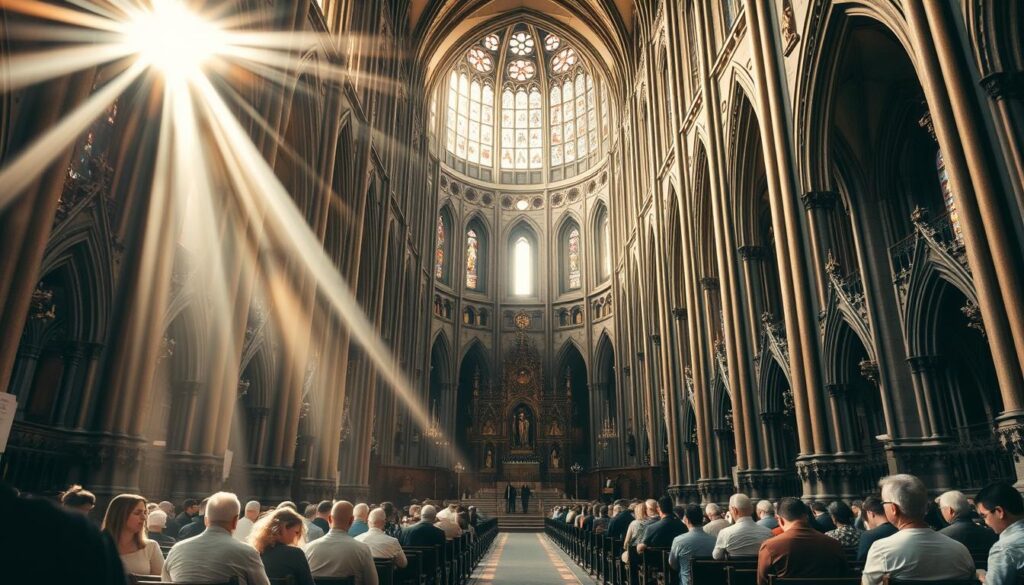
Missionaries traveled protected trade routes, building chapels where Roman roads once ended. By the 13th century, Gothic cathedrals stood where pagan temples had fallen. The empire’s support helped create:
| Region | Historical Event | Lasting Impact |
|---|---|---|
| Central Europe | Carolingian Renaissance | Monastic schools preserved knowledge |
| Congo Basin | 1491 royal conversion | 35 million+ adherents today |
| New Spain | 16th-century missions | Fusion of indigenous/Christian art |
Colonial Impacts and Indigenous Traditions
European empires carried their faith like seeds, planting churches from Quebec to Manila. French colonizers left lasting marks in Vietnam’s cathedrals and Louisiana’s Mardi Gras. But local cultures grew through the cracks.
In the Congo River basin, Portuguese missionaries found unexpected success. After converting King João I’s family, his successor declared: “Our land shall mirror Rome’s devotion.” Today, vibrant processions blend ancestral drums with Latin hymns.
This cultural mixing created unique traditions:
- Mexican Day of the Dead altars with saints’ statues
- Filipino Simbang Gabi dawn masses with rice cakes
- Haitian Vodou ceremonies honoring Catholic saints
Modern leaders increasingly recognize these blends as strength, not compromise. As one Vatican scholar noted: “Faith becomes universal when it speaks every culture’s language.”
Spotlight on Leading Nations in Catholic Traditions
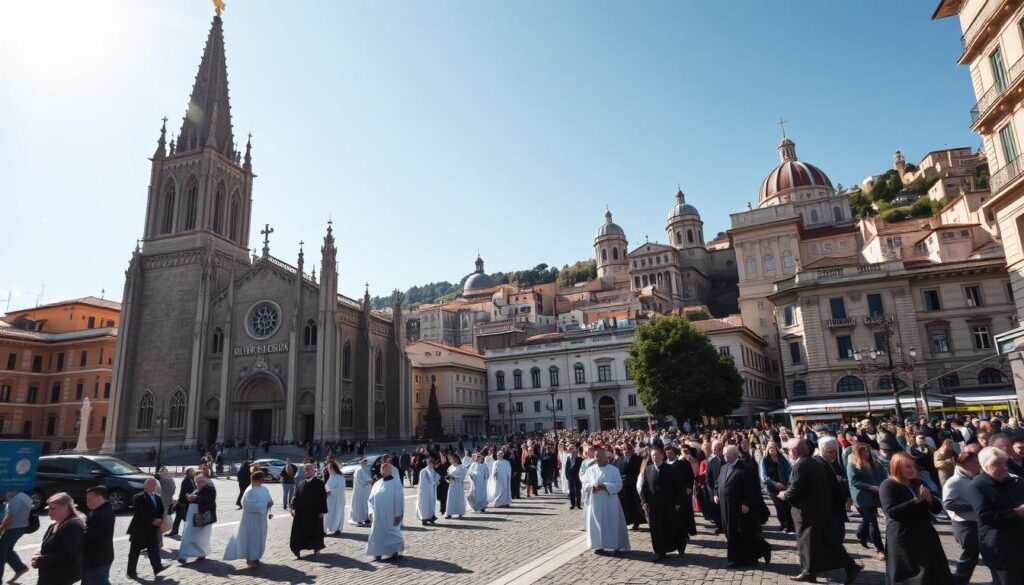
Global faith communities thrive through unique cultural expressions. These six nations demonstrate how spiritual traditions evolve while maintaining core beliefs, creating vibrant tapestries of worship.
Powerhouses of Devotion
Brazil’s 105.3 million adherents form the largest Catholic population worldwide. Rainforest villages blend indigenous rituals with sacraments, while Rio’s Christ the Redeemer statue watches over soccer-crazed cities. Local festivals often feature samba processions alongside traditional hymns.
Mexico’s 91.2 million faithful showcase ancient roots. Mayan-inspired altars for Día de Muertos display skull-shaped sweets beside saint statues. Mariachi bands regularly perform Las Mañanitas during feast days, filling plazas with trumpet-led tributes.
The Philippines stands out in Asia with 86 million followers. Text message prayer chains circulate daily, and Manila’s 16th-century churches host smartphone-lit candle offerings. “Faith here moves as fast as our internet,” notes a Manila archdiocese spokesperson.
Contrasts in Practice
North America’s United States presents surprises – 67 million adherents maintain vibrant parishes despite Protestant majorities. Mega-churches share neighborhoods with historic cathedrals, reflecting religious diversity.
Italy’s 42 million Catholics preserve centuries-old traditions. Vatican-linked art restorers work beside nuns brewing espresso in monastery cafés. Meanwhile, the Democratic Republic Congo’s 37 million followers fuel growth through coffee trade profits funding rural chapels.
| Nation | Unique Feature | Community Impact |
|---|---|---|
| Brazil | Amazon rituals | 65% attend monthly Mass |
| DR Congo | Coffee-funded churches | 87% weekly attendance |
| Philippines | Digital prayer networks | 92% self-identify as Catholic |
Catholicism’s Evolving Role in Modern Society
Spiritual landscapes are shifting faster than ever. The Catholic Church now navigates a world where ancient traditions meet modern skepticism. While some regions see vibrant growth, others face unprecedented tests of relevance.
When Numbers Tell Two Stories
Germany’s 22.1 million adherents paint a complex picture. Only 14% attend weekly services – that’s 3.1 million actively practicing. Contrast this with the Netherlands, where 35% identified with the faith last century. Today? Just 17% remain.
Brazil’s situation highlights another paradox. Home to the world’s largest Catholic population, only 8% regularly attend Mass. Urbanization and alternative spiritual movements reshape engagement patterns globally.
Yet adaptation continues. Digital ministries now reach millions, while social justice initiatives address contemporary concerns. As one Vatican leader recently observed: “Our challenge isn’t counting believers, but making belief count.”
FAQ
Which country currently has the largest Catholic population?
Brazil holds the world’s largest Catholic population, with over 120 million followers. Mexico and the Philippines follow closely, reflecting strong historical ties to European missionary efforts.
How did the Holy Roman Empire shape Catholic traditions in Europe?
The Holy Roman Empire unified political and religious power, spreading Latin liturgy and church governance. This legacy still influences practices in Germany, Austria, and parts of Central Europe today.
What role did colonization play in spreading Catholic communities globally?
Spanish and Portuguese colonizers established missions across Latin America, Africa, and Asia. These efforts blended European rituals with local customs, creating unique traditions in places like the Democratic Republic of Congo and Peru.
How is the United States’ Catholic community evolving?
While the U.S. has over 70 million Catholics, attendance has declined since 2000. Immigration from Latin America and the Philippines now drives growth, reshaping parish dynamics.
Why does Italy remain central to Catholic identity despite secularization trends?
Italy hosts Vatican City, the Church’s spiritual headquarters. Pilgrimages to Rome and traditions like Easter celebrations keep Catholicism deeply woven into national culture, even as secular attitudes rise.
How do indigenous practices influence Catholicism in countries like Mexico?
Mexican traditions like Día de los Muertos (Day of the Dead) blend pre-Hispanic rituals with Catholic feast days. This syncretism appears in art, festivals, and local patron saint devotions.
What challenges does the Church face in maintaining its global presence?
Secularism, clergy shortages, and demographic shifts test growth. However, Africa’s rising Catholic population—projected to reach 460 million by 2050—offers a counterbalance to declines in Europe.