For over 2,000 years, a spiritual tradition has shaped art, politics, and daily life across continents. Roman Catholicism stands as the largest Christian denomination, uniting 1.3 billion people through shared rituals and teachings. Its influence stretches from medieval cathedrals to modern social movements, making it a cornerstone of global culture.
This faith traces its roots to Jesus Christ and the Apostles, evolving into a structured institution led by the pope. The Holy See – the church’s governing body – operates as history’s oldest continuous monarchy. From Renaissance masterpieces to humanitarian efforts, its impact appears in unexpected corners of daily life.
Why does this matter today? Understanding this tradition helps decode Western literature, legal systems, and even music. Composers like Mozart drew inspiration from its rituals, while authors like Dante built worlds around its teachings. Let’s explore how ancient practices continue shaping our modern world.
Key Takeaways
- Roman Catholicism remains the world’s largest Christian group, with over a billion followers
- The church’s structure dates back to early Christian communities and the first popes
- Papal leadership forms the oldest continuously operating monarchy globally
- Cultural landmarks like Gothic architecture stem from Catholic traditions
- Understanding this faith provides context for Western art and history
- The Holy See governs Catholic communities across six continents
Historical Origins and Evolution of Catholicism
The story of Roman Catholicism begins in the bustling heart of the Roman Empire, where early Christians gathered in secret. Letters from the New Testament reveal vibrant communities forming within decades of Jesus Christ‘s resurrection. By AD 57, Paul’s Epistle to the Romans addressed a well-organized group meeting in homes across the ancient capital.
Early Church Foundations and Apostolic Roots
Archaeological evidence and writings from saints like Clement of Rome confirm Peter’s leadership as the first bishop of Rome. Early church fathers argued this role gave Rome special authority among Christian churches. “You are Peter, and on this rock I will build my church,” became a cornerstone text for papal claims.
The Role of Peter, Paul, and the Papacy
Both Peter and Paul’s martyrdom in Rome transformed the city into a spiritual hub. As the western empire crumbled, Rome’s bishops gained influence through land management and diplomacy. By 600 AD, Gregory I used the title “pope,” merging religious power with political savvy.
Major Schisms and the Reformation Impact
The Great Schism of 1054 split Christianity over debates about papal supremacy and theological details. Nearly 500 years later, Martin Luther’s protests sparked the Reformation, challenging Roman Catholic teachings on salvation. These divisions created today’s landscape of western and eastern churches.
Overview of catholicism beliefs and practices
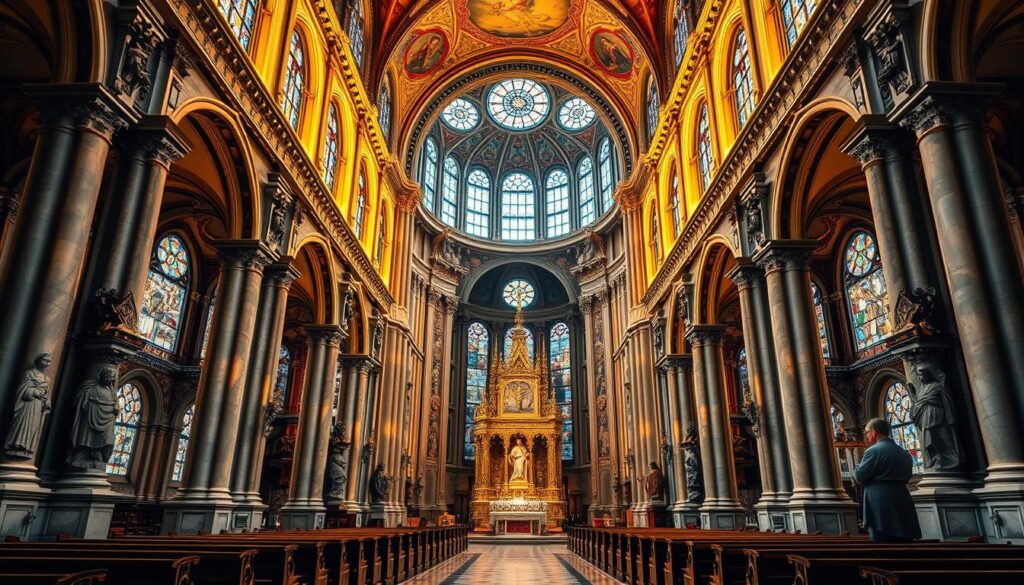
At the heart of Roman Catholic identity lies a distinctive fusion of ancient rituals and doctrinal pillars. These elements shape daily spiritual life while connecting modern worshippers to two millennia of tradition.
Defining Key Doctrines and Traditions
Roman Catholics view their church as the original Christian community founded by Jesus. They emphasize apostolic succession – the unbroken line from Peter to today’s pope. This authority structure guides interpretation of both New Testament writings and oral teachings passed through generations.
A central concept is the treasury of merit. Imagine a spiritual savings account filled with Christ’s infinite grace and saints’ virtuous deeds. Members access these reserves through sacraments and prayers. “The Church holds the keys to this divine inheritance,” notes a catechism text.
| Aspect | Mortal Sin | Venial Sin |
|---|---|---|
| Criteria | Grave matter, full knowledge, deliberate consent | Less serious offense, partial awareness |
| Consequence | Breaks relationship with God | Weakens spiritual connection |
| Resolution | Confession required | Prayer or minor penance |
The Holy Spirit plays a vital role in maintaining doctrinal unity. When popes speak ex cathedra on faith matters, Catholics believe this guidance comes without error. This rare practice last occurred in 1950 with the Assumption dogma.
Afterlife teachings include purgatory – a purification process before heaven. Unlike eternal damnation, this temporary state reflects God’s mercy. Families often pray for souls undergoing this cleansing, believing their petitions speed the journey toward divine light.
The Church’s Sacraments and Rituals
Seven sacred ceremonies guide Catholics through life’s milestones, each infused with divine grace. These sacraments act as spiritual landmarks – visible signs of invisible blessings that strengthen faith at critical moments. They’re grouped into three categories reflecting life’s journey: beginnings, healing, and lifelong commitments.
Baptism, Eucharist, and Confirmation
The initiation trio starts with Baptism, where holy water washes away original sin. Infants or adults become church members through this Trinitarian ritual. Next comes the Eucharist, celebrated as holy communion using consecrated bread wine believed to transform into Christ’s essence.
Confirmation completes initiation when bishops anoint foreheads with oil. This rite empowers believers with the Holy Spirit’s gifts. “Be sealed with the gift of the Holy Spirit,” the minister declares during this sacred anointing.
Reconciliation, Anointing of the Sick, Matrimony, and Ordination
Healing sacraments offer renewal. Through reconciliation, believers confess sins privately to priests. The anointing sick ritual comforts those facing illness with prayers and blessed oil.
Vocational rites shape life paths. Marriage unites couples in unbreakable bonds before God. Holy orders through ordination set apart deacons, priests, and bishops for church leadership. Each ceremony uses specific symbols – rings for spouses, laying hands for clergy – marking eternal commitments.
Liturgical Practices and Daily Observances
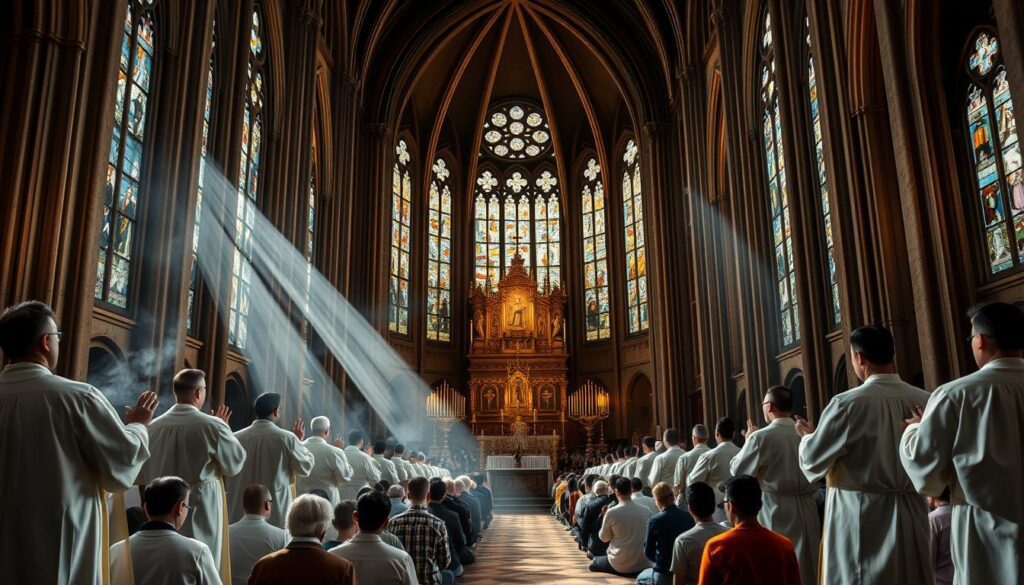
The scent of incense and the sound of hymns mark the heartbeat of Catholic worship. These ancient patterns unite communities through carefully preserved rituals that engage sight, sound, and touch. At their core lies the Mass – a sacred dance of words, gestures, and symbols repeated weekly across continents.
Structure of Mass and the Liturgy of the Word
Sunday services begin with a procession of clergy in colorful vestments. The first major part, called the Liturgy of the Word, features Bible readings followed by the priest‘s homily. “Through Scripture, God speaks directly to his people,” explains a Vatican document on worship.
Congregants respond with sung psalms and creeds. This interactive format roots faith in both ancient texts and modern life. The second part shifts focus to the altar, where bread and wine become holy communion through consecration prayers.
Prayer, Gestures, and the Sign of the Cross
Physical actions deepen spiritual connections. Worshippers trace the cross on their bodies while invoking the Trinity – forehead to chest, then shoulder to shoulder. Folded hands during prayers symbolize inner focus, while genuflection honors Christ’s presence in the tabernacle.
Many extend these practices beyond Sunday services. Morning offerings, meal blessings, and nighttime examinations of conscience weave faith into daily routines. A variety of devotional objects – from rosary beads to saint medals – serve as tangible reminders of spiritual commitments.
Key Figures, Doctrinal Developments, and Schisms
Leadership and doctrine have steered the Roman Catholic Church through centuries of change. From medieval kings to modern reformers, pivotal figures reshaped spiritual authority while councils cemented lasting traditions. This journey reveals how ancient institutions adapt to new eras.
Influential Leaders: Charlemagne to Pope Francis
Charlemagne’s 800 AD coronation by Pope Leo III forged church-state alliances that defined Europe. Centuries later, St. Gregory the Great expanded Rome’s reach through missionary work. “The care of souls is the art of arts,” he wrote, emphasizing pastoral duties.
Modern leaders like Pope Francis address climate change and inequality while upholding tradition. His 2015 encyclical Laudato Si’ blended environmental ethics with Catholic social teaching. This balance mirrors St. Francis of Assisi’s 13th-century call for simplicity and service.
| Leader | Contribution | Era |
|---|---|---|
| Charlemagne | Strengthened papal political power | 8th-9th century |
| St. Gregory I | Established monastic reforms | 6th century |
| St. John XXIII | Launched Vatican II reforms | 1960s |
| Pope Francis | Focus on social justice issues | 21st century |
Development of Doctrines and Council Decisions
The 1215 Fourth Lateran Council transformed daily church life. It required annual confession and formalized transubstantiation – the belief that communion elements become Christ’s body. These rules still guide official Roman Catholic practice today.
In 1870, Vatican I declared papal infallibility for faith-related teachings. This controversial move centralized power amid rising secularism. Later, Vatican II (1962-1965) modernized worship by allowing local languages instead of Latin.
Bishops worldwide now collaborate through synods, blending ancient hierarchy with collective input. From medieval decrees to modern dialogues, these developments show how doctrine evolves while maintaining core principles.
Impact on Society and Global Reach
A global network of 1.3 billion believers makes the Catholic Church both a spiritual force and social catalyst. Its influence stretches beyond Sunday services into education, healthcare, and international diplomacy. This unique position allows it to address both eternal truths and urgent human needs.
Cultural and Artistic Legacies
From Gothic cathedrals to Renaissance frescoes, Catholic traditions shaped the world’s artistic heritage. Monasteries preserved ancient texts during Europe’s dark ages, while universities like Oxford began as church schools. Today, these churches remain among humanity’s most visited cultural landmarks.
Music and literature also bear Catholic fingerprints. Gregorian chants inspired classical symphonies, while writers like Tolkien wove sacramental themes into modern stories. This creative legacy continues through faith-based films and community theater productions.
Social Stances and Political Influence
The Catholic Church champions specific life principles – opposing abortion while promoting large families through natural planning methods. Its 2,700+ charitable organizations worldwide feed millions annually, blending service with spiritual guidance.
Political engagement varies by era. Medieval popes crowned emperors, while modern leaders advocate for climate action. Religious orders like Franciscan friars demonstrate this variety, running homeless shelters beside Vatican diplomats negotiating peace treaties.
Through these dual roles, the institution remains a home for both contemplative nuns and activists fighting injustice. Its ability to adapt while maintaining core teachings explains its enduring presence across continents and centuries.
FAQ
What role does the Pope play in the Catholic Church?
The Pope, as Bishop of Rome and successor to St. Peter, holds supreme authority in teaching, governance, and unifying global Catholics. He is considered Christ’s representative on Earth.
How many sacraments do Catholics celebrate?
There are seven sacraments: Baptism, Eucharist, Confirmation, Reconciliation (Confession), Anointing of the Sick, Matrimony, and Holy Orders. These rituals mark key spiritual milestones.
Why is the Mass central to Catholic worship?
The Mass commemorates Jesus’s sacrifice and Resurrection. Through the Liturgy of the Word and Eucharist, believers encounter Christ’s presence in Scripture and the transformed bread and wine.
What caused the split between Eastern Orthodoxy and Catholicism?
The Great Schism of 1054 arose from disputes over papal authority, theological differences like the Filioque clause, and cultural divides between Latin and Greek traditions.
Do Catholics pray to saints?
Catholics ask saints to intercede with God, much like asking friends for prayers. Saints are honored as holy examples, but worship is reserved for God alone.
How does the Church address social issues today?
It promotes human dignity through teachings on poverty, immigration, and life ethics. Pope Francis emphasizes environmental care and dialogue with modern cultures.
What’s the purpose of Confirmation?
This sacrament strengthens baptismal grace, deepens the Holy Spirit’s gifts, and empowers individuals to live as committed witnesses to their faith.
How does Anointing of the Sick provide comfort?
Through prayer and oil, the sacrament offers spiritual healing, peace, and strength during illness or near death, uniting the person with Christ’s suffering.