Let’s explore how faith shapes communities from California to Maine. With over 77 million members, the United States is home to the fourth-largest Catholic community globally. This vibrant tradition weaves through cities, suburbs, and rural towns, creating a spiritual mosaic as diverse as America itself.
Why do patterns of belief vary so widely between regions? The answer lies in history, migration, and cultural shifts. Early Spanish missions in the Southwest tell different stories than French-founded parishes in Louisiana. Industrial-era immigrants built iconic cathedrals in Northeast cities, while recent arrivals continue reshaping worship spaces today.
This guide makes sense of complex demographic data through clear maps and insights. You’ll discover how Texas and New York became modern hubs, why the Midwest maintains deep roots, and what surprises emerge in fast-growing states. We’ll also examine how leadership through the US Conference of Catholic Bishops unites these regional identities.
Key Takeaways
- The US ranks fourth globally in Catholic population size
- Regional differences reflect unique historical and cultural influences
- Modern demographic shifts continue reshaping communities
- National leadership coordinates 77+ million members nationwide
- State-level analysis reveals unexpected trends and growth areas
Overview of U.S. Catholic Demographics
America’s spiritual fabric took shape through centuries of cultural exchange. Early European settlers brought more than goods across the Atlantic—they carried traditions that would redefine a continent.
Historical Roots of U.S. Catholicism
Spanish missionaries built the first permanent Catholic settlements in the 1500s. Their adobe chapels dotted the Southwest, while French colonial settlements clustered around the Mississippi Delta. These outposts became spiritual anchors for future generations.
The 1800s transformed the religious landscape. Territorial expansions added 1.2 million square miles with existing Catholic communities. Waves of European immigrants later tripled the faithful population between 1850-1900. Irish dockworkers, German farmers, and Italian artisans all shaped local worship styles.
Statistical Highlights and Data Sources
Modern surveys reveal fascinating patterns. The U.S. Religion Census tracks membership in over 17,000 congregations nationwide. Recent findings show:
- 6 states account for 45% of all Catholic adherents
- Urban centers host 68% of parish communities
- 22% of members live in rural areas
Researchers combine census data with church records for accuracy. This blended approach helps explain regional variations while maintaining a national perspective. As demographics shift, these tools remain vital for understanding America’s evolving faith communities.
Regional Insights: Shifts Across the Nation
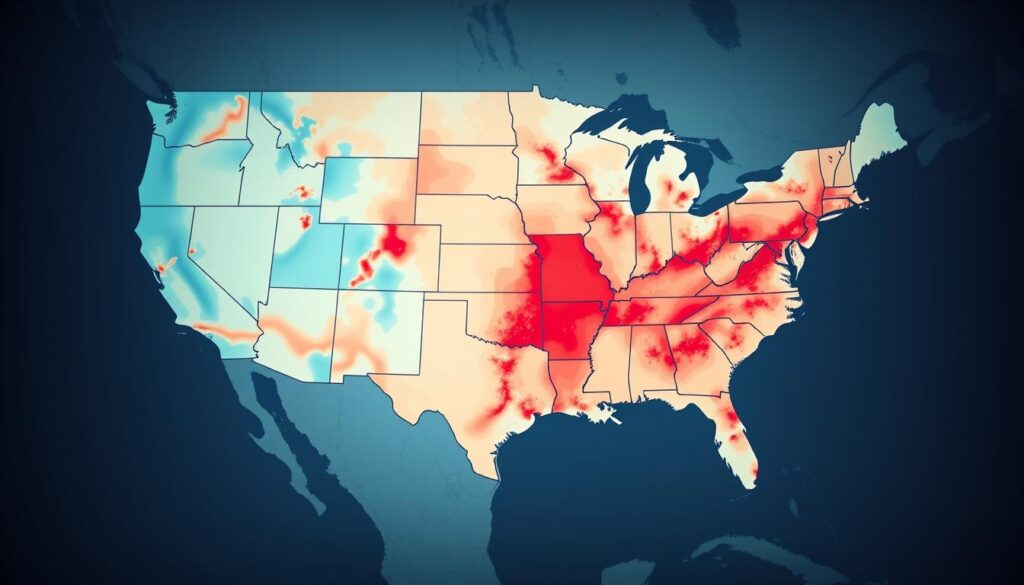
The U.S. Religion Census reveals a stunning reversal in America’s spiritual geography. Where historic parishes once defined religious life, new patterns now emerge through domestic migration and cultural blending. This transformation reshapes everything from Sunday services to community outreach programs.
Northeast and Midwest: Established Traditions
New England’s brick cathedrals still anchor neighborhoods, but their influence spreads beyond Sunday pews. In Rhode Island and Connecticut, Catholic traditions color local festivals, education systems, and even seafood festivals. “These communities built America’s social fabric,” notes a researcher from the Association of Statisticians of American Religious Bodies.
Despite declining percentages, these regions maintain deep cultural roots. Boston’s St. Patrick’s Day parade draws half a million visitors annually, while Chicago’s Polish masses continue generations-old customs. Urban parishes adapt by hosting ESL classes and immigrant support groups.
South and West: Emerging Trends
Sunbelt states tell a different story. Texas added more Catholic congregants last decade than any other state – enough to fill 50 new mid-sized parishes. Arizona and Georgia follow closely, with growth fueled by both relocation and new conversions.
County-level data shows particular strength along cultural crossroads. Eight Rio Grande counties report Catholic majorities, blending Mexican traditions with Texan identity. Meanwhile, Nevada’s congregations doubled since 2010, matching the state’s overall population boom.
This geographic shift creates fresh opportunities. Churches in Atlanta now offer Mass in six languages, while Phoenix parishes partner with solar companies to reduce energy costs. As one Louisiana priest observes: “We’re not just keeping traditions – we’re writing new chapters.”
In-Depth Analysis: catholicism by state and Its Demographic Trends
Mapping America’s religious landscape reveals fascinating patterns hidden in plain sight. The latest U.S. Religion Census offers a treasure trove of insights for those curious about how spiritual communities evolve.
Top States with the Highest Catholic Populations
Rhode Island stands unchallenged as the nation’s most Catholic stronghold. With 42% of residents identifying with this tradition, the Ocean State’s cultural fabric reflects waves of immigration. “Our parishes tell the story of French-Canadian mill workers, Irish dockhands, and Portuguese fishermen,” notes a local historian.
Massachusetts and New Jersey tie at 34%, each showcasing unique demographic blends. Boston’s historic churches now host Polish and Brazilian festivals, while Newark’s archdiocese serves half a million members across 200 parishes. Southern states like Mississippi (4%) highlight striking regional contrasts.
Interpreting Change Over Time
The Association of Statisticians of American Religious Bodies tracks 373 faith groups through meticulous surveys. Their 2020 report shows:
- 19 states gained Catholic adherents since 2010
- 8 counties along cultural borders report majority-Catholic populations
- Urban centers drive 73% of membership growth
These shifts aren’t just numbers—they reshape community resources and cultural traditions. As one researcher explains: “Where people worship influences everything from food pantries to youth programs.” Understanding these trends helps predict which areas might need new parishes or multilingual services next decade.
Conclusion
The story of faith in America keeps rewriting itself. Recent surveys show 61.9 million people participate in Catholic congregations nationwide – nearly 1 in 5 residents. This makes the Catholic Church the largest single religious group when counting denominations separately.
Numbers tell a compelling story. Over the past decade, 2 million new adherents joined these communities despite regional shifts. While traditional strongholds see gradual changes, 36 states now recognize Catholic groups as their largest religious body.
Growth patterns reveal surprising momentum. Southern and Western regions added more members than any other area since 2010. This expansion influences everything from multilingual services to youth programs in fast-growing counties.
Understanding these trends helps leaders make smart choices. Data from the U.S. Religion Census guides decisions about new parishes and outreach efforts. As communities evolve, this information becomes vital for maintaining connections.
The future looks bright for diverse worship communities. With adaptable approaches and fresh energy in growing regions, Catholic traditions continue shaping American society in meaningful ways.
FAQ
Which U.S. states have the largest Catholic populations?
California, Texas, and New York consistently rank as the top three states by Catholic population. These regions reflect historical migration patterns, cultural diversity, and established diocesan networks. Detailed data is available through the U.S. Religion Census.
How does the U.S. Religion Census track Catholic demographics?
The Association of Statisticians of American Religious Bodies collaborates with dioceses to collect congregation counts and self-reported adherence rates. This data is compiled every decade, offering insights into regional growth or decline.
Are Catholic populations growing faster in certain regions?
The South and West show notable growth due to immigration, younger demographics, and outreach efforts. Meanwhile, the Northeast and Midwest maintain strong historical ties but face slower growth rates.
What factors influence shifts in Catholic adherence over time?
Migration, generational trends, interfaith marriages, and secularization play key roles. States with robust immigrant communities often see steadier engagement, while others experience gradual declines.
How reliable are Catholic population estimates at the county level?
County-level data from the U.S. Religion Census provides a general overview but may undercount non-affiliated or culturally identifying Catholics. Local parish records often supplement these figures for accuracy.
Which organizations contribute to Catholic demographic research?
The Center for Applied Research in the Apostolate (CARA) and the National Catholic Educational Association frequently analyze trends. Their reports complement broader surveys like the Pew Research Center’s religious landscape studies.