What does the word “Catholicism” truly mean? For many, it’s more than just a label—it’s a vibrant faith followed by over 1.3 billion people worldwide. Let’s explore this rich tradition in simple terms, perfect for anyone curious about its role in history and modern life.
At its core, this word describes the largest Christian denomination, shaped by shared rituals and teachings spanning 2,000 years. Led by the Pope in Rome, it emphasizes community, sacraments, and service. Its influence stretches far beyond churches, touching art, education, and social justice movements across continents.
You’ll notice how its meaning balances ancient traditions with modern relevance. From Gothic cathedrals to humanitarian efforts, Catholicism remains a living force. Whether you’re learning for personal growth or cultural awareness, this guide clarifies its essentials without overwhelming details.
Key Takeaways
- Represents the world’s largest Christian group, uniting 1.3 billion followers
- Centered around the Pope’s leadership and Rome’s historical significance
- Blends ancient rituals with modern global outreach
- Shaped Western art, philosophy, and social systems for centuries
- Focuses on sacraments, community service, and universal teachings
Overview of Catholicism – Basic Meaning and Usage
Let’s unpack the term that connects ancient roots with modern relevance. The word itself acts as a bridge between language and belief, appearing in diverse contexts from news headlines to personal faith journeys.
From Greek to Global
Originating from “katholikos” (Greek for “universal”), this meaning reflects a mission to reach all people. Across languages, the term adapts while keeping its core identity:
| Language | Translation | Cultural Context |
|---|---|---|
| Spanish | Catolicismo | Latin American traditions |
| German | Der Katholizismus | European history |
| Chinese | 天主教 | Growing Asian communities |
Modern Applications
Today’s usage goes beyond religious practice. You might hear it in debates about healthcare policies or museum tours discussing Renaissance art. Recent examples include:
- Scholars analyzing voting patterns
- Documentaries exploring cathedral architecture
- Neighborhood festivals celebrating shared heritage
This flexibility shows how one word can shape conversations across time zones and disciplines. Whether discussing moral philosophy or community food drives, its influence remains unmistakable.
Historical Evolution of Roman Catholicism
How did a movement from ancient Judea become a global faith shaping two millennia of history? The story begins with twelve followers and grows through pivotal moments that defined roman catholicism as we know it today.
Foundations in Early Christianity
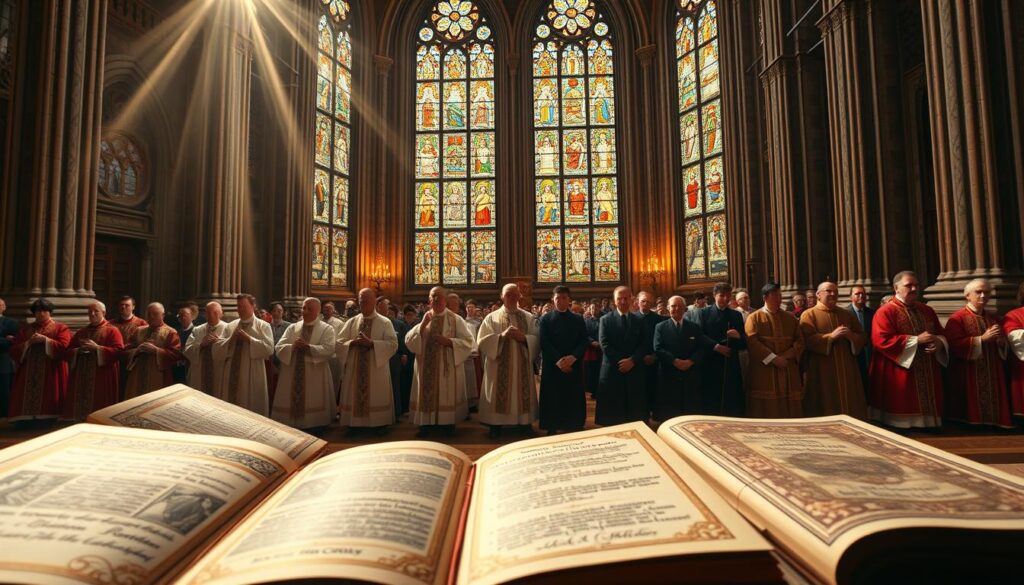
The roots of the catholic church stretch back to Jesus’ teachings and his apostles’ missionary work. Early believers formed tight-knit communities, sharing rituals like baptism and communion. By the 4th century, these groups evolved into an organized institution with clear leadership roles.
Key Figures and Milestones
Visionary leaders propelled the church forward through critical eras. Consider these game-changers:
| Figure | Contribution | Era |
|---|---|---|
| St. Gregory I | Strengthened papal authority | 6th century |
| Charlemagne | United church and empire | 800 CE |
| St. John XXIII | Launched modern reforms | 1960s |
Development from Apostolic Tradition
St. Irenaeus laid groundwork still used today. His three-pillar system combined:
- New Testament teachings
- Bishops’ leadership chain
- Passed-down practices
This framework helped roman catholicism maintain unity while adapting to new cultures. From medieval monasteries to urban parishes, the catholic church keeps rewriting its history through service and renewal.
Deep Dive into “catholicism def”
Let’s explore how language shapes our understanding of major belief systems. The search for clear definitions often reveals fascinating connections between ancient traditions and modern expressions.
Usage in Contemporary and Historical Context
Today’s usage of these words spans personal journeys and global politics. A 2025 Harper’s interview asks:
“How did converting affect your relationship with evil?”
This shows faith transitions shaping philosophical perspectives.
Historical meanings remain surprisingly stable. Time Magazine notes:
“Portuguese colonizers used it as spiritual framework and political tool.”
Here, thewordbridges cultural influence across centuries.
Example Sentences and Practical Illustrations
Real-world examples help decode complex concepts. Consider these 2025 references:
- Literary Hub debates repentance frameworks
- The Enquirer tracks local conversion stories
These words appear everywhere – from voting analysis to neighborhood festivals. They help us discuss identity, power, and community without specialized jargon. Next time you encounter the term, notice how it connects personal choices with wider cultural patterns.
Cultural and Social Impact of Catholic Traditions
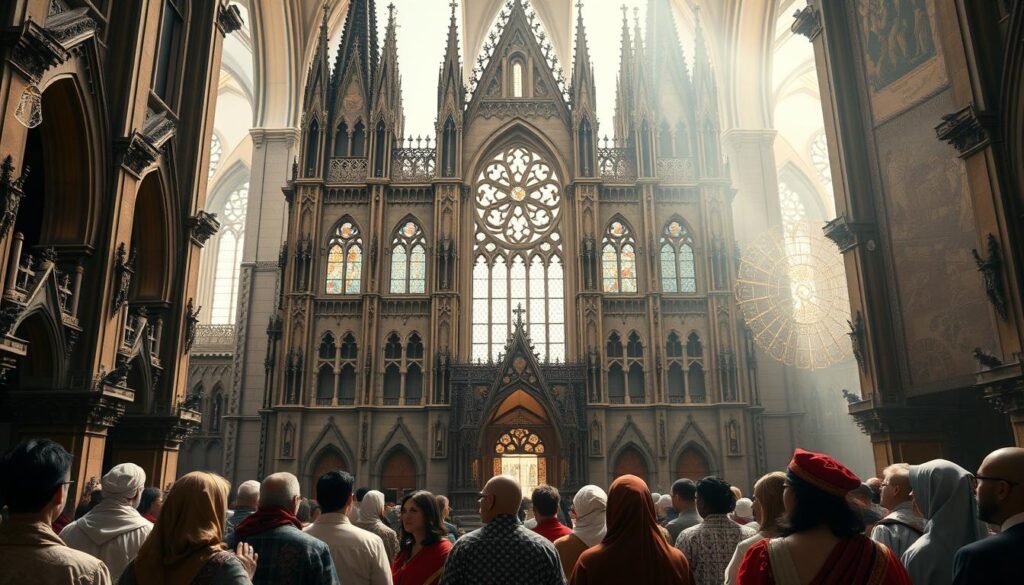
Imagine walking through a European city where every corner whispers stories of faith and creativity. The Catholic Church didn’t just build churches—it shaped how we see beauty, justice, and community across continents.
Masterpieces That Speak Across Centuries
From Michelangelo’s brushstrokes in the Sistine Chapel to Dante’s journey through heaven and hell, Roman Catholicism fueled humanity’s greatest creations. Gothic cathedrals like Notre-Dame became stone textbooks teaching biblical stories through stained glass and spires.
Composers like Mozart wrote masses that still give chills today. As one art historian notes:
“You can’t separate Western art history from the Catholic Church—it was the original patron of genius.”
A Faith That Travels Well
This tradition crossed oceans and adapted without losing its core. Today, Filipino processions blend local dances with ancient prayers. Mexican altars burst with marigolds during Day of the Dead—a mix of indigenous and Catholic practices.
The world sees this blend in action:
- Brazil’s Christ the Redeemer overlooking Rio
- Vietnamese martyrs celebrated with lotus flowers
- Chicago food pantries run by parish volunteers
Through art, service, and shared rituals, these traditions keep shaping how people connect across cultures. They prove that religion isn’t just about beliefs—it’s about the beauty we create together.
Catholicism in Daily Practice and Faith Communities
Morning light filters through stained glass as millions begin their day with familiar rhythms. These routines form the heartbeat of a living tradition, connecting kitchen tables to cathedral altars worldwide.
Everyday Practices and Community Life
Faith communities thrive through shared actions – from blessing meals to volunteering at shelters. Many start with morning prayers or meditative walks, weaving spiritual awareness into ordinary moments. Weekly Mass often serves as both worship and neighborhood reunion.
Parish life pulses with seasonal traditions. Summer festivals feature ethnic foods and heritage dances, while Advent wreath workshops prepare hearts for Christmas. Local food pantries and tutoring programs demonstrate beliefs in action, creating tangible support networks.
Modern adaptations keep traditions vibrant. Apps deliver daily reflections to smartphones, while young adults organize eco-friendly service projects. This blend of ancient and new shows how daily practices remain relevant across generations.
Through these patterns, personal faith grows alongside community bonds. Whether lighting candles or packing school supplies, believers find meaning in both quiet devotion and collective action.
FAQ
What does "catholicism" mean?
The term refers to the beliefs, practices, and traditions of the Roman Catholic Church, rooted in Jesus Christ’s teachings. It emphasizes unity, sacraments like the Eucharist, and loyalty to the Pope as spiritual leader.
How did Roman Catholicism develop historically?
It grew from early Christian communities, shaped by apostles like Peter and Paul. Key moments include the Council of Nicaea (325 CE) and the Vatican II reforms. The Church’s structure, like dioceses and papal authority, evolved over centuries.
How is the word "catholicism" used today?
It describes both the faith’s global presence and its doctrinal identity. For example, phrases like “catholicism def” often seek quick explanations of its core tenets, such as grace or communion.
What role does tradition play in Catholic life?
Rituals like Mass, sacraments, and liturgical seasons (e.g., Lent) anchor daily practice. Communities gather for worship, service, and events like parish festivals, reflecting shared values.
How has Catholicism influenced culture?
It inspired Renaissance art (Michelangelo’s Sistine Chapel), Western ethics, and education systems. Missionaries spread its teachings worldwide, blending with local customs in places like Latin America or the Philippines.
What distinguishes Roman Catholicism from other Christian groups?
Unique features include devotion to Mary, papal infallibility, and seven sacraments. The Church also maintains ancient traditions, like Latin Mass, alongside modern adaptations under leaders like Pope Francis.