Whether you grew up attending Mass every Sunday or are simply curious about one of the world’s oldest faiths, this guide is here to help. Many people have questions about Catholic teachings, traditions, and how they shape daily life. You’re not alone—and the doors of understanding are always open.
Some might wonder why rituals like Communion matter or how the Church views modern social issues. Others may have heard the phrase “Once a Catholic, always a Catholic” and want to know what that truly means. This journey isn’t just about facts—it’s about connecting with a spiritual heritage that has inspired art, shaped laws, and comforted billions.
No prior knowledge is needed here. We’ll explore everything from core beliefs to cultural influences in plain language. If you’re returning after years away or stepping into this world for the first time, consider this your welcome back—or your warm introduction.
Key Takeaways
- Designed for both lifelong members and newcomers seeking clarity
- Addresses common misunderstandings with compassion
- Connects ancient traditions to their modern-day impact
- Explains complex ideas using everyday language
- Highlights the Church’s role as a spiritual home for all
Foundations of Catholic Belief and History
What makes the Catholic Church’s story unique? It begins with a bold claim: this global community of faith traces its roots to a single moment when Jesus told his disciple Peter, “You are the rock on which I will build my church.” This promise, recorded in Matthew’s Gospel, forms the bedrock of Catholic identity.
The Origins of the Catholic Church
Peter’s leadership didn’t end with his death. Catholics believe each pope inherits that same spiritual authority through apostolic succession—a chain linking every bishop back to the original twelve Apostles. Imagine a family tree stretching across 2,000 years, connecting modern parishes to those first gatherings in Jerusalem.
The early church faced Roman persecution, internal debates, and cultural shifts. Yet it grew from house churches to grand cathedrals. Key to this survival? Three pillars established by leaders like St. Irenaeus:
- Scripture (the New Testament)
- Oral teachings passed through generations
- Regional centers led by apostolic successors
The Role of the Apostles and Peter
Peter wasn’t just the first pope—he was part of a team. The Apostles spread Jesus’ message across continents, planting seeds that became dioceses. Their successors still guide the church today, blending ancient tradition with modern challenges.
This living history explains why Catholic practices feel both timeless and adaptable. From Roman catacombs to streaming Masses, the core remains: a community built on that original rock.
Core Doctrines and Sacred Traditions
How does a global community spanning 2,000 years maintain unity in belief? The answer lies in two pillars: concise doctrinal statements and a living chain of spiritual wisdom.
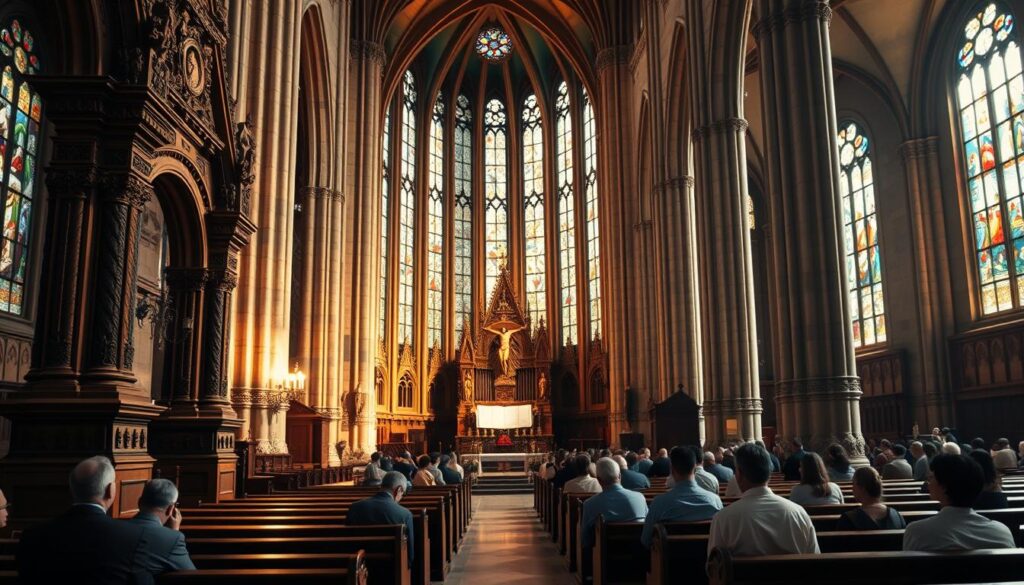
Understanding the Nicene Creed
Recited weekly at Mass worldwide, this fourth-century statement remains Christianity’s most universal summary of faith. Let’s unpack its key declarations:
| Phrase | Meaning |
|---|---|
| “One God, the Father Almighty” | Affirms monotheism |
| “Only Begotten Son… born of the Father” | Jesus’ divine nature |
| “He rose again on the third day” | Core resurrection belief |
| “One holy, catholic church” | Universal community vision |
As St. Athanasius noted: “The Creed is like a fence—it keeps error out and truth secure.” This ancient text grounds modern worship while allowing fresh insights.
The Significance of Sacred Tradition
Sacred Tradition isn’t about folklore or customs. It’s the authority to interpret Scripture, passed from Apostles to bishops through generations. Consider these distinctions:
- Divine Origin: Rooted in Jesus’ direct teachings
- Living Transmission: Adapts methods, not core truths
- Scripture’s Partner: The New Testament itself emerged from Tradition
The Catholic Church views Tradition and Scripture as twin streams flowing from the same spring. As Vatican II taught: “Tradition hands on everything necessary for holy living.” This dynamic process ensures teachings remain consistent yet responsive to new questions.
catholicism explained: Exploring Key Teachings
At the heart of Catholic teaching lies a profound mystery: the belief that God became human to bridge heaven and earth. This truth shapes how followers understand their purpose, relationships, and ultimate destiny.
The Divine-Human Connection
Jesus Christ stands central as both fully divine and fully human—a concept called the Incarnation. Catholics see this dual nature as essential: His divinity confirms He’s the Son God promised, while His humanity allows Him to fully share our struggles. As St. Paul wrote, “In Him, all things hold together.”
His death and resurrection aren’t just historical events. They’re seen as the turning point in human history, offering salvation through faith and sacraments like Baptism. This gift isn’t earned but freely given—a cornerstone of Catholic spirituality.
Mary’s Unique Role in Faith
The Virgin Mary holds a special place as the only person besides Jesus called “full of grace” in Scripture. Catholics believe God prepared her from conception (Immaculate Conception) to bear the Savior without sin’s shadow. Her “yes” to becoming Christ’s mother models perfect trust.
Four key Marian beliefs shape devotion:
- Perpetual Virginity: Mary remained a virgin before, during, and after Christ’s birth
- Assumption: Taken body and soul into heaven after her earthly life
- Intercession: Asks Jesus to aid those who seek her help
- Honor vs. Worship: Veneration differs from adoration given to God alone
Prayers like the Rosary aren’t about repeating words. They’re tools to reflect on Jesus’ life while leaning on His mother’s guidance—like holding a spiritual compass in challenging times.
Insights into Sacraments and Church Practices
Sacraments act as spiritual milestones in Catholic life, marking key moments from birth to eternal life. These sacred rituals bridge divine grace and daily living, offering tangible ways to experience God’s presence. Let’s explore how these practices shape faith journeys.
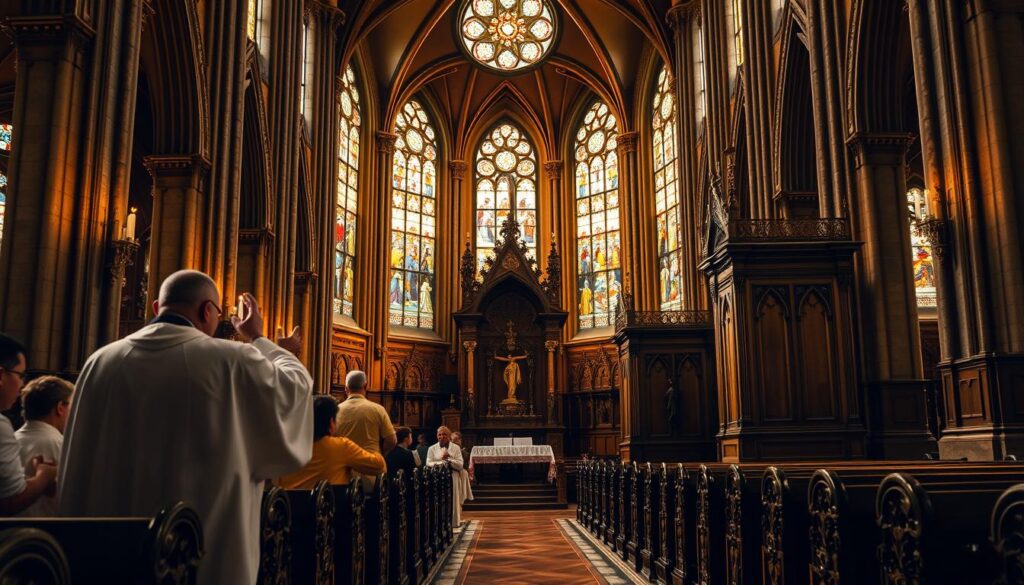
The Seven Sacraments and Their Meanings
Each sacrament serves a unique purpose:
- Baptism: Washes away original sin, welcoming believers into the Church
- Confirmation: Strengthens faith with the Holy Spirit’s gifts
- Eucharist: Nourishes through Christ’s real presence in consecrated bread and wine
- Reconciliation: Restores relationships through confession and forgiveness
- Marriage: Unites couples with Christ-like commitment
- Holy Orders: Sets apart clergy for sacred service
- Anointing of the Sick: Brings comfort and healing in times of crisis
The Importance of the Eucharist and Reconciliation
The Eucharist stands as the “source and summit” of Catholic worship. During Mass, bread and wine become Christ’s body and blood through transubstantiation. As St. Augustine wrote: “What you see is the bread and the cup… but your faith sees much more.”
Reconciliation (or confession) offers a fresh start. Catholics believe Jesus empowered priests to forgive sins through His authority. This sacrament heals spiritual wounds and renews community bonds. As James 5:16 teaches: “Confess your sins to one another… that you may be healed.”
| Sacrament | Key Impact |
|---|---|
| Baptism | Spiritual rebirth |
| Eucharist | Divine nourishment |
| Reconciliation | Moral renewal |
| Holy Orders | Leadership consecration |
Historical Influences and Social Teachings
How did a faith born in Roman persecution become a global force shaping art, law, and social justice? The answer lies in centuries of adaptation guided by timeless principles.
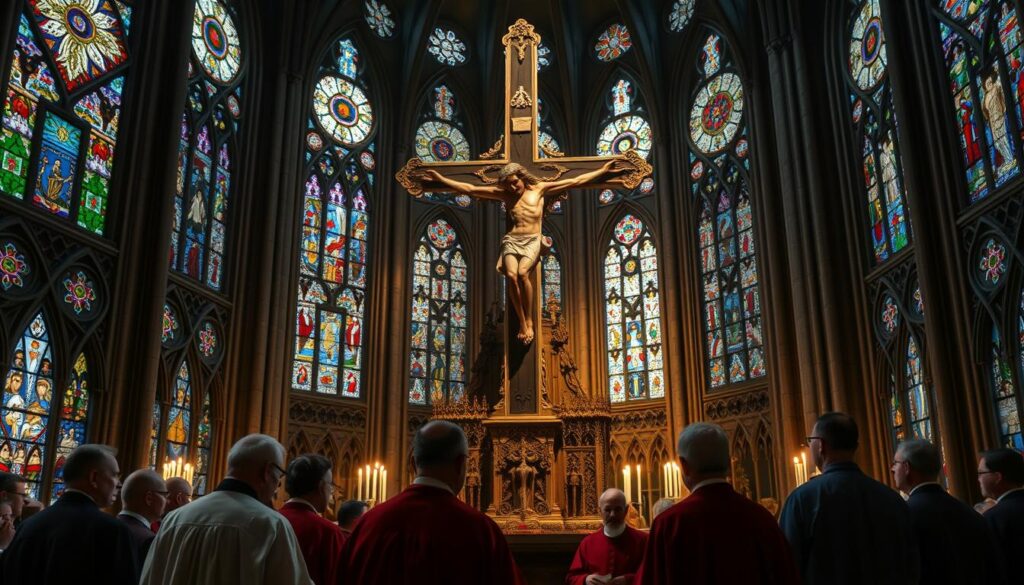
From Early Church to Medieval Influence
The early church transformed from underground gatherings to Europe’s spiritual backbone. When Emperor Constantine legalized Christianity in 313 AD, believers emerged from catacombs to build basilicas. Monasteries became hubs of learning, preserving ancient texts while advancing agriculture and medicine.
Key moments reshaped the church’s path:
| Event | Impact |
|---|---|
| Great Schism (1054) | Split with Orthodox Christians over papal authority |
| Protestant Reformation (1517) | Led to new Christian denominations |
| Council of Trent (1545-63) | Strengthened Catholic identity through reforms |
The Impact of the Second Vatican Council
The Second Vatican Council (1962-65) revolutionized modern Catholic life. Mass switched from Latin to local languages, making worship more accessible. The church acknowledged truth in other faiths while reaffirming its core teachings.
Three lasting changes emerged:
- Laypeople gained active roles in liturgy and ministries
- Interfaith dialogue replaced hostile debates
- Social justice became central to mission work
From supporting labor rights to fighting climate change, Catholic social doctrine continues evolving. As Pope Francis notes: “A good Catholic meddles in politics, offering the best of themselves to help leaders serve.”
Distinctive Doctrines and Organizational Structure
Structure and compassion form twin pillars supporting the Catholic Church’s global mission. This unique blend of organization and outreach shapes how over a billion people experience their faith daily.
Clerical Hierarchy and Papal Authority
The Church’s leadership mirrors a spiritual family tree. At its apex stands the pope, seen as Peter’s successor and the chief teacher of faith. Cardinals and bishops support this vision, governing regions while preserving unity through apostolic succession.
Priests serve as local shepherds, ordained through sacramental authority passed down from the Apostles. Celibacy reflects Christ’s example of undivided devotion. The Roman Curia assists the papacy in matters like liturgy and doctrine, ensuring global coherence.
Catholic Social Teaching and Modern Challenges
Catholic social teaching applies ancient wisdom to today’s struggles. It champions human dignity in debates about poverty, immigration, and environmental care. These principles urge believers to see policy through a moral lens.
While holding firm on issues like marriage and life ethics, the Church adapts its methods. Outreach programs and interfaith partnerships demonstrate how timeless teaching meets 21st-century needs. As Pope Francis reminds us: “Real power is service—nothing else.”
FAQ
How did the Catholic Church begin?
The Catholic Church traces its roots to Jesus Christ, who appointed the apostles to spread His teachings. After Christ’s resurrection, the apostles established communities that grew into the Church. Saint Peter, recognized as the first pope, played a central role in unifying early believers.
Why is the Nicene Creed important?
The Nicene Creed summarizes core Christian beliefs, like the Trinity and Christ’s divinity. It was created in 325 AD to address misunderstandings about faith. Catholics recite it during Mass to affirm shared beliefs with other Christian churches.
What role does Virgin Mary play in Catholicism?
Mary is honored as the Mother of God for her “yes” to bearing Jesus. Catholics believe she intercedes for believers and remains a model of faith. While she’s not worshipped, devotion to her reflects deep respect for her unique relationship with Christ.
Why are sacraments like Baptism and Eucharist essential?
Sacraments are visible signs of God’s grace. Baptism cleanses original sin and initiates one into the Church. The Eucharist, celebrated at every Mass, allows Catholics to receive Christ’s body and blood, strengthening their spiritual life.
How did the Second Vatican Council change the Church?
Vatican II (1962–1965) modernized practices, like allowing Mass in local languages instead of Latin. It emphasized lay participation, interfaith dialogue, and social justice. Pope John XXIII and Pope Paul VI led efforts to make the Church more accessible.
What is the pope’s authority based on?
Catholics believe the pope inherits Saint Peter’s role as Christ’s earthly representative. This papal authority, called apostolic succession, ensures unity in teachings. The pope guides doctrine but works with bishops worldwide on pastoral decisions.
How does Catholic social teaching address modern issues?
It applies Gospel values to challenges like poverty, immigration, and climate change. Principles like human dignity and care for creation inspire action. Pope Francis’s encyclical Laudato Si’, for example, urges environmental responsibility.
What’s the purpose of Reconciliation?
Also called Confession, this sacrament offers forgiveness for sins through a priest’s absolution. Catholics examine their conscience, express sorrow, and commit to change. It’s seen as a healing encounter with God’s mercy.