What transformed a small group of believers into the world’s largest Christian community? The story begins with early followers of Jesus in 1st-century Palestine. Their teachings spread across continents, blending spiritual ideals with cultural influences.
This faith tradition grew through centuries of change. Leaders shaped its practices, while political shifts influenced its structure. By the 4th century, it became central to Western civilization’s development.
Historical records show gradual growth rather than a single founding moment. Key events like the Council of Nicaea (325 CE) helped standardize beliefs. The papacy emerged as a unifying force during Rome’s decline.
Today, over 1.3 billion people identify with this global religion. Its teachings combine ancient traditions with modern interpretations. Understanding its origins helps explain its enduring impact on art, law, and society.
Key Takeaways
- Origins trace back to Jesus’ teachings and early Christian communities
- Developed organizational structure over several centuries
- Major councils shaped core doctrines and practices
- Cultural adaptation helped spread the faith globally
- Maintains continuity with ancient traditions while evolving
- Second-largest religious group worldwide after Islam
Understanding the Origins of Catholicism
The roots of the world’s largest Christian community stretch back to a transformative era in ancient history. Following Jesus Christ’s teachings, early believers formed tight-knit groups that prioritized shared meals and spiritual guidance. These gatherings laid the groundwork for organized worship practices still observed today.
From Followers to Faith Leaders
New Testament writings reveal how Jesus’ disciples evolved into church builders. Letters like Paul’s epistle to Rome show leaders addressing practical concerns – from meal disputes to leadership roles. By AD 100, bishops emerged as regional organizers, maintaining connections between scattered congregations.
Pillars of Early Belief
Three core elements defined these pioneering communities:
- Communal meals evolving into Eucharist rituals
- Oral traditions becoming written scriptures
- Apostolic leadership chains creating continuity
| Early Center | Key Figure | Contribution |
|---|---|---|
| Rome | St. Peter | Administrative hub development |
| Antioch | St. Paul | Outreach to non-Jewish populations |
| Alexandria | St. Mark | Theological education systems |
Archaeological finds confirm active house churches in Roman cities by AD 50. These spaces hosted mixed groups – wealthy patrons and slaves sharing faith equally. Such radical inclusivity helped the church survive persecution and spread rapidly.
Exploring the Historical Timeline
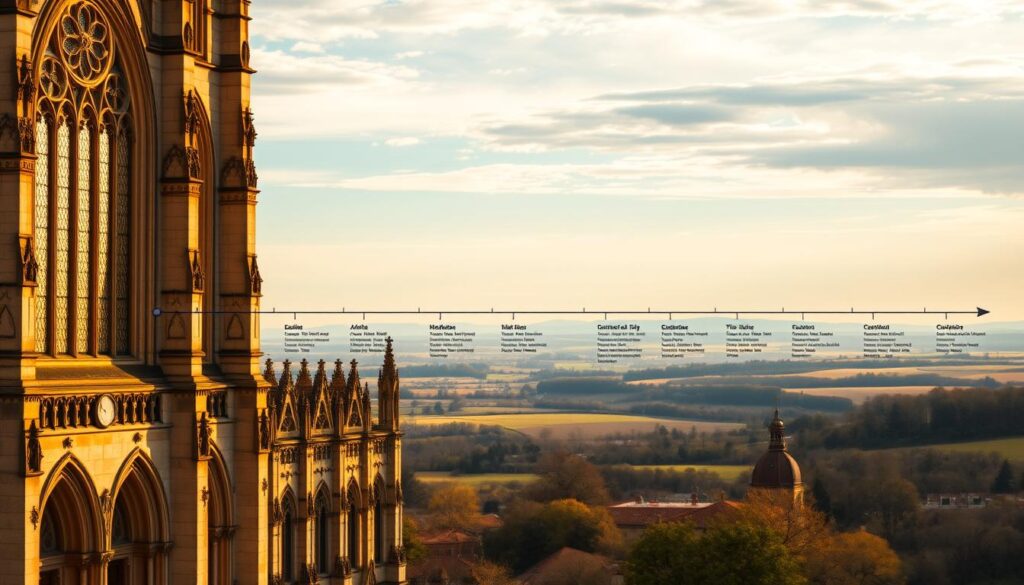
Centuries of change shaped one of history’s most enduring institutions. Through persecution and political shifts, the church adapted while preserving its core identity. Let’s explore pivotal moments that defined its development.
Key Milestones Across Centuries
The year 313 marked a turning point with the Edict of Milan. This agreement ended Christian persecution in Rome. Emperor Constantine’s support transformed underground communities into public institutions, though he delayed baptism until 337.
By 380, Emperor Theodosius made Christianity Rome’s official religion. This decision blended spiritual authority with political power. Church leaders gained influence over laws and education systems.
“The cross which had been a sign of shame became a symbol of triumph.”
Medieval times brought both unity and division. Monks preserved ancient texts while architects built soaring cathedrals. The 1054 split with Eastern Orthodox churches highlighted growing cultural differences.
| Event | Year | Impact |
|---|---|---|
| Edict of Milan | 313 | Legalized Christian worship |
| Theodosian Decree | 380 | Established state religion |
| Great Schism | 1054 | Permanent east-west divide |
| Vatican II Council | 1962-1965 | Modernized practices |
These historical facts show how challenges often spurred growth. From Reformation debates to 20th-century reforms, the church continues evolving while honoring ancient traditions.
How “catholicism founded” Developed Over Centuries
How did scattered congregations unite under a shared spiritual framework? Visionary thinkers and evolving structures transformed early Christian practices into a cohesive global community. This growth relied on intellectual rigor and organizational innovation.
Role of Early Church Fathers
Scholars like Irenaeus of Lyon shaped core beliefs through passionate debates. They defended teachings against competing ideas, establishing foundational concepts like Christ’s divine-human nature. Their writings became reference points during doctrinal crises.
Three methods solidified their impact:
- Hosting councils to resolve theological disputes
- Writing detailed explanations of complex beliefs
- Training future leaders in emerging church centers
The Evolution of Church Authority
Leadership structures developed to maintain unity across regions. Irenaeus proposed a three-part system still used today:
| Source | Function | Example |
|---|---|---|
| Scripture | Guided moral decisions | New Testament letters |
| Bishops | Preserved apostolic teachings | Roman episcopal line |
| Tradition | Maintained ritual continuity | Eucharist practices |
This framework allowed local flexibility while preventing fragmentation. By 200 CE, major cities had bishop networks coordinating doctrine and discipline. Over time, Rome’s bishops gained prominence as final arbiters in disputes.
“Truth is the light of the soul, preserved through unbroken teaching.”
Canon law and liturgical standards emerged from these efforts. Leaders balanced ancient customs with new challenges, creating a system adaptable yet rooted in its origins.
The Influence of the Roman Catholic Church on Western Civilization
The Roman Catholic Church’s fingerprints appear across Western civilization’s most iconic achievements. Its teachings shaped laws, inspired artists, and guided communities through centuries of change. This enduring impact continues to influence modern life in surprising ways.
Cultural and Social Impacts
Monasteries became knowledge hubs during Europe’s turbulent Middle Ages. Monks preserved ancient texts while creating new works on philosophy and science. These efforts kept learning alive when few could read or write.
The church established Europe’s first universities, setting the course for modern education. Schools like Paris’ Sorbonne taught critical thinking skills to generations of scholars. Their methods still shape classrooms today.
| Social Contribution | Historical Example | Modern Legacy |
|---|---|---|
| Healthcare Systems | Medieval hospital networks | Nonprofit medical centers |
| Legal Principles | Canon law courts | Human rights frameworks |
| Community Support | Monastic food banks | Food pantry models |
Legacy in Art and Architecture
Gothic cathedrals like Notre-Dame showcase the church’s architectural ambition. These stone marvels united entire communities through decades of construction. Their stained glass windows taught biblical stories to people through color and light.
Renaissance masters found both patrons and purpose in church projects. Michelangelo’s Sistine Chapel ceiling remains one of humanity’s greatest artworks. Such creations blended spiritual themes with technical innovation.
“Beauty leads us to the divine through the work of human hands.”
From Gregorian chants to Mozart’s masses, sacred music shaped Western musical traditions. These compositions still fill concert halls and inspire new generations of artists.
Key Figures in Catholic History
Throughout history, visionary leaders have shaped the Roman Catholic Church’s journey through times of growth and challenge. Their actions established patterns of leadership still visible today, blending spiritual authority with practical governance.
Charlemagne and St. Gregory the Great
St. Gregory the Great redefined the pope’s role during his 14-year leadership. He organized Rome’s first food distribution system during a famine and standardized liturgical music. His reforms created templates still used in Roman Catholic worship services.
Charlemagne partnered with Church leaders to unify Western Europe. Crowned emperor by Pope Leo III in 800 CE, he blended military power with religious mission. His support helped bishops establish schools and preserve ancient texts across his realm.
Other Influential Leaders
Early bishops like St. Clement of Rome maintained unity among scattered churches. Their letters settled disputes about leadership roles and worship practices. Three pioneers stand out:
- St. Francis of Assisi: Revived spiritual passion through poverty-focused ministry
- St. John XXIII: Modernized practices through Vatican II reforms
- St. Ignatius of Antioch: Defined church hierarchy in persecution-era writings
These leaders balanced tradition with innovation. From managing crises to inspiring movements, their legacies prove how individual vision shapes institutional growth. Their stories remind us that faith communities thrive through dedicated stewardship.
The Role of Constantine and Early Church Controversies

Many myths surround Emperor Constantine’s relationship with the Roman Catholic Church. Contrary to popular belief, he never served as pope or established the religion. Historical records show Christian communities existed centuries before his reign.
Constantine’s 313 Edict of Milan changed everything. This decree ended persecution and allowed public worship. While not converting immediately, he saw value in unifying his empire through religious tolerance.
Three key facts clarify his actual role:
- Baptized on his deathbed in 337 – 24 years after legalizing Christianity
- Supported church projects but left doctrine to bishops
- Funded buildings but didn’t control theological debates
The Council of Nicaea (325 CE) reveals how church authority operated independently. Constantine organized the meeting but didn’t dictate outcomes. Bishops resolved the Arian controversy by affirming Christ’s divinity through collective decision-making.
“The emperor provided the meeting hall, not the conclusions.”
Christianity became Rome’s state religion 55 years after Constantine’s death through Emperor Theodosius. This gradual shift shows how political support and spiritual growth developed separately. Understanding this history helps dispel modern misconceptions about the church’s origins.
From Acts to Apostolic Tradition
Early Christian writings and practices merged to create lasting spiritual frameworks. This blend of scripture and lived experience formed a bridge between diverse communities. Three elements proved vital: shared rituals, leadership networks, and adaptable teachings.
Scriptural Foundations in the New Testament
The Book of Acts shows believers organizing meals and choosing leaders. Paul’s letters to young churches addressed practical needs – from fundraisers to leadership disputes. These texts became guidebooks for maintaining unity across regions.
Key patterns emerged:
- Baptism rituals marking spiritual commitment
- Communal meals reinforcing social bonds
- Letter exchanges solving doctrinal questions
Developing a Unified Tradition
Oral teachings gradually became standardized practices. Leaders preserved Jesus Christ’s message through repeated storytelling and symbolic actions. By 150 CE, most churches followed similar worship patterns despite local variations.
Four factors strengthened continuity:
- Traveling teachers sharing best practices
- Persecution creating urgent need for cohesion
- Common Greek language enabling communication
- Shared opposition to competing belief systems
This organic process created a resilient global community. Today’s church still draws strength from these early efforts to balance flexibility with core truths.
FAQ
How did the Roman Catholic Church begin?
The roots trace back to Jesus Christ and His apostles. Early followers spread teachings through communities, with the bishop of Rome gaining prominence as a unifying figure. This structure solidified over time through tradition and doctrinal clarity.
What role did Constantine play in Catholic history?
Constantine’s Edict of Milan (313 CE) ended Christian persecution. His support allowed the faith to grow publicly, shaping its institutional framework. However, theological debates like Arianism emerged during his reign.
How does apostolic tradition influence Catholic beliefs?
The Church views tradition as equal to Scripture in authority. Teachings passed down from the apostles—through writings, liturgy, and leadership—ensure continuity with Christ’s original message.
Why is the New Testament central to Catholic doctrine?
It documents Jesus’ life, teachings, and resurrection, forming the core of the faith. The Church interprets these texts through its episcopal authority, maintaining consistency across generations.
How did Charlemagne impact Western Christianity?
Charlemagne promoted education, liturgy, and Church reforms. His partnership with the papacy strengthened the Roman Catholic Church’s political and cultural influence in medieval Europe.
What controversies shaped early Church authority?
Disputes over Christ’s divinity, papal primacy, and jurisdictional claims led to councils like Nicaea. These events clarified doctrine and reinforced hierarchical structures under bishops.
How did Catholic teachings affect art and architecture?
Cathedrals, frescoes, and sculptures visualized biblical stories for worshippers. Gothic architecture, like Notre-Dame, symbolized theological ideals—light as divine truth, verticality as heavenly ascent.
What distinguishes Catholic views from other denominations?
Emphasis on sacraments, Marian devotion, and papal infallibility set it apart. The Church also integrates faith with reason, drawing from theologians like Augustine and Aquinas.