Discover the remarkable story of a spiritual tradition that has weathered dynastic changes, cultural shifts, and modern transformations. This exploration traces how a global religion established deep roots in East Asia, blending ancient traditions with local customs. Through centuries of adaptation, it has created a distinctive identity that continues to evolve.
From early missionary efforts to today’s vibrant communities, the narrative reveals both struggle and resilience. Leadership transitions from foreign influence to local stewardship mark critical turning points, reflecting broader societal changes. These shifts demonstrate how spiritual practices adapt while preserving core values.
Modern followers navigate complex realities, balancing devotion with contemporary pressures. Their experiences highlight universal themes of perseverance and cultural integration. This ongoing journey offers insights into how belief systems thrive in diverse environments.
Key Takeaways
- Centuries of adaptation shaped a unique spiritual identity in East Asia
- Leadership evolved from foreign missionaries to local community stewardship
- Distinct church groups coexist while maintaining shared traditions
- Cultural integration plays a crucial role in preserving ancient practices
- Resilience remains central to the community’s modern experience
- Current practices reflect balancing acts between tradition and modernity
Historical Foundations and Early Missionary Influence
Spiritual traditions often travel unexpected paths, shaped by shifting politics and cultural exchanges. One pivotal moment arrived with the 1842 Treaty of Nanjing, which transformed religious landscapes by granting missionaries legal protections. This agreement opened coastal cities like Shanghai, creating gateways for faith communities to grow.
Colonial Encounters and Treaty of Nanjing Impact
Foreign missionaries seized new opportunities after the treaty. Within six decades, their efforts helped the faithful multiply sevenfold to over 740,000. Churches and schools sprouted nationwide, blending European traditions with local customs.
Violent opposition emerged too. The Boxer Rebellion claimed dozens of clergy lives between 1899-1901. Yet communities rebuilt swiftly, proving their resilience. By 1900, nearly 500 Chinese priests worked alongside 900 foreign missionaries—a partnership that reshaped leadership dynamics.
Key Councils and the Modern Inculturation of the Faith
A landmark 1924 meeting in Shanghai sparked lasting change. Church leaders gathered for a month to address cultural integration. Their decisions emphasized adapting practices while preserving core teachings.
This council marked a turning point. It encouraged blending rituals with Chinese heritage, from ancestor veneration to festival celebrations. Such efforts laid groundwork for today’s unique spiritual identity, balancing ancient roots with modern realities.
Evolution of Catholic Leadership in China
The transformation of religious leadership often mirrors broader societal shifts. In the early 20th century, visionary reforms reshaped ecclesiastical structures, creating space for local voices to guide spiritual communities.
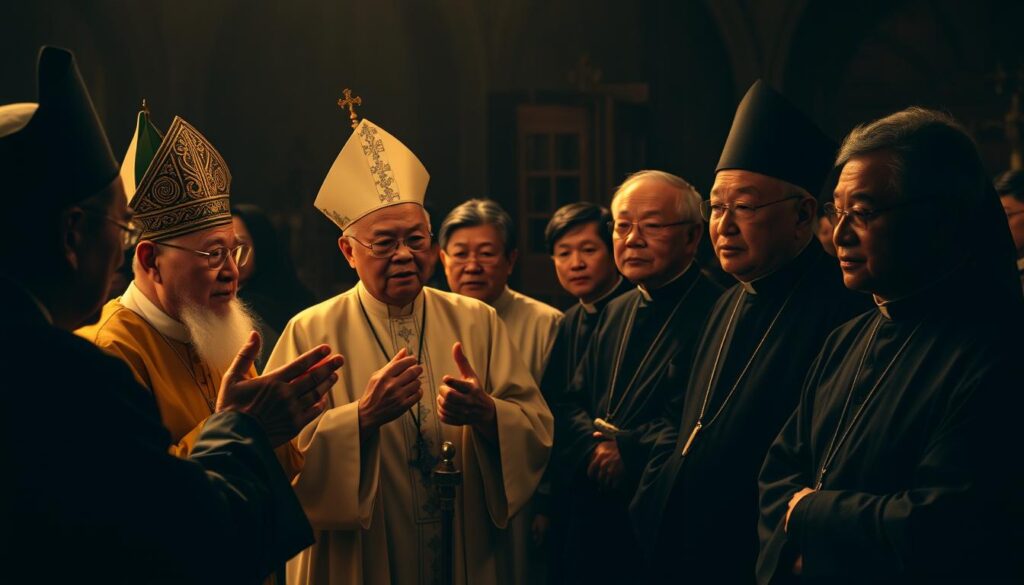
Transition from Foreign Missionaries to Indigenous Clergy
Pope Benedict XV’s 1919 encyclical “Maximum Illud” sparked revolutionary change. It declared:
“Becoming Christian does not imply abandoning loyalty to one’s people.”
This directive empowered theHoly Seeto prioritize training localpriestsover relying solely on foreignmissionaries.
Archbishop Celso Costantini arrived in 1922 as the first apostolic delegate. His bold moves included:
- Promoting Chinese clergy to leadership roles by 1924
- Advocating Chinese-language liturgy over Latin
- Organizing Rome’s first ordination of Chinese bishops in 1926
Papal Initiatives and the Role of Apostolic Delegates
The table below shows key milestones in leadership development:
| Year | Initiative | Impact |
|---|---|---|
| 1919 | “Maximum Illud” encyclical | Launched indigenous clergy training |
| 1926 | Six Chinese bishops ordained | First native hierarchy established |
| 1946 | Cardinal Tien Ken-sin appointed | Local leadership reached highest rank |
By 1946, Chinese clergy comprised nearly 25% of bishops. This strategic shift proved vital when foreign missionaries later faced expulsion. The Holy See‘s commitment to local ordination created lasting infrastructure for spiritual guidance.
Contemporary Perspectives on Catholicism in China
Modern spiritual communities navigate a delicate balance between devotion and state oversight. Two parallel systems coexist: one operating under strict government supervision, the other preserving ancient traditions through hidden networks.
Government Policies, Surveillance, and Religious Freedom
The Chinese authorities recognize only the state-sanctioned Catholic Patriotic Association. This group operates independently from Rome, with leaders appointed by the communist party. Surveillance cameras monitor every corner of approved worship spaces, tracking attendance and activities.
Religious Affairs Bureau officials:
- Approve sermon topics weekly
- Restrict youth participation in services
- Remove crosses from church rooftops
The 2018 agreement between Beijing and the Vatican attempted to bridge divides. Yet tensions persist—police still block church entrances when crowds grow “too large.”
Underground Church vs. State-Sanctioned Church Dynamics
This table shows key differences between the two communities:
| Aspect | State-Sanctioned | Underground |
|---|---|---|
| Leadership | Government-appointed | Papal-recognized |
| Surveillance | Camera-monitored | Secret locations |
| Religious Materials | Censored | Smuggled |
| Youth Programs | Banned | Home-based |
Underground members face harsh penalties but maintain creative resilience. Some priests deliver hour-long homilies to compensate for banned religious education. Foreign worshippers report officials photographing attendees during Mass—a reminder that religion remains tightly controlled.
Impact of Sociopolitical Changes on Religious Life
Political shifts have dramatically reshaped spiritual landscapes across generations. Since 1949, the Chinese Communist Party has implemented policies to assert control over religious institutions, creating deep divisions that persist today.
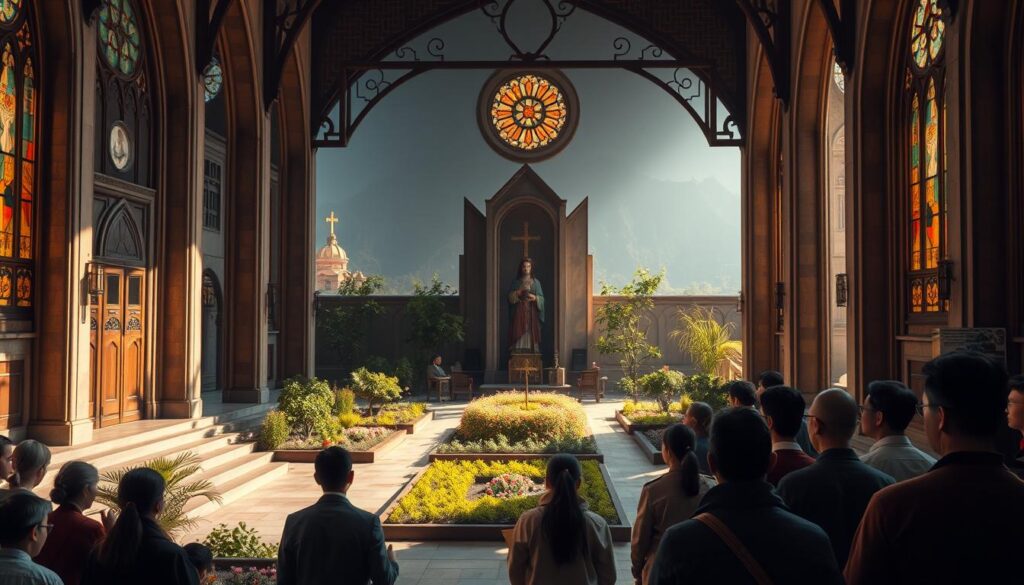
The Influence of the Communist Party on Religious Practices
The 1951 expulsion of Vatican diplomat Archbishop Riberi marked a turning point. Authorities launched the Three Autonomies Movement, demanding clergy sever ties with Rome. This policy targeted the church’s hierarchy, aiming to replace papal authority with state oversight.
By 1955, over 200 clergy faced arrest in coordinated raids. Among them was Bishop Ignatius Kung, imprisoned for rejecting state-mandated independence. These actions revealed a pattern: religious persecution became a tool for political consolidation.
Case Studies: Persecution and Resilience in the Field
Modern examples show evolving tactics against dissent:
- Bishop SU Zhimin vanished in 1997 after criticizing state interference
- Bishop SHI Enxiang, now 102, remains under house arrest since 2001
- Bishop Ma Daqin lost his title in 2012 for leaving the state-sanctioned association
Despite these challenges, underground communities thrive through coded messages and secret gatherings. Over 25 Chinese bishops currently face restrictions, yet their followers maintain rituals in homes and rural hideouts. This resilience demonstrates how faith adapts to survive under intense pressure.
Cultural and Global Influences Shaping the Faith’s Journey
Cultural exchange often sparks unexpected transformations in spiritual practices. Visitors to Beijing’s churches notice something surprising—Santa Claus figurines standing beside traditional nativity scenes. This blend of global symbols reflects how communities adapt traditions while maintaining core beliefs.
Western Encounters and Comparative Reflections
Chinese Catholics creatively reinterpret Western holiday symbols. A worshipper in Wuhan explained: “Frosty the Snowman isn’t just decoration—he represents our joy in celebrating Christ’s birth openly.” This perspective turns commercial icons into meaningful faith expressions.
Government efforts to hide historic churches reveal another layer of adaptation. St. Joseph’s Church in Wangfujing now sits behind towering office blocks—a visual metaphor for ongoing tensions. Yet inside, vibrant services continue, blending ancient rituals with modern touches.
| Global Tradition | Chinese Adaptation | Significance |
|---|---|---|
| Christmas Eve Mass | Elaborate nativity displays with local motifs | Cultural resistance through celebration |
| Church Architecture | Hidden structures with active underground networks | Perseverance amid suppression |
| Religious Symbols | Santa Claus as freedom metaphor | Reclaiming secular icons |
Western observers note unique worship styles that balance doctrine with local realities. One expat described midnight Mass where carols blended with traditional instruments—a soundscape embodying cultural fusion.
These adaptations show how global religious communities maintain unity through diverse expressions. The Chinese Catholic experience demonstrates faith’s power to evolve without losing its essence, creating bridges between worlds.
Future Outlook and Trend Analysis of the Church in China
Global dialogue continues shaping spiritual communities across borders. Recent gatherings like May’s Rome conference highlight this trend, where scholars examined the 1924 Council’s lasting impact. Pope Francis emphasized in his video message: “True growth springs from mutual understanding, not imposed structures.”
Bridging Divides Through Shared Wisdom
Cardinal Parolin’s keynote address stressed the Holy See‘s commitment to peaceful coexistence. The recognition of Bishop Joseph Shen Bin in 2023 shows progress—local leaders now gain papal approval while respecting regional dynamics. Such moves hint at thawing tensions between global institutions and national policies.
Collaborative Horizons Emerging
Three potential growth areas stand out:
- Expanding the 2018 provisional agreement between Rome and Beijing
- Increasing youth engagement through digital ministry tools
- Developing seminary programs blending tradition with cultural context
As these efforts unfold, communities demonstrate remarkable adaptability. The church in China enters a new era where respectful dialogue could redefine ancient practices for modern realities. Through patience and creativity, shared spiritual goals might yet overcome historical divides.
FAQ
How did colonial history shape the Catholic Church’s presence in China?
The Treaty of Nanjing (1842) opened ports to foreign influence, allowing missionaries to expand their work. However, ties to colonial powers later fueled mistrust among local communities and authorities, complicating the faith’s integration.
What role does the Chinese Communist Party play in religious practices today?
The government enforces strict regulations through bodies like the State Administration for Religious Affairs. Worship must align with state policies, and clergy in the state-sanctioned Catholic Patriotic Association are required to reject Vatican authority.
How does the underground Church differ from the state-sanctioned Church?
The underground Church remains loyal to the Holy See, operating outside government control. In contrast, the state-sanctioned Church follows Communist Party directives, including appointing bishops approved by Beijing rather than the Pope.
What was the significance of the 2018 provisional agreement between China and the Vatican?
This deal allowed Pope Francis to recognize seven government-appointed bishops while granting Beijing a role in their selection. Critics argue it risks legitimizing state control, but supporters see it as a step toward unity.
How have indigenous clergy influenced the Church’s growth in China?
After foreign missionaries were expelled in the 1950s, local leaders like Bishop Ignatius Kung Pin-Mei preserved traditions secretly. Today, homegrown clergy navigate dual loyalties to their faith and state demands.
What challenges do Catholics face under China’s religious policies?
Authorities monitor services, restrict youth participation, and demolish unauthorized churches. Recent campaigns, such as replacing crosses with government symbols on buildings, highlight ongoing tensions between faith and policy.
How does Chinese Catholicism compare to other Asian Catholic communities?
Unlike nations like the Philippines or South Korea, China’s Church operates under unique political constraints. Its survival relies on balancing inculturation with resistance to state interference, creating a distinct identity.
Are there signs of reconciliation between the Vatican and Beijing?
While dialogue continues, issues like Taiwan’s diplomatic status and bishop appointments remain hurdles. Pope Francis has prioritized diplomacy, but lasting unity depends on mutual concessions from both sides.