Few stories blend cultural endurance and spiritual devotion like the journey of this faith tradition across the island nation. With just 0.34% of the population identifying as adherents, its impact far outweighs its numbers. Over 1,400 institutions – from schools to hospitals – serve communities nationwide, creating bridges between belief systems.
Foreign workers now form a vibrant part of this spiritual tapestry. Nearly half a million immigrants from places like the Philippines and Vietnam bring new traditions to local parishes. This fusion creates living connections between ancient rituals and modern global movements.
Historical challenges shaped today’s unique landscape. Early missionaries faced fierce resistance, leading to centuries of secret worship practices. Today, their legacy thrives through respected educational centers that rank among the nation’s most prestigious learning environments.
Key Takeaways
- Less than 0.5% of Japanese citizens practice this faith, yet its social influence remains significant
- Educational and charitable organizations serve as primary community touchpoints
- Underground worship traditions evolved into publicly recognized institutions
- Immigrant populations now drive demographic shifts within the religious community
- Church-run schools enjoy exceptional reputation despite small membership numbers
Exploring the Landscape of Catholicism in Japan
Modern Japan offers a fascinating environment for religious communities. While Shinto shrines and Buddhist temples dominate the spiritual scene, the Catholic Church maintains a respected presence through its social contributions. Less than 1% of the population identifies as Christian, yet this minority faith continues shaping Japanese society in meaningful ways.
Context and Contemporary Interest
Public expressions of faith face minimal resistance here compared to many Western nations. Christmas markets glow brightly in December, while Catholic schools attract families seeking strong moral education. Over 60% of students in these institutions come from non-religious households.
Immigration brings fresh energy to parishes. Vietnamese and Filipino communities now account for 40% of Sunday worshippers in urban areas. This blend creates vibrant spaces where traditional rituals meet global traditions.
Key Challenges and Opportunities
Aging congregations and Japan’s shrinking population test every religious group. However, the Church’s legacy in healthcare and elder care positions it as a trusted partner. Many see potential in bridging Japan’s labor shortages with immigrant support programs.
| Challenge | Opportunity | Current Impact |
|---|---|---|
| Declining membership | Immigrant integration | Multilingual Masses offered |
| Aging facilities | Historic reputation | Schools maintain waitlists |
| Limited resources | Social welfare expertise | 15% of daycare centers Church-affiliated |
Cultural openness allows unique dialogues about spirituality. University religion courses frequently feature Catholic speakers, while interfaith projects address modern social issues. This tolerance enables quiet but meaningful growth.
Historical Roots and Milestones
Japan’s spiritual landscape holds stories of remarkable resilience that shaped its religious identity. A pivotal chapter began when St. Francis Xavier stepped onto Kyushu’s shores in 1549. His approach blended respect for local customs with spiritual teachings, sparking rapid growth across social classes.
Missionary Beginnings with St. Francis Xavier
The Jesuit pioneer’s evangelization methods proved revolutionary. Within 40 years, communities flourished to over 300,000 members. This success led to Japan’s first diocese in 1588 – a milestone marking organized missionary efforts.
Local leaders initially welcomed foreign ideas. But shifting political winds soon brought turmoil. By 1587, authorities ordered missionaries to leave, setting the stage for conflict.
The Era of Hidden Christians and Persecution
Brutal crackdowns began in 1597 with 26 martyrs crucified near Nagasaki. Their canonization centuries later honored their sacrifice. Bans intensified until 1614, forcing believers underground for 250 years.
Hidden Christians developed secret practices to survive. They disguised prayers as folk songs and carved symbols into everyday objects. The Shimabara uprising’s violent end in 1638 claimed 40,000 lives but couldn’t erase their faith.
This underground network preserved traditions through oral histories and adapted rituals. Their legacy lives in modern worship styles that blend ancient Catholic teachings with Japanese cultural expressions.
Modern Trends: catholicism in japan in a Changing Society
Japan’s religious landscape is undergoing quiet transformation as global migration patterns reshape local communities. While membership numbers show modest decline, fresh energy flows through parishes adapting to new cultural realities.
Current Statistics and Demographic Shifts
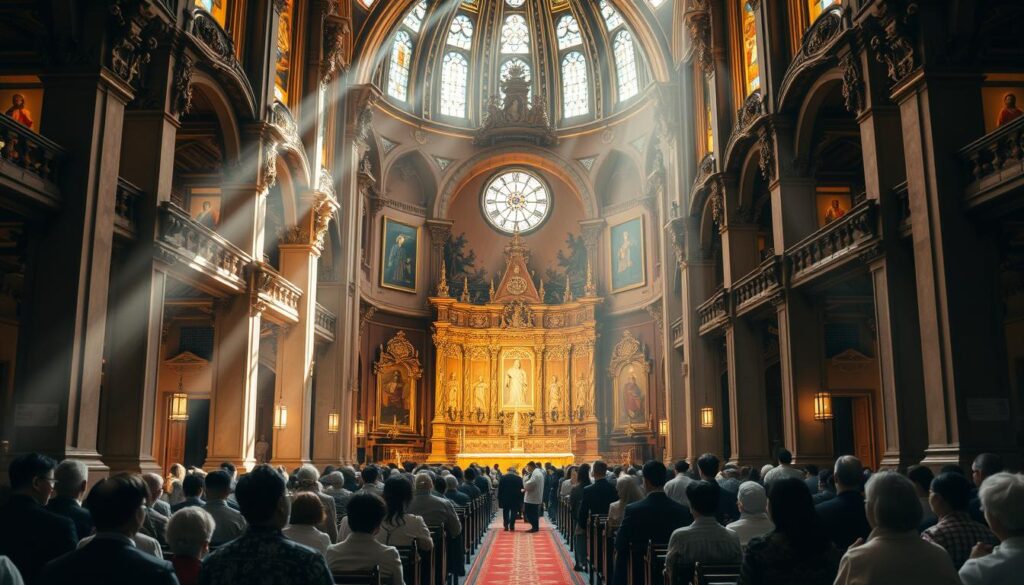
The Catholic Church reports 419,414 members today – 20,000 fewer than a decade ago. Yet three dioceses buck this trend with 3-5% growth. Saitama’s community thrives near Tokyo, while Naha and Nagoya attract young families through innovative outreach.
Foreign believers now form 54% of Sunday worshippers nationwide. Over 520,000 Vietnamese residents – the largest immigrant group – bring vibrant traditions to urban centers. “Our parish gained new life when Vietnamese families joined,” shares a Nagasaki priest. “Their enthusiasm reminds us faith transcends borders.”
Impact of Immigration and Multiculturalism
Rural areas see unexpected growth through international marriages. Filipino women married to local farmers lead prayer circles where churches don’t exist. Their grassroots efforts create spiritual hubs in regions untouched for years.
| Demographic Trend | Opportunity Created | Example |
|---|---|---|
| Vietnamese immigration surge | Youthful parish revitalization | Osaka’s Vietnamese-language catechism classes |
| Filipino-Japanese families | Rural faith networks | Kyushu farm village prayer groups |
| Multilingual worship needs | Global Catholic unity | St. Anselm’s 4-language Mass schedule |
This cultural blending presents both promise and complexity. While multilingual services foster inclusion, they challenge communities to preserve Japanese Catholic identity. The country’s churches now serve as laboratories for intercultural dialogue, testing models that could inspire the global Church in Japan and beyond.
Influence Through Education and the Jesuit Legacy
Education shapes minds and communities in ways few institutions can match. The Catholic Church operates 828 schools nationwide, blending academic rigor with moral development. These centers of learning have become trusted pillars of Japanese society, often serving as first contact points between families and Catholic values.
Catholic Schools and Their Social Contributions
Prestigious institutions like Sophia University attract global talent while nurturing local leaders. Founded in 1913 by German Jesuits, this Tokyo-based university educates 14,000 students from 80+ countries. Its alumni network includes government officials and corporate executives who shape national policies.
Even imperial families recognize their value. Empress Michiko, mother of the current emperor, graduated from Sacred Heart schools. “Our kindergartens often outshine churches in public recognition,” notes Archbishop Kikuchi. This educational focus creates unique opportunities to share faith through excellence.
The Continuing Role of Jesuit Missions
Jesuit priests maintain their 470-year mission with cultural sensitivity. The Society of Jesus runs four elite high schools, a Hiroshima music college, and Sophia University. Though 150 active Jesuits serve nationwide, over half face retirement age – a challenge requiring innovative solutions.
Their approach mirrors St. Francis Xavier’s methods: dialogue over dogma. Through schools blending Catholic traditions with Japanese values, they create spaces where different worldviews enrich each other. This strategy ensures their legacy endures beyond demographic shifts.
| Institution | Impact | Enrollment |
|---|---|---|
| Sophia University | Global leadership training | 14,000+ students |
| Hiroshima Music College | Cultural preservation | 300 musicians trained yearly |
| Jesuit Secondary Schools | Moral education | 4 campuses nationwide |
Cultural Integration and Community Adaptation
Harmony between tradition and innovation defines Japan’s spiritual communities. Local customs reshape global religious practices here, creating worship experiences that honor both cultural identity and sacred rituals. This delicate balance reveals how communities evolve while preserving core values.
Unique Liturgical Practices in Japanese Context
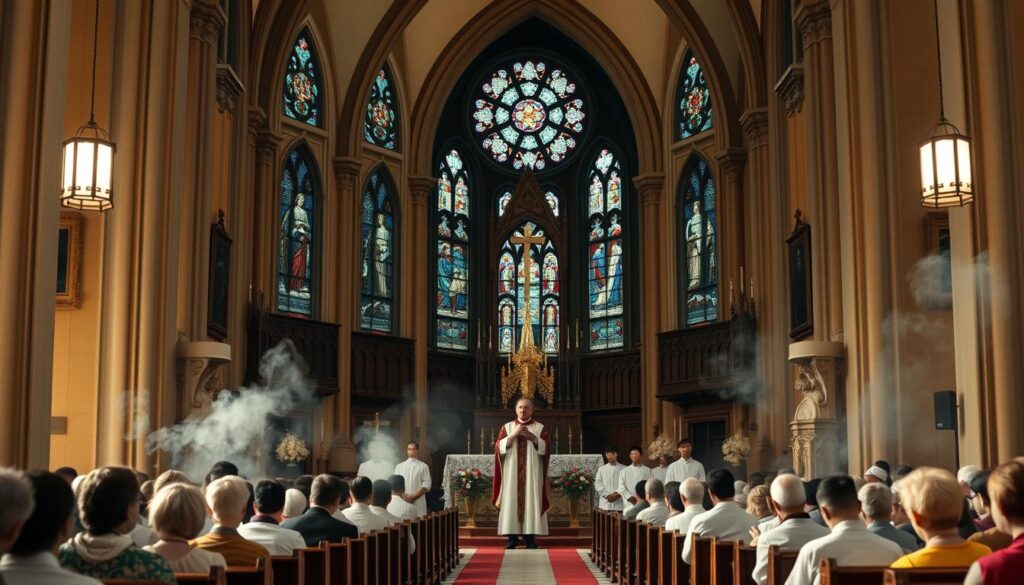
Worship services reflect cultural preferences for restraint and order. Unlike Western congregations, Japanese Catholic communities avoid physical contact during prayers. The Orans posture – raised hands during the Our Father – remains exclusive to priests, maintaining clear roles in sacred spaces.
Silent reverence replaces hand-holding traditions. This approach aligns with local norms about public behavior while deepening spiritual focus. “Our stillness speaks volumes,” shares a Tokyo parishioner. “It helps us connect without distractions.”
Innovative Approaches to Faith Expression
Leadership gaps due to frequent priest transfers empower laypeople. Volunteers manage parish operations, blending administrative skills with faith commitment. Some churches introduce visitors during Mass – a practice sparking debate about worship priorities.
Multilingual services address diverse congregations. Priests often use visual aids and simple language to bridge cultural divides. Rural areas see creative solutions like smartphone prayer groups, keeping scattered communities connected.
Reflections on Liturgical Practices and Community Challenges
Communities across the nation face delicate balancing acts in worship traditions. While global religious trends influence local practices, cultural expectations shape how faith appears in daily life. This creates unique tensions between preserving sacred rituals and adapting to modern realities.
Traditional Roots Meet Modern Pressures
Weekly Mass attendance hovers near 40% in many parishes, reflecting broader societal shifts. Some priests adopt theatrical styles to engage crowds, sparking debates about reverence versus relevance. “We want people to feel welcomed, not entertained,” shares a Kyoto parish leader.
Homilies frequently address social issues like climate change. While these topics matter, some members crave deeper teachings on salvation. This mirrors global trends where religion intersects with contemporary concerns.
| Liturgical Challenge | Cultural Factor | Community Response |
|---|---|---|
| Low Mass participation | Less social expectation for weekly worship | Flexible volunteer-led prayer groups |
| Access to Latin Mass | Urban-rural resource divide | Tokyo-only traditional services |
| Doctrinal teaching gaps | Focus on harmony over confrontation | Small group catechism sessions |
Unique local factors shape these dynamics. Unlike other countries, bishops rarely discuss abortion policies publicly. This quiet approach respects cultural norms but limits moral guidance opportunities.
Visiting missionaries often note the careful balance communities strike. As one Brazilian priest observed during his three-year assignment: “The challenge lies in honoring ancient traditions while speaking to today’s needs.” These ongoing conversations will shape how worship evolves in coming years.
Conclusion
Centuries after secret worship practices sustained their faith, Japan’s Catholic Church now champions unity in diversity. Pope John Paul II set this tone in 1981, calling for peace in Hiroshima. Nearly four decades later, Pope Francis echoed this message, urging the country to “protect all life” during his historic 2019 visit.
These papal journeys reinforced the Church’s mission as outlined by Japanese bishops: building bridges between cultures. “Our strength lies in welcoming others,” emphasizes Archbishop Kikuchi. Today, parishes thrive as spaces where Vietnamese families pray beside descendants of martyrs – a living testament to resilience.
Challenges persist, from aging populations to shifting social values. Yet the global world watches as this community models coexistence. Through schools nurturing tomorrow’s leaders and multilingual Masses uniting diverse cities, Japan’s spiritual tapestry grows richer – stitch by stitch, century by century.
FAQ
How did the Catholic faith first arrive in Japan?
Missionaries like St. Francis Xavier brought Christianity to Japan in 1549. His work with the Jesuit order laid the foundation for early communities, though later persecution forced many to practice secretly as “Hidden Christians.”
What challenges do believers face in Japanese society today?
Catholics make up less than 1% of the population, so evangelization remains difficult. Archbishop Kikuchi has emphasized adapting traditions to resonate with local culture while addressing aging congregations and priest shortages.
How have Catholic schools influenced Japan?
Institutions like Sophia University, founded by Jesuits, blend academic excellence with ethical values. These schools are respected for fostering social responsibility and intercultural dialogue, even among non-Christian students.
Are there unique worship practices in Japanese parishes?
Yes! Some communities incorporate traditional music or meditative silence into Mass. Others host tea ceremonies or seasonal festivals to connect faith with Japan’s cultural identity.
How has immigration affected the Church?
Filipino and Latin American immigrants revitalize parishes, adding multilingual services and vibrant celebrations. This diversity helps counter declining membership and strengthens global connections.
Why did Pope Francis’s 2019 visit matter?
His trip honored martyrs like St. Paul Miki and encouraged dialogue on peace and environmental justice. It also spotlighted Japan’s small but resilient Catholic community on the world stage.
What legacy did the “Hidden Christians” leave behind?
For over 200 years, these groups preserved prayers and rituals without priests. Their endurance, recognized as a UNESCO World Heritage, inspires modern efforts to keep faith alive amid secular pressures.