Welcome to a vibrant exploration of faith and language! This guide uncovers how religious traditions shape societies through art, language, and shared values. You’ll discover how centuries-old practices continue to influence modern life across Spanish-speaking regions.
Known as “catolicismo” in Spanish, this global belief system connects over 32 million members in Spain alone. The Spanish Episcopal Conference oversees 70 dioceses, blending ancient rituals with contemporary spiritual life. But this journey goes beyond church structures – it’s about understanding the living traditions that color daily experiences.
Why focus on Spain? For over a thousand years, this nation has perfected the art of merging faith with culture. From Santiago’s pilgrimage routes to Valencia’s fire festivals, spiritual expressions become community celebrations. You’ll learn not just translations, but the stories behind sacred spaces and seasonal traditions.
Our friendly approach makes complex ideas simple. Whether you’re studying language or exploring heritage, we’ll break down terms like “parroquia” (parish) or “adviento” (Advent) while revealing their cultural weight. Ready to see how faith shaped cathedrals and inspired poets? Let’s begin!
Key Takeaways
- Spanish religious terms carry deep historical meaning beyond direct translations
- Spain’s 70 dioceses showcase unique blends of medieval and modern practices
- Major festivals often combine spiritual significance with local traditions
- Understanding church vocabulary enhances cultural appreciation
- Architectural wonders like cathedrals tell stories of evolving faith
Examining “catholicism in spanish”: Definitions and Insights
Language shapes faith experiences in profound ways. Let’s unpack essential terms and sounds that bridge spiritual concepts across cultures. This practical guide helps you speak about religious ideas with confidence.
Glossary of Key Terms and Translations
The core term “catolicismo” serves as your anchor. This masculine noun covers everything from sacraments to church leadership. Build your word list with related phrases:
- Católico (Catholic) – Adjective describing people or traditions
- Iglesia católica – Official name for the Catholic Church
- Fe católica – Specific beliefs distinguishing this faith
Understanding Pronunciations and Usage
Master these sounds to avoid confusion. English speakers say “kuh-THAH-luh-siz-um” (/kəˈθɒləˌsɪzəm/), while Spanish pronunciation flows as “kah-toh-lee-SEEZ-moh.” Remember the grammar rules:
- Always use el catolicismo – The definite article stays
- No plural form exists for this concept
- Combine with location words: Catolicismo europeo (European Catholicism)
Regional flavors add spice to conversations. In Mexico, you might hear “la doctrina católica” during debates, while Spaniards reference “tradiciones católicas” in historical contexts. Practice with sample sentences:
“El catolicismo influyó en el arte colonial” (Catholicism influenced colonial art)
Historical Roots and Evolution of Catholic Practices in Spain
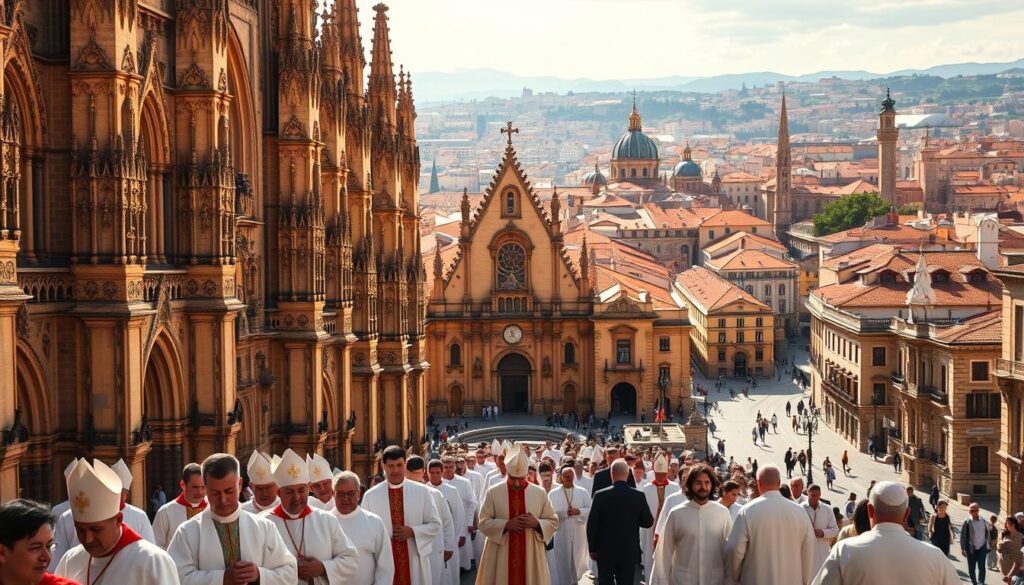
Spain’s spiritual landscape grew from ancient seeds. Early Christian communities possibly formed during Roman rule, with traditions strengthening under Visigothic kings. These rulers shifted from Arian beliefs to Roman Catholicism in 589 AD, weaving faith into law and culture.
Medieval Battles and Religious Identity
The 711 Muslim invasion sparked eight centuries of cultural clashes. Northern Christian kingdoms developed unique rituals during the Reconquista. By 1492, Catholic monarchs unified the peninsula, using religion to build national pride.
Church power peaked with the Spanish Inquisition. This system enforced orthodoxy through dramatic trials. Meanwhile, missionaries carried Roman Catholic practices worldwide, making Spain a global religious influencer.
From Dictatorship to Democracy
The 20th century brought dramatic changes. During the Civil War, the Roman Catholic Church backed Franco’s regime. After Vatican II reforms, tensions grew between conservative leaders and progressive clergy.
Modern Spain balances tradition with secular values. The 1978 Constitution ended state religion status while preserving the church’s cultural role. Today, cathedrals stand beside modern institutions, showing faith’s evolving place in society.
“Our history lives in every procession and prayer,” notes Madrid historian Elena Gómez. “But our future requires understanding this complex legacy.”
Cultural Traditions, Architectural Heritage, and Spiritual Pilgrimages
Spain’s streets and stones whisper stories of devotion. From candlelit processions to mountain-top monasteries, faith becomes tangible through time-honored traditions and breathtaking buildings.
Festivals, Processions, and Pilgrimages
Holy Week transforms cities into open-air theaters. In Seville, 58 processions parade pasos (religious floats) dating to the 1500s. Hooded nazarenos carry these treasures while crowds chant saetas – raw flamenco prayers.
The Camino de Santiago remains Europe’s ultimate spiritual hike. Over 100,000 modern pilgrims walk ancient routes yearly. Many seek meaning through blistered feet and starry nights at rustic hostels.
Iconic Cathedrals and Sacred Monuments
Spain’s skyline spikes with stone masterpieces. Toledo Cathedral showcases Gothic grandeur with its 15th-century altarpiece – a golden Bible in wood. Barcelona’s Sagrada Família reimagines tradition with rainbow-stained glass and melting spires.
| Architectural Wonder | Style | Unique Feature |
|---|---|---|
| Santiago Cathedral | Romanesque | Botafumeiro incense burner |
| Seville Cathedral | Gothic | Christopher Columbus’ tomb |
| Sagrada Família | Modernist | 18 spiral towers |
| Burgos Cathedral | French Gothic | Star-vaulted ceilings |
Monasteries like Montserrat keep centuries-old chants alive. Visitors touch the Black Madonna’s orb – a tradition linking modern hands to medieval hopes. These sites aren’t museums but living bridges between past and present.
Conclusion
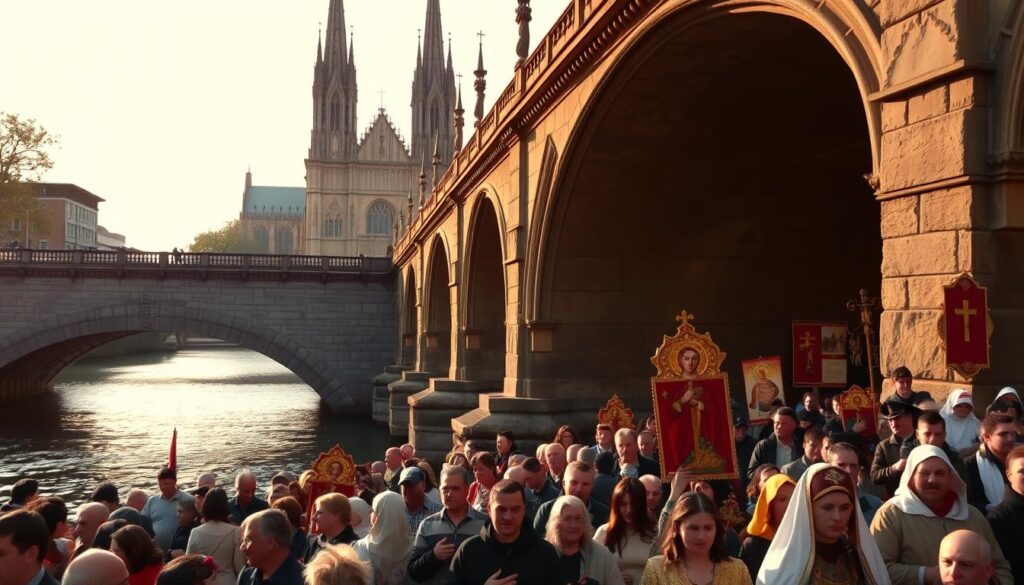
Our journey through Spain’s spiritual landscape reveals a fascinating cultural tapestry. While 92% of citizens remain baptized members, daily practice tells a dynamic story – only 19% attend weekly services. This contrast highlights how ancient traditions adapt to modern life.
Language learners gain unexpected rewards here. Mastering terms like “adviento” or “parroquia” unlocks deeper connections with art, literature, and local conversations. Even non-religious travelers benefit when recognizing cathedral symbolism or festival origins.
Spain’s 70 dioceses showcase this blend of past and present. Though priest numbers have dropped by 21% since 1975, pilgrimage routes like the Camino de Santiago attract record crowds. Major festivals thrive as living history lessons, blending sacred roots with community pride.
Understanding these layers makes every Spanish interaction richer. Whether discussing Gaudí’s architecture or Seville’s processions, you’ll spot cultural echoes of faith. This knowledge becomes a bridge – connecting curious minds to shared stories across generations and borders.
Keep exploring how language carries heritage. Each phrase learned honors centuries of tradition while building meaningful dialogues today. That’s the true power of cultural fluency.
FAQ
How has Spanish culture shaped Catholic traditions globally?
Spanish culture deeply influenced global Catholic practices through missionary work, art, and festivals like Semana Santa. Its blend of indigenous and European customs created unique rituals still celebrated worldwide.
What role did the Reconquista play in Spain’s religious identity?
The Reconquista (711–1492) unified Christian kingdoms, strengthening ties between the Roman Catholic Church and Spanish monarchy. This period solidified Spain’s identity as a Catholic nation, shaping its laws and cultural values.
Are there specific Spanish terms essential for understanding Catholic practices?
Key terms include “misa” (Mass), “peregrinación” (pilgrimage), and “advocación mariana” (Marian devotion). Proper pronunciation, like “ka-to-lee-sees-mo” for catolicismo, helps engage authentically with Spanish-speaking communities.
Which Spanish landmarks symbolize Catholic heritage?
Sites like Barcelona’s Sagrada Família, Santiago de Compostela Cathedral, and Seville’s Giralda Tower reflect centuries of architectural devotion. These monuments attract millions seeking spiritual and historical connections.
How do modern Spanish Catholics balance tradition and contemporary life?
Many blend ancient customs, like pilgrimages to El Camino de Santiago, with modern social activism. The Church also addresses current issues while preserving rituals such as Easter processions and local patron saint festivals.