From colonial roots to modern-day influence, the Catholic Church has played a transformative role in shaping America’s social fabric. With over 72 million members nationwide, this faith community represents nearly a quarter of the population—a testament to its enduring presence across generations. What began as a small network of believers now stands as the country’s largest single Christian denomination, reflecting centuries of growth and adaptation.
The story of this religious tradition is deeply tied to waves of immigrants who brought vibrant traditions and built thriving communities. Their legacy lives on through iconic institutions—schools, hospitals, and universities—that remain pillars of American life today. Over 16,000 congregations now operate under the guidance of regional dioceses and the United States Conference of Catholic Bishops, which helps shape both spiritual and civic priorities.
Yet challenges persist in the 21st century. Declining participation rates and debates over social issues test the church’s ability to connect with younger generations. Despite these hurdles, its impact on education, healthcare, and justice initiatives continues to resonate, creating a dynamic relationship between faith and national identity that evolves with each era.
Key Takeaways
- Over 72 million Americans identify with this faith, making it the nation’s second-largest religious group
- Historical growth spans from colonial-era minorities to today’s extensive network of 16,000+ congregations
- Immigrant communities laid the foundation for enduring educational and healthcare institutions
- Governance occurs through 200 dioceses coordinated by the national bishops’ conference
- Modern challenges include addressing attendance trends and contemporary social concerns
- Catholic organizations remain vital contributors to public infrastructure and civic life
Introduction to Catholicism in the US
One in four Americans today identifies with this faith tradition, according to a 2020 Gallup poll. This vibrant community blends ancient rituals with modern American values
You’ll discover worship services in English, Spanish, French, and even Latin—a nod to both immigrant roots and global connections. From Irish neighborhoods in Boston to Mexican-American parishes in Texas, regional traditions showcase how local cultures enrich shared beliefs.
“Our strength lies in unity through diversity,” observes a diocesan leader. “The same Mass connects farmworkers in California and lawyers in Manhattan.”
The table below highlights key demographic features:
| Ethnic Group | Percentage of Catholic Population | Notable Traditions |
|---|---|---|
| Hispanic/Latino | 34% | Our Lady of Guadalupe celebrations |
| European descent | 47% | St. Patrick’s Day parades |
| Asian/Pacific Islander | 6% | Filipino Simbang Gabi |
| African American | 4% | Gospel Masses |
Over 200 dioceses coordinate activities nationwide, while Eastern Catholic Churches maintain distinct liturgies. The Basilica in Washington D.C.—North America’s largest Catholic church—symbolizes this faith’s enduring presence across the country.
From food festivals to college scholarships, Catholic institutions touch daily life in countless ways. This adaptability helps explain why 72 million people still claim this heritage despite modern challenges.
Historical Overview of Catholicism in America
Long before the Declaration of Independence, spiritual pioneers planted seeds of faith across the continent. Spanish and French explorers built the first chapels, blending European traditions with local cultures.
Colonial Foundations and Early Practices
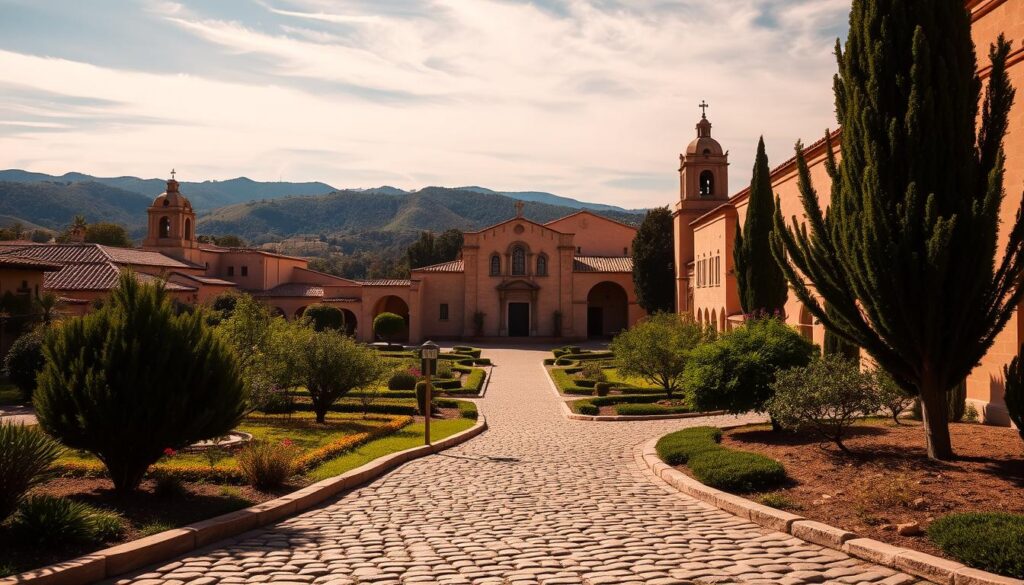
Dominican friars celebrated the first Catholic Mass on U.S. soil in 1526—83 years before Jamestown’s founding. San Miguel Mission in Santa Fe still holds services today, making it the nation’s oldest active parish.
Missionaries transformed landscapes from Florida to California. They taught farming techniques while establishing 21 permanent settlements by 1650. French Catholics left their mark too, designing cities like New Orleans with central church squares.
Impact of the American Revolution
Only 35,000 Catholics lived in the colonies during the 1770s—yet their contributions shaped history. Charles Carroll risked his fortune signing revolutionary documents, while Commodore John Barry became the Navy’s “Father.”
The war’s outcome brought unexpected benefits. Constitutional religious freedoms let Catholics build schools and hospitals openly. By 1800, Baltimore’s cathedral symbolized their growing acceptance in the young nation.
The Early Catholic Experience in the Thirteen Colonies
Colonial America’s religious landscape presented unique opportunities and obstacles for early believers. While most colonies enforced Protestant dominance, two regions became safe havens—Maryland and Pennsylvania.
Sanctuaries of Faith: Maryland’s Bold Experiment
Maryland’s story began with Cecil Calvert, a Catholic nobleman who established North America’s first religious tolerance law in 1649. His Maryland Toleration Act protected Trinitarian Christians—a radical concept when Puritan colonies punished heresy.
By 1785, over 15,800 believers called Maryland home. Wealthy families like the Carrolls built private chapels when public churches faced restrictions. Charles Carroll, later a Declaration of Independence signer, managed vast estates while secretly supporting clergy.
When Fear Overcame Freedom
Other colonies treated Catholics with suspicion. New York’s 1,500 believers faced test oaths barring them from voting or holding office. A Philadelphia printer once warned: “Papist plots threaten our liberties!”
| Colony | Catholic Population (1785) | Key Figures |
|---|---|---|
| Maryland | 15,800 | Charles Carroll |
| Pennsylvania | 7,000 | William Penn |
| New York | 1,500 | St. Peter’s Church founders |
“We worshipped in attics and barns,” wrote a Jesuit missionary. “Yet our numbers grew—like wheat springing from frozen ground.”
Only 25 priests served all thirteen colonies. They traveled disguised as merchants, celebrating Mass in homes. Despite these struggles, these communities planted seeds for future churches that would reshape the nation’s spiritual map.
Catholic Church Structure and Dioceses in the United States
The framework connecting America’s Catholic communities combines centuries-old traditions with modern organizational strategies. This system stretches from neighborhood parishes to national leadership, creating a network that supports over 70 million believers.
From Carroll’s Vision to Modern Networks
John Carroll’s 1789 appointment as Baltimore’s bishop marked the start of formal church governance. His single diocese has multiplied into 200 regional divisions today. Each operates like a spiritual hub, managing parishes that average 3,000 members.
| Region | Dioceses | Key Cities |
|---|---|---|
| Northeast | 45 | New York, Boston |
| Midwest | 55 | Chicago, St. Louis |
| South | 60 | Houston, Miami |
| West | 40 | Los Angeles, Denver |
National Coordination, Local Leadership
The United States Conference of Catholic Bishops helps dioceses collaborate on shared goals. President Timothy Broglio notes: “Our structure allows both local creativity and national unity.” Bishops meet annually to address issues like education reforms and community outreach.
While parishes remain grassroots centers for worship, dioceses handle larger projects. Recent years have seen mergers in areas with priest shortages—12% of parishes consolidated since 2010. Yet new immigrant communities spur diocese expansions in the Southwest and South.
Influence of Immigrant Communities and Ethnic Heritage
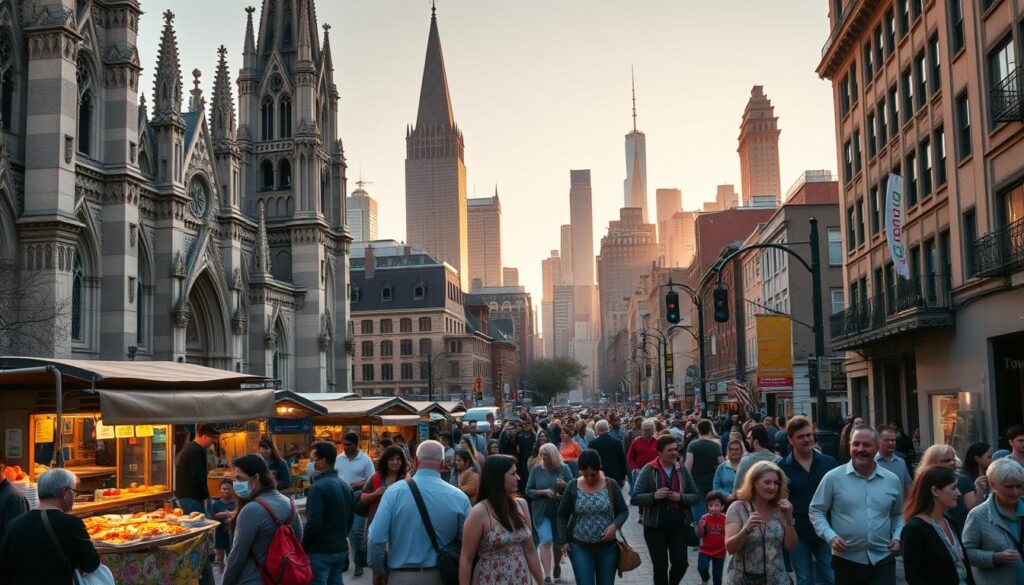
America’s religious landscape transformed dramatically as waves of newcomers reshaped Catholic identity. The 1840s Irish potato famine sparked a pivotal shift—over 1 million arrived by 1850, tripling the catholic population in three decades. Their legacy? A network of schools and labor unions that lifted communities nationwide.
German settlers brought Old World traditions to industrial hubs. Milwaukee’s “Holyland” district still features churches with spires rivaling Bavarian cathedrals. One immigrant’s diary reveals: “We sang hymns in our tongue while building America’s railroads.”
“We built more than churches—we built a home,” remarked an Irish priest in New York’s Five Points neighborhood.
Later groups added vibrant threads to this tapestry. By 1900, Italian festivals filled New York streets with saints’ processions, while Polish parishes in Chicago showcased golden-domed architecture. These communities often clashed over resources—German and Irish leaders initially resisted sharing power with southern European arrivals.
Today’s story continues with Hispanic families revitalizing urban parishes. Their devotion to traditions like Las Posadas keeps the faith dynamic, proving immigration remains central to the church’s evolution.
Cultural Contributions and Catholic Traditions
America’s map tells a story of faith through city names and campus spires. Spanish missionaries and French settlers left marks that shape communities from coast to coast, while religious orders built schools that became national treasures.
Spanish Missions and French Influences
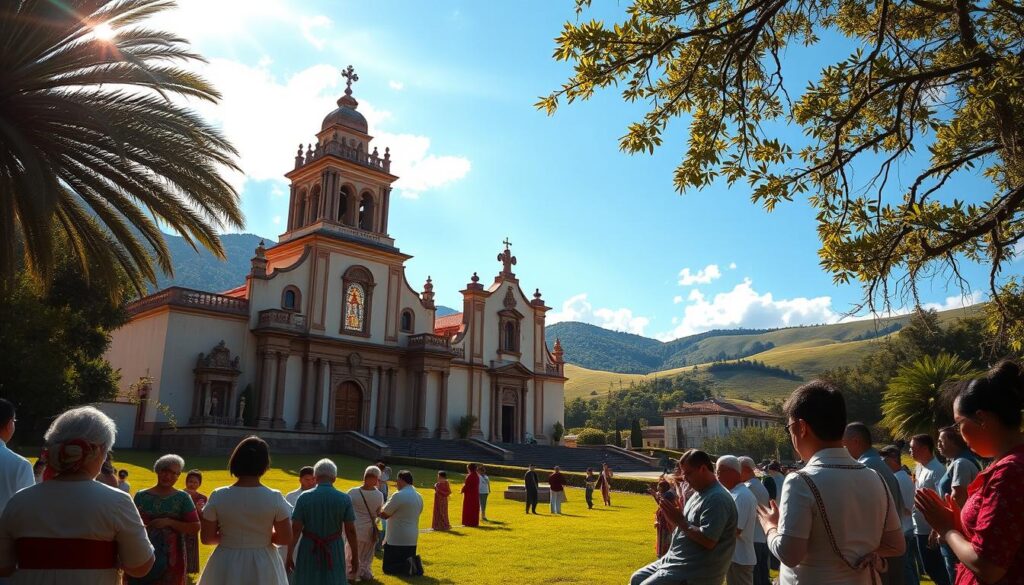
Drive through California, and you’ll pass cities bearing saints’ names—Los Angeles (The Angels) and San Francisco (St. Francis). Franciscan missionaries led by Junípero Serra established 21 coastal missions in the 1700s. These outposts taught farming methods and introduced adobe architecture still admired today.
French Catholics shaped the Midwest and South differently. St. Louis’s Cathedral Basilica echoes Parisian design, while New Orleans’ Catholic roots birthed Mardi Gras traditions. A historian notes: “They blended piety with practicality—churches doubled as trading posts.”
Legacy of Catholic Educational Institutions
Jesuit priests launched America’s first Catholic college—Georgetown University—in 1789. Their model combined philosophy classes with ethics training, creating leaders like Supreme Court justices and Nobel laureates. Today, over 200 Catholic colleges operate nationwide.
| Institution | Founded | Notable Alumni |
|---|---|---|
| Georgetown University | 1789 | Bill Clinton |
| University of Notre Dame | 1842 | Condoleezza Rice |
| Boston College | 1863 | John Kerry |
Elementary and high schools followed, with 6,000+ institutions currently serving 1.6 million students. New York’s Regis High School, founded in 1914, still offers free Jesuit education to gifted teens. These schools prioritize service, with 85% requiring community volunteer hours.
Key Figures in American Catholic History
Visionary leaders have shaped America’s religious landscape through bold actions and enduring legacies. John Carroll, the nation’s first Catholic bishop, laid foundations in 1789 that still support communities today. His work creating Georgetown University blended faith with education—a model followed nationwide.
Charles Carroll’s signature on the Declaration of Independence proved devotion to country and creed could coexist. As the only Catholic signer, this wealthy Marylander broke barriers during revolutionary times. His cousin John later built church structures still used by American bishops.
The 20th century brought new milestones. John F. Kennedy’s 1960 election as the first Catholic president silenced doubts about political acceptance. Meanwhile, Cardinal James Gibbons became a bridge between Rome and growing immigrant populations.
Archbishop John Ireland championed integration, urging English-language education despite opposition. These pioneers show how Catholic leaders balanced tradition with progress—forging paths that continue inspiring the faithful across the United States.
FAQ
How did the American Revolution impact Catholic communities?
The American Revolution boosted religious freedom, allowing Catholics to practice openly. Figures like Charles Carroll, a signer of the Declaration of Independence, helped reduce anti-Catholic bias and integrate the faith into the new nation.
Where did early Catholic communities thrive in the Thirteen Colonies?
Maryland and Pennsylvania became hubs for early Catholic settlers. Maryland’s 1649 Toleration Act protected religious minorities, while Pennsylvania’s Quaker-led tolerance attracted diverse groups, including Catholics.
What role does the USCCB play in the Catholic Church?
The United States Conference of Catholic Bishops (USCCB) guides doctrine, social justice efforts, and national policies. It unites dioceses under shared goals like education, immigration reform, and ethical healthcare practices.
How did immigrant groups shape American Catholicism?
Irish, Italian, German, and Hispanic immigrants enriched traditions, festivals, and parish life. They built schools, hospitals, and charities, blending cultural heritage with Catholic teachings to address urban poverty and labor rights.
What is the legacy of Catholic educational institutions?
Schools like Georgetown University (1789) and networks like Notre Dame emphasized academic excellence and moral formation. Parochial schools also provided accessible education, especially for immigrant families.
Who were key figures in early American Catholic history?
John Carroll, the first U.S. bishop, founded Georgetown and organized dioceses. St. Elizabeth Ann Seton pioneered Catholic schools, while Cesar Chavez later merged faith with labor activism.
How did anti-Catholic sentiment affect early believers?
Colonial-era laws barred Catholics from voting or holding office. Prejudice peaked with the 19th-century “Know-Nothing” movement, which falsely accused Catholics of disloyalty to America.
What cultural influences did Spanish missions leave?
Spanish missions in California and the Southwest introduced Catholicism to Indigenous communities. They shaped regional architecture, feast days like Our Lady of Guadalupe, and agricultural practices.