Exploring the roots of one of America’s most influential faith traditions reveals a story of perseverance and adaptation. From humble beginnings in colonial settlements to shaping modern society, Catholic communities have grown into a vibrant force. Today, nearly 1 in 4 Americans identifies with this faith, reflecting its enduring presence.
Early followers faced challenges, yet their dedication laid foundations for institutions still thriving today. Schools, hospitals, and social programs emerged as cornerstones of community support. Waves of immigrants from Europe and Latin America later infused new traditions, creating a diverse spiritual tapestry.
The Church’s role extends beyond worship. It has influenced debates on education reform, healthcare access, and civil rights. While membership numbers have shifted in recent decades, the legacy remains deeply embedded in cultural values and public life.
Key Takeaways
- Approximately 19-25% of Americans identify with this faith tradition today
- Immigration patterns significantly shaped community growth and cultural practices
- Catholic institutions helped build America’s education and healthcare systems
- Early practitioners overcame persecution to establish lasting influence
- Recent surveys show changing membership trends within modern congregations
Historical Roots and Colonial Beginnings
Colonial America’s religious tapestry was woven with threads of Catholic tradition from multiple European powers. While Protestant groups dominated much of the Eastern seaboard, diverse faith communities quietly took root across the continent.
Seeds of Faith in New Worlds
Maryland emerged as a bold experiment in 1634. Founded by Lord Baltimore, it became a rare safe haven for English Catholics escaping persecution. Nearly a century later, Pennsylvania surprised many by welcoming Catholic settlers despite its Quaker origins.
Spanish missionaries left an even earlier mark. They established San Miguel Mission in 1610 – now recognized as the oldest standing church in the country. French explorers meanwhile built vibrant communities along strategic waterways, blending European traditions with frontier life.
Cultural Crossroads
Three distinct colonial approaches shaped early religious landscapes:
| Colony | Founder | Key Contribution |
|---|---|---|
| Maryland | Lord Baltimore | First English Catholic refuge |
| Spanish Missions | Franciscan friars | Oldest continuous parishes |
| French Territories | Explorers & traders | Mississippi River communities |
By 1785, only 25 priests served 25,000 faithful nationwide. This scarcity made lay leadership crucial. Colonial Catholics navigated strict laws but planted institutions that would flourish after the American Revolution.
Catholic Pioneers and Founding Figures
Visionary leaders emerged as America transitioned from colonies to nationhood, blending spiritual guidance with civic responsibility. Two members of the Carroll family stood at this crossroads, shaping both religious and political landscapes.
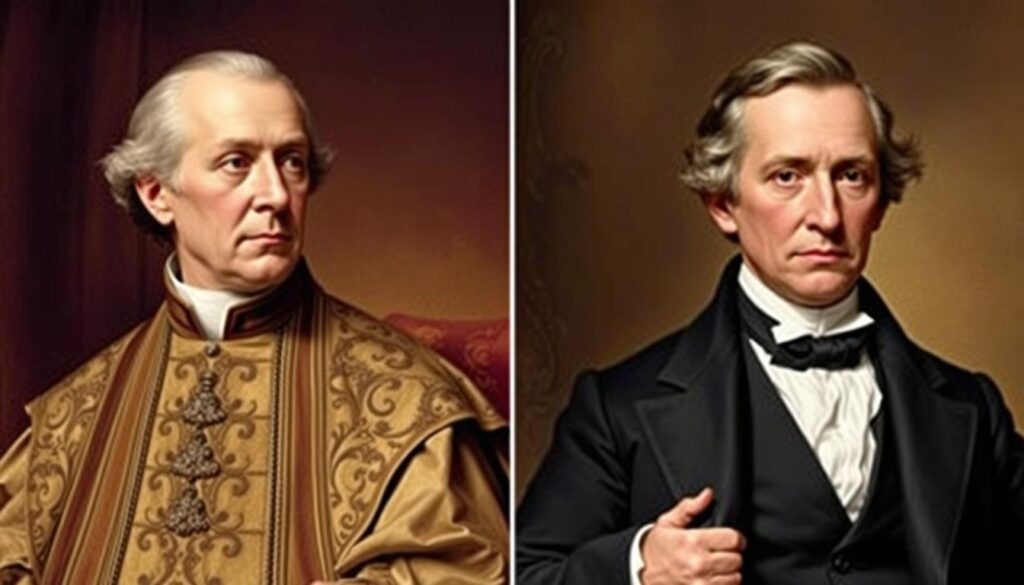
Architect of American Catholicism
John Carroll revolutionized religious life after the Revolution. Appointed as Prefect Apostolic in 1784, he became the first leader of Catholic communities across the new nation. His crowning achievement? Founding Georgetown University in 1789 – still thriving as America’s oldest Catholic university.
When Pope Pius VI named him the first American bishop in 1789, Carroll’s diocese stretched from Georgia to Maine. He championed education, declaring “Knowledge and piety must grow together” – a philosophy still guiding Catholic institutions.
Patriot With a Pen
Across the political arena, Charles Carroll made history as the sole Catholic signer of the Declaration of Independence. Owning 60,000 acres, he leveraged his wealth to fund revolutionary causes. His famous quip – “We’ve crossed the Rubicon” – captured the revolution’s irreversible momentum.
The Carroll legacy extended through the Constitutional Convention. Two Catholic delegates – Daniel Carroll and Thomas Fitzsimons – helped draft governing principles protecting religious freedom. Their work laid groundwork for the First Amendment’s guarantees.
Expansion Through Immigration and 19th Century Growth
America’s cities transformed into spiritual hubs during the 1800s as ships disgorged weary travelers at Eastern ports. Between crowded tenements and factory jobs, these newcomers built something extraordinary – a religious network that would redefine urban landscapes.
Immigrant Waves: Irish, German, and Beyond
The 1840s brought desperation and hope. Ireland’s potato famine pushed over a million starving families toward New York harbor. Simultaneously, German Catholics fled political chaos, carrying their traditions to Midwest cities like Cincinnati.
By 1850, these groups formed the largest Christian denomination nationwide. The numbers stunned observers – seven million faithful by 1890, triple the figure from thirty years prior. Ethnic parishes became lifelines, offering native-language services and cultural solidarity.
| Immigrant Group | Peak Arrival | Cultural Legacy |
|---|---|---|
| Irish | 1845-1855 | Urban parish networks |
| German | 1840s-1880s | Liturgical societies |
| Italian/Polish | Post-1890 | Festival traditions |
Later arrivals from Italy and Poland added new flavors to this mix. Chicago’s Holy Trinity parish became Polonia’s heart, while New York’s Little Italy buzzed with feast-day processions. Remarkably, nearly 700,000 Americans chose to join the Catholic Church voluntarily during this century.
This immigrant surge didn’t just fill pews – it reshaped how communities organized. From soup kitchens to parochial schools, the church became a cornerstone of upward mobility. The foundations laid here still support diverse congregations today.
The Role of Catholic Churches in American Communities
Steeples reaching toward the sky marked more than sacred spaces – they symbolized community lifelines. For generations, these institutions have acted as neighborhood hearts, pumping vitality into cities and towns through practical compassion.
Community Outreach and Social Services
Walk into any parish today, and you’ll find food pantries humming alongside prayer groups. Over 16,000 congregations nationwide operate like Swiss Army knives of support. They offer:
| Service | Impact | Year Established |
|---|---|---|
| Parochial Schools | Educated 1.6M students (2023) | 1840s |
| Hospital Systems | 1 in 7 US patients served | 1820s |
| Immigrant Centers | 500+ language programs | 1890s |
New arrivals in the 1900s often found their first friends at church basements. “We didn’t just save souls – we saved families,” remarked a 1920s Brooklyn priest. Volunteers taught English while connecting workers to jobs.
This legacy of social justice continues today. Many parishes now host:
- Free medical clinics open weekends
- After-school STEM programs
- Disaster response teams
From rebuilding after hurricanes to stocking neighborhood fridges, these efforts show faith in action. As one deacon put it: “Our doors open outward.”
Architectural and Cultural Landmarks
From coast to coast, stone spires and golden domes rise as testaments to faith and cultural identity. These structures blend artistic vision with spiritual purpose, creating spaces that inspire both devotion and wonder.
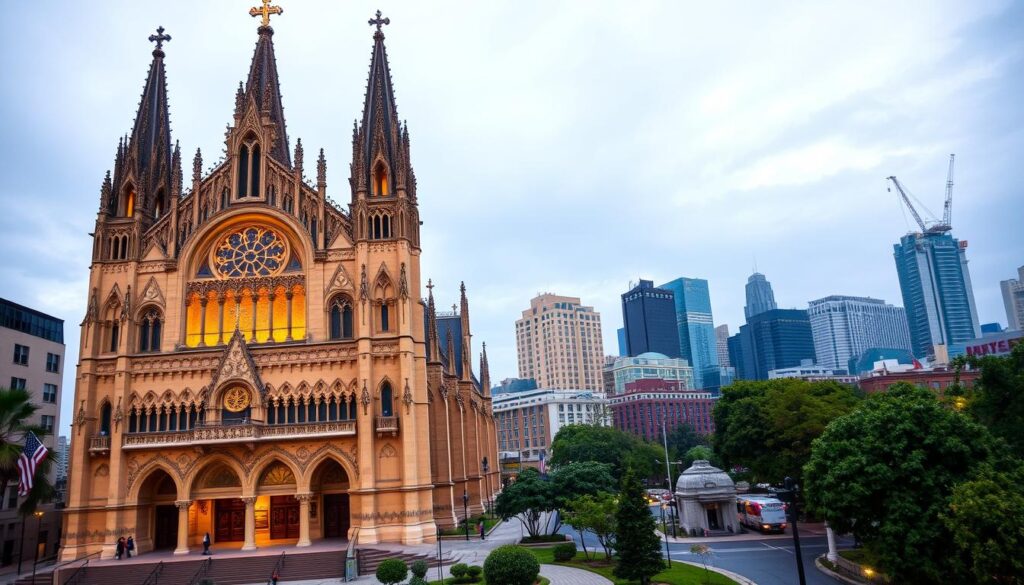
Iconic Churches, Missions, and Basilicas
St. Patrick’s Cathedral in New York City captures 19th-century ambition with its 330-foot towers. Completed in 1878, this Gothic Revival marvel used marble from Massachusetts and Connecticut. Over 3 million visitors now walk its aisles yearly.
The Basilica of the National Shrine in Washington D.C. holds a different record. As North America’s largest Catholic church, its 79,000-square-foot interior glows with 14,000 golden tiles. One worker famously called it “a love letter in stone to the faithful.”
| Landmark | Location | Architectural Style | Key Fact |
|---|---|---|---|
| Basilica of the National Shrine | Washington D.C. | Byzantine Revival | Largest in North America |
| St. Patrick’s Cathedral | New York | Gothic Revival | 1878 completion |
| Mission San Juan Capistrano | California | Spanish Colonial | Founded 1776 |
| San Xavier del Bac | Arizona | Baroque | Active since 1797 |
Spanish missionaries left lasting marks through place names. Cities like San Francisco and Los Angeles carry their original religious titles. Over 20 California communities still use “San” or “Santa” prefixes from 18th-century missions.
Modern buildings continue this legacy. The 2015 Cathedral of Christ the Light in Oakland mixes glass and wood, proving tradition evolves. As one architect noted: “Great churches speak the language of their times while echoing eternity.”
Development of the American Diocesan System
A network of spiritual leadership took shape across America during the 19th century. Bishops worked to unify practices through three historic Plenary Councils of Baltimore (1852, 1866, 1884). These meetings standardized religious education and created frameworks still used today.
The councils’ most famous achievement? The Baltimore Catechism. This question-and-answer guide taught generations their faith basics. One educator called it “the book that built Catholic America.”
| Council Year | Key Decision | Lasting Impact |
|---|---|---|
| 1852 | Standardized liturgy | National unity |
| 1866 | School mandates | Education expansion |
| 1884 | University founding | Catholic intellectual hub |
Today’s structure includes 200 dioceses – third-largest globally. Local bishops adapt teachings to regional needs while maintaining core principles. The United States Conference of Catholic Bishops coordinates nationwide efforts, from social justice to education.
This flexible system weathered immigration waves and cultural shifts. As one historian notes: “It’s like a tree – roots in tradition, branches reaching new heights.” From frontier missions to digital outreach, the framework continues evolving while preserving its mission.
Modern Perspectives on Catholicism in the United States
America’s religious landscape continues evolving, with Catholic communities adapting to new cultural realities. A 2025 Pew study reveals striking changes – adherents dropped from 24% to 19% of the population since 2007. Yet vibrant transformations are reshaping worship spaces and traditions nationwide.
Shift in Demographics and Evolving Practices
Hispanic believers now form nearly 40% of the Catholic population. This growth sparked Spanish-language masses in 4,500+ parishes. Cultural celebrations like Mexico’s Las Posadas processions and Filipino Simbang Gabi dawn masses now brighten December calendars.
| Community | Tradition | Parishes Adopted |
|---|---|---|
| Mexican-American | Las Posadas | 2,100+ |
| Filipino-American | Simbang Gabi | 1,400+ |
| Vietnamese-American | Tet Masses | 600+ |
Younger generations blend traditional faith with modern approaches. Over 60% of millennial Catholics personalize spiritual practices while maintaining community ties. Churches answer with livestreamed services and TikTok faith challenges.
Influence on Contemporary Religious Policies
Leadership now prioritizes issues resonating with diverse followers. Many Catholics push for climate action and immigration reform through parish programs. As one Chicago deacon noted: “Our pews hold global stories – our policies must reflect that.”
The Catholic Church remains a social cornerstone despite membership shifts. Food pantries serve 5 million annually, while disaster relief teams mobilize within hours. This active compassion keeps communities anchored through changing times.
Impact on American Politics and Social Justice
Faith communities have long shaped national conversations through moral leadership and civic action. Their influence extends from voting booths to legislative halls, blending spiritual values with public service.
Political Engagement and Advocacy by Catholics
John Kennedy’s 1960 presidential victory marked a turning point. As the first Roman Catholic commander-in-chief, he challenged stereotypes about faith and governance. His success opened doors for future leaders across party lines.
Decades later, Catholic bishops amplified their political voice. They championed social justice causes while addressing ethical debates around life and family. These efforts sparked dialogue in communities and congressional offices alike.
Patriotism during global conflicts also shifted perceptions. Service in World War I and II showcased loyalty, melting prejudices against believers. Military chaplains and homefront volunteers became symbols of unity.
Today, many parishes continue this legacy. They bridge faith and civic duty through voter drives and policy forums. As one activist noted: “Our values don’t stop at the church door.”
FAQ
Who was the first Catholic bishop in America?
A: John Carroll became the first bishop in 1789. He founded Georgetown University and shaped the early church’s structure, emphasizing education and interfaith collaboration.
How did Catholic immigrants shape 19th-century America?
Waves of Irish, German, and Italian immigrants built parishes, schools, and social networks. They faced discrimination but strengthened the church’s presence through cultural festivals and labor advocacy.
What role did Catholics play in the American Revolution?
A: Charles Carroll, a signer of the Declaration of Independence, symbolized Catholic patriotism. His leadership helped dispel anti-Catholic biases and align the faith with American ideals.
Are there famous Catholic landmarks in the U.S.?
Yes! The Basilica of the National Shrine in Washington, D.C., and California’s historic missions showcase stunning architecture. These sites blend cultural heritage with spiritual significance.
How does the church address social justice today?
The U.S. Conference of Catholic Bishops advocates for immigration reform, poverty relief, and racial equality. Many parishes run food banks, shelters, and educational programs to support local communities.
Why was Maryland important for early Catholics?
Founded as a haven for English Catholics, Maryland passed the 1649 Toleration Act. This law allowed religious freedom, though tensions with Protestant settlers persisted.
How has the diocesan system evolved?
From one diocese in 1789, the church now has nearly 200. This growth reflects population shifts, with new dioceses in the South and West addressing modern demographic changes.
Did Catholics face historical prejudice?
Yes. Anti-Catholic laws existed in some colonies, and 19th-century groups like the Know-Nothings opposed immigrants. The 1960 election of John F. Kennedy marked a turning point in acceptance.