With over 7 million followers, Vietnam’s Catholic community ranks among Asia’s largest. This vibrant faith community blends centuries-old traditions with modern practices, creating a unique spiritual identity. Its roots stretch back to 16th-century Portuguese missionaries, whose work began a story of resilience and growth.
Today, the Church here thrives through 27 dioceses and more than 2,200 parishes. These numbers reflect not just size but also deep cultural integration. From grand cathedrals in Hanoi to rural chapels in the Mekong Delta, religious spaces serve as hubs for worship and community life.
The faith’s journey mirrors Vietnam’s own history—marked by colonial influences, wartime struggles, and social change. Key figures like the Martyrs of Vietnam highlight its enduring legacy, while contemporary believers continue shaping local customs and values.
Understanding this heritage offers insights into how spirituality intersects with daily life. Festivals, education, and charitable work reveal the Church’s ongoing role in society. What makes this community stand out? Its ability to adapt while preserving core traditions.
Key Takeaways
- Vietnam hosts Asia’s fifth-largest Catholic population, with 7 million adherents
- Historical roots trace back to 16th-century European missionaries
- 27 dioceses and 2,200+ parishes showcase modern organizational strength
- Cultural integration shapes unique worship practices and community bonds
- Faith-based initiatives continue influencing social development nationwide
Introduction to Catholicism in Vietnam
The story of Vietnam’s Catholic community is one of resilience and cultural fusion. With 7 million adherents, this group forms nearly 7.4% of the nation’s total population—a testament to its enduring influence across generations.
Faith Through Centuries of Change
European missionaries first brought their teachings to coastal villages in the 1500s. These early efforts laid foundations for a spiritual network that now spans 27 dioceses. Despite periods of tension, the catholic church maintained its presence through wars and political shifts.
Modern Social Contributions
Today, Vietnamese Catholics actively shape their society. Over 2,200 parishes support education programs and medical clinics nationwide. One Hanoi-based charity provides meals for 15,000 students annually, blending faith with practical aid.
| Country | Catholic Population | % of National Total |
|---|---|---|
| Philippines | 86 million | 80% |
| India | 20 million | 1.5% |
| Vietnam | 7 million | 7.4% |
Relations with the government have improved significantly since 2007. Joint initiatives address social issues while respecting cultural traditions. “Our faith strengthens our commitment to Vietnam’s future,” notes a parish leader in Ho Chi Minh City.
Historical Beginnings and Early Missions
Foreign ships carried more than spices when they reached Southeast Asian shores. European explorers brought spiritual pioneers who planted seeds of faith that would grow for generations. These early efforts transformed local beliefs while adapting to regional customs.
Merchant Ships and Spiritual Pioneers
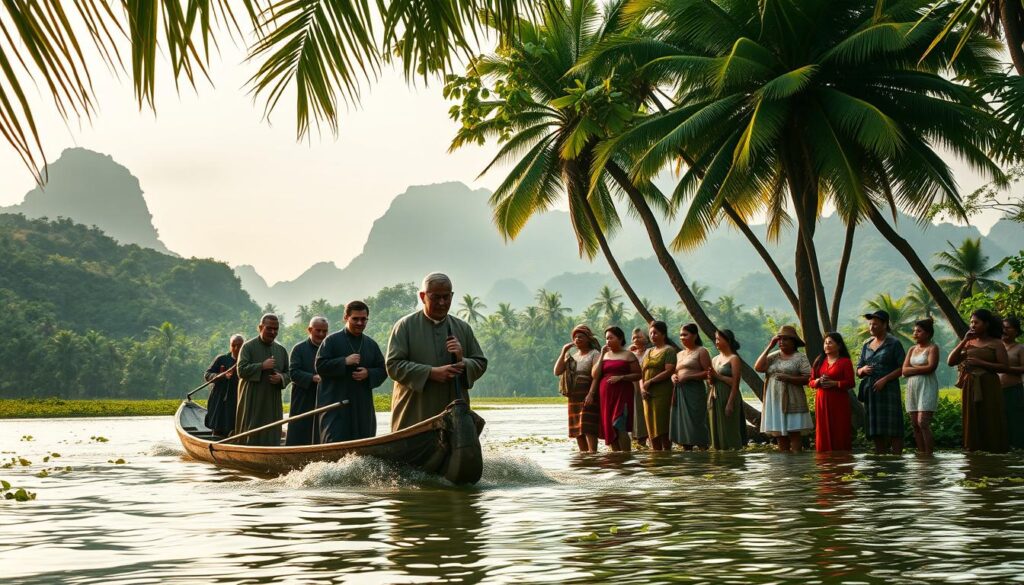
Portuguese trader Duarte Coelho’s 1524 voyage to Hội An did more than establish trade routes. His crew included missionaries who introduced new teachings to coastal communities. Nine years later, I-nê-khu became the first documented priest to preach in northern regions.
By 1615, two determined priests built Vietnam’s inaugural catholic church community in Hội An. Francesco Buzomi and Diogo Carvalho navigated language barriers and cultural differences to create lasting spiritual connections.
Jesuit Breakthroughs in Tonkin
The 1620s saw remarkable growth through innovative approaches. Alexandre de Rhodes and Pero Marques mastered local dialects, creating teaching materials that resonated with villagers. Their teamwork converted over 6,000 people in three years—a staggering achievement for the era.
These pioneers faced royal opposition and competing belief systems. Yet their legacy became an essential part of Vietnam’s cultural fabric. “We sowed seeds in rocky soil,” de Rhodes later wrote, “but with patience, they took root.”
Evolution of the Vietnamese Catholic Script
Language became an unexpected bridge between cultures when 17th-century missionaries crafted Vietnam’s modern writing system. Their work transformed how communities shared knowledge and preserved spiritual traditions.
Development of Chữ Quốc Ngữ
Four Jesuit scholars—Francisco de Pina, Gaspar do Amaral, Antonio Barbosa, and Alexandre de Rhodes—designed a revolutionary alphabet. By adding diacritical marks to Latin letters, they captured Vietnam’s six distinct tones. This system replaced complex characters with symbols ordinary people could learn in weeks.
Early missionaries like Girolamo Maiorica had used traditional chữ Nôm script for religious texts. But the new approach created order amid linguistic chaos. “We needed a key to unlock hearts through shared understanding,” de Rhodes later explained about their phonetic innovation.
Impact on Literacy and Religious Education
The simplified script let villagers read prayer books and hymns independently. For the first time, farming families could study faith materials without scholar intermediaries. Church leaders quickly adopted chữ Quốc ngữ for training programs and worship guides.
By 1900, over 70% of Catholic communities used this writing practice daily. It became a cornerstone for schools and newspapers, spreading far beyond religious circles. Today, grocery lists and government documents alike bear witness to this enduring cultural gift.
Catholic Missionaries and the Nguyễn Dynasty
The late 18th century witnessed an extraordinary partnership between European clergy and Vietnamese nobility. French Bishop Pigneau de Behaine’s alliance with Nguyễn Ánh—future Emperor Gia Long—reshaped both political power structures and spiritual networks across the region.
Pigneau de Behaine’s Influence
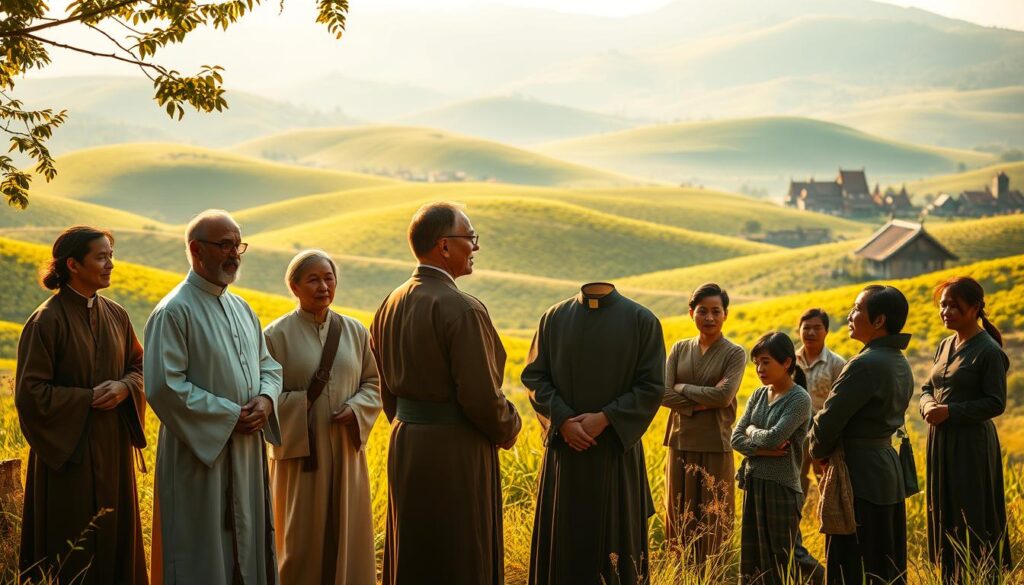
This French missionary became Nguyễn Ánh’s trusted advisor during his fight to unify Vietnam. Pigneau negotiated international support while secretly advancing church interests. His death in 1799 marked a turning point, though his legacy lived through Gia Long’s victorious reign.
The emperor’s funeral tribute called Pigneau “the most illustrious foreigner ever to appear at the court of Cochinchina”. This recognition opened doors for religious growth despite earlier tensions with local rulers.
Interactions with Vietnamese Royalty
By 1802, three thriving dioceses served 320,000 faithful through coordinated efforts. The structure blended local leadership with foreign expertise:
| Diocese | Members | Vietnamese Priests | Missionary Priests | Catholic Bishops |
|---|---|---|---|---|
| Eastern Tonkin | 140,000 | 41 | 4 | 1 |
| Western Tonkin | 120,000 | 65 | 46 | 1 |
| Central/Southern | 60,000 | 15 | 5 | 1 |
Local clergy outnumbered foreign missionaries in two regions, showing successful training programs. Royal tolerance allowed communities to flourish, creating foundations for future expansion during challenging eras.
Church Expansion During the French Colonial Era
Strategic support from foreign rulers propelled church expansion across Vietnam’s territories during the 19th century. When French forces began their campaign in 1858, many local believers saw collaboration as a path to religious security. This alliance helped colonial troops secure key regions while boosting the catholic church’s influence.
Victory brought tangible rewards. Colonial authorities granted Vietnamese Catholics prime government roles and educational access. Over 120,000 acres of confiscated royal land shifted to church control, creating economic powerhouses that funded new parishes.
The population of faithful grew rapidly under this system. By 1886, South Vietnam alone housed 20 new seminaries and 300 primary schools. “We built not just chapels, but centers of community life,” wrote a missionary in letters home. These institutions became pillars of social development for decades.
This partnership carried lasting consequences. Some citizens viewed the church as an extension of foreign rule rather than spiritual leadership. Though the country gained infrastructure, tensions simmered beneath the surface—setting the stage for future challenges to religious authority.
Struggles and Repression Under Traditional Regimes
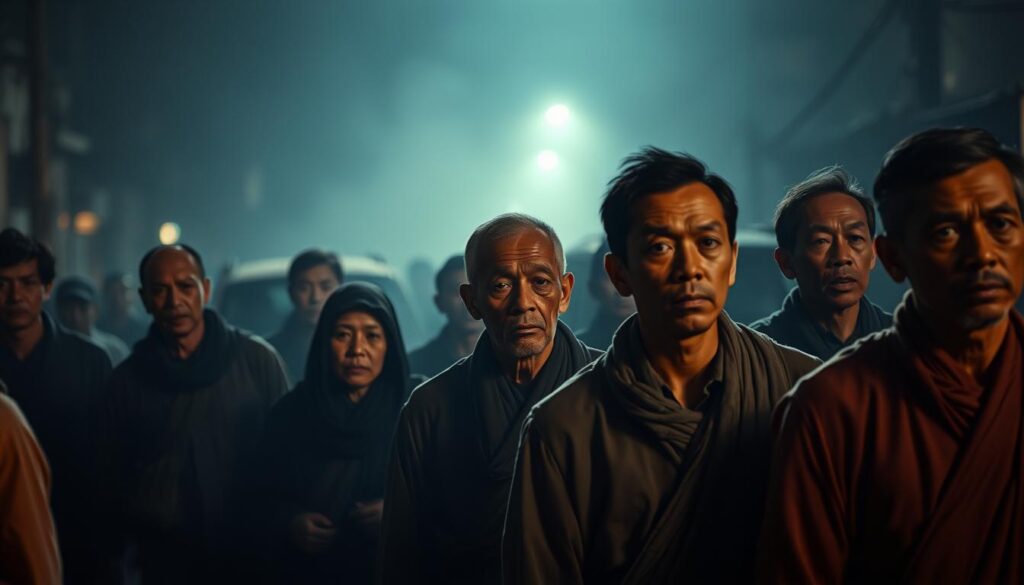
Emperor Minh Mạng’s 1833 declaration set a chilling tone: “This foreign creed corrupts our ancestral customs.” His edicts banned religious gatherings and labeled Christian teachings as threats to social order. Followers faced property seizures, forced renunciations, and even execution for practicing their beliefs.
Imperial Edicts and Anti-Catholic Measures
The 1836-37 crisis saw six missionaries executed, including Bishop Pierre Borie. Authorities targeted both foreign clergy and local believers. Jean-Charles Cornay faced dismemberment, while Ignacio Delgado died chained in a cage—harsh punishments meant to terrify the community.
Resistance and Martyrdom
Despite risks, underground networks kept the faith alive. Families hid priests in attics and farmhouses. Oral traditions preserved prayers when written materials were destroyed. One survivor’s diary reveals: “We whispered hymns while guards patrolled outside.”
Pope John Paul II honored this legacy in 1988 by canonizing 117 Vietnamese Martyrs. Their recognition strengthened global ties while validating local devotion. Today, pilgrimages to martyr sites draw thousands annually—proof that courage outlives oppression.
Impact of the Vietnam War on Catholic Communities
The mid-20th century brought seismic shifts for religious groups caught in Vietnam’s division. Families faced agonizing choices as political borders hardened, reshaping spiritual networks across the nation.
Faith on the Move
Operation Passage to Freedom (1954-55) saw 650,000 believers flee North Vietnam for the south—equivalent to emptying a major city. Many traveled with only prayer books and family heirlooms. “We carried our church in our hearts,” recalled one refugee decades later.
This mass exodus left just 600,000 followers in northern regions. Coastal towns lost entire congregations overnight, while South Vietnam gained new cultural hubs. The migration created concentrated Catholic districts around Saigon and Da Nang.
Lasting Divides
The southern government under Ngô Đình Diệm prioritized these displaced communities, allocating land and resources. By 1955, 60% of Vietnamese Catholics lived below the 17th parallel—a dramatic reversal from pre-war distributions.
This demographic shift fueled tensions during subsequent conflicts. Former northern refugees often became staunch anti-communists, while their relatives up north faced suspicion. The war’s end in 1975 sparked new waves of global diaspora, carrying these complex legacies worldwide.
FAQ
How did missionaries first introduce the Catholic faith to Vietnam?
Portuguese and Spanish missionaries arrived in the 16th century, followed by Jesuits like Alexandre de Rhodes. They blended local customs with religious teachings, creating early communities in regions like Đàng Trong and Đàng Ngoài.
What role did Chữ Quốc ngữ play in spreading the faith?
Jesuit missionaries developed Chữ Quốc ngữ, a Romanized Vietnamese script. This made religious texts accessible, boosted literacy, and helped unify communities across dialects, shaping both faith and culture.
How did Pigneau de Behaine influence Vietnam’s history?
As a French bishop, Pigneau supported Nguyễn Ánh (later Emperor Gia Long) during the Tây Sơn uprising. His political and military aid strengthened French-Vietnamese ties, paving the way for colonial involvement.
Why did the French colonial era impact church growth?
Colonial authorities promoted Catholic institutions, building cathedrals like Saigon’s Notre-Dame Basilica. This era saw expanded influence, though it also linked the church to foreign rule in public perception.
Were Vietnamese Catholics persecuted under traditional rulers?
Yes. Emperors like Minh Mạng viewed the faith as a threat, issuing anti-Catholic edicts. Thousands faced martyrdom, yet underground communities thrived, later honored by the Vatican as saints.
How did the Vietnam War affect Catholic communities?
Many fled north-south divisions, becoming refugees. Post-1975, some faced restrictions, but groups like the Bishops’ Conference now advocate for religious freedom while navigating state relations.
What is the status of the Catholic Church in Vietnam today?
With 7 million followers, it’s a vibrant minority. The government recognizes its social role, though tensions over land and oversight persist. Pope Francis’s 2023 meeting with leaders signaled warmer Vatican relations.