How has the global religious landscape changed in the last 100 years? A Pew Research Center study reveals striking shifts. In 1910, 291 million people identified with the Catholic Church. By 2010, that number soared to 1.1 billion – tripling worldwide followers.
This growth tells a story of cultural transformation. While Europe once housed most adherents, Latin America and Africa now drive expansion. The United States remains a key hub, with diverse communities shaping local practices. Yet the faith’s share of the global population stayed steady at 16-17%, showing balanced growth alongside world demographics.
Our interactive tools help you explore these patterns visually. See how migration, historical events, and societal changes influenced regional devotion levels. We’ll also explain how researchers verify data through sources like the CIA Factbook – ensuring accuracy without dry statistics.
Key Takeaways
- Global Catholic followers tripled since 1910, reaching 1.1 billion
- Latin America and Africa now lead in growth, surpassing Europe
- Pew Research Center provides trusted demographic insights
- Historical events deeply shaped today’s religious geography
- Multiple organizations collaborate to ensure data reliability
Understanding the Global Catholic Landscape
How do you track a faith followed by over a billion people? Current estimates show 1.3 billion Catholics worldwide – nearly 17% of humanity. This spiritual community spans continents, cultures, and languages, creating a vibrant mosaic of traditions.
https://www.youtube.com/watch?v=HC-ItniAeys
Overview of Catholic Demographics
The Pew Research Center reveals fascinating patterns. While Europe remains historically significant, Latin America now hosts 40% of all Catholics. Africa’s share grew from 1% to 16% since 1910 – the fastest regional increase.
Three key sources shape our understanding:
- Vatican yearbooks tracking baptized members
- National census records
- The Religion & Public Life project’s surveys
Key Statistical Insights from Global Data
Despite world population growth, Catholics maintained a steady 16-17% global share for decades. The Pew Research Center attributes this balance to two factors:
- Rapid growth in developing nations
- Declining numbers in traditional strongholds
Asia-Pacific regions show surprising vitality. Countries like the Philippines and South Korea report increasing church participation, while European nations see gradual secularization.
Historical Growth and Expansion of Catholicism
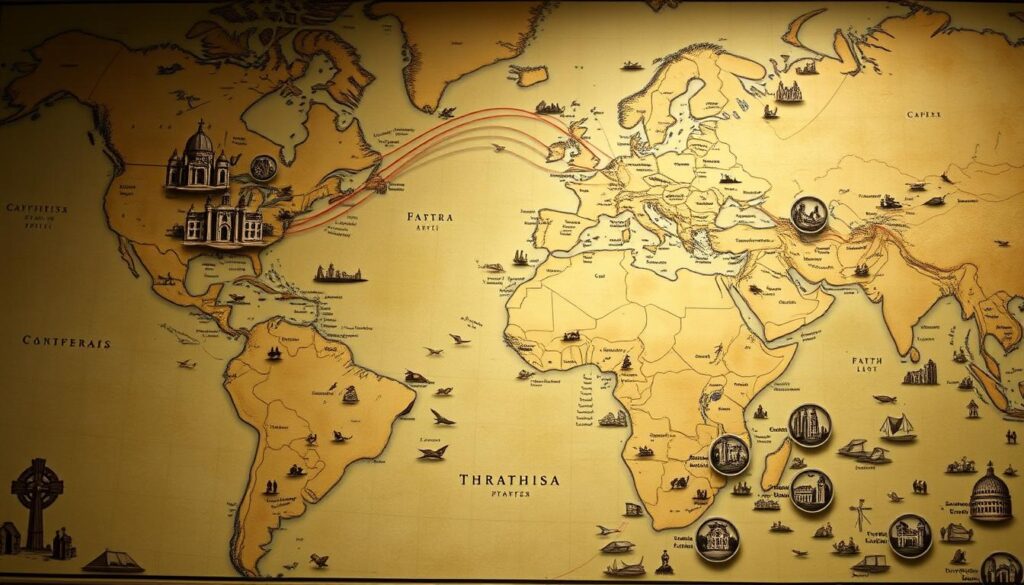
The story of religious expansion reveals surprising twists over 11 decades. Colonial ships carried more than spices and settlers – they transported belief systems that reshaped continents.
Colonial Beginnings and Early Developments
Spanish and Portuguese explorers planted the seeds of their faith across new territories. Missionaries built Catholic churches alongside trading posts, blending spiritual and economic goals. By 1600, 90% of Mexico’s total population practiced this religion.
French colonies took different approaches. Their North American settlements focused on cultural integration rather than mass conversion. This strategy created lasting communities in Quebec and Louisiana that still thrive today.
| Region | 1910 Share | 2010 Share |
|---|---|---|
| Europe | 65% | 24% |
| Latin America | 24% | 39% |
| North America | 5% | 8% |
| Africa | 1% | 16% |
Modern Trends and Shifting Populations
The United States now hosts the fourth-largest Catholic community globally. Urban centers like Chicago and Los Angeles showcase diverse practices blending old traditions with new cultural influences.
Africa’s dramatic growth stands out. From 1 million adherents in 1900 to 230 million today, the continent represents faith’s future. The Forum on Religion & Public Life notes this shift mirrors broader demographic changes in developing regions.
These transformations continue shaping global religious landscapes. As birth rates and migration patterns evolve, so does the geography of spiritual practice.
Exploring the catholicism map
Modern tools transform raw statistics into compelling stories. Our interactive visualization reveals how spiritual communities form unique patterns across borders. You’ll see clusters where historical events and migration shaped today’s religious landscape.
Interpreting Data Points and Visual Trends
Color gradients show concentration levels – from Brazil’s deep hues representing 123 million adherents to lighter shades in regions with smaller communities. The United States appears as a mosaic, reflecting its diverse population distribution.
Three key insights emerge from the Pew Research data:
- 90% of Filipinos identify with the Catholic Church
- Democratic Republic of Congo shows rapid growth since 2000
- Mexico maintains 82% adherence despite secular pressures
| Country | Catholic Population | % of Total |
|---|---|---|
| Brazil | 123 million | 58% |
| Mexico | 98 million | 82% |
| Philippines | 85 million | 90% |
| United States | 72 million | 22% |
| DR Congo | 44 million | 51% |
The Forum on Religion & Public Life helps explain why coastal West Africa shows higher concentrations than inland areas. Colonial trade routes and missionary activities left lasting imprints visible in today’s churches.
Eastern Catholic Churches add fascinating complexity. These communities maintain unique traditions while remaining part of the global faith network. Their presence creates vibrant pockets in regions like Eastern Europe and the Middle East.
Updated weekly using Pew Research and CIA Factbook data, our tools let you track changes over decades. Watch how urbanization affects spiritual practices or explore pandemic-era shifts in community participation.
Regional Impact in Latin America
Latin America’s religious identity remains deeply tied to its spiritual roots. While 39% of global adherents live here, recent shifts reveal changing attitudes. The percentage of Catholics dropped from 90% in 1910 to 72% by 2010 – a gradual decline masked by overall population growth.
Demographic Trends and Cultural Influence
Brazil and Mexico showcase this dual reality. Both countries lead in absolute number Catholics but face declining participation rates. Urban youth increasingly explore alternative faiths or secular lifestyles.
| Country | 2000 Catholic % | 2010 Catholic % |
|---|---|---|
| Brazil | 74% | 65% |
| Mexico | 89% | 85% |
| Argentina | 83% | 76% |
Cultural imprints endure despite these changes. Catholic traditions shape holidays, education systems, and community values across the country landscapes. Over 500 hospitals and 120 universities in the region still operate under church guidance.
The United States connection matters too. Migration patterns create cultural bridges, with Latino communities influencing North American practices. This exchange keeps Latin American traditions relevant in global dialogues about faith’s future.
Catholicism Across Europe

Europe’s religious landscape tells two stories at once. While historic cathedrals still dot the skyline, weekly church attendance tells a different tale. The research center data shows a 9% drop in Catholic affiliation since 1910 – from 44% to 35% of Europe’s population.
Changing Demographics and Regional Variability
Germany’s unique tracking system reveals hidden patterns. The government collects a church tax from registered members, creating precise records. This contrasts with Spain’s self-reported surveys showing 52.9%-70% adherence.
| Country | Catholic % | Data Source |
|---|---|---|
| Poland | 71.1% | National Census |
| Ireland | 69% | Research Center |
| Italy | 66.7-81.7% | Multiple Surveys |
| Germany | 26% | Tax Records |
Eastern Catholic communities add rich diversity. Ukraine and Romania maintain vibrant Byzantine traditions within the global Catholic Church. These groups account for 4% of Europe’s faithful according to recent studies.
The United States connection brings new energy. Immigrants from Latin America and Africa fill pews in cities like Madrid and Rome. Meanwhile, France reports rising secularism – only 8% of young adults attend weekly services.
Urbanization reshapes practices across regions. Younger generations often blend traditional rituals with modern values. The research center notes this creates unique local expressions of faith within the universal church.
Analyzing Catholic Presence in Africa and the Middle East
Two contrasting narratives emerge when examining spiritual communities across these regions. Sub-Saharan Africa’s faith communities have multiplied 170 times since 1910 – a transformation reshaping global Catholic demographics.

African Growth Redefines Religious Geography
The Pew Research Center reports stunning numbers: Africa’s Catholic population exploded from 1 million to 171 million in a century. This 21% regional adherence rate makes Africa crucial for understanding future growth.
Three factors drive this expansion:
- Vibrant community rituals blending local traditions
- High birth rates in developing countries
- Grassroots missionary strategies
Middle Eastern Stability Through Challenges
Despite being Christianity’s birthplace, the Middle East hosts under 1% of global Catholic followers. Political conflicts and emigration maintain this contrast with African growth.
Eastern Catholic communities persist as living history. Lebanon’s Maronite Church and Iraq’s Chaldeans demonstrate resilience, though their numbers remain small. The Pew Research Center notes these groups preserve ancient traditions amid modern challenges.
The Role of Catholic Institutions in Asia-Pacific
The Asia-Pacific region writes a new chapter in faith’s global story. Over 131 million people here now identify with this tradition – up from just 14 million in 100 years. The Philippines leads this growth, with 89 million adherents making it the world’s third-largest community.
Catholic organizations shape daily life across the region. In Manila, church-run universities educate future leaders. Seoul’s hospitals blend modern medicine with spiritual care. These institutions create lasting bonds with local populations while preserving cultural heritage.
New Patterns in Spiritual Engagement
According to Pew Research, Asia-Pacific’s Catholic share tripled to 3% since 1910. India shows unique growth – ancient Eastern traditions merge with global practices through Eastern Catholic communities. Youth programs and digital outreach help maintain relevance in tech-savvy nations.
The church faces both opportunities and challenges here. Urbanization tests traditional practices, while social services build trust. As demographics shift, this vibrant region could redefine what global faith communities look like in coming decades.
FAQ
Where is the Catholic faith most concentrated globally?
Latin America has the largest share of Catholics, followed by Europe and sub-Saharan Africa. Brazil, Mexico, and the Philippines rank among the top countries by membership, according to Pew Research Center.
How has history shaped the distribution of Catholics worldwide?
Colonial-era missionary work, trade routes, and migration patterns laid the foundation for growth. Today, regions like Africa and Asia-Pacific show rapid increases, while Europe’s share declines.
What tools help visualize the faith’s geographic spread?
Interactive maps and census data highlight membership density, institutional presence, and regional trends. For example, 40% of the global Catholic population resides in Latin America.
Why does Latin America dominate in Catholic demographics?
Spanish and Portuguese colonization introduced the faith centuries ago. Cultural traditions, festivals, and societal norms still reflect its deep-rooted influence across the region.
Is Europe’s Catholic population shrinking?
Yes. While countries like Italy and Poland retain strong ties, secularization and lower birth rates have reduced membership. Contrast this with growth in Germany’s immigrant communities.
Which African countries report significant Catholic growth?
Nigeria, Uganda, and the Democratic Republic of Congo are seeing surges. Youthful populations and active evangelization contribute to this trend, per recent surveys.
How does the Middle East’s Catholic presence compare?
Smaller communities exist in Lebanon, Syria, and Iraq, often linked to Eastern Catholic Churches in full communion with Rome. Political instability affects long-term stability.
What role do institutions play in Asia-Pacific regions?
Schools, hospitals, and charities run by religious groups bolster engagement. South Korea and India report rising membership, driven by social outreach and conversions.
Are Eastern Catholic Churches included in global data?
Yes. Groups like the Maronite Church or Ukrainian Greek Catholics are counted in reports, though they maintain distinct liturgical traditions under the pope’s authority.
How reliable are current Catholic population estimates?
Pew Research Center and Vatican yearbooks provide detailed insights, but variations exist due to census methods, self-identification, and regional survey limitations.