Let’s explore a story that stretches across continents and centuries. The Catholic Church began as a small group of believers and grew into one of humanity’s most enduring institutions. From ancient rituals to modern reforms, its journey reflects both steadfast tradition and remarkable adaptability.
You’ll see how early Christian communities laid foundations that still support over 1.4 billion followers today. Through wars, artistic revolutions, and social shifts, this global faith shaped education systems, healthcare networks, and cultural masterpieces. Its teachings traveled further than the Roman Empire ever did.
This timeline isn’t just about dates – it’s about people. Discover how leaders navigated political storms while preserving core beliefs. See how cathedrals became classrooms and prayers turned into policies. We’ll make complex ideas simple, showing why this living tradition remains relevant in our fast-changing world.
Key Takeaways
- The Catholic Church maintains 1.4+ billion followers worldwide
- Historical events continuously shaped religious practices and doctrines
- Balanced preservation of core beliefs with cultural adaptation
- Significant influence on art, education, and social systems globally
- Connects ancient rituals to modern spiritual needs
- Offers accessible exploration of complex theological concepts
Introduction to Catholic Heritage
Imagine holding a key that unlocks two millennia of human achievement. This guide helps you explore how spiritual beliefs shaped societies, inspired masterpieces, and built systems we still use today. You’ll see connections between ancient prayers and modern hospitals, medieval manuscripts and current laws.
Your Map Through Time
Think of this as your friendly roadmap through complex stories. We’ll show how a Roman Catholic community in Jerusalem grew into a global network of 24 distinct churches. These groups work together across 3,500 dioceses, yet keep their unique traditions alive.
Beyond Sunday Services
The Catholic Church’s influence reaches far beyond worship spaces. Consider these impacts on daily life:
- Monks saved classical texts during wars, preserving philosophy and science
- Cathedral schools evolved into today’s university system
- Early hospitals followed monastic care models
Art lovers recognize this heritage in soaring Gothic arches and Mozart’s melodies. Lawmakers still debate ideas from St. Thomas Aquinas about justice and human rights. By understanding these connections, you’ll see why the church remains a force in our modern world.
The Early Church: Foundations and Apostolic Roots
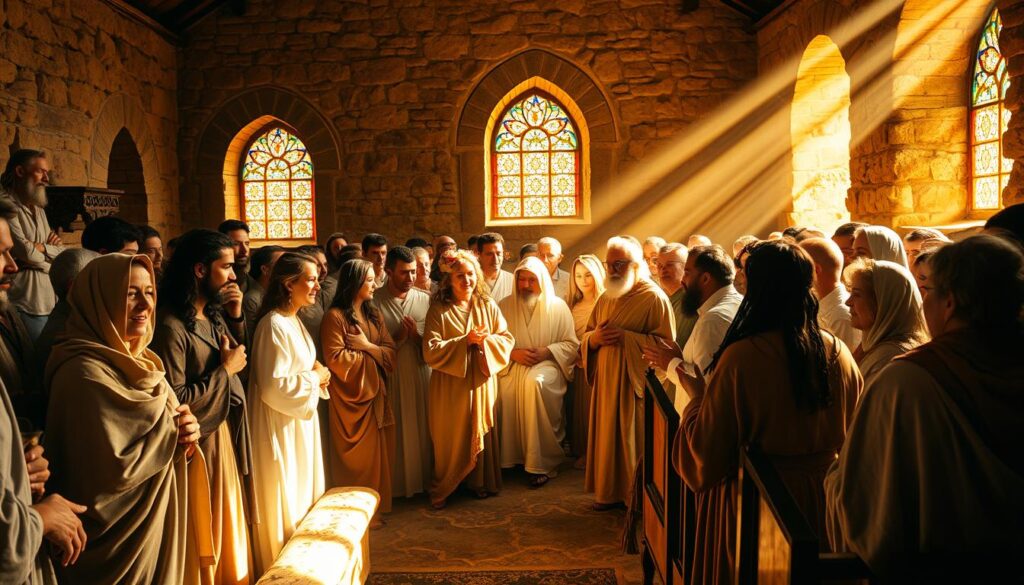
What does it take to turn a small group of followers into a global movement? In the decades after Jesus Christ‘s resurrection, his disciples faced this challenge head-on. Their work created the blueprint for what we now recognize as the Catholic Church.
Seeds of Belief: The Apostolic Era
The years 33-100 AD saw explosive growth. Apostles like Peter and Paul traveled tirelessly, planting faith communities across the Mediterranean. They adapted teachings from the New Testament to local cultures while keeping core doctrines intact.
Key developments emerged during this age:
| Event | Location | Impact |
|---|---|---|
| Pentecost (33 AD) | Jerusalem | Holy Spirit empowers apostles |
| Paul’s missions (45-60 AD) | Asia Minor/Greece | Spread to Gentile communities |
| Peter in Rome (60-68 AD) | Roman Empire | Established leadership center |
Communities That Changed the World
Early believers met in homes, sharing meals and prayers. Jerusalem’s Jewish Christians worshipped differently than Corinth’s Greek converts, yet both followed the same church structure. The breaking of bread (Eucharist) became their sacred bond.
These groups faced persecution but grew rapidly. By 100 AD, thriving communities stretched from Egypt to Spain. Their unity in diversity set patterns still seen in today’s Catholic Church.
Development of Catholic Doctrine in Antiquity
How did scattered writings become sacred scripture? The answer unfolded over four centuries as early Christians shaped their Catholic doctrine through prayerful debate and inspired leadership. This era transformed oral teachings into a unified faith system that still guides millions today.
Scriptural Traditions and Early Canon Formation
Imagine early believers debating which letters deserved shelf space beside Torah scrolls. By 95 AD, Clement of Rome referenced eight New Testament books in his teachings. Within 15 years, Polycarp recognized fifteen texts as authoritative.
The process accelerated across generations:
- Ignatius of Antioch validated seven books by 115 AD
- The Muratorian Canon (170 AD) excluded four later-accepted texts
- Irenaeus championed 21 books by 185 AD
Final approval came through councils – Laodicea (363 AD) confirmed 26 books, while Hippo and Carthage (393-397 AD) sealed the 27-book New Testament we know. This careful curation became the tradition that unites the Catholic Church worldwide.
The Transition from Jewish Roots to Distinct Beliefs
Early Christians walked a tightrope between honoring Jewish heritage and proclaiming radical new beliefs. Leaders like Irenaeus developed frameworks showing how Jesus fulfilled prophecies while establishing fresh truths. Their work birthed core concepts:
“The Word became flesh,” wrote John, capturing Christ’s dual nature debated for centuries. Through spirited councils and personal sacrifices, the church clarified doctrines about the Trinity and salvation by grace. These decisions shaped a Catholic doctrine that resonated across cultures while keeping apostolic roots alive.
Influence of the Roman Empire and Legalization of Christianity
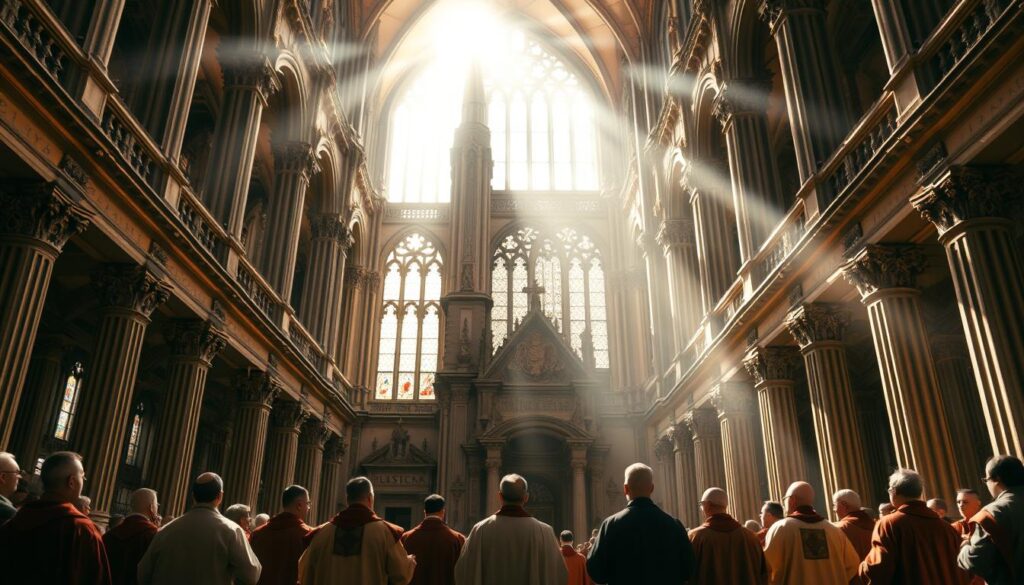
The fourth century reshaped Christianity’s destiny through imperial power. What began as underground gatherings became church structures mirroring Rome’s efficiency. This fusion of faith and governance created pathways for global influence still felt today.
Constantine’s Game-Changing Moves
Emperor Constantine flipped the script in 313 AD with the Edict of Milan. Suddenly, Christians could worship openly after centuries of persecution. His conversion paved the way for:
- Massive basilicas replacing hidden catacombs
- Church leaders gaining legal protection
- Missionaries using Roman roads for rapid spread
| Event | Year | Impact |
|---|---|---|
| Edict of Milan | 313 AD | Legalized Christian worship |
| First Council of Nicaea | 325 AD | Standardized core beliefs |
| Edict of Thessalonica | 380 AD | Made Christianity state religion |
When Faith Met State Power
Theodosius I’s 380 AD decree brought new challenges. As the official Roman Catholic church gained privileges, leaders balanced spiritual missions with political demands. The Catholic Church now managed:
- Land ownership across provinces
- Education systems for new converts
- Diplomatic relations between regions
This period laid foundations for medieval Europe’s power structures. Through imperial support, the church became a unifying force in a fragmenting world, blending ancient traditions with emerging Roman Catholic practices.
Evolution of Worship, Liturgy, and Sacramental Life
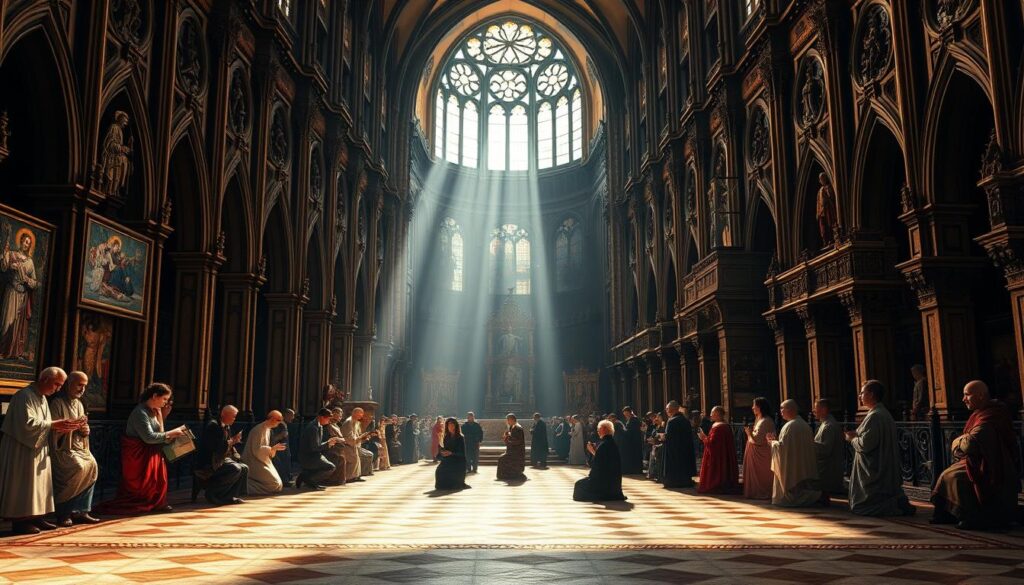
Sacred rituals have always shaped how communities connect with the divine. Early believers transformed simple meals into powerful ceremonies that still guide spiritual life today. This journey from whispered prayers to grand liturgies reveals a living faith adapting to human needs across eras.
The Emergence of the Mass and Daily Celebrations
By 394 AD, the Catholic Church made Mass a daily practice. What began as shared bread in homes became structured worship echoing through stone cathedrals. “Do this in memory of me” took physical form as priests consecrated bread and wine, sustaining believers through famine and feast alike.
This meal became medicine for the soul. Daily celebrations offered comfort during Rome’s collapse, turning ordinary moments into encounters with grace. Though transubstantiation wasn’t formally defined until later, early Christians sensed holiness in these gatherings.
The Development of the Sacraments
Seven sacred milestones emerged to mark life’s journey:
- Baptism evolved from river immersions to candlelit ceremonies
- Anointing rituals expanded to comfort the sick and dying
- Marriage vows gained spiritual significance beyond legal contracts
Each sacrament became a doorway – washing newborns, healing bodies, uniting couples. By 526 AD, prayers for the dying formalized into Extreme Unction, showing care for souls facing death. These practices turned daily life into a dance with the divine, every step blessed by the church.
Apostolic Succession and the Papacy
How does a 2,000-year-old leadership model stay vital in modern times? The answer lies in a living chain connecting today’s believers to the original apostles. This unbroken line forms the backbone of the Catholic Church‘s global mission.
The Role of St. Peter and Early Bishops
Jesus’ words to Peter in Matthew 16:18 – “You are Peter, and on this rock I will build my church” – set the stage. Early communities looked to bishops as spiritual heirs of the apostles. By 607 AD, Emperor Phocas recognized Boniface III as “pope,” cementing Rome’s central role.
These leaders weren’t just administrators. They preserved core teachings while addressing new challenges. The church structure they created allowed local customs to flourish under shared doctrines.
Concept of Apostolic Authority in the Church
What makes a bishop’s guidance valid? The Catholic Church points to consecration rituals tracing back to the first apostles. This faith in continuous succession ensures unity across 3,500 dioceses today.
The pope’s role evolved from spiritual leader to global voice. Yet the essence remains: a shepherd guiding the flock, just as Peter did. This system blends ancient roots with modern governance, keeping the Roman Catholic tradition alive for new generations.
FAQ
How did Constantine influence Christianity’s growth?
Constantine’s Edict of Milan in 313 CE ended persecution and allowed public worship. This shift helped spread the faith and integrate it into Roman culture, leading to its eventual status as the empire’s official religion.
What is apostolic succession?
Apostolic succession refers to the unbroken line of bishops tracing back to Jesus’ apostles. This tradition ensures continuity in teaching and leadership, central to the Church’s authority and unity.
How did Jewish traditions shape early beliefs?
Early followers of Jesus were part of Jewish communities, blending rituals like Passover with new teachings. Over time, practices like baptism and Sunday worship emerged, creating a distinct identity.
When did the Mass become a regular practice?
The Mass evolved from informal gatherings in homes to structured liturgies by the 4th century. Daily celebrations grew as churches were built, emphasizing communal prayer and the Eucharist.
Why is St. Peter significant to the papacy?
St. Peter, seen as the first pope, symbolizes unity and leadership. Early bishops of Rome claimed his legacy, shaping the papacy’s role as a spiritual and administrative center.
What sacraments existed in the early Church?
Baptism and the Eucharist were central from the start. Other rites like confirmation and confession developed later, formalizing ways to experience grace and community connection.