Many people wonder how two major faith traditions with shared roots can have distinct practices and teachings. While both groups hold core beliefs like the Trinity and Jesus’ resurrection, their approaches to worship and doctrine reveal fascinating contrasts. Understanding these nuances helps foster respect and clarity in spiritual discussions.
Over 1.2 billion individuals globally identify with the Catholic tradition, including nearly a quarter of Americans. These communities share foundational teachings about salvation and Christ’s divinity. However, differences in authority structures, sacraments, and interpretations of scripture create meaningful divides.
This guide breaks down key distinctions in approachable terms. We’ll explore historical origins, leadership models, and views on salvation. You’ll also discover how practices like communion and prayer vary between these traditions. Whether you’re exploring your own path or seeking to understand others, this comparison offers valuable insights.
Key Takeaways
- Both traditions share core beliefs in Jesus’ divinity and salvation through faith
- Distinct views on church authority create significant theological differences
- Sacraments and worship practices vary widely between the two groups
- Historical developments shaped their unique approaches to scripture interpretation
- Understanding these contrasts promotes meaningful interfaith dialogue
Historical Foundations of Catholicism and Christianity
Let’s travel back through the centuries to uncover how ancient spiritual movements shaped modern religious practice. The story begins with humble beginnings and grows into a global legacy that still impacts billions today.
Seeds of Faith in Ancient Times
The Catholic Church traces its roots to Jesus’ teachings and the work of His apostles. Early followers faced harsh persecution for nearly 300 years under Roman rule. Everything changed when Emperor Constantine legalized Christian worship in 313 AD, marking a turning point in religious history.
From Underground Movement to Global Institution
By 380 AD, Emperor Theodosius declared the Roman Catholic Church as the empire’s official religion. This decision created a structured hierarchy that unified believers across vast territories. Missionaries carried these teachings far beyond Rome’s borders over time, planting the seeds for future churches worldwide.
Not everyone agreed on how to practice their faith. Debates about leadership roles and scriptural interpretations grew louder through the years. These discussions eventually led to major divisions, including the split between Eastern Orthodox and Roman Catholic traditions centuries later.
Understanding this shared history helps explain why different Christian groups exist today. While their paths diverged over time, all maintain connections to those early gatherings of believers from 2,000 years ago.
Core Beliefs and Doctrines
Central to these traditions is a profound agreement on sacred truths that shape worship and daily life. Followers across denominations find common ground in ancient declarations about God’s nature and humanity’s relationship with the divine.
Understanding the Trinity and Divinity of Jesus
Both groups affirm the Trinity – one God existing as Father, Son, and Holy Spirit. Early creeds like the Nicene formulation capture this mystery: “We believe in one Lord, Jesus Christ, the only Son of God.” This shared belief underscores Christ’s dual nature as fully divine and fully human.
Scriptural foundations for this doctrine appear throughout the New Testament. Jesus’ statement “I and the Father are one” (John 10:30) remains a cornerstone text. The resurrection accounts further reinforce His divine authority over life and death.
Key Scriptural Interpretations
While united on core truths, approaches to biblical understanding reveal distinct perspectives. Many Protestant communities emphasize sola scriptura – scripture as the ultimate authority. Others value church tradition as a complementary guide to interpretation.
| Aspect | Shared Ground | Distinct Approaches |
|---|---|---|
| Divine Nature | Trinity affirmed | Emphasis on Marian doctrines varies |
| Salvation | Through Christ alone | Role of sacraments debated |
| Authority | Bible as inspired | Tradition’s weight differs |
The Apostles’ Creed serves as a unifying summary of essential beliefs. Its declarations about Christ’s birth, death, and resurrection create a theological framework embraced by diverse communities. These shared truths continue to guide worship and spiritual practice worldwide.
The Role of Salvation: Faith, Grace, and Works
Understanding salvation’s mechanics reveals deep contrasts between major Christian traditions. While both affirm Christ’s central role, their paths diverge when explaining how believers receive eternal life. These differences shape worship practices, spiritual disciplines, and community expectations.
Justification Through Grace
The Council of Trent (1545-1563) settled a fiery debate: Can faith alone save someone? Catholic teachings answer no, viewing salvation as a lifelong process requiring sacraments and moral effort. Protestants counter with Ephesians 2:8-9: “By grace you have been saved through faith… not a result of works.”
Significance of Good Works
Here’s where rubber meets road. One tradition sees good works as essential for maintaining salvation, while another views them as natural outcomes of genuine faith. Catholics participate through rituals like confession and communion. Most Protestants celebrate these acts as symbolic reminders, not spiritual requirements.
| Aspect | Tradition A | Tradition B |
|---|---|---|
| Sacraments | Necessary channels | Symbolic gestures |
| Works’ Role | Maintain grace | Demonstrate faith |
| Scriptural Focus | James 2:14-26 | Ephesians 2:8-9 |
This tension isn’t new. Reformers argued grace needs no human help, while others emphasized faith’s active nature. Both groups agree salvation starts with God’s gift—but disagree sharply on what happens next.
Sacraments and Religious Practices
Sacred rituals shape spiritual journeys in distinct ways across faith communities. These traditions mark life’s milestones while reinforcing core beliefs through symbolic actions.
Lifecycle of Sacred Rituals
The Catholic Church structures spiritual growth through seven sacraments. These include:
- Baptism for newborns
- First Communion ceremonies
- Confirmation during adolescence
Infant baptism involves sprinkling holy water to cleanse original sin. Families celebrate First Communion when children receive the Eucharist for the initial time. Teens confirm their faith through special church ceremonies.
Modern Worship Expressions
Many Protestant groups focus on two primary practices. Believer’s baptism occurs when adults or older youth choose faith through full immersion. Communion services memorialize Jesus’ last supper rather than recreating it.
| Practice | Catholic Approach | Protestant View |
|---|---|---|
| Baptism | Infant sacrament | Adult ordinance |
| Communion | Transubstantiation | Symbolic remembrance |
| Confession | Priest-mediated | Direct to God |
These differences stem from varying interpretations of scripture’s authority. While the Catholic Church maintains formal sacraments, other churches emphasize personal spiritual experiences. Both approaches seek to connect believers with divine grace through meaningful practices.
Authority and Leadership in the Church
Leadership structures create visible divides among believers. The Catholic Church maintains a top-down model rooted in centuries of tradition. Other groups favor decentralized systems that empower local congregations.
The Papacy and Church Hierarchy
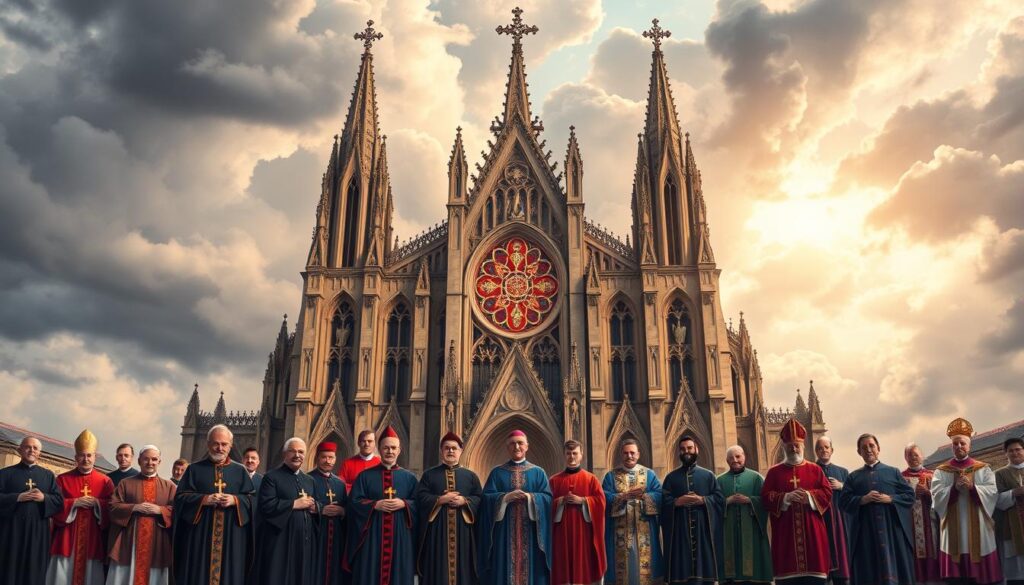
At the summit stands the Pope, bearing titles like Vicar of Christ and Supreme Pontiff. Catholics believe his authority flows directly from Jesus through apostolic succession. This hierarchy extends through cardinals, archbishops, bishops, and local priests.
The doctrine of papal infallibility remains controversial. When officially defining faith matters, Catholics accept his rulings as error-free. Most Protestant denominations reject this concept entirely, citing biblical references to Christ as the only perfect mediator.
Comparison of Clergy Roles
Priests serve unique functions across traditions:
| Role | Catholic Practice | Protestant Approach |
|---|---|---|
| Leadership | Ordained mediators | Guiding facilitators |
| Celibacy | Required | Optional |
| Sacraments | Essential channels | Symbolic acts |
Protestant ministers emphasize the priesthood of all believers, encouraging direct prayer without clerical intermediaries. This contrast shapes how communities interpret scripture, resolve disputes, and maintain spiritual disciplines.
Scriptural Canon and Biblical Differences
Not all Bibles are created equal—some contain extra chapters and books. While both traditions cherish the New Testament, their Old Testament collections tell different stories. This divergence stems from ancient debates about which writings hold divine authority.

Differences in Holy Bible Canons
The Catholic Church includes seven additional texts called deuterocanonical books. These works like Tobit and Maccabees appear in Catholic Bibles but not Protestant ones. A 16th-century council solidified this divide by declaring these writings essential.
“If anyone does not accept these entire books as sacred Scripture… let them be anathema.”
The Impact of the Apocrypha
Protestant reformers removed these books, arguing they lacked historical consistency. This decision reinforced their sola scriptura principle—biblical texts alone guide church teachings. Meanwhile, Catholic tradition values these writings for insights into prayer practices and afterlife beliefs.
| Bible Version | Old Testament Books | New Testament Books |
|---|---|---|
| Catholic | 46 (includes Apocrypha) | 27 |
| Protestant | 39 | 27 |
Both groups fully agree on the 27 New Testament books. The clash centers on how tradition shapes scriptural understanding. One sees sacred writings as a living conversation, while the other prioritizes original texts alone.
catholicism vs christianity: A Direct Comparison
At the heart of both traditions lies a shared story of redemption that unites millions worldwide. While their spiritual journeys follow different routes, they converge at essential crossroads of belief and practice.
Key Similarities and Divergences
Both groups affirm foundational truths about God’s nature. They agree on:
- The Trinity’s mysterious unity
- Christ’s miraculous birth and resurrection
- Humanity’s need for divine rescue from sin
Where paths diverge, the differences reshape daily spiritual life. Consider these contrasts:
| Aspect | Shared Belief | Distinct Approaches |
|---|---|---|
| Salvation | Through Christ | Faith alone vs. sacraments + works |
| Authority | Scripture’s importance | Bible vs. Bible + tradition |
| Prayer | To God | Through saints vs. direct access |
Mary’s role highlights another key difference. One tradition celebrates her as spiritual mother, while others focus solely on her historical significance. This shapes how people seek intercession in prayers.
Sacraments like confession stir debate too. Some view them as essential channels of grace, others as symbolic reminders. These practices influence how people experience forgiveness for sin.
Despite variations, both traditions guide people toward deeper faith. Understanding these nuances helps believers appreciate shared roots while respecting distinct spiritual expressions.
Interpretation of Tradition and Doctrinal Authority
Spiritual guidance often stems from ancient wisdom and evolving practices. The authority of tradition plays a vital role in shaping beliefs for many communities. Historic councils like Vatican II reinforced this view, declaring sacred traditions equal to scripture in guiding the faithful.
Living Wisdom Through Generations
The Catholic teachings emphasize tradition as a dynamic force. Documents like the Catechism provide clear summaries of core principles. Updated in 1992, this text became a cornerstone for modern believers under Pope John Paul II’s leadership.
How does the church teach these enduring truths? Through both written words and lived practices passed down centuries. This dual approach helps maintain unity while addressing contemporary spiritual needs.
Balancing tradition with scripture remains a distinctive way of preserving doctrinal integrity. The Catechism serves as a compass, blending ancient insights with current understandings of divine authority. This living document continues to shape how communities apply timeless teachings to modern life.
FAQ
How do beliefs about salvation differ between Catholics and other Christians?
Catholics emphasize grace, faith, and good works as essential for salvation, while many Protestant traditions teach salvation through faith alone. The Catholic Church views sacraments like baptism and confession as channels of divine grace, whereas some Christian groups focus more on personal faith in Jesus Christ.
Why does the Catholic Church recognize seven sacraments when others don’t?
The seven sacraments—like Eucharist and marriage—are rooted in sacred tradition and early church teachings. Other Christian denominations, such as Baptists or Methodists, often recognize fewer sacraments, prioritizing practices directly tied to Jesus’ teachings in the New Testament.
What role does the Pope play in Catholicism compared to other churches?
The Pope is seen as the spiritual successor to Saint Peter and holds authority over doctrine and church governance. Most Protestant churches reject papal authority, instead relying on local clergy or congregational leadership guided by Scripture alone.
Why do Catholics pray to Mary and saints?
Catholics view Mary and saints as intercessors who can pray to God on their behalf. This practice stems from sacred tradition and the belief in the communion of saints. Many Protestant groups avoid this, focusing prayers solely on God through Jesus Christ.
How do interpretations of the Bible differ between Catholics and Protestants?
Catholics include the Apocrypha (deuterocanonical books) in their Old Testament and rely on church tradition for interpretation. Protestants follow the 66-book canon and prioritize sola scriptura (“Scripture alone”), rejecting extra-biblical traditions as doctrinal sources.
Do Catholics and Protestants share the same view of the Trinity?
Both affirm the Trinity—Father, Son, and Holy Spirit—as central to their faith. However, Catholics emphasize mysteries of faith upheld by church teaching, while Protestants often ground their understanding strictly in biblical texts like Matthew 28:19.
Why is confession to a priest necessary in Catholicism?
Catholics believe priests act in persona Christi (in the person of Christ) to absolve sins, based on John 20:23. Most Protestants confess directly to God, citing 1 Timothy 2:5, which emphasizes Jesus as the sole mediator between God and humanity.
How did the Protestant Reformation shape differences in worship practices?
Reformers like Martin Luther rejected certain Catholic practices, such as Latin Mass and indulgences. This led to simplified worship styles in Protestant churches, focusing on preaching, congregational singing, and Scripture reading rather than liturgical rituals.