Over 2.4 billion people worldwide follow one of two major Christian traditions rooted in shared beliefs about Jesus Christ and the Trinity. These faith groups, though united in worshiping one God, developed unique practices after a historic split in the 16th century. Today, they represent distinct paths within the Christian faith that continue to shape cultures and communities.
The term “Roman Catholic” originates from the Greek word for “universal,” reflecting its global reach. The other tradition emerged when reformers protested specific church practices, sparking a religious revolution. Both groups affirm core teachings like Christ’s crucifixion and resurrection but differ in how they interpret scripture and structure worship.
This guide explores their historical roots, theological contrasts, and modern-day practices. You’ll learn why these differences matter and how both traditions strive to honor their understanding of biblical truth. Whether you’re exploring your own beliefs or seeking clarity, this comparison offers valuable insights into two influential expressions of Christianity.
Key Takeaways
- Over 2.4 billion people follow these two major branches of Christianity worldwide
- Both share core beliefs in the Trinity and Jesus as divine Savior
- The Protestant Reformation reshaped religious practices in the 1500s
- Differences center on authority structures and worship traditions
- Understanding these distinctions fosters better interfaith dialogue
Historical Background and Origins
From ancient creeds to revolutionary protests, Christian history is marked by pivotal moments that reshaped worship practices. The early church’s journey from a unified movement to divided traditions reveals how interpretations of Jesus Christ’s teachings evolved over centuries.
Early Christianity and the Formation of Traditions
The Apostles’ Creed, written around 150 CE, first described the “one holy, catholic church.” This phrase reflected the early believers’ commitment to preserving faith as taught by Christ’s original followers. By the 4th century, the Roman Catholic Church emerged as Western Europe’s dominant religious force, blending local customs with biblical teachings.
Latin became its official language, and traditions like papal authority took root. Leaders claimed direct succession from Saint Peter, whom they viewed as the first Pope. These structures created a unified identity that lasted through the Middle Ages.
The Impact of the Reformation and Schism
In 1517, Martin Luther’s Ninety-five Theses ignited a spiritual revolution. He challenged the sale of indulgences—payments believed to reduce punishment for sins—arguing salvation came through faith alone. Other reformers like Calvin and Zwingli joined this movement, questioning church hierarchy and ritual practices.
Though aiming to reform Christianity from within, their ideas clashed with Rome’s authority. The resulting split created new church models across Northern Europe. The Catholic Church later launched its own reforms but maintained core traditions, cementing the divide that still shapes Christian worship today.
Core Beliefs and Doctrinal Differences
At the heart of Christian theology lies a pivotal question: How do people connect with God? While sharing foundational beliefs about Jesus Christ, these traditions answer differently through their teachings about grace and human nature.
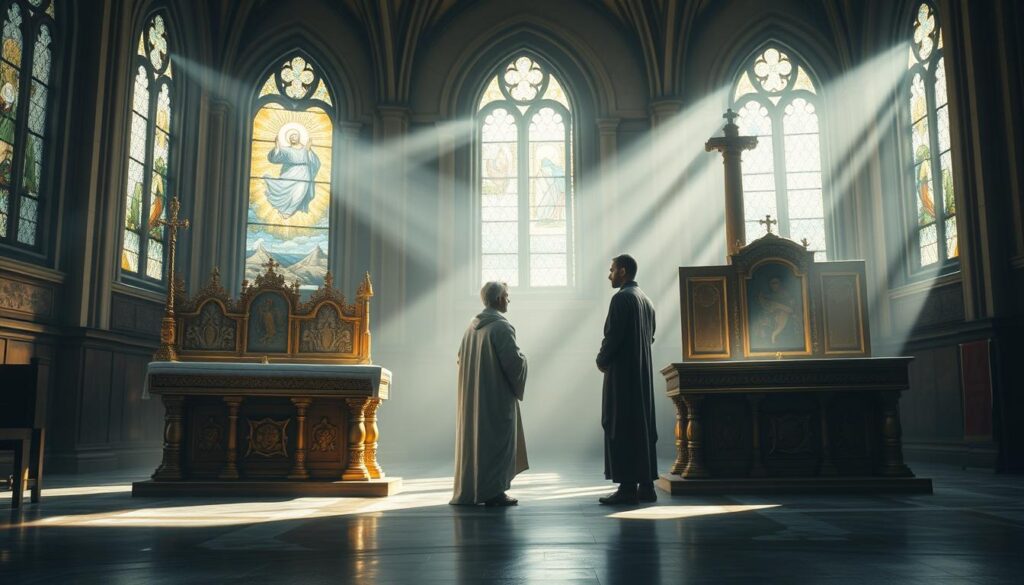
Salvation, Grace, and the Role of Faith
Catholics believe salvation grows through sacraments like baptism and communion. They view grace as spiritual fuel earned through prayer, confession, and good works. Regular Mass attendance helps maintain this connection.
Protestants believe grace flows freely to those who accept Christ through faith alone. Many teach that salvation can’t be lost once truly received. This “sola fide” approach simplifies the path to redemption.
Original Sin and the Concept of Redemption
Both groups agree humanity inherited original sin from Adam. Catholics address this through infant baptism, seeing newborns as needing purification. Most Protestant churches wait until children understand right from wrong.
While Protestants and Catholics agree Christ’s sacrifice covers human sins, they differ on daily practice. One emphasizes personal prayer, the other sacramental rituals. Yet both aim to honor the same Savior through their distinct beliefs.
Structures, Leadership, and Worship Practices
How communities organize their spiritual lives reveals much about their core values. From towering cathedrals to modest chapels, physical spaces and leadership models reflect distinct approaches to connecting with the divine.
Clergy Roles and Hierarchical Organization
The Roman Catholic Church operates like a spiritual pyramid. At its peak sits the Pope, considered Christ’s representative on earth. Cardinals and bishops manage regional authority, while priests lead local parishes. This chain of command ensures uniform teachings across 1.3 billion members.
Protestant churches favor flatter structures. Pastors often answer to elected boards rather than distant hierarchies. Many denominations let congregations choose their leaders, reflecting Reformation-era pushes for localized authority.
Places of Worship and Liturgical Rituals
Catholic Mass transforms ordinary bread and wine into the body blood Christ through transubstantiation. Services follow ancient patterns: incense swirls, choirs chant, and rituals repeat weekly. Stained glass windows tell biblical stories to worshippers.
Protestant gatherings prioritize scripture over ceremony. Sermons dissect Bible passages, while hymns invite crowd participation. Communion bread remains symbolic—a memorial meal rather than sacred mystery.
Sacramental Life and Ritual Practices
Seven sacraments shape Catholic spiritual growth, from baptism to last rites. Each ritual marks life’s milestones with holy practices. Confession offers forgiveness through priestly mediation.
Most Protestant groups recognize two sacraments: baptism and communion. Personal prayer replaces formal confession. These differences show how traditions balance structure with individual faith journeys.
Exploring catholicism protestantism in Daily Faith
How believers live out their faith each day reveals much about their deepest convictions. Morning rituals, prayer habits, and moments of reflection shape spiritual growth in unique ways. These routines bridge ancient teachings with modern life.
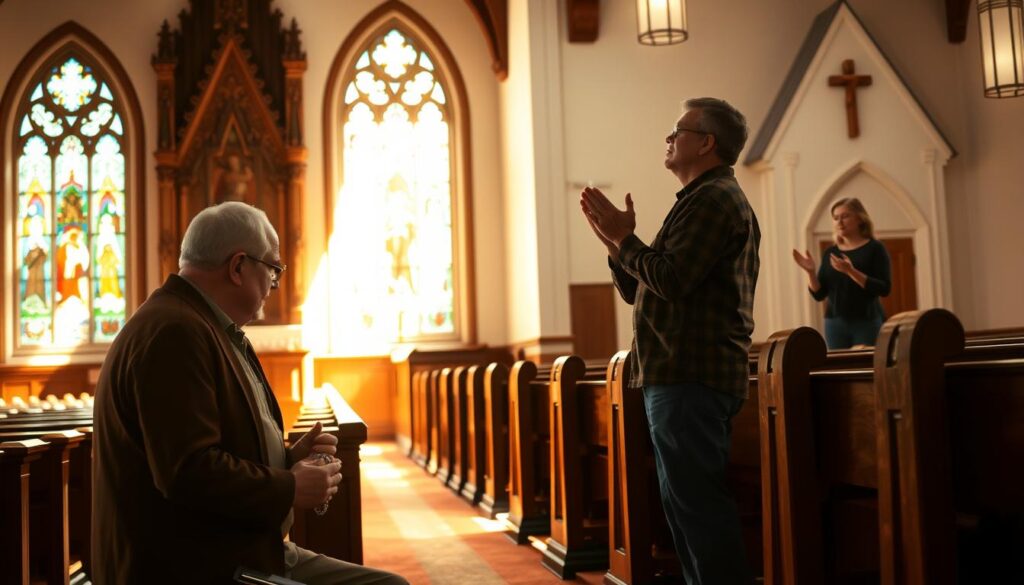
Daily Devotions and Prayer Practices
Catholic spiritual life often includes structured practices like the Rosary—a meditative prayer honoring the Virgin Mother. Many light candles before statues of saints, seeking their heavenly support. Some attend daily Mass, viewing communion as spiritual nourishment.
Protestant routines focus on personal Bible study and spontaneous prayer. Quiet time with scripture helps believers apply teachings to today’s challenges. Worship songs and journaling often complement these moments of reflection.
The way followers handle mistakes shows key differences. Catholics confess sins to priests during Reconciliation, receiving guidance and penance. Protestants share struggles directly with God through Jesus, valuing unmediated forgiveness.
Both traditions encourage serving others as an expression of faith. Whether through church food drives or neighborhood help, acts of kindness remain central. These habits keep beliefs alive beyond Sunday services.
Iconography, Tradition, and Scriptural Interpretations
Visual symbols and sacred texts shape spiritual understanding in distinct ways across Christian traditions. These differences reveal how communities balance artistic expression with scriptural teachings while maintaining their core identities.
The Use of Statues, Icons, and Visual Symbols
Catholic worship spaces often feature statues of saints and biblical scenes. These traditions aim to inspire prayer and connect believers with holy figures. Stained glass windows and frescoes serve as visual sermons, especially historically for those unable to read.
Many Protestant churches avoid religious imagery, citing concerns about idolatry. Plain walls and simple crosses reflect their view that God deserves undivided attention. This contrast stems from differing interpretations of the Second Commandment about graven images.
Interpreting the Scriptures: Bible Versions and Teachings
Catholic doctrine draws authority from three sources: Scripture, Church tradition, and papal teachings. The Douay-Rheims Bible includes books Protestants consider apocrypha. Church leaders provide official interpretations through the Magisterium.
Protestants follow sola scriptura—the belief that the Bible alone holds ultimate authority. The King James Version dominates many congregations, and believers are encouraged to study Scripture personally. This approach reflects their view of early church simplicity before later traditions developed.
| Aspect | Catholic Practice | Protestant Practice |
|---|---|---|
| Religious Art | Statues and icons used devotionally | Minimal decoration to avoid distraction |
| Scriptural Authority | Bible + Tradition + Magisterium | Bible alone (sola scriptura) |
| Tradition’s Role | Equal to Scripture | Secondary to Scripture |
These differences trace back to the rock build debate—whether Jesus founded his church specifically through Peter (as Catholics teach) or through all believers. Such distinct beliefs practices continue to define each tradition’s identity today.
Cultural Influence and Global Impact
The footprints of faith traditions extend far beyond church walls, shaping continents and creative expression alike. Roman Catholics and various Protestant groups have molded societies through sacred art, music festivals, and community values. Their global reach shows how spiritual beliefs transform cultures over generations.
Where Faith Meets Geography
Nearly 1 in 3 people worldwide identify with the catholic church, concentrated in Latin America and Southern Europe. The mother church remains central to life in places like Mexico and the Philippines, where festivals blend faith with local traditions. Protestant communities thrive in North America and Africa, with diverse denominations adapting to regional needs.
Creative Legacies That Endure
Michelangelo’s Sistine Chapel frescoes showcase roman catholicism’s artistic legacy, while Protestant hymns like “Amazing Grace” shaped musical history. Both traditions influenced education—Catholic universities and Protestant colleges dot landscapes globally. Holiday customs reveal shared roots: protestants catholics worldwide celebrate Jesus Christ’s birth at Christmas, though observances differ.
From Bach’s cantatas to today’s gospel music, these groups continue inspiring creativity. Their shared focus on Jesus Christ unites them, even as distinct practices enrich global culture. Understanding these impacts helps explain why faith remains woven into humanity’s story.
FAQ
What caused the split between the Roman Catholic Church and Protestant groups?
The Reformation in the 16th century, led by figures like Martin Luther, challenged Catholic teachings on authority, salvation, and practices. Disagreements over papal authority, indulgences, and scriptural interpretation led to a lasting schism.
How do Catholics and Protestants view salvation differently?
Catholics emphasize faith combined with sacraments and good works for salvation. Protestants stress justification by faith alone, believing grace comes through Christ’s sacrifice, not human effort.
Why do Roman Catholics venerate Mary and saints, while most Protestants don’t?
Catholics see Mary and saints as intercessors who pray to God on believers’ behalf. Protestants typically reject this, focusing solely on Christ as the mediator between humanity and God.
What’s the difference between the Eucharist and Communion?
Catholics believe in transubstantiation, where bread and wine become Christ’s body and blood. Protestants view Communion as symbolic or spiritual, not a literal transformation.
Do both groups use the same Bible?
Catholic Bibles include seven additional books (Deuterocanonical) not found in Protestant versions. Protestants follow the 66-book canon, prioritizing scripture’s authority over tradition.
How do worship styles differ between the two traditions?
Catholic services are liturgical, with rituals like the Mass and sacraments. Protestant worship varies—some follow structured liturgies, while others favor sermons, hymns, and spontaneous prayer.
Why does the Catholic Church have a pope, but Protestant churches don’t?
Catholics believe the pope is Peter’s successor and Christ’s representative on Earth. Protestants reject papal authority, favoring local church leadership or congregational governance.
How have these traditions influenced global culture?
Catholic art, architecture, and festivals (like Lent) shaped Europe and Latin America. Protestant values, like individualism and literacy, influenced education and social reforms in places like the U.S. and Northern Europe.
Can someone switch between these faiths today?
Yes, though it often involves formal steps. Converts to Catholicism undergo rites like Confirmation, while Protestants might reaffirm beliefs through baptism or a statement of faith.
Do Catholics and Protestants agree on any core teachings?
Both affirm the Trinity, Christ’s divinity, and the Resurrection. They share the Nicene Creed and focus on spreading the Gospel, despite differences in practice.