Let’s explore how one of history’s most influential faiths grew from ancient roots to touch nearly every corner of Earth. Today, over 1.375 billion people identify with this tradition, forming the largest single Christian denomination. That’s roughly 17.6% of humanity connected through shared beliefs and practices.
From its beginnings in the Middle East, this spiritual community now thrives in diverse cultures. The Pew Research Center notes fascinating shifts in demographics, with growth hotspots in Africa and Latin America. Meanwhile, historic strongholds in Europe maintain rich traditions despite changing societal trends.
What makes this growth possible? A network of 225,406 parishes and 134,098 mission stations supports followers worldwide. Over 5,000 bishops and 400,000 priests guide communities, from Vatican City’s 100% adherence to nations with smaller but vibrant minorities.
Modern migration patterns and cultural exchanges keep reshaping this religious landscape. Our visual guide highlights these dynamics, revealing how historical events and current realities intertwine. Ready to see how faith transcends borders?
Key Takeaways
- 1.375 billion followers make this the largest Christian denomination globally
- 17.6% of Earth’s population identifies with these spiritual traditions
- Over 225,000 parishes support communities across 134+ nations
- Demographic shifts show rapid growth in Global South regions
- Historical events and modern migration shape distribution patterns
Global Overview of Catholicism
Global religious demographics reveal fascinating stability in Catholic adherence amidst massive population changes. The Catholic Church grew from 291 million followers in 1910 to 1.1 billion by 2010 – tripling in size while maintaining 16-17% of Earth’s total population.
Historical Growth and Demographic Shifts
What makes this expansion remarkable? The Pew Research Center shows Catholic numbers kept pace with global population explosions. While Europe’s share decreased, Africa and Asia saw surges. This balancing act explains why percentages stayed steady despite regional upheavals.
Here’s what many find surprising: Catholics grew from 48% to 50% of the Christian population worldwide since 1910. Migration patterns and birth rates created new strongholds while traditional areas maintained influence.
Comparative Global Statistics
The World Christian Database highlights key comparisons through time:
| Year | Catholics | % of Christians | % of Global Population |
|---|---|---|---|
| 1910 | 291M | 48% | 17% |
| 2010 | 1.1B | 50% | 16% |
This table shows how the Catholic Church expanded its reach while adapting to demographic realities. The Pew Research Center notes these patterns continue shaping global Christianity today.
Interpreting the catholicism world map
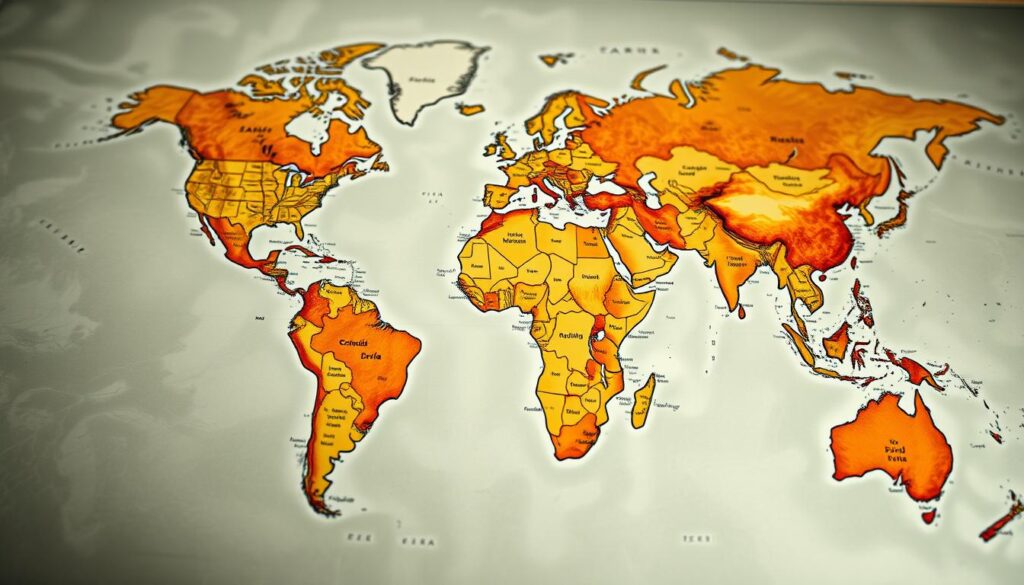
Maps tell stories beyond borders, and the distribution of religious communities reveals unexpected patterns. Visual tools help us spot trends that numbers alone might miss—like how cultural history shapes modern belief systems.
Key Figures and Visual Insights
Brazil’s 115 million Catholics make it the faith’s largest national community. Mexico follows closely with 101 million, showing Latin America’s enduring influence. The Philippines surprises many as Asia’s Catholic stronghold with 89 million followers.
North America and Africa complete the top five:
| Country | Catholics | % of Nation |
|---|---|---|
| United States | 75M | 22% |
| DR Congo | 60M | 42% |
While raw numbers impress, percentages reveal deeper truths. Vatican City naturally shows full adherence, but Timor-Leste’s 97% rate proves widespread cultural adoption. Research centers highlight how Brazil’s 53% Catholic share differs from Poland’s 87% in a smaller population.
These visual contrasts explain why analysts study both quantity and concentration. From European heartlands to growing African communities, the global Catholic presence keeps evolving through migration and local traditions.
Methodology and Data Sources
Accurate numbers form the backbone of understanding religious trends. Let’s examine how experts track spiritual communities across continents.
Insights from PEW Research and CIA Factbook
The Pew Research Center leads in religious demographics. Their surveys interview over 100,000 people globally. “Our multi-year studies combine census data with self-reported beliefs,” notes a Pew analyst. This approach captures both official records and personal identities.
Government sources add another layer. The CIA Factbook verifies figures through national reports. For example, Brazil’s 123 million followers appear in both Pew surveys and Brazilian census data. These cross-checks reduce errors.
Germany offers unique precision. Churches there track members through tax records. This system provides exact numbers unavailable elsewhere. About 26 million Germans appear on official Catholic registries.
| Data Source | Key Contribution | Coverage |
|---|---|---|
| World Christian Database | Historical trends | Global projections |
| Latinobarometro | Latin American focus | 18 countries |
| Census Records | Government-verified | National counts |
The World Christian Database predicts 1.27 billion followers by 2025. Meanwhile, groups like the Forum on Religion & Public Life compare methodologies. This teamwork ensures balanced reporting across regions.
Why does this matter? Multiple sources prevent skewed perspectives. When Pew Research, census data, and local surveys agree, we gain confidence in the numbers shaping our understanding of faith communities.
Regional Distribution and Shifting Demographics
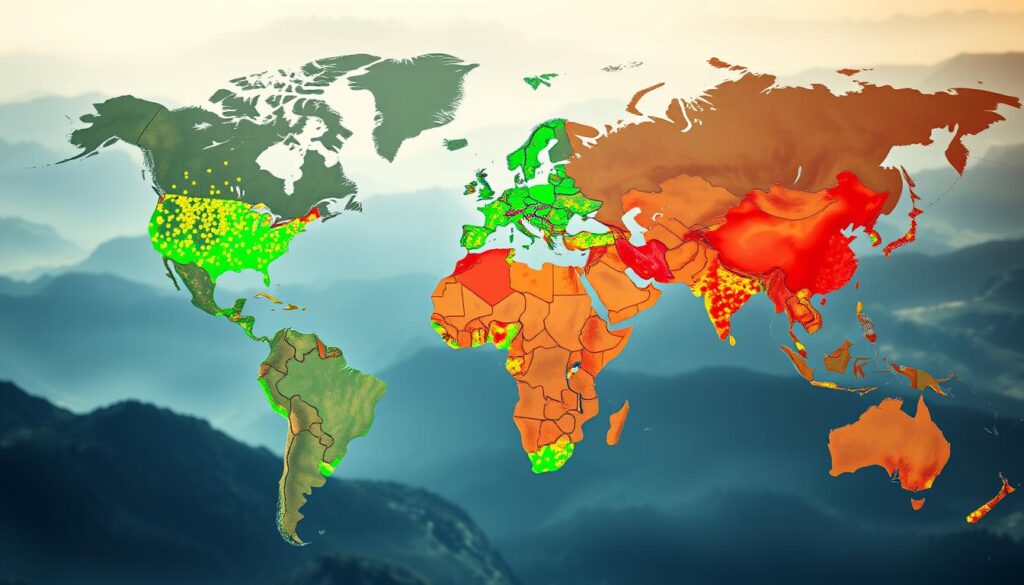
The geography of faith communities has transformed dramatically in modern times. A century-long shift moved spiritual centers from traditional strongholds to emerging regions. This change reflects population growth, cultural adaptation, and missionary efforts across continents.
Growth Trends in Latin America and the Caribbean
Latin America now hosts 39% of global adherents, up from 24% in 1910. While absolute numbers grew, the Pew Research Center reveals a twist: only 72% of locals identify with this tradition today versus 90% in 1910. Urbanization and new religious movements reshape spiritual preferences.
Expanding Presence in Sub-Saharan Africa
Africa’s Catholic community exploded from 1% to 16% of worldwide followers since 1910. Over 171 million Africans now participate, with countries like DR Congo leading growth. This surge matches the continent’s rapid population expansion.
Changing Statistics in Europe and Asia-Pacific
Europe’s share plummeted from 65% to 24% as birth rates declined. Meanwhile, Asia-Pacific nations like Papua New Guinea tripled their numbers. The Philippines remains a key anchor with 89 million followers.
| Region | 1910 Catholic Population | 2010 Catholic Population | % Change |
|---|---|---|---|
| Europe | 65% | 24% | -63% |
| Latin America | 24% | 39% | +62% |
| Sub-Saharan Africa | <1% | 16% | +1,500% |
| Asia-Pacific | 5% | 12% | +140% |
These shifts show how migration and local practices reshape spiritual landscapes. Research centers track these patterns to understand our evolving world population.
Infrastructure and Global Impact of the Catholic Church
The Catholic Church maintains a spiritual and operational network unmatched in human history. Over 225,000 parishes form its backbone, supported by 134,098 mission stations reaching remote communities. This structure connects diverse traditions, from the Western Latin Church to 23 Eastern Catholic Churches that preserve unique rituals while sharing full communion with the Bishop of Rome.
Parish Networks and Mission Stations
Only 3,241 mission stations have resident priests, revealing the challenge of serving isolated areas. The remaining 130,857 rely on visiting clergy or local leaders. This system allows the church to maintain presence in regions from Amazon villages to Himalayan towns.
Clergy Statistics and Community Outreach
Over 5,300 bishops guide 407,872 priests worldwide—nearly 280,000 serve local dioceses, while 128,000 belong to religious orders. They’re joined by 49,000 permanent deacons and 658,000 nuns and brothers who run schools and clinics.
The church’s social impact shines through numbers:
- 5,000 hospitals treat patients regardless of faith
- 95,000 elementary schools educate future generations
- 10,000 orphanages provide safe havens
These efforts make the Catholic Church the largest non-government provider of education and healthcare globally. Its infrastructure bridges ancient traditions with modern community needs, proving faith and service often share the same address.
U.S. Catholic Demographics and Public Life
America’s religious landscape tells a story of constant renewal. While 24% of U.S. adults identify with this tradition today, the Catholic population balances gains and losses through surprising channels.
Immigration’s Transformative Role
New arrivals fuel demographic stability. Over half of all migrants to the United States practice this faith – that’s 52% bringing cultural traditions from abroad. Latin America supplies 76% of these immigrants, reshaping local communities.
The numbers speak volumes: 30% of American adherents (22.2 million people) were born elsewhere. This foreign-born share doubles the national average, creating vibrant multicultural parishes.
The Switching Phenomenon
Stability hides a quiet crisis. Pew Research finds one in ten adults left the faith – more departures than conversions. The Forum on Religion & Public Life notes this trend challenges long-term growth.
Yet hope arrives through young families. Many immigrants maintain strong ties, while second-generation members often blend traditions. This dynamic exchange keeps the United States central to global religious developments.
FAQ
Which countries have the largest Catholic populations?
Brazil, Mexico, and the Philippines top the list, with the U.S. and Italy following closely. Latin America alone accounts for nearly 40% of the global Catholic population, according to Pew Research Center data.
How fast is the faith growing in Sub-Saharan Africa?
Sub-Saharan Africa has seen a 130% increase in Catholics since 1980, driven by high birth rates and active missionary work. Countries like Nigeria and the Democratic Republic of Congo are key growth hubs.
What sources are used to track global Catholic demographics?
Studies from Pew Research, the CIA World Factbook, and the Vatican’s Annuario Pontificio provide data on membership, parish networks, and regional trends. Surveys often cross-reference census reports for accuracy.
Why is Europe’s Catholic population declining?
Lower birth rates, secularization, and religious switching have reduced Europe’s share of Catholics from 65% in 1910 to 24% today. Countries like Germany and France report significant drops in regular church attendance.
How does immigration shape U.S. Catholic demographics?
Hispanic immigrants now make up 40% of U.S. Catholics, revitalizing parishes in states like Texas and California. However, religious disaffiliation among younger generations poses challenges for retention.
What role does the Vatican play in global Catholic outreach?
The Holy See oversees 1.3 billion members through dioceses, clergy, and social programs. Its influence extends to education, healthcare, and advocacy, with over 221,000 parishes worldwide supporting communities.