For over 2,000 years, the Roman Catholic Church has shaped cultures, inspired art, and guided billions worldwide. With 1.3 billion members, it remains the largest Christian tradition, blending ancient practices with modern global influence. This guide invites you to explore its many expressions – from grand cathedrals to quiet monasteries – while discovering what unites them.
Rooted in apostolic teachings, the Church evolved through medieval kingdoms, Renaissance revolutions, and today’s multicultural societies. While the pope leads from Rome, vibrant communities thrive everywhere – think Filipino festivals honoring saints or African drumming during Mass. These variations reveal how faith adapts while keeping core beliefs intact.
You’ll learn how Gothic architecture mirrors theological ideas or why thinkers like St. Thomas Aquinas still matter. We’ll also explore lesser-known groups: Eastern Catholics preserving Byzantine traditions and religious orders like Franciscans serving the poor. Understanding these branches isn’t just history – it’s key to grasping Western law, art, and even modern ethics.
Key Takeaways
- The Roman Catholic Church serves 1.3 billion people globally through diverse cultural practices
- Historical roots trace back to Jesus’ apostles, with continuous growth over two millennia
- Eastern Catholic Churches and Latin Rite communities coexist under papal leadership
- Artistic and intellectual achievements reflect Catholic values across different eras
- Recognizing variations within Catholicism aids cultural literacy and interfaith dialogue
Introduction to Catholic Denominations
Many envision the Roman Catholic Church as a straightforward pyramid, but reality paints a richer picture. Beneath papal leadership lies a vibrant network of traditions, rituals, and communities spanning six continents. This guide helps you navigate that complexity without getting lost in theological jargon.
Purpose and Scope of the Guide
We’ll explore how 24 distinct churches coexist under Rome’s umbrella, each with unique liturgies yet shared beliefs. From Syrian Catholics chanting Aramaic to Ukrainian Greek-Catholics using Byzantine rites, this variety showcases faith adapting to local cultures. You’ll learn:
- How religious orders like Jesuits and Benedictines shape global education and social justice
- Why Egyptian Coptic Catholics preserve ancient desert monastic traditions
- What makes Latin Rite practices in Mexico different from those in Poland
Why Understanding Diversity Matters
Grasping this variety helps explain why a Filipino fiesta Mass and a German cathedral service both count as Catholic worship. It reveals how the Church maintains unity through:
- Common sacraments despite regional music or art styles
- Shared doctrine expressed in 14 different liturgical languages
- Global networks of parishes, schools, and charities serving local needs
This understanding isn’t just academic – it’s key to appreciating how a 2,000-year-old faith remains relevant from Chicago to Nairobi.
Historical Evolution of the Roman Catholic Church
The story of Christianity’s largest tradition begins with fishermen and tax collectors transformed by a revolutionary message. Within decades of Jesus Christ‘s ministry, communities from Jerusalem to Rome were reshaping Mediterranean spirituality.

Apostolic Foundations and Early Growth
St. Paul’s Epistle to the Romans reveals vibrant faith groups in the empire’s capital by AD 57. Early leaders like St. Clement documented how Peter – Christ’s “rock” – became Rome’s first bishop. This apostolic chain formed what St. Irenaeus called “the preeminent foundation” of church leadership.
Three pillars stabilized early Christian identity:
- Scriptures later compiled as the New Testament
- Bishops maintaining apostolic teaching
- Oral traditions preserving unwritten practices
The Role of Tradition in Shaping Authority
When disputes arose over doctrines like Christ’s divinity, leaders turned to tradition as a living memory. St. Irenaeus argued true faith required “what has been believed everywhere, always, by all” – creating checks against radical interpretations.
This approach allowed flexibility within boundaries. Greek philosophical terms entered Latin liturgies. Persian architectural styles influenced Byzantine churches. Yet core sacraments and papal authority remained constant, proving adaptable across centuries.
By AD 200, the framework was set: a global network of bishops upholding unity through shared history and evolving customs. This foundation would later spark both Renaissance masterpieces and modern social justice movements.
Understanding the denomination of catholicism
The word “Catholic” comes from Greek roots meaning “according to the whole” – a clue to its core mission. While often used interchangeably, “Catholic” and “Roman Catholic” carry distinct meanings. The first describes Christianity’s universal nature, while the second specifies traditions tied to Rome’s leadership.
Roman Catholics see their church as both global family and local community. As one theologian noted:
“We’re like a symphony – different instruments playing one score under a conductor.”
This dual identity explains why Mexican processions and Polish pilgrimages share core beliefs despite cultural differences.
Three pillars define Roman Catholic theology:
- Scripture and ancient oral teachings as equal foundations
- Unbroken leadership tracing back to Jesus’ apostles
- Sacraments that make divine grace tangible
Modern challenges test this balance. How does a 2,000-year-old faith stay unified while embracing diverse cultures? The answer lies in what scholars call “unity in essentials, freedom in accidentals.” Core doctrines remain fixed, while music, art, and local customs adapt.
This approach lets Roman Catholics worldwide say the same Creed in 20 languages, kneel before identical sacraments, yet celebrate with unique cultural flavors. It’s why a teenager in Chicago and a grandmother in Manila both call Rome their spiritual home.
The Papacy, Bishops, and Ecclesiastical Authority
Governance in the Roman Catholic Church operates like a spiritual blueprint – precise in doctrine yet adaptable in practice. At its heart lies a 2,000-year-old framework connecting local parishes to global leadership through sacred authority structures.
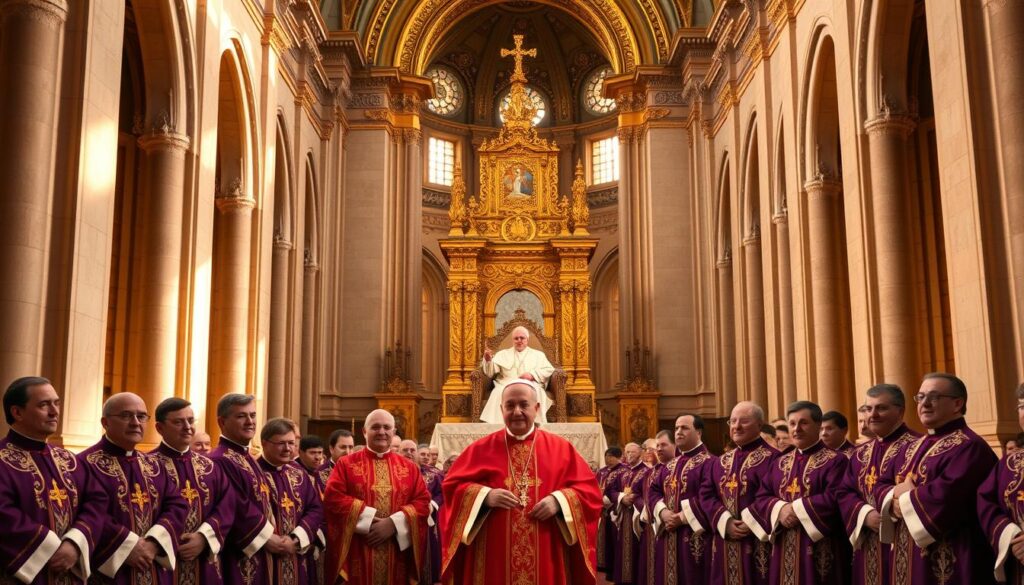
Papal Infallibility and Leadership
The pope serves dual roles as Bishop of Rome and spiritual guide for 1.3 billion believers. Since 1870, his ex cathedra pronouncements on faith/morals carry divine protection from error. As Cardinal Newman observed:
“This safeguard prevents doctrinal drift while respecting cultural diversity in worship.”
This rare power – used only twice since its definition – maintains theological consistency across continents. Bishops reinforce this unity through apostolic succession, tracing their ordination lineage back to Christ’s original apostles.
The Structure of the Holy See and Roman Curia
Vatican City’s 121-acre state houses the Church’s central government. The Holy See operates through:
| Branch | Function | Example |
|---|---|---|
| Roman Curia | Administrative departments | Congregation for Divine Worship |
| Papal Offices | Strategic initiatives | Pontifical Council for Culture |
| Diplomatic Corps | International relations | UN observer status |
Three clergy tiers support this system: bishops governing dioceses, priests leading parishes, and deacons assisting communities. This structure enables both centralized doctrine and localized pastoral care – Mexican mariachi Masses and Polish chant traditions coexist under one global family.
The Seven Sacraments and Spiritual Practices
At the heart of Roman Catholic spirituality lies a dynamic system connecting physical rituals with divine grace. These sacred seven sacraments serve as spiritual milestones, guiding believers from birth through life’s challenges to eternal hope.

Overview of Catholic Sacraments
Each sacrament uses tangible elements to convey spiritual realities. Baptism welcomes infants into faith through water, while Confirmation empowers teens with the Holy Spirit’s gifts. Adults might experience:
- Marriage blessings uniting couples
- Anointing the sick during health crises
- Holy Orders commissioning clergy
The Eucharist remains central to worship, celebrated daily in global parishes. As one priest explains: “Our rituals aren’t magic – they’re God’s love made touchable.”
Significance of Transubstantiation and Worship
During Mass, Catholics believe ordinary bread and wine transform into Christ’s body and blood through transubstantiation. This 13th-century teaching maintains the substance changes while appearances stay unchanged – a mystery mirroring Jesus’ incarnation.
Weekly confession and annual Easter communion obligations reinforce these practices. Modern churches blend ancient traditions with local flavors – think gospel choirs in Baltimore or incense-filled Mexican processions – proving sacraments adapt while keeping core meanings intact.
The Impact of the Protestant Reformation
The 16th century shook Europe’s spiritual foundations as thinkers like Martin Luther nailed revolutionary ideas to church doors. This movement didn’t just challenge practices – it reshaped how millions understood faith itself. Let’s explore how these changes created lasting divisions while pushing the Roman Catholic Church to clarify its core teachings.
Key Figures and Doctrinal Shifts
Reformers targeted issues like indulgence sales and leadership abuses. Luther’s 95 Theses argued salvation came through grace alone, not payments. John Calvin expanded these ideas, stressing God’s sovereignty. Their Five Solas became battle cries:
- Scripture Alone over church authority
- Faith Alone replacing ritual-based salvation
Contrasts Between Belief Systems
The Roman Catholic response reaffirmed tradition’s role alongside scripture. While Protestants saw justification as God’s one-time declaration, Catholics taught it as an ongoing process needing human cooperation. Sacraments remained vital channels of grace, contrasting with Protestant emphasis on personal faith.
These debates birthed new Christian traditions while deepening doctrine discussions. Today, many find common ground, yet 500-year-old questions about authority and salvation still shape religious dialogues.
FAQ
What defines the Roman Catholic Church’s authority?
The Roman Catholic Church teaches that its authority comes from Jesus Christ, passed down through apostolic succession. The Pope, bishops, and sacred tradition work together to uphold teachings and guide spiritual life.
How do the seven sacraments shape Catholic practice?
Sacraments like Baptism, Eucharist, and Confirmation are seen as visible signs of God’s grace. They mark key moments in a believer’s journey, fostering a deeper connection to faith and community.
What caused divisions during the Protestant Reformation?
Figures like Martin Luther challenged doctrines such as papal authority and justification by faith. These debates led to lasting contrasts in worship, scripture interpretation, and church structure between Catholics and Protestants.
Why is the Pope considered infallible in certain teachings?
Papal infallibility applies only when the Pope speaks ex cathedra on matters of faith or morals. This doctrine reinforces unity and ensures clarity in core beliefs, rooted in centuries of tradition.
How does Catholic worship differ from other Christian traditions?
Catholic liturgy emphasizes rituals like the Mass, which includes the Eucharist (believed to involve transubstantiation). Saints, Mary, and sacraments also play a central role, unlike many Protestant services.
What role do bishops play in the Catholic Church?
Bishops oversee dioceses, teach doctrine, and preserve unity with the Pope. They act as successors to the Apostles, ensuring continuity in leadership and spiritual guidance worldwide.