Imagine a story spanning two thousand years, beginning with a small group of followers in ancient Judea. What started as a grassroots movement weathered Roman persecution, doctrinal debates, and global expansion to become one of humanity’s most enduring institutions. This journey reveals how faith shaped empires, inspired art, and connected cultures across continents.
From its earliest days, communities gathered around shared beliefs passed down by apostles. Early followers faced immense challenges, including waves of persecution under Roman rule. Yet by the 4th century, this growing spiritual force became the empire’s official religion – a turning point that reshaped Europe’s political and cultural landscape.
The medieval period saw the Church emerge as a unifying force during fragmented times. Missionaries traveled uncharted lands while scholars preserved knowledge through turbulent eras. However, internal tensions led to pivotal moments like the 11th-century division between Eastern and Western traditions, followed centuries later by the Reformation’s seismic impact.
Modern transformations include landmark councils that redefined engagement with the contemporary world. Through every era, leaders balanced ancient traditions with evolving societal needs. Today, over 1.3 billion people identify with this global community, demonstrating its lasting relevance across shifting historical currents.
Key Takeaways
- Origins trace back to 1st-century teachings with continuous growth across 20 centuries
- Survived early persecution to become Rome’s state religion in 380 CE
- Major divisions include the East-West split (1054) and Protestant Reformation (1517)
- Councils like Trent and Vatican II addressed critical challenges through reforms
- Maintains core traditions while adapting to modern global realities
- Influenced art, education, and governance patterns worldwide
Apostolic Foundations and Early Beginnings
At the heart of the catholic church lies a transformative story that began in a humble Judean town. Historical records place Jesus’s birth around 4 BC in Bethlehem, during a time of Roman dominance. His teachings, rooted in compassion and spiritual renewal, sparked a movement that would reshape the ancient world.
Ministry of Jesus and the Origins
Around 28-29 AD, Jesus began his public work by gathering twelve devoted followers. These Apostles witnessed miracles and learned principles later recorded in the New Testament. Peter stood out as their leader, entrusted with guiding the growing community after Jesus’s crucifixion around 30-33 AD.
The Role of the Apostles in Early Christianity
Following Jesus’s resurrection, the Apostles faced a critical mission. At Pentecost, a powerful spiritual experience empowered them to spread their message globally. Peter’s first sermon drew thousands, proving ordinary people could build an extraordinary legacy.
The Great Commission – Jesus’s call to teach all nations – became their driving force. Through persecution and cultural barriers, this small group planted seeds for what’s now the world’s largest religious community. Their courage shows how personal conviction can ignite lasting change.
The Apostolic Age and Early Church Martyrdom
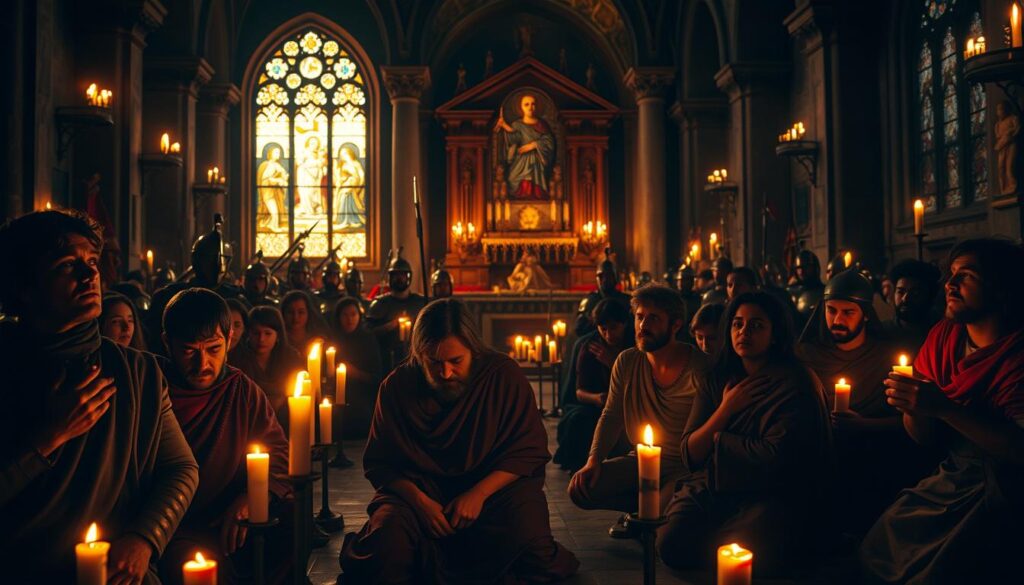
Fire tested faith in Christianity’s first century. Followers faced brutal opposition while planting spiritual roots across hostile lands. Their sacrifices became cornerstones for a movement that would outlive empires.
Foundations Forged Through Sacrifice
Stephen’s stoning in 34 AD marked a grim milestone. As the first recorded martyr, his death proved faith could withstand violence. This pattern continued as Roman authorities targeted believers.
Paul’s dramatic transformation reshaped the church. Once a persecutor, he became its most driven missionary. His journeys between 46-67 AD established communities from Antioch to Rome:
| Leader | Contribution | Legacy |
|---|---|---|
| Peter | Unified Jewish/Gentile believers | First pope tradition |
| Paul | Wrote 13 New Testament letters | Spread faith beyond Judaism |
| Stephen | Modeled martyr courage | Inspired later saints |
Nero’s brutal crackdown after Rome’s fire (64 AD) claimed both Peter and Paul. Their executions near the empire’s heart showed no person was safe. Yet their work thrived – Linus continued leading believers within three years of their deaths.
“I have fought the good fight, I have finished the race, I have kept the faith.”
These pioneers built the catholic church on conviction stronger than fear. Their stories remind us how ordinary people changed history through extraordinary commitment.
Formation of the New Testament Canon
How did early believers decide which writings belonged in their sacred texts? This critical process unfolded over 300 years as communities compared teachings with living apostolic traditions. Leaders sought to preserve Jesus’s message while filtering out later additions or distortions.
Emerging Scriptures and Early Writings
By 95 AD, Clement of Rome referenced eight texts we now find in the New Testament. Polycarp expanded this list to fifteen books within thirteen years. These leaders treated apostolic connections as essential – only writings linked to Jesus’s original followers gained traction.
The Muratorian Canon (170 AD) marked a turning point. This early list included 22 books but omitted five later additions like James and Hebrews. Church elders applied three tests:
| Criterion | Purpose | Example |
|---|---|---|
| Apostolic Origin | Verify direct links to Jesus’s circle | Mark’s connection to Peter |
| Doctrinal Harmony | Prevent contradictory teachings | Rejecting Gnostic gospels |
| Widespread Use | Confirm broad acceptance | Paul’s letters read across regions |
Irenaeus strengthened the canon by 185 AD, defending 21 books against rival groups. His work emphasized consistency with oral traditions passed down from the first believers. “Where the Church is,” he wrote, “there is the Spirit of God.”
Final approval came through fourth-century councils. Hippo (393 AD) and Carthage (397 AD) confirmed all 27 books after verifying their roots in apostolic teaching. This careful selection process created a unified foundation for Christian practice worldwide.
The Rise of Church Doctrine and the Council Era
How did ancient debates shape core Christian teachings? The answer lies in groundbreaking meetings where leaders defined essential beliefs. These gatherings established frameworks still guiding millions today.
The First Ecumenical Councils and Creeds
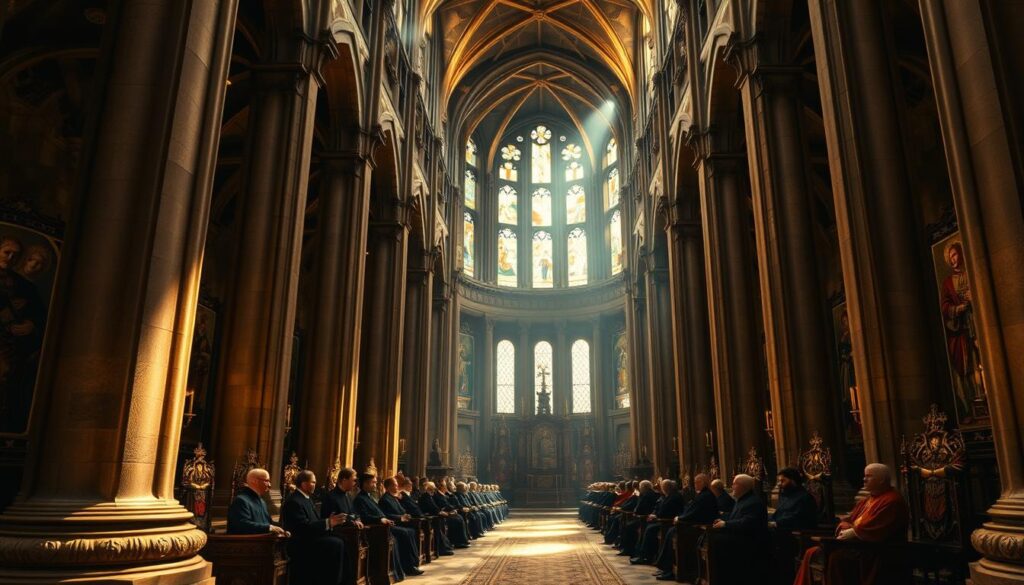
Emperor Constantine summoned 300 bishops to Nicaea in 325 AD. Their task? Settle disputes about Jesus’s divinity. The resulting Nicene Creed became Christianity’s first universal statement, affirming Christ as “true God from true God.”
Later councils built on this foundation. Constantinople’s 381 AD meeting clarified the Holy Spirit’s role. Ephesus (431 AD) tackled how divine and human natures coexisted in Jesus. Each ecumenical council strengthened theological unity across regions.
Defining Doctrinal Boundaries
Chalcedon’s 451 AD gathering produced Christianity’s most precise Christological formula. Leaders declared Jesus “fully divine and fully human” – a paradox still central to church teachings. This definition rejected popular theories separating his dual nature.
These meetings did more than debate ideas. They created systems for resolving conflicts through collective wisdom. As one bishop noted: “Truth prevails when hearts seek understanding together.”
The catholic church emerged from this era with clearer identity markers. While later councils addressed new challenges, these early ecumenical councils set patterns for maintaining unity amid diversity.
The Impact of the Roman Empire on the Church
A single emperor’s decision reshaped religious history forever. When Constantine embraced Christianity, he didn’t just change his faith – he transformed the Roman Empire’s relationship with spiritual communities. This shift created ripple effects still felt in modern religious practice.
Constantine’s Conversion and the Edict of Milan
The Battle of Milvian Bridge in 312 AD became Christianity’s breakthrough moment. According to legend, Constantine saw a blazing cross with the words “In this sign, conquer” before his victory. This vision led him to adopt the Christian symbol as his military standard.
Within a year, the Roman Empire issued its landmark Edict of Milan. The decree stopped centuries of persecution, letting believers worship openly. Churches regained confiscated property, and leaders could finally focus on community growth instead of survival.
Constantine’s support went beyond laws. He donated the Lateran Palace to the church, creating Christianity’s first official headquarters. His funding helped build iconic basilicas that became centers for worship and charity work.
“In this sign, you shall conquer.”
The emperor’s new capital Constantinople (modern Istanbul) became a Christian powerhouse. As the Roman Empire shifted eastward, this city nurtured theological developments for generations. Constantine’s actions blended political strategy with spiritual vision, setting patterns for church-state relations that endure today.
Medieval Growth and the Shaping of Catholic Authority
The medieval period transformed spiritual leadership into a cornerstone of European society. As political structures shifted, religious institutions became vital centers of stability. One visionary leader emerged to reshape both worship practices and social responsibility.
Architect of Enduring Systems
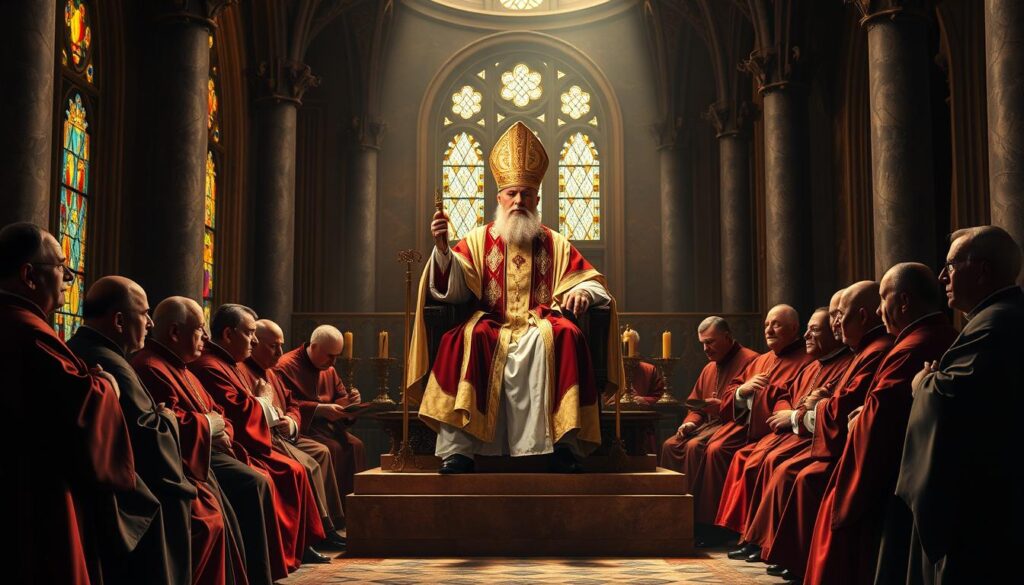
Gregory I took the papal office in 590 AD amid crisis. His 14-year leadership established frameworks still used today. The church became a powerhouse of organization through three key strategies:
| Reform Area | Action | Lasting Impact |
|---|---|---|
| Administration | Centralized property management | Funded hospitals & aid programs |
| Liturgy | Standardized musical worship | Gregorian chant endures 1,400 years |
| Language | Mandated Latin (600 AD) | Unified European scholarship |
| Doctrine | Defined Purgatory (593 AD) | Shaped afterlife concepts |
| Missions | Sent monks to England (596 AD) | Converted Anglo-Saxon kingdoms |
Gregory believed true leadership served others. He sold church treasures to feed famine victims, declaring: “When we relieve the poor, we give them what is theirs, not ours.” His 595 AD decree banning enslavement of converts showed unprecedented social vision.
“The care of souls is the art of arts.”
Through these reforms, the catholic church became Europe’s moral compass. Gregory’s work proved faith could inspire both beautiful worship and practical compassion. His legacy reminds us that lasting change requires both vision and attention to daily needs.
Key Moments in the catholicism history timeline
Throughout the centuries, pivotal gatherings and bold reforms have sculpted the Church’s path. These turning points reveal how spiritual leaders balanced ancient traditions with emerging challenges.
When Unity Sparked Transformation
The ecumenical council tradition began shaping doctrine in 325 AD. Centuries later, the Council of Trent (1545-63) answered Reformation challenges through education reforms and clarified sacraments. This gathering revitalized spiritual practices while preserving core teachings.
Major divisions also drove change. The 1054 East-West split created distinct traditions, yet recent dialogues show growing reconciliation. Meanwhile, Vatican II (1962-65) reimagined engagement with modern society – allowing Mass in local languages and interfaith cooperation.
From the Nicene Creed to social justice teachings, these milestones prove adaptability strengthens enduring values. Today’s global community continues this legacy – addressing new questions while honoring two millennia of shared wisdom.
FAQ
How did the apostles shape early Christian communities?
The apostles, like Peter and Paul, spread Jesus’ teachings across the Roman Empire. They established churches, ordained leaders, and defended the faith during persecution, laying the groundwork for the Church’s growth.
Why was Constantine’s conversion significant for the Church?
Constantine’s embrace of Christianity in 312 CE led to the Edict of Milan, which legalized the faith. This ended widespread persecution and allowed the Church to grow publicly, influencing doctrine and governance.
What role did the Council of Trent play in Catholic doctrine?
The Council of Trent (1545–1563) addressed Protestant reforms by clarifying teachings on salvation, sacraments, and scripture. It standardized practices and reinforced the Church’s authority during the Counter-Reformation.
How did Pope Gregory the Great impact medieval Catholicism?
Pope Gregory I (590–604) reformed liturgy, promoted monasticism, and strengthened papal authority. His missionary efforts, like sending Augustine to England, expanded the Church’s reach across Europe.
When was the New Testament canon officially recognized?
The canon was largely settled by the 4th century, affirmed by councils like Carthage (397 CE) and Rome (382 CE). It solidified the 27 books as inspired scripture, guiding worship and teaching.
What caused the East-West Schism of 1054?
Theological disputes, like the Filioque clause, and tensions over papal authority led to the split. The mutual excommunication of Rome and Constantinople divided Christianity into Catholic and Orthodox branches.
How did Vatican II modernize the Church?
The Second Vatican Council (1962–1965) introduced reforms like Mass in local languages, ecumenical dialogue, and a renewed focus on lay participation. It aimed to make the Church more accessible in a changing world.