How has one of the world’s oldest institutions maintained its influence across continents? Over the past century, the Catholic community has grown from 291 million to over 1.3 billion members, according to Vatican records. This growth reflects not just spiritual devotion but also shifting cultural landscapes.
Recent studies by the Pew Research Center show this faith now represents nearly half of all Christians worldwide. While Europe once dominated these numbers, today’s believers are increasingly concentrated in Africa, Asia, and Latin America. These changes reveal fascinating patterns about migration, birth rates, and societal values.
Tracking these trends helps us understand broader global dynamics. Organizations like the World Christian Database highlight how demographic shifts impact everything from humanitarian efforts to political alliances. The church’s role extends beyond spirituality—it shapes education, healthcare, and community development worldwide.
Why does this matter? Whether you’re studying cultural evolution or planning international programs, recognizing these patterns offers valuable insights. Let’s explore how centuries-old traditions adapt to modern realities while maintaining their core identity.
Key Takeaways
- Catholic membership tripled since 1910, reaching 1.3 billion by 2021
- Represents 48% of Christians globally despite geographic redistribution
- Major growth now occurs in Africa and Latin America instead of Europe
- Pew Research and Vatican sources provide complementary data
- Demographic shifts influence cultural and policy decisions worldwide
Historical Foundations and Global Expansion
From its roots in ancient Mediterranean communities to modern megachurches, the Catholic Church has built a unique organizational framework. This network connects diverse traditions through shared leadership while preserving local practices.
Early Growth and Legacy
The church’s structure emerged gradually. Early Christians organized around bishops, with the Bishop of Rome gaining prominence as a unifying figure. By the 4th century, this system helped spread teachings across Europe and North Africa.
What makes this institution stand out? Unlike other ancient organizations, it blended centralized leadership with cultural flexibility. Missionaries adapted rituals to local customs while maintaining core beliefs.
Evolution of Church Structure
Today’s Catholic Church operates as a federation of 24 autonomous churches. The Latin Church forms the largest group, while 23 Eastern Catholic Churches preserve ancient Syrian, Byzantine, and Coptic traditions. All recognize the Bishop of Rome’s authority.
Vatican II reshaped perspectives in the 1960s. Leaders declared Eastern communities “true Churches” rather than just ritual variants. This affirmed their equal status while strengthening global unity.
The World Christian Database notes this structure enabled remarkable resilience. Through political changes and social revolutions, the church maintained schools and hospitals worldwide. Its 200,000+ institutions serve communities regardless of religious affiliation.
Demographic Shifts in the Catholic Church
What does a century of global change look like for a faith community? Between 1910 and 2010, Catholic membership tripled to 1.1 billion people, yet their share of humanity barely shifted. This balancing act—growing exponentially while keeping pace with worldwide trends—reveals unexpected resilience.
Comparative Trends Over the Century
In 1910, nearly half of all Christians identified with this tradition. Fast-forward 100 years: that figure held steady at 50%, even as Christianity spread to new regions. “The consistency is staggering,” notes a Pew Research Center report. “Like running alongside a speeding train without falling behind.”
Europe’s role changed dramatically. Once home to two-thirds of followers, it now accounts for just 24%. Meanwhile, Latin America quietly became the anchor—holding steady at 39% of the global total since 1910. Researchers credit higher birth rates and cultural integration for this shift.
Tracking these patterns isn’t simple. Political upheavals and evolving census methods create gaps in historical records. The Pew Research Center combines surveys, sacramental registries, and migration data to build accurate models. Their work shows how faith communities mirror broader societal changes—from industrialization to urbanization.
Why does this century-long view matter? For planners and policymakers, it highlights durable cultural forces. While membership numbers rise and fall, the Church’s proportional presence acts like a compass—steady amid humanity’s stormy seas.
Regional Distribution of catholicism population
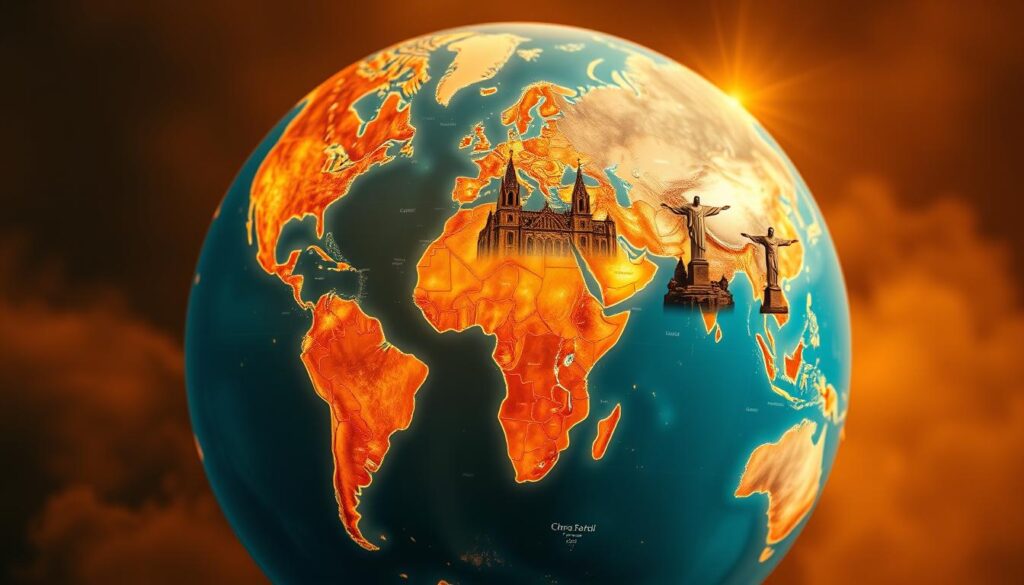
The global map of faith communities has been redrawn. Where once European cathedrals defined this tradition, today’s vitality pulses through tropical rainforests and bustling Asian cities.
Powerhouses of the Global South
Latin America and the Caribbean now anchor nearly 40% of all followers. Brazil and Mexico alone account for over 200 million believers. Cultural integration explains much of this endurance—festivals like Mexico’s Día de los Muertos blend indigenous practices with spiritual traditions.
Africa’s growth story astonishes demographers. From just 1% in 1910, the continent now hosts 171 million followers. The Democratic Republic of Congo exemplifies this shift, rising from colonial-era missions to Africa’s third-largest Catholic community.
Changing Dynamics in Established Regions
Europe’s share halved since 1910, though cultural influence remains strong. Meanwhile, the Asia-Pacific region tripled its percentage. The Philippines stands out—its 86 million members make it the world’s third-largest Catholic country.
North America’s growth comes primarily through migration. Key patterns include:
- Spanish-speaking communities reinforcing US membership
- Canadian parishes adapting to multicultural cities
- Urban centers becoming hubs for diverse traditions
These shifts shape global priorities. As one Vatican observer noted: “Our leadership tables now need maps that stretch beyond Rome’s cobblestone streets.”
Key Factors Influencing Growth and Decline
Understanding why faith communities grow or shrink requires looking beyond numbers. Economic shifts, cultural evolution, and human movement all shape religious landscapes in surprising ways.
Socioeconomic and Cultural Drivers
Urbanization and education often reshape spiritual connections. In Brazil, Catholic identification fell from 74% to 65% in just ten years as cities expanded. Similar patterns emerged in Mexico, where better access to education correlated with changing beliefs.
Women’s empowerment plays a crucial role. As families delay marriage and prioritize careers, traditional religious practices often adapt. “Modern life demands new ways to engage,” notes a Rio de Janeiro community leader. “Empty pews push us to rethink outreach.”
Migration and Changing Identities
Cross-border movement reshapes religious demographics dramatically. Over half of U.S. immigrants identify with this tradition, creating vibrant multicultural parishes. Nearly 30% of American members today were born elsewhere—triple the national average.
This diversity brings both energy and challenges. Second-generation immigrants often blend customs from their parents’ homeland with local practices. Meanwhile, evangelical groups and secular worldviews compete for attention in crowded spiritual marketplaces.
These dynamics show how faith intersects with public life. From education policies to healthcare initiatives, understanding these shifts helps communities stay relevant in changing times.
Impact on Public Life and Global Culture
Beyond Sunday services, Catholic institutions shape daily life for millions worldwide. From classrooms in Manila to clinics in Nairobi, these organizations bridge gaps where governments struggle to reach.
Education, Healthcare, and Social Services
The Church operates 1 in 5 global schools, serving over 60 million students annually. Its healthcare network treats 120 million patients each year through:
| Institution Type | Global Count | Primary Regions |
|---|---|---|
| Hospitals | 5,000+ | Africa, Latin America |
| Elementary Schools | 95,000 | Asia, Europe |
| Orphanages | 10,000 | Global South |
These efforts create ripple effects. In the Philippines, Catholic schools train 75% of public school teachers. Brazilian church-run clinics provide free care to 12 million annually. “We don’t ask for baptism certificates,” notes a Nairobi hospital director. “Our doors open to all.”
The Holy See’s diplomatic ties amplify this work. Through 183 country agreements, it coordinates disaster relief and refugee support. Recent partnerships helped deliver COVID vaccines to 45 nations.
Cultural influence appears in unexpected places. Mexico’s healthcare laws mirror Catholic social teachings on human dignity. European climate policies often align with Vatican environmental statements. This global footprint shows how faith-based networks shape societies far beyond religious practice.
Methodological Insights from Global Data Studies
Why do official numbers tell different stories about the same community? Measuring religious affiliation involves navigating cultural nuances, tax systems, and survey designs. A Pew Research Center analyst explains: “Even basic questions like ‘Are you Catholic?’ mean different things in São Paulo versus Seoul.”

CIA Factbook vs. Pew Research Center Data
Government reports and independent surveys often clash. Germany’s church tax system tracks precise membership records, while Brazil’s estimates vary wildly:
| Data Source | Methodology | Coverage | Sample Case |
|---|---|---|---|
| CIA Factbook | Government reports | Broad estimates | Mexico: 91.89% |
| Pew Research | Surveys | Cultural context | Mexico: 83.9% |
| Latinobarometro | Regional polling | Latin America | Brazil: 57% |
Survey Analysis and Census Comparisons
Question wording changes everything. The phrase “active member” cuts Brazil’s numbers by 11% versus simple affiliation questions. Timing matters too—post-holiday surveys show higher religious identification.
Mexico’s 2010 census revealed a 8% gap versus CIA figures. Researchers attribute this to cultural pride in heritage versus actual practice. As one demographer notes: “In some regions, checking ‘Catholic’ is like checking ‘American’—it’s about identity, not weekly mass.”
Projections and Future Demographic Scenarios
Tomorrow’s spiritual landscape will look radically different. By 2050, nearly half of all followers could live in just ten nations—from Congo to the Philippines—as global membership surpass 1.6 billion. This transformation reshapes how communities worship, organize, and engage with society.
Impact of Immigration Trends
Migration patterns are redrawing faith maps. The U.S. could gain 15 million members by mid-century, fueled by Hispanic communities and African immigrants. Urban centers like Houston and Chicago now host multilingual parishes blending Nigerian hymns with Mexican traditions.
Europe faces contrasting realities. While Germany’s numbers drop 6%, Poland maintains stable membership through diaspora networks. Younger generations increasingly identify with cultural heritage rather than weekly practice—a trend mirrored globally.
Shifts in Global Demographic Power
Africa’s 146% growth surge will make it home to 22% of all followers by 2050. Angola and Uganda join Congo as emerging hubs, while Asia’s 63% rise centers on Filipino and Vietnamese communities. Latin America remains steady, with Brazil and Mexico anchoring 25% of global membership.
These changes challenge traditional leadership models. As one Vatican strategist notes: “Our future requires understanding Lagos as deeply as Lisbon.” The data paints a clear picture—vitality now blooms where diversity meets youthful energy.
FAQ
How large is the global Catholic population today?
Roughly 1.3 billion people identify as Catholic worldwide, making it the largest Christian denomination. Brazil, Mexico, and the Philippines are among the countries with the highest numbers of adherents.
What factors drove the historical growth of Catholicism?
Missionary work, colonization, and cultural integration expanded the Church’s reach. Institutions like schools and hospitals also reinforced its influence, particularly in Latin America and Africa.
How have Catholic demographics shifted in the last century?
While Europe’s share of adherents has declined, regions like sub-Saharan Africa and Asia-Pacific have seen growth. Urbanization and changing birth rates play significant roles in these trends.
Which regions have the strongest Catholic presence today?
Latin America remains the most concentrated region, followed by Europe. Africa’s Catholic community is growing rapidly, while the U.S. maintains a stable but aging demographic.
How do socioeconomic factors influence Catholic growth?
Poverty, education access, and healthcare disparities often correlate with higher adherence. Conversely, secularization in wealthier nations has contributed to membership declines.
What role does the Church play in public life globally?
Catholic institutions operate tens of thousands of schools, hospitals, and charities worldwide. These services often fill gaps in government-provided social support, especially in developing nations.
How reliable are sources like the Pew Research Center for Catholic data?
Pew’s surveys and the CIA World Factbook are widely respected, but methodologies differ. Pew emphasizes self-identification, while census data may undercount unregistered believers.
Could immigration reshape future Catholic demographics?
Yes. Migration from high-growth regions like Africa to secularizing areas like Europe may slow declines. Cultural retention among diaspora communities will also shape these trends.