For centuries, religious traditions have woven themselves into the fabric of daily life across Central Europe. Nearly 1 in 4 residents still identify with a specific faith community, though participation rates tell a more complex story. Recent data shows only 6% of members actively engage in weekly services – a striking contrast to historical norms.
This exploration reveals how centuries-old practices continue influencing modern celebrations, art, and social values. From vibrant Bavarian festivals to quiet village traditions, these cultural fingerprints remain visible even as society evolves. The numbers paint a vivid picture: over 400,000 individuals formally ended their affiliations in 2023 alone.
Regional differences add depth to this narrative. Areas like the Rhineland maintain stronger connections to spiritual heritage compared to urban centers. Meanwhile, former East German regions show markedly different patterns shaped by 20th-century history.
Understanding these shifts helps decode broader European trends. As membership declines but cultural imprints persist, communities grapple with preserving identity while adapting to modern values. This tension forms the heartbeat of today’s social landscape.
Key Takeaways
- 24% of the population maintains formal religious affiliation despite changing practices
- Weekly participation rates have dropped to just 6% among members
- Over 920,000 individuals left their faith communities between 2022-2023
- Cultural traditions remain strong in regions like Bavaria
- Urban areas and former East Germany show distinct secularization patterns
- Historical influences continue shaping modern celebrations and values
Historical Foundations and Cultural Contributions
The roots of Germany’s cultural landscape stretch back through centuries of spiritual influence, where sacred institutions shaped society’s very framework. Monastic communities laid groundwork for modern education—medieval cathedral schools evolved into prestigious universities like Heidelberg and Freiburg. These centers preserved knowledge through political storms, blending faith with academic rigor.
Early Influences and Deep-rooted Traditions
For over 1,000 years, local churches served as community anchors. They established Europe’s first hospitals and orphanages—models for today’s social services. Seasonal festivals like Corpus Christi processions still color town squares, merging faith with regional pride.
An Overview of Catholic Heritage
Pilgrimage routes such as the Cologne-to-Kevelaer path remain cultural touchstones. The 6.848 billion euros collected in 2022 through church tax funds museums, music programs, and historic preservation. This financial muscle sustains traditions even as participation shifts.
| Year | Catholic Membership | Weekly Mass Attendance | Church Tax Revenue |
|---|---|---|---|
| 2003 | 25.5 million | 15.2% | 4.1 billion € |
| 2023 | 19.5 million | 6.2% | 6.8 billion € |
Bishops’ conference reports reveal a stark 20-year trend—6 million fewer members since 2003. Yet the church’s imprint persists in language, art, and labor laws. Its social teachings inspired Germany’s worker protections and market ethics, proving ideas often outlast attendance numbers.
Catholicism in Germany: Cultural Identity and Community Influence
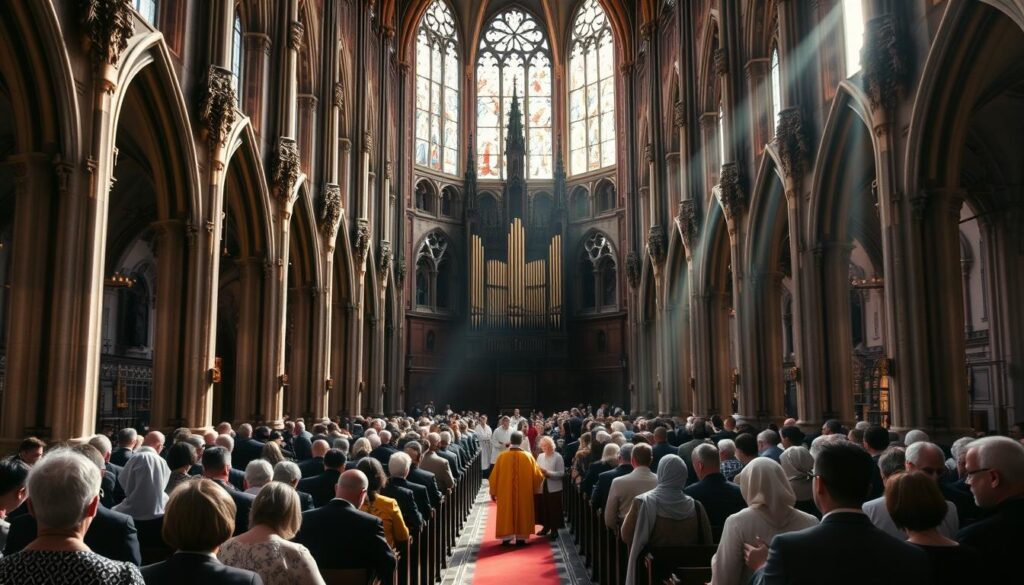
Regional faith practices paint a vivid picture of Germany’s evolving spiritual landscape. Take the Diocese of Görlitz – this border community near Poland boasts a 13.9% Mass attendance rate, nearly triple the national average. Yet just 300 miles west, Aachen’s churches see only 4.2% of members regularly participating. What explains such dramatic contrasts?
The Role of the Church in Shaping National Values
Smaller communities like Görlitz thrive through cultural cross-pollination. Their proximity to Poland’s strong Catholic traditions creates a reinforcing effect. “Shared festivals and pilgrimages keep our identity vibrant,” notes a local parish leader. These areas often blend spiritual practices with regional customs, creating unique expressions of faith.
Urban centers face different challenges. Industrial hubs like Aachen saw factory work reshape community ties. As steel mills replaced village squares, weekly Mass became less central to social life. Still, Catholic ethics influence debates about healthcare reform and climate action – even among non-practicing Germans.
Traditions and Modern Adaptations in Religious Practice
Three key adaptations help churches stay relevant:
- Digital outreach through livestreamed services and faith-based apps
- Contemporary music blending hymns with popular genres
- Interfaith partnerships addressing homelessness and refugee support
Traditional festivals like Corpus Christi processions now draw curious tourists alongside devout worshippers. This cultural crossover keeps ancient rituals alive while introducing them to new audiences. Meanwhile, Catholic schools and hospitals continue serving over 1.2 million students and patients annually – proving institutional influence extends far beyond Sunday services.
Current Trends, Reforms, and Statistical Insights
Modern societal changes are reshaping long-standing religious affiliations across regions. Recent reports from the German Bishops’ Conference show 402,694 members formally exited in 2023—a 23% drop from the previous year’s record numbers. While this suggests slowing departures, deeper challenges persist.
Membership Decline and Shifts in Mass Attendance
Only 38 new priests joined the clergy last year, down from 45 in 2022. This shortage strains communities already grappling with 6.2% weekly attendance rates. Younger members increasingly cite financial concerns, with 9% income-based church tax driving exit decisions.
Impact of Church Tax, Exits, and Synodal Reforms
Three factors dominate departure discussions:
- Tax obligations affecting household budgets
- Ongoing abuse crisis management
- Demands for structural reforms through the Synodal Way
Despite Vatican pushback, German bishops pursue changes to celibacy rules and leadership roles. “People want transparency,” notes a Cologne parish council member. “When institutions feel outdated, exits follow.”
Comparative Analysis of Diocesan Variations
| Diocese | 2023 Exits | Mass Attendance | Priests Ordained |
|---|---|---|---|
| Munich | 51,203 | 5.1% | 7 |
| Cologne | 38,491 | 4.8% | 5 |
| Erfurt | 4,872 | 11.3% | 2 |
Eastern regions like Erfurt show stronger retention, contrasting sharply with western urban centers. Projections suggest church tax payers could halve by 2060, forcing creative solutions for maintaining community services.
Conclusion
As communities navigate modern challenges, spiritual institutions grapple with maintaining relevance while honoring tradition. Bishop Georg Bätzing’s recent statement captures this tension perfectly: “Reforms alone won’t solve the church crisis, but the crisis will worsen without them.” With over 1.7 million exits since 2019, the comprehensive crisis facing these communities demands creative solutions.
Regional differences tell a hopeful counter-narrative. Areas near Poland maintain stronger participation rates, while western cities see faster decline. The bishops conference reports these variations highlight how local culture shapes practice – some dioceses retain triple the national average for services.
Through schools and hospitals, the church still impacts daily life for millions. Nearly 1.2 million students attend faith-based institutions yearly. This institutional presence ensures cultural influence persists even as membership numbers drop.
The Synodal Way reforms attempt to balance modern values with tradition. While tensions remain about governance changes, these efforts show communities adapting rather than disappearing. As the next decade unfolds, this evolution will shape how historical institutions contribute to contemporary identity.
FAQ
How has Catholicism shaped Germany’s cultural identity?
The faith’s influence spans centuries, embedding traditions like Christmas markets, Easter customs, and regional festivals into daily life. Monasteries and cathedrals also stand as architectural symbols of its historical role in shaping art, education, and social values.
Why are many Germans leaving the Catholic Church?
Recent scandals, debates over reforms, and the mandatory church tax have driven a surge in exits. Over 522,000 people formally left in 2022 alone, reflecting frustration with institutional policies and declining trust in leadership.
What role does the church tax play in membership trends?
Members pay 8–9% of their income tax as a church fee, which funds diocesan operations. However, this system has become contentious, with many opting to leave officially to avoid the financial burden amid broader disagreements with the church’s direction.
How are dioceses addressing declining engagement?
The German Bishops’ Conference has initiated synodal reforms focusing on transparency, lay participation, and modernizing teachings. Some dioceses experiment with digital services or relaxed Mass formats, though progress remains uneven across regions.
Are Catholic traditions still relevant in modern Germany?
While sacraments like baptisms or weddings retain cultural significance, weekly Mass attendance has dropped below 10%. Younger generations often blend traditional practices with personal spirituality, reflecting a shift toward individualized faith expressions.
How does Germany’s Catholic crisis compare to other countries?
Exit rates here outpace many European nations, partly due to the unique church tax system. However, debates over clergy abuse, gender equality, and governance reforms mirror global challenges facing the Vatican’s authority.