Nearly eight out of ten people in the country identify with the Roman Catholic faith, according to recent national surveys. This spiritual connection stretches back over five centuries, weaving itself into the fabric of daily life and national celebrations. From vibrant festivals honoring local saints to community-driven social programs, the Church’s presence remains a cornerstone of cultural identity.
The relationship between religious institutions and public life has evolved dramatically since colonial times. Early missionaries blended European traditions with indigenous practices, forming unique rituals still celebrated today. Modern congregations continue adapting ancient customs to address contemporary needs, creating a living tradition that bridges generations.
Local parishes and dioceses form an extensive network supporting communities across the nation. Over 90 regional church districts coordinate efforts ranging from education initiatives to disaster relief programs. This organized structure enables rapid response to social challenges while maintaining deep local roots.
Key Takeaways
- Over three-quarters of the population identifies with the dominant faith tradition
- Historical blending of European and native practices created distinct cultural expressions
- Church networks provide essential community services nationwide
- Ongoing adaptation maintains relevance in modern social contexts
- Balancing tradition with contemporary issues shapes current religious dynamics
Introduction to Catholicism’s Influence in Mexico
With over 15,700 priests and 46,000 religious workers nationwide, the Catholic Church maintains one of Mexico’s most extensive community networks. This spiritual organization operates through 90 regional districts, creating a web of support that touches education, healthcare, and neighborhood initiatives. Its presence can be seen in the cobblestone plazas of small towns and the grand cathedrals lining Mexico City’s historic center.
What This Guide Reveals
Our exploration uncovers how religious traditions became embedded in local culture over centuries. You’ll discover how Sunday masses interweave with mariachi music, and why street processions transform cities into open-air celebrations. We’ll show how family values and community ethics stem from centuries-old teachings.
Your Journey Through Faith and Culture
Expect to uncover surprising connections between historic events and modern practices. From revolutionary-era church reforms to today’s youth programs, you’ll see how adaptation keeps this religion relevant. We’ll examine architectural marvels built by early missionaries and explore how digital tools now spread spiritual messages.
This guide doesn’t just recount history – it highlights living traditions shaping modern life. You’ll gain insights into how festivals unite neighborhoods and why home altars remain central to family routines. Through vivid examples, we reveal the enduring influence shaping Mexico’s social fabric.
Historical Origins and Colonial Beginnings
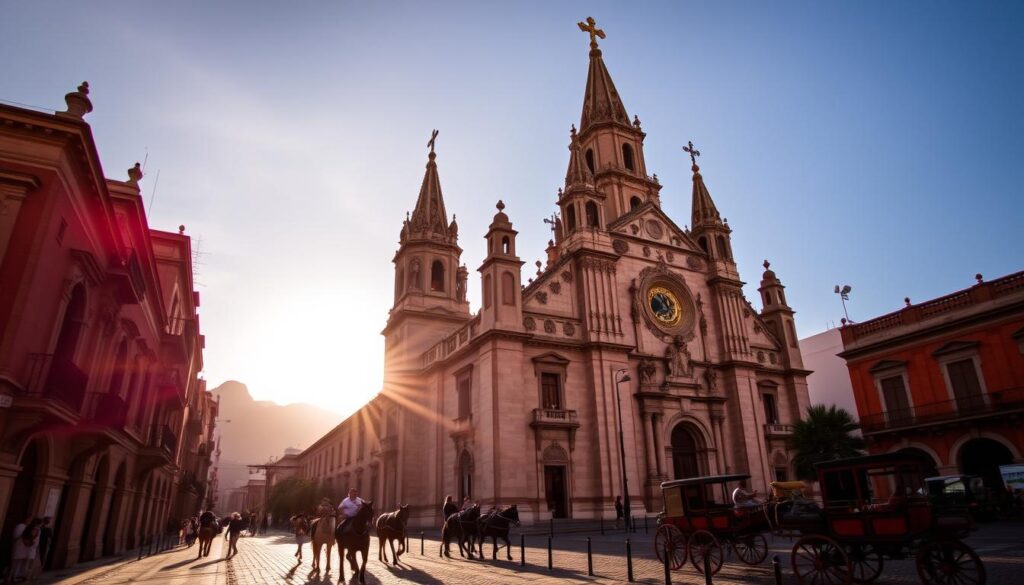
Spanish authorities quickly realized that converting indigenous groups required more than military might – it demanded cultural adaptation. The 16th-century arrival of European missionaries marked a seismic shift, blending spiritual goals with government agendas. Conquistadors and priests worked side by side, using both swords and crosses to establish colonial control.
The Arrival of Catholicism with the Spanish Conquest
Spain’s Patronato Real system granted monarchs direct power over religious affairs. This arrangement let the crown appoint bishops and fund clergy while expanding political influence. Early church leaders like Bishop Juan de Zumárraga became key figures in reshaping local traditions through converted temples and new rituals.
The Role of Early Missionaries and Orders
Franciscan friars pioneered conversion efforts starting in 1524, followed by Dominicans and Augustinians. These priests learned native languages and created hybrid practices – mixing European teachings with local customs. Their institutions formed networks of doctrinas that served as spiritual and community hubs for centuries.
This transformative period established patterns still visible today. By building worship spaces atop sacred sites and blending belief systems, missionaries laid foundations for a unique religious identity. Their work during this critical century shaped how communities balance tradition with external influences.
The Spiritual Conquest and Evangelization Efforts
A pioneering group of twelve Franciscan priests landed in 1524, marking the start of organized religious transformation. Known as the Twelve Apostles of Mexico, these friars launched what historians call the “spiritual conquest” – a cultural reshaping through faith and education.
Strategies of Three Major Orders
The Franciscans, Dominicans, and Augustinians received strong government support to establish churches across New Spain. Royal authorities understood that converting indigenous people strengthened political control. Missionaries learned local languages and redesigned sacred spaces, often building new chapels where temples once stood.
Bernardino de Sahagún set a powerful example by documenting Aztec traditions while creating Nahuatl-language catechisms. This bilingual approach helped priests bridge cultural gaps. Beyond spiritual work, the orders founded 120 hospitals within a century, showing their commitment to community support.
Each group claimed specific regions – Franciscans worked crowded central areas, Dominicans moved south, and Augustinians headed north. Their coordinated efforts created lasting networks of churches, schools, and social services that still influence community structures today.
Transformation Through the Colonial Era
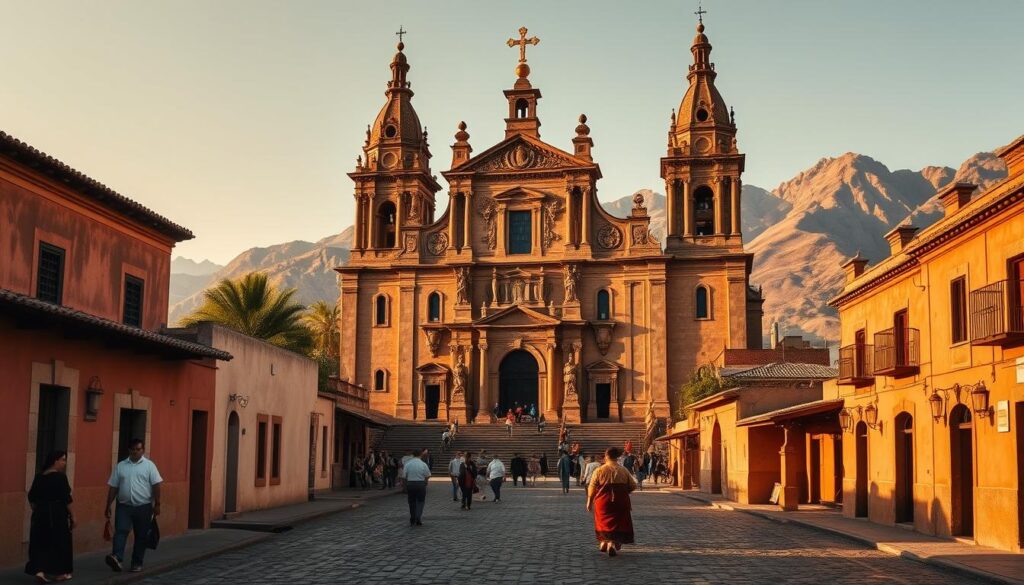
Colonial-era stone buildings still dot urban landscapes, silent witnesses to a foundational chapter in societal development. Between 1550 and 1800, religious organizations built networks that shaped daily routines and community bonds. These structures weren’t just places of worship – they became hubs for education, healthcare, and civic record-keeping.
Establishment of Church Institutions
Mexico City emerged as the nerve center of this transformation. The Royal Indian Hospital, operating from 1553 to 1822, exemplified the church’s growing role in public welfare. “The colonial church became the spine of society – it educated, healed, and documented lives,” notes historian Elena Martínez.
Pedro Moya de Contreras’ 1573 appointment as archbishop marked a turning point. As the first non-mendicant leader, he symbolized the shift from temporary missions to permanent systems. Diocesan priests now managed:
| Institution | Services Provided | Duration |
|---|---|---|
| Royal Indian Hospital | Healthcare for indigenous communities | 269 years |
| Monastery Schools | Basic education & religious training | 1540s-1821 |
| Parish Networks | Birth/death records, marriage counseling | Ongoing |
By 1600, religious orders controlled 30% of urban properties. Spanish-born and local priests formed a powerful class influencing politics and land management. Their legacy lives on through fiesta traditions and neighborhood solidarity practices still common today.
Liberal Reforms and Church-State Conflicts
Mid-19th century Mexico witnessed a dramatic clash between progress and tradition as liberal leaders reshaped national governance. The 1857 Constitution sparked heated debates by stripping religious groups of land ownership rights and special legal protections. This bold move aimed to modernize society but triggered decades of political tension.
Impact of the Reform Laws on Church Privileges
New regulations hit religious institutions like a thunderbolt. The government seized control of marriage records and banned clergy from running schools. Special church courts vanished overnight, leaving legal matters entirely in state hands. By 1860, over 25% of national property had shifted from religious to public management.
The Shift in Power Dynamics
These changes flipped centuries-old power structures. Conservatives fought fiercely to protect traditional church-state relations, even supporting armed rebellions. The Reform War (1857-1861) saw clergy backing military groups against President Benito Juárez’s administration.
| Aspect | Pre-Reform Era | Post-Reform Era |
|---|---|---|
| Property Ownership | Churches held 40% of land | State-controlled property sales |
| Education | Religious schools dominant | Secular public schools created |
| Legal Authority | Separate church courts | Unified civil court system |
This conflict set patterns for future clashes between religious and secular leaders. Though tensions eased eventually, the reforms established clear boundaries that still shape modern governance. As historian Carlos Fuentes noted, “The 1857 Constitution didn’t just change laws – it redefined what it meant to be a Mexican citizen.”
Mexican Catholic Traditions and Folk Customs
Colorful altars in homes blend ancient symbols with sacred icons, telling stories of cultural fusion. This blending of worlds creates living traditions where faith wears local dress and speaks in regional dialects. Communities celebrate spiritual connections through rituals that honor both ancestral roots and adopted teachings.
Syncretism with Indigenous Beliefs
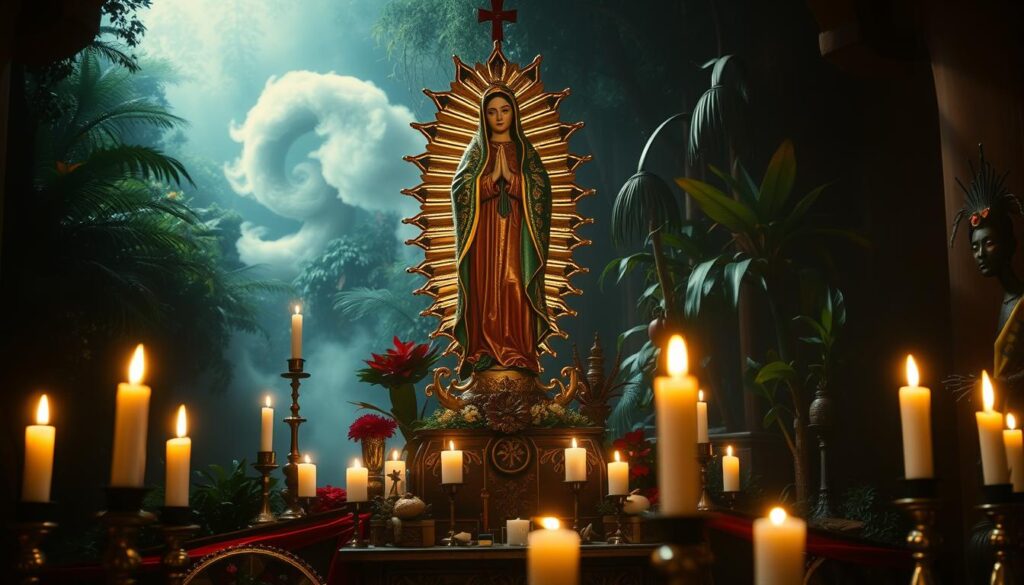
The Lady of Guadalupe embodies this cultural merger like no other symbol. Her 1531 appearance to Juan Diego transformed a hillside into a national shrine, merging Nahua cosmology with Marian devotion. Today, her image graces everything from taxi dashboards to concert halls, uniting Mexican people across generations.
Local churches showcase this blend through architecture and art. Carved stone facades often feature corn motifs beside crosses, while interior murals might depict saints wearing traditional textiles. “These spaces aren’t just buildings – they’re visual dialogues between worlds,” observes cultural anthropologist Dr. Isabel Ríos.
| Element | Pre-Columbian Origin | Modern Practice |
|---|---|---|
| Day of the Dead | Miccailhuitontli festival | All Saints’ Day altars with marigolds |
| Healing Rituals | Temazcal sweat lodges | Blessings with holy water & herbs |
| Harvest Celebrations | Offerings to Tlaloc | Saint Isidore processions |
Family traditions keep this fusion alive. Children learn to arrange marigold petals around saint statues while elders recount origin stories. Seasonal festivals pulse with pre-Hispanic drum rhythms beneath church bell carillons, creating soundscapes that defy simple categorization.
“Our spirituality flows like two rivers merging – you can’t separate the waters once they’ve joined.”
This dynamic interplay continues evolving. Young artists reimagine the Lady of Guadalupe in street murals, while urban people adapt ancestral rituals for apartment living. The result remains unmistakably Mexican – a testament to enduring cultural creativity.
Organizational Structure of the Catholic Church in Mexico
At the heart of Mexico’s religious framework lies a hierarchical organization spanning from bustling cities to remote villages. Eighteen ecclesiastical provinces form the backbone of this system, each containing multiple dioceses that serve distinct cultural regions. This structure allows both centralized coordination and local adaptability.
Dioceses, Archdioceses, and Local Parishes
Mexico City serves as the spiritual capital, home to the country’s primary archdiocese led by the archbishop of Mexico. Over 6,000 parishes operate nationwide, staffed by more than 15,000 active priests. These local churches act as community anchors, hosting events from Sunday masses to neighborhood festivals.
Eastern and Regular Jurisdictions
Special jurisdictions accommodate unique traditions within the Catholic Church. The Armenian Catholic Apostolic Exarchate and Maronite Catholic Eparchy preserve Eastern rites in Mexico City and beyond. Military ordinariates separately serve armed forces members, demonstrating the church’s flexible approach to diverse needs.
This multilayered system balances ancient traditions with modern demands. Young priests train alongside digital outreach teams, while historic cathedrals share streets with contemporary worship spaces. Through this adaptive structure, the church maintains its vital role in communities across the nation.
FAQ
How did the Catholic Church first arrive in Mexico?
The Church came with Spanish conquistadors like Hernán Cortés in the 16th century. Missionaries followed, aiming to convert Indigenous populations through evangelization efforts.
Which religious orders played key roles in early evangelization?
Franciscans, Dominicans, and Augustinians led the spiritual conquest. They built missions, schools, and churches while blending European traditions with local customs.
How did Indigenous beliefs mix with Catholic practices?
Syncretism emerged as communities merged pre-Hispanic rituals with Christian symbols. For example, Our Lady of Guadalupe became a unifying figure tied to Indigenous identity.
What caused conflicts between the Church and Mexican government?
The 19th-century Reform Laws stripped the Church of land and political power. Tensions peaked during the Cristero War (1926–1929) over anti-clerical policies.
How is the Church organized in Mexico today?
It’s structured into dioceses and archdioceses, like Mexico City’s Metropolitan Archdiocese. Local parishes and Eastern Catholic jurisdictions also serve diverse communities.
Why is Our Lady of Guadalupe significant in Mexican culture?
Her 1531 apparition symbolizes unity between faith and Indigenous heritage. Millions celebrate her feast on December 12, reflecting deep cultural and spiritual pride.