For over 500 years, spiritual traditions have shaped daily life across Central and South America. From vibrant festivals to community values, these practices created a distinct identity merging European customs with native heritage. Today, this legacy faces new challenges as societies evolve.
Nations like Brazil and Mexico still lead globally in adherent numbers, yet church attendance continues to decline. Recent legal shifts reveal deeper changes – Argentina’s 2010 same-sex marriage law, Chile’s 2022 equality reforms, and growing reproductive rights debates show shifting priorities among younger generations.
Nearly half of all global followers reside here, making the area crucial for understanding worldwide religious trends. This unique position creates tension between preserving traditions and embracing modern social values. How communities navigate this balance impacts education, politics, and family structures.
Key Takeaways
- Central and South America host nearly 40% of worldwide adherents to this faith tradition
- Brazil and Mexico remain key strongholds despite decreasing participation rates
- Legal changes on marriage equality and health choices signal cultural shifts
- Historical blending of European and native practices created unique local identities
- Regional developments influence global religious leadership and policy discussions
Introduction: Setting the Stage for Latin America and Catholicism
Centuries of cultural blending have forged a unique spiritual landscape across Central and South America. What began with European arrival in the 1500s evolved into a complex fusion of traditions, where imported rituals merged with local customs. Today, 57% of people in these regions still identify with the dominant faith – a sharp drop from 90% in the 1970s.
Overview of Historical and Contemporary Context
Early colonizers used religious institutions to reshape societies, creating a framework that still influences education and governance. Over generations, communities adapted imported traditions to fit local realities. This led to regional variations – from Mexico’s vibrant patron saint festivals to Brazil’s Afro-influenced celebrations.
| Era | Key Development | Modern Impact |
|---|---|---|
| 1500s-1800s | Forced conversions & mission systems | Baseline for national identities |
| 1900s | State-church separation movements | Legal frameworks for pluralism |
| 2000s | Rise of secularism & rival faiths | Shifting family structures |
Purpose and Scope of the Trend Analysis
This examination combines hard data with cultural insights to map evolving spiritual trends. We’ll explore:
- How urbanization affects traditional practices
- Youth attitudes toward inherited beliefs
- The political power of religious institutions
“The real story isn’t in pew counts, but in how people reinvent traditions to meet modern needs.”
By analyzing census reports alongside festival attendance records, we reveal tensions between official doctrine and lived experiences. This approach helps decode why some communities cling to old ways while others embrace change.
Historical Roots of Catholicism in Latin America
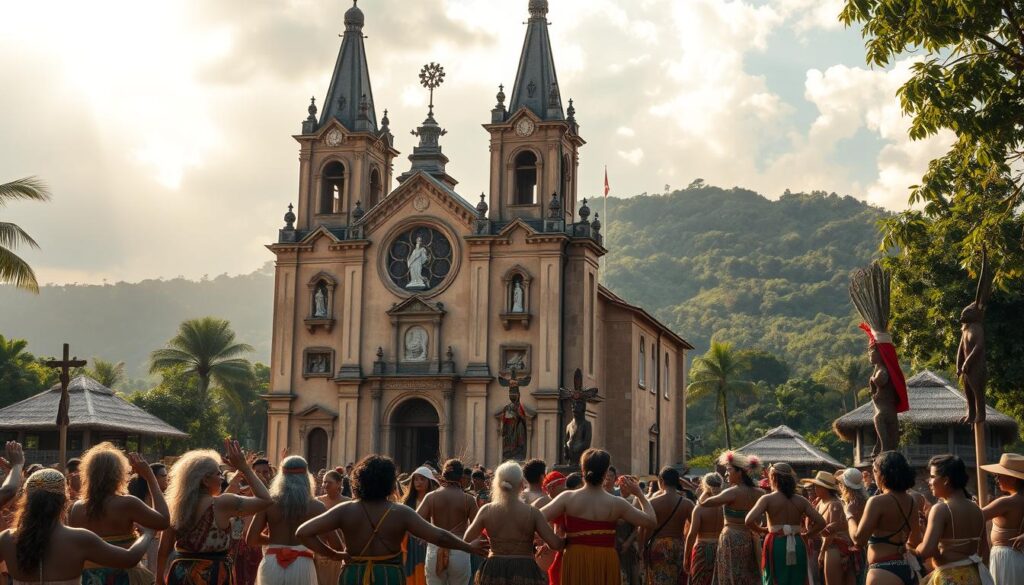
When Spanish ships first reached American shores, they carried swords and sacred texts in equal measure. This dual approach shaped a religious landscape still visible today across many catholic countries.
Colonial Power and Religious Expansion
Conquistadors viewed faith conversion as vital to claiming new territories. Mass baptisms became common – one priest reportedly “christened” 4,000 people in a single day. Names changed, but deeper understanding rarely followed.
Pope Paul III’s 1537 decree created loopholes for blending traditions. Indigenous converts could keep certain spiritual practices if they attended weekly services. This flexibility allowed ancestral rituals to survive beneath surface-level observances.
Missionary Methods and Cultural Blending
Early friars faced fierce resistance. Cuban chief Hatüey’s last words – “I choose hell to avoid Christians” – reveal the violent pushback against forced conversions. Yet over years, a unique fusion emerged:
- Native harvest festivals merged with saint days
- Local deities gained Christian identities
- Sacred spaces became church grounds
“We plant the cross where their idols stood, but their hearts keep old shadows.”
Regional differences flourished due to Spain’s patchwork rule. Some areas enforced strict orthodoxy, while remote villages developed hybrid traditions that still form part of daily life. This uneven legacy explains today’s diverse religious expressions across the region.
Demographic Shifts and the Decline of Traditional Catholic Adherence
Numbers tell a striking story across the region. A decade of surveys reveals rapid changes in spiritual identification, reshaping what many considered unshakable foundations.
Statistical Trends from Brazil, Mexico, and Argentina
Brazil’s Catholic population sank from 66% to 55% between 2010-2020. At this pace, the world’s second-largest Catholic nation could lose its majority status within years. Mexico’s 9-point drop represents over 10 million people distancing from inherited faith.
Argentina’s collapse stuns observers most. Nearly half the population (49%) now identifies differently – a 27-point plunge in ten years. Even historically devout nations like Guatemala and El Salvador report minority Catholic populations.
- U.S. Latino Catholics fell 10% (2009-2019)
- Uruguay’s affiliation rate sits at 34%
- Chile reports similar declines
What drives this shift? Urbanization plays a role, but deeper many reasons emerge. Younger generations criticize institutional responses to inequality and scandals. “We want communities, not cathedrals,” notes a São Paulo focus group participant.
These trends ripple beyond latin american countries. As the percentage catholics shrinks in traditional strongholds, global religious leadership faces new pressures. The data signals not just changing beliefs, but evolving views on family, justice, and personal choice.
The Rise of Evangelicalism and Changing Moral Landscapes
A spiritual revolution is reshaping communities from Rio de Janeiro to Guatemala City. New beliefs are gaining ground as Evangelical churches redefine spiritual life for millions. This shift carries profound implications for social norms and governance.
Comparative Growth Trends and Conservative Values
Brazil’s Evangelical population exploded from 3% to 22% in 20 years – some estimates suggest 30%. Guatemala saw even steeper growth, with 41% now identifying as Evangelical Christians. These changes mirror rising conservative views:
| Country | 2000 | 2020 |
|---|---|---|
| Brazil | 3% | 22% |
| Guatemala | 19% | 41% |
Neo-Pentecostal groups attract people through messages addressing daily struggles. “These churches speak to my worries about safety and making ends meet,” shares Maria, a shopkeeper in São Paulo.
Impact on Social and Political Domains
Evangelical forces now shape elections and laws. Brazil’s 2018 presidential race saw overwhelming support for candidates promoting traditional family practices. Similar patterns emerge across the region:
- 54% of Brazilians supported conservative policies by 2016
- Guatemalan lawmakers proposed strict abortion bans
- Chile debates morality education in schools
“We’re not just changing churches – we’re reclaiming our culture.”
This transformation reflects deeper searches for identity. As urban populations grow, many latin americans find new faith communities offering certainty in uncertain times.
catholicism latin america – Cultural Identity and National Holidays
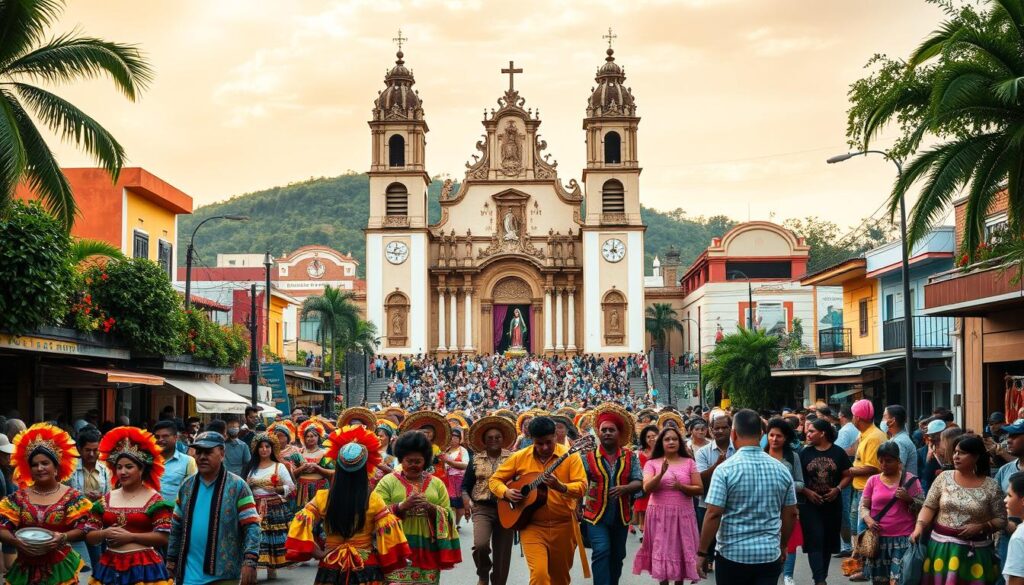
The rhythm of the year in many regions is marked by centuries-old celebrations blending faith and folklore. From Mexico’s bursting piñatas to Colombia’s candlelit processions, these holidays form the heartbeat of shared heritage. Even non-religious residents often join festivities that define their national identities.
Preservation of Tradition Through Religious Celebrations
December 12th transforms cities across american countries into seas of glowing candles and mariachi music. The Lady of Guadalupe festival draws millions, mixing indigenous dances with Catholic rituals. Colombia’s nine-night Christmas tradition (La Novena) shows how communities reinvent customs:
| Celebration | Unique Feature | Social Impact |
|---|---|---|
| Semana Santa | Elaborate street carpets | Boosts local tourism |
| St. Joseph’s Day | Father-child bonding rituals | Strengthens family ties |
| Immaculate Conception | Nighttime lantern parades | Fosters neighborhood unity |
Influence on Latin American National Identities
These holidays act as cultural glue, especially for diaspora communities. A Venezuelan baker in Miami explains: “Making hallacas during Holy Week keeps our roots alive.” Governments recognize this power – Mexico spends $15 million annually on Guadalupe festivities.
While formal catholicism declines, 78% in latin american countries still attend major religious festivals. The shared meals, music, and stories during these events shape what it means to belong. As one Guatemalan teen notes, “It’s not about church – it’s about who we are.”
Indigenous Spirituality and the Syncretism of Beliefs
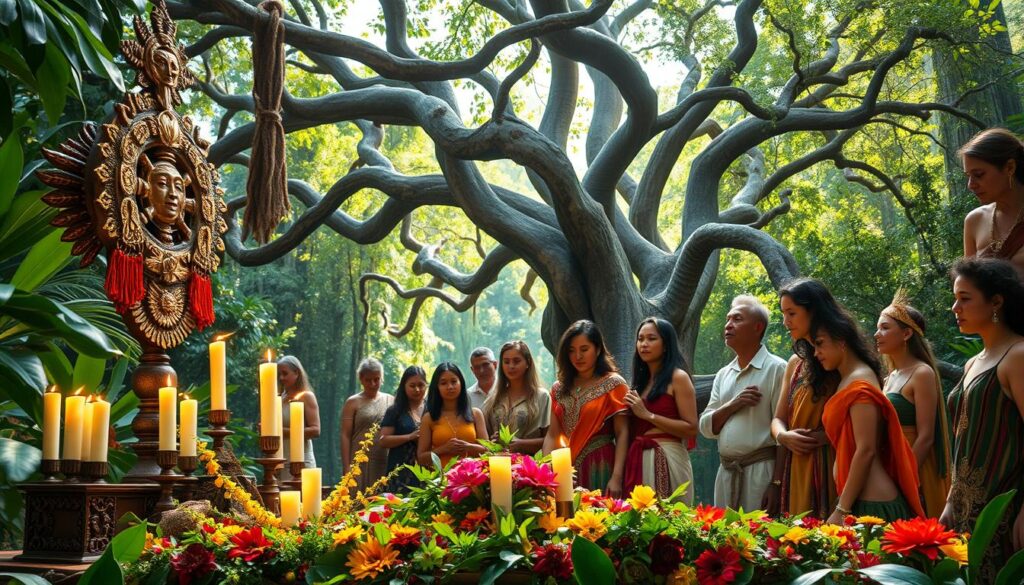
Beneath the surface of modern traditions lies a vibrant tapestry woven from ancient roots and colonial influences. Communities developed creative ways to preserve ancestral spiritual practices while adopting new forms of worship. This blending created living traditions that honor multiple histories.
Blending Ancient Rituals with Catholic Practices
Spanish missionaries often turned local sacred sites into churches, but people found clever ways to maintain old customs. In many cases, native ceremonies merged with saint days. The Aztec festival honoring Mictecacihuatl, goddess of death, evolved into Día de los Muertos – now celebrated with Catholic prayers and marigold altars.
Three key elements define this fusion:
- Sacred spaces serving dual purposes
- Shared symbols like candles and incense
- Oral traditions preserving origin stories
Living Examples of Cultural Merging
The Lady of Guadalupe stands as the ultimate syncretic figure. Millions visit her Mexico City basilica annually, yet scholars note her resemblance to Tonantzin – an Aztec mother goddess. Farmers still bless seeds with pre-Hispanic chants before Mass, showing how rituals adapt across generations.
“We don’t choose between traditions – we carry them all in our hearts.”
From Guatemala’s kite festivals to Bolivia’s Pachamama offerings, these blended beliefs shape daily life. They prove that spiritual identity can thrive through adaptation, creating something entirely new from old roots.
Political and Social Influence of Catholic Traditions
Policy decisions across the region still echo with centuries-old spiritual convictions. Religious institutions maintain surprising sway in education systems and healthcare access, shaping laws that affect millions. Recent debates show this enduring impact – from Mexico’s abortion legislation to Chile’s school curriculum reforms.
Shaping Policies Through Community Ties
In many Latin communities, local clergy still advise lawmakers on family and morality issues. Guatemala’s 2022 adoption reforms and Brazil’s welfare programs both reflect church-backed values. Yet younger activists increasingly challenge these norms, pushing for secular approaches in public policy.
Recent surveys reveal a divide: 63% of Argentines support church-state separation, while rural areas favor traditional alliances. This tension plays out in courtrooms and classrooms alike. As one Bogotá council member notes, “Our laws must respect heritage and modern realities.”
The balance between old traditions and new priorities continues to evolve. While religious groups lobby for influence, many Latin American governments now prioritize diverse voices in policy-making. This shift reshapes everything from environmental regulations to women’s rights initiatives.
FAQ
How did Catholicism become so dominant in the region?
The faith arrived with European colonizers in the 16th century, blending with local traditions through missionary efforts. Over generations, it became central to social structures and cultural identity across nations like Mexico and Peru.
Are fewer people identifying as Catholic today?
Yes—countries such as Brazil and Argentina have seen gradual declines. Shifting demographics, urbanization, and the growth of other spiritual movements contribute to this trend, though many still engage with traditions tied to the faith.
Why are evangelical groups gaining followers?
Evangelical communities often emphasize personal connections, adaptability to modern values, and grassroots outreach. Their growth reflects changing priorities, especially among younger generations seeking relatable practices.
How do holidays reflect blended beliefs?
Celebrations like Día de los Muertos mix pre-colonial rituals with Catholic symbolism. Similarly, Our Lady of Guadalupe represents a fusion of Indigenous narratives and imported traditions, shaping unique national identities.
Does the Church still influence politics there?
While its direct power has waned, it remains a voice in debates like abortion laws or social justice. In some areas, clergy actively shape policies, reflecting enduring ties between faith and governance.
What role do Indigenous practices play today?
Many communities maintain ancestral customs alongside formal rituals. This syncretism appears in healing ceremonies, festivals, and art—showcasing resilience against centuries of cultural pressure.