How does a faith rooted in mercy approach society’s most challenging moral questions? This guide explores one of the most debated topics in modern ethics through the lens of a timeless spiritual tradition. At its core lies a profound belief: every person’s worth remains unshaken, even when confronting acts that shock the conscience.
For centuries, religious leaders have balanced two principles—state authority to protect communities and the sacredness of human existence. Pope John Paul II crystallized this balance in 1999: “A society that values life must seek justice without repeating violence.” Modern teachings urge nations to prioritize non-lethal methods of protection wherever possible.
This evolving stance reflects deeper truths about redemption and responsibility. While recognizing governments’ role in maintaining order, contemporary guidance emphasizes that legal rights don’t always align with moral imperatives. The journey from theory to practice reveals how ancient wisdom adapts to new understandings of justice.
Key Takeaways
- Human dignity remains central to ethical evaluations of justice systems
- Modern teachings strongly favor alternatives to lethal punishment
- Church doctrine distinguishes between legal rights and moral obligations
- Protection of society and rehabilitation are prioritized over retribution
- Historical context shapes current interpretations of moral responsibility
Foundations of Catholic Teaching on the Death Penalty
Exploring the roots of justice in sacred texts reveals evolving moral priorities. Early scriptures present tension between communal safety and mercy—a balance that shaped centuries of ethical debate.
Scriptural Insights and Tradition
Genesis tells us God protected Cain after history’s first murder. “The Lord put a mark on him so no one would kill him” (Genesis 4:15). This act of preservation contrasts with later Old Testament laws permitting strict penalties.
Jesus shifted the focus toward compassion. When religious leaders tested Him regarding a woman’s adultery, He challenged them: “Let the sinless throw the first stone”. New Testament letters later instructed communities to respect governing authority while upholding life’s sacredness.
| Biblical Era | Approach to Crime | Moral Emphasis |
|---|---|---|
| Old Testament | Eye for eye | Social order |
| New Testament | Turn the cheek | Personal redemption |
| Early Church | Civil obedience | Communal harmony |
Historical Perspectives from Church Fathers
St. Augustine acknowledged governments might need severe measures. Yet he warned: “Punishment should heal, not destroy”. Centuries later, Thomas Aquinas outlined three tests for capital punishment:
- Only state leaders may decide
- Crime must threaten society’s survival
- Guilt must be beyond doubt
These thinkers shaped a tradition valuing both human person dignity and community protection. Their insights continue guiding modern debates about justice systems and moral responsibility.
Evolving Church Teachings and Modern Context
The journey toward protecting life has reshaped modern religious guidance. Leaders now emphasize that justice must evolve alongside society’s capacity for mercy.
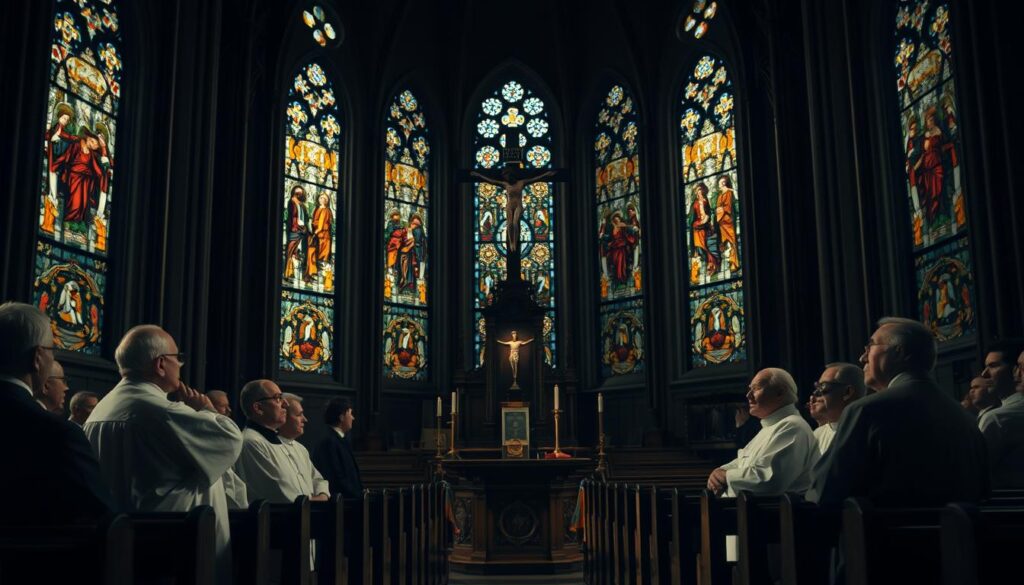
Papal Visionaries: From Theory to Practice
John Paul II’s 1995 encyclical Evangelium Vitae marked a turning point. He wrote:
“Punishment should not eliminate the possibility of redemption.”
His stance grew from witnessing oppressive regimes misuse power—experiences that deepened his commitment to human dignity.
This perspective influenced the Catechism of the Catholic Church. It shifted from acknowledging state authority to stressing non-lethal solutions. Improved prison security became a key factor, making extreme measures unnecessary.
New Standards for New Possibilities
Pope Francis advanced this thinking in 2018. He declared the death penalty “inadmissible” because better systems exist to protect communities. Father Joseph Waters notes this wasn’t a reversal but a “natural growth” of existing teachings.
Modern nations now have tools like:
- Maximum-security prisons
- Advanced monitoring technology
- Rehabilitation programs
These developments fulfill John Paul II’s vision—society can uphold justice without taking life. The Church’s teachings continue adapting, proving ancient wisdom can meet modern challenges.
Catholicism Death Penalty: The Faith Perspective on U.S. Justice Reform
In a nation grappling with justice reform, faith communities offer moral clarity on life’s value. For 25 years, the U.S. Conference of Catholic Bishops has urged leaders to reject lethal measures, stating:
“A society that values life must seek justice without repeating violence.”
Their call reflects a growing recognition that modern systems can protect without taking lives.
The Role of Church Teaching in Modern Public Policy
Catholic institutions shape legislative debates through three key strategies. They partner with lawmakers to draft bills promoting rehabilitation, host interfaith dialogues about restorative justice, and mobilize congregations to support policy changes. Seven states have abolished capital punishment since 2018, often citing moral arguments from faith leaders.
The USCCB’s 25-year campaign emphasizes that life imprisonment achieves public safety without irreversible consequences. Archbishop José Gomez recently noted: “We can’t teach killing is wrong by killing.” This principle guides efforts to redirect funds from execution costs to victim support services.
Societal Impact and U.S. Legislative Trends
Public support for the death penalty has dropped 21% since 2000, with 60% now favoring alternatives. Catholic advocacy contributes to this shift through education about racial disparities and wrongful convictions. Families of victims increasingly speak out, echoing bishops’ guidance that “no execution mends broken hearts.”
Recent federal proposals mirror Church teachings by pushing for:
- Elimination of mandatory minimum sentences
- Expansion of mental health courts
- Funding for trauma-informed policing
Pope Francis’ 2018 declaration against capital punishment energized these efforts, proving ancient wisdom remains relevant in modern policy debates. As one senator remarked: “Faith doesn’t write laws—it lights the path to better ones.”
Ethical Challenges and Considerations in Capital Punishment
When justice systems confront irreversible decisions, moral tensions surface. How do societies uphold accountability while honoring the inherent dignity of every individual? This dilemma sits at the heart of debates about final sentences.

Moral Dilemmas and the Value of Human Dignity
The Church teaches that “no act erases a person’s worth”. Even those convicted of terrible acts retain their human dignity—a truth complicating support for permanent punishments. DNA evidence has freed 189 wrongfully convicted individuals since 1989, proving justice systems can fail catastrophically.
Racial disparities amplify these concerns. Federal data shows African Americans face capital punishment charges 2.7 times more often than white defendants for similar crimes. Such patterns challenge claims of equal justice.
Justice, Mercy, and the Fine Line Between Vengeance and Protection
Restorative approaches seek healing over retaliation. As one exoneree stated:
“An execution ends all chances for truth to emerge.”
This perspective aligns with teachings emphasizing redemption’s possibility, even in darkness.
State-sanctioned execution also impacts communities. Prison chaplains report lasting trauma among staff involved in lethal procedures. Meanwhile, 74% of murder victims’ families prefer life sentences, finding closure through accountability without violence.
Modern justice systems now face a critical question: Can protection coexist with mercy? Emerging alternatives like mental health courts demonstrate societies can address crime while preserving life’s sanctity—a balance echoing ancient wisdom for new times.
Conclusion
Faith communities continue shaping society’s moral compass through timeless truths. Catholic teaching maintains that defending human dignity requires rejecting lethal measures, even when addressing grave wrongs. This stance isn’t about excusing harm—it’s about affirming life’s sacredness in every circumstance.
Modern justice systems now have tools to protect communities without permanent punishments. As the USCCB notes, ending capital punishment often happens through daily choices: jurors opting for life sentences, lawmakers funding rehabilitation, and citizens demanding fairer policies. These efforts align with a vision where safety and mercy coexist.
Advocating for alternatives doesn’t diminish support for crime victims. Many faith groups partner with survivors, pushing for trauma counseling and restorative programs. This balanced approach honors both accountability and healing.
Building a culture of life means valuing every person’s potential for change. While debates continue, dialogue rooted in mutual respect can bridge divides. Progress lies not in perfect solutions, but in persistently choosing hope over despair.
As society evolves, so does our capacity to protect life while pursuing justice. The path forward challenges us to ask: How can we create systems that reflect our highest ideals? The answer begins with recognizing that true security flows from respecting the worth of all people.
FAQ
What does the Church teach about capital punishment today?
The Catholic Church strongly opposes the use of capital punishment in modern society. Recent teachings emphasize protecting human dignity and promoting rehabilitation over retribution. Pope Francis updated the Catechism in 2018 to declare it “inadmissible” in all cases, reflecting advancements in justice systems that prioritize life.
How have papal leaders shaped this stance?
St. John Paul II called for ending executions in his encyclical Evangelium Vitae, urging societies to defend life “from conception to natural death.” Pope Francis expanded this, linking opposition to the death penalty with broader social justice efforts, such as prison reform and addressing systemic inequality.
Why did the Church’s position evolve over time?
Earlier teachings permitted capital punishment as a last resort to protect society. However, modern advancements in secure detention and restorative justice reduced the need for extreme measures. The Church now emphasizes mercy, viewing every person as capable of redemption through God’s grace.
How does this teaching influence U.S. policy debates?
Catholic leaders actively advocate against executions, partnering with interfaith groups to push for legislative bans. Bishops highlight racial disparities and wrongful convictions in the justice system, urging lawmakers to prioritize humane alternatives that align with the common good.
What ethical issues arise with capital punishment?
It raises moral concerns about irrevocable harm, the risk of executing innocents, and whether vengeance undermines justice. The Church stresses that true healing comes from addressing root causes of crime while respecting the sacredness of every life, even those who commit grave wrongs.
How can individuals apply these teachings practically?
Catholics are encouraged to support victim advocacy programs, educate others about restorative justice, and contact elected officials to oppose executions. Prayer, volunteering, and promoting fair sentencing laws are tangible ways to uphold human dignity and foster mercy in communities.