At the heart of a global religious community stands a figure recognized by over 1.3 billion followers. This leader serves as both spiritual guide and organizational anchor, bridging ancient traditions with modern challenges. The role traces its roots to Saint Peter, whom believers view as the first appointed successor by Jesus.
Today’s church governance centers on the bishop of Rome, who holds authority through apostolic succession. This concept ensures continuity from Peter’s ministry, symbolized by the “Keys of Heaven” described in scripture. Elected in 2025, Leo XIV now guides the institution through 21st-century complexities while preserving core teachings.
Understanding this position requires exploring its dual nature: part ancient tradition, part living administration. From shaping moral frameworks to addressing global crises, the office adapts without losing its foundational identity. We’ll unpack how historical events reshaped its influence and why it remains pivotal in faith communities worldwide.
Key Takeaways
- The bishop of Rome leads as both spiritual figurehead and organizational leader
- Apostolic succession links modern leadership to Saint Peter’s original ministry
- Papal elections follow time-honored traditions updated for contemporary needs
- Church governance balances ancient doctrine with modern societal challenges
- Global influence stems from both religious authority and diplomatic engagement
Historical Foundations of the Papacy
Long before grand cathedrals, humble gatherings in Roman homes planted seeds for what would become a global religious office. Early believers met in secret, sharing teachings passed down from Jesus’ closest followers. This network of communities would shape leadership patterns for centuries.
Early Christian Beginnings
First-century followers organized under presbyter-bishops who led local groups. Rome gained importance through its connection to martyred apostles. By 180 AD, Irenaeus noted: “Every church must agree with this Church because of its superior origin”.
Archaeologists found a 2nd-century burial site beneath St. Peter’s Basilica. This supports traditions about Peter’s final resting place. Emperor Constantine later built a shrine there, cementing Rome’s spiritual significance.
| Event | Century | Impact |
|---|---|---|
| Peter’s Martyrdom | 1st | Established Rome’s apostolic link |
| Irenaeus’ Writings | 2nd | Defined Roman Church authority |
| Basilica Construction | 4th | Solidified physical legacy |
Apostolic Succession and the Role of St. Peter
The idea of direct succession from Peter gave Roman bishops special status. While historians debate early records, the faith community embraced this continuity. Leaders used this spiritual lineage to unify growing congregations.
By the 3rd century, clear bishop lists appeared. These documents connected each successor to the original apostles. This system helped maintain doctrinal consistency across regions.
St. Peter’s Legacy in Shaping the Church
A fisherman turned foundational leader, Peter’s journey reveals how personal transformation shapes institutional identity. His story begins with a radical call to discipleship, evolving into responsibilities that would define leadership for generations.
The Significance of Peter’s Leadership
Three biblical moments anchor Peter’s unique role. In Matthew 16:18, Jesus renames Simon as “Peter” (meaning “rock”), declaring: “Upon this rock I will build my church.” This passage forms the bedrock of leadership succession claims.
The symbolic keys to the kingdom in Matthew 16:19 represent authority to guide believers. Early Christians saw this as Peter’s mandate to unify communities through decisive spiritual governance. Later leaders inherited this responsibility as successors of St. Peter.
John’s Gospel adds depth with Jesus’ post-resurrection command: “Feed my sheep.” This charge established pastoral care as central to leadership. Modern leaders mirror this through teaching, crisis response, and global outreach.
Peter’s blend of boldness and humility created a leadership template. He walked on water yet denied knowing Jesus. He received divine revelations but needed correction from Paul. This balance of human frailty and spiritual authority remains vital for those guiding the church today.
Exploring the Role of catholicism pope in the Church
Guiding a global faith community requires balancing ancient traditions with modern responsibilities. The Bishop of Rome serves as both spiritual compass and organizational anchor, addressing timeless questions while navigating 21st-century challenges. This dual mission shapes every aspect of church governance and global engagement.
Spiritual Leadership and Servanthood
The Church’s central figure holds multiple titles reflecting varied responsibilities. As “Servant of the Servants of God,” the leader emphasizes humility while exercising authority over matters of faith and morals. This unique combination ensures doctrinal unity across 1.3 billion followers through teaching documents like encyclicals and apostolic letters.
Modern spiritual leadership extends beyond traditional boundaries. Recent leaders have addressed climate change, interfaith cooperation, and social inequality while maintaining core teachings. Their guidance helps believers navigate complex moral landscapes through the Magisterium – the Church’s official teaching authority.
| Traditional Role | Modern Adaptation |
|---|---|
| Doctrinal preservation | Environmental encyclicals |
| Sacramental oversight | Digital outreach initiatives |
| Ecclesiastical governance | Global humanitarian advocacy |
World leaders frequently consult the Holy See on peacebuilding and human rights issues. This advisory role demonstrates how spiritual leadership influences international diplomacy while staying rooted in serving humanity’s needs.
Development Through Early Christianity
As dawn broke on Christianity’s second century, Rome’s church began shaping faith communities far beyond its city walls. Letters like the one sent to Corinth in 96 CE showed leaders stepping into disputes, setting patterns for centralized guidance. This growing influence would redefine how believers navigated spiritual and practical challenges.
Growth of the Roman Church
By 195 CE, Bishop Victor I made a bold move. He cut ties with Eastern churches celebrating Easter on Nisan 14, insisting on Sunday observance. This marked Rome’s first major enforcement of unified practices. Such decisions cemented its role as an arbiter for the wider church.
Influence of Doctrinal Debates
The Arian controversy rocked the 4th-century church. When some leaders denied Christ’s divinity, bishops gathered at Nicaea in 325 CE. Their creed affirmed core teachings while acknowledging Rome’s special position. Emperor Constantine’s support after 313 CE boosted the church’s public role, blending spiritual authority with political weight.
These early struggles built frameworks still used today. From settling calendar disputes to defining orthodox beliefs, Rome’s leaders shaped Christianity’s course. Their actions forged systems that balanced local diversity with centralized doctrine – a legacy enduring through time.
Papacy in Late Antiquity and the Middle Ages
When Rome’s political structures crumbled, spiritual leaders stepped into new roles. The collapse of imperial governance in 476 CE left Western Europe searching for stability. Religious figures gradually became crucial anchors, blending spiritual guidance with practical leadership.
Transitions from Imperial Power to Religious Authority
Pope Gregory I (540-604) transformed church operations during chaotic times. His reforms standardized worship practices and organized food distribution during famines. This practical approach earned him the title “Gregory the Great” – a model for balancing faith and governance.
The year 800 marked a seismic shift. By crowning Charlemagne as emperor, Leo III established that royal authority required church approval. This partnership between throne and altar shaped European politics for centuries.
| Event | Century | Impact |
|---|---|---|
| Gregory’s Reforms | 6th | Strengthened social services |
| Charlemagne’s Coronation | 9th | Linked political power to church blessing |
| Saeculum Obscurum | 10th | Exposed political vulnerabilities |
Dark times followed from 867-1049. Known as the “Age of Shadows,” this period saw multiple leaders deposed or harmed. Yet the office endured, proving its lasting importance in medieval society.
Through these challenges, religious leaders maintained their role as moral guides. Their ability to adapt ensured continued influence across a changing world.
Papal Election: The Conclave Process
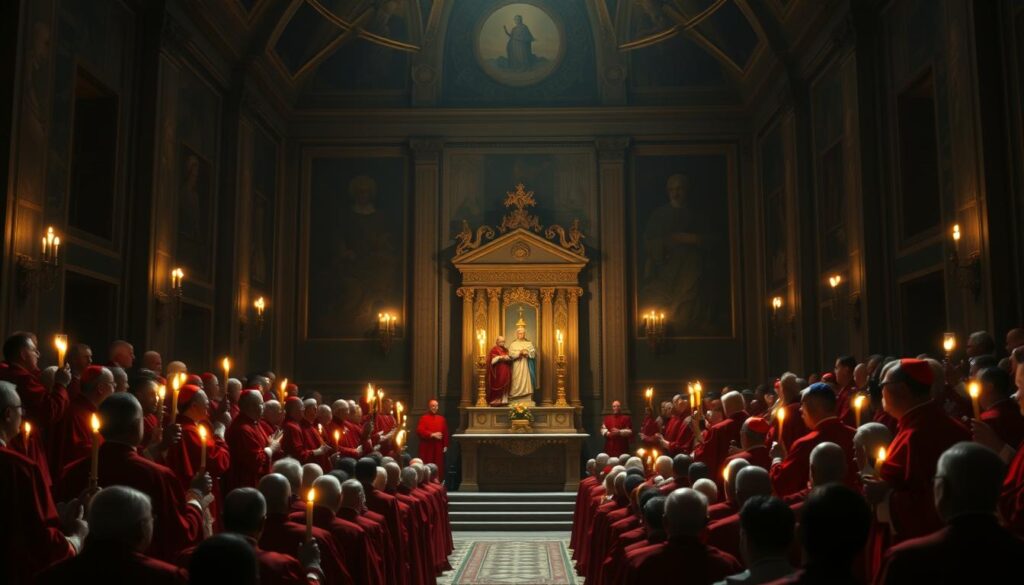
When a spiritual leader’s seat becomes vacant, cardinals embark on a sacred electoral journey steeped in tradition. The conclave—derived from Latin meaning “with key”—requires participants to isolate themselves within Vatican walls until consensus emerges. This centuries-old system blends prayerful reflection with structured decision-making.
Traditions and Rituals in the Conclave
Cardinals under age 80 enter the Sistine Chapel swearing secrecy. Each morning begins with Mass, followed by four voting sessions daily. Ballots bear the phrase “Eligo in Summum Pontificem” (“I elect as Supreme Pontiff”), folded twice before casting.
After each round, ballots burn in a stove with chemicals producing black or white smoke. Black signals no decision; white announces success. The famous chimney becomes the world’s most-watched signal during these events.
The Two-Thirds Majority Requirement
Electors need a two-thirds majority to confirm leadership. This threshold prevents factional splits by requiring broad agreement. If deadlocked after 34 votes, rules permit election by absolute majority—a change made in 2007.
Once chosen, the new leader selects a name reflecting spiritual priorities. The declaration “Habemus Papam!” then introduces him to crowds in St. Peter’s Square, completing one of history’s most consequential transitions of authority.
Symbols, Titles, and Authority of the Pope
Behind every name given to the Vatican’s highest authority lies a story of faith, tradition, and governance. The Holy See’s official directory lists multiple titles that evolved over centuries, each reflecting distinct responsibilities. These designations aren’t just ceremonial—they shape how global communities understand spiritual leadership.
Exploring Ecclesiastical Titles
The title “Bishop of Rome” remains foundational, connecting modern leaders to the city where early apostles witnessed their faith. This designation anchors the Bishop of Rome as both local pastor and global figure. Another key name, “Vicar of Jesus Christ,” underscores the belief in divinely guided stewardship across nations.
Historical records show titles like “Servant of the Servants of God” emerged to emphasize humility amid growing influence. While “pope” is commonly used, it’s formally a less solemn style. The office balances local duties with worldwide guidance—mirrored in titles like “Primate of Italy.” This layered system, rooted in the Bishop of Rome’s ancient role, helps maintain continuity while addressing modern challenges.
FAQ
Why is St. Peter considered the first leader of the Church?
According to tradition, Jesus entrusted Peter with building His Church (Matthew 16:18). Early Christian communities recognized his leadership, and bishops of Rome later traced their authority to this apostolic succession.
How does the conclave process work?
Cardinals gather in Vatican City’s Sistine Chapel to vote in secrecy. A two-thirds majority is required to elect a new leader. Rituals like burning ballots symbolize transparency and the Holy Spirit’s guidance.
What authority does the bishop of Rome hold?
The office teaches on faith and morals, as seen in documents like Pope Leo XIII’s social encyclicals. While respected globally, his role emphasizes spiritual service, not political power.
How did doctrinal debates shape the Church’s growth?
Early councils, like Nicaea, addressed disputes over Christ’s divinity. These debates solidified core teachings, uniting believers under shared doctrines despite cultural shifts.
What symbols represent the Holy See’s leadership?
The Keys of St. Peter, papal tiara, and Fisherman’s Ring symbolize spiritual authority. Titles like “Pontiff” reflect bridging roles between God and humanity.
How did the Second Vatican Council modernize Church practices?
It promoted vernacular Masses and interfaith dialogue, balancing tradition with contemporary needs. Pope John Paul II later expanded its vision through global outreach.
Why is Vatican City significant?
As the world’s smallest independent state, it houses St. Peter’s Basilica and serves as the Holy See’s administrative center. Its sovereignty ensures spiritual independence.