Imagine a spiritual tradition that has shaped art, laws, and daily life for billions over two millennia. The Catholic Church stands as a cornerstone of Christianity, serving 1.4 billion members across 3,500 dioceses worldwide. Its teachings blend ancient rituals with modern outreach, creating a living bridge between past and present.
Rooted in apostolic teachings, this global institution operates through 24 self-governing churches united under shared beliefs. From Rome to rural communities, its structure balances central guidance with local traditions. The Trinity, sacraments, and papal leadership form the bedrock of its doctrine, while social justice initiatives reflect its evolving role in society.
Why does this faith remain influential after 2,000 years? Its ability to preserve core values while adapting to cultural shifts offers part of the answer. Through universities, charities, and artistic patronage, the Church continues shaping education and humanitarian efforts worldwide.
Key Takeaways
- Global spiritual community serving 1.4 billion members
- Operates through 24 autonomous churches and 3,500 dioceses
- Combines ancient traditions with modern social initiatives
- Core teachings include sacraments and papal authority
- Significant historical impact on Western culture and values
Introduction to Catholicism
The story of the Catholic Church begins with twelve ordinary men chosen for an extraordinary mission. In first-century Palestine, Jesus of Nazareth selected his apostles, tasking them with spreading his teachings to all nations. This “Great Commission” launched a spiritual movement that would reshape civilizations.
Origins and Early Church Foundations
Fifty days after Jesus’ resurrection, a transformative event occurred. At Pentecost, the apostles received the Holy Spirit, empowering them to lead the growing Christian community. The Book of Acts records how this small Jerusalem group became the seed of a global church.
| Event | Time Period | Impact |
|---|---|---|
| Appointment of Apostles | 30 AD | Established leadership structure |
| Pentecost | 30 AD | Marked official ministry launch |
| Roman Empire Expansion | 1st-4th Century | Spread teachings across continents |
Purpose of the Ultimate Guide
This resource illuminates how ancient practices evolved into modern faith traditions. You’ll discover:
- How apostolic teachings survived persecution
- The Church’s role in preserving Western history
- Connections between early rituals and today’s sacraments
Whether you’re exploring spiritual paths or studying religious history, this guide offers clear insights into one of humanity’s most enduring institutions.
Understanding the catholicism definition
The roots of the term “Catholic” stretch back to ancient linguistic crossroads. Originating from the Greek katholikos, it blends kata (“concerning”) and holos (“whole”) to mean “universal”. This simple phrase became a revolutionary idea shaping religious identity across continents.
Meaning of “Catholic” in Historical Context
Early Christians used this term to describe their vision of unity. Saint Ignatius of Antioch made history around 110 AD by declaring:
“Wherever Jesus Christ is, there is the Catholic Church.”
This wasn’t just geography – it declared a community transcending borders and cultures.
The church’s universal nature solved practical challenges. As Christianity spread through Roman trade routes, believers needed shared identity markers. Calling themselves katholikos emphasized their connection to global believers while maintaining local practices.
Three key aspects defined this early understanding:
- Unity across diverse communities
- Shared core beliefs despite cultural adaptations
- Commitment to preserving apostolic teachings
This historical context explains why Catholic tradition still values global outreach. From 1st-century house churches to modern megacities, the principle remains: one faith embracing humanity’s rich tapestry.
Historical Evolution of the Catholic Church
The transformation of a small sect into a worldwide institution reveals pivotal moments in religious history. This journey spans two millennia, marked by spiritual growth and challenging divisions.
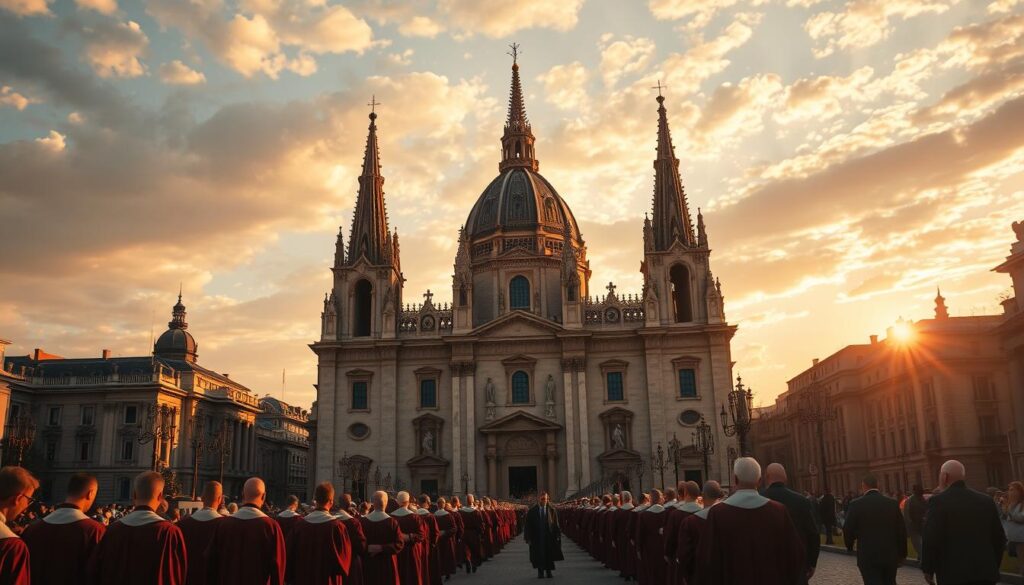
Apostolic Beginnings and Papal Roots
Jesus’ declaration to Peter – “You are Peter, and on this rock I will build my church“ – set the foundation. The bishop of Rome gradually became Christianity’s central figure. By 313 AD, Emperor Constantine’s Edict of Milan ended persecutions, allowing public worship.
Between 350-500 AD, Roman bishops strengthened their authority. They settled theological disputes and standardized practices. This period solidified Rome’s role as the primary seat of Christian leadership.
Key Milestones and Schisms
The church faced its first major split in 1054. Differences in leadership styles and theological debates caused the East-West Schism. Eastern Orthodox Christians formed their own tradition, though both branches kept core beliefs.
Sixteenth-century reformers like Luther challenged practices they saw as outdated. The Protestant Reformation reshaped Europe’s religious landscape. Despite these divisions, the church adapted while preserving ancient rituals.
Three patterns emerge across centuries:
- Centralized leadership under the bishop of Rome
- Balancing tradition with cultural changes
- Maintaining unity through shared sacraments
Through plagues, wars, and social revolutions, this institution demonstrated remarkable resilience. Its history shows how faith communities evolve while keeping core values intact.
The Role of Jesus Christ in Catholic Tradition
At the core of Catholic belief stands a figure who transformed human history through radical love and sacrifice. The church views Jesus Christ not merely as a teacher, but as God incarnate – the living foundation of its spiritual identity.
Life, Teachings, and the Great Commission
Jesus’ three-year ministry reshaped religious understanding. The New Testament Gospels show him healing, preaching, and forming disciples. His final instruction became Christianity’s marching orders:
“Go therefore and make disciples of all nations.”
This command launched global missionary efforts. The Twelve Apostles became the first leaders, laying groundwork for today’s bishops. Their work continues through sacraments like baptism, which initiates believers into the church community.
Jesus’ Influence on Church Doctrine
Catholic teachings draw directly from Christ’s words and actions. Belief in his dual nature – fully human and fully divine – shapes key practices. The Eucharist, for example, celebrates his ongoing presence among followers.
Modern church leaders see themselves continuing Jesus’ mission. They interpret his teachings for contemporary issues, from social justice to bioethics. This living tradition keeps the New Testament message relevant across generations.
Through prayer and scripture study, Catholics maintain personal connections to Christ. This relationship fuels their participation in the church‘s sacramental life and worldwide outreach.
Exploring Key Catholic Doctrines
Three pillars uphold the spiritual framework of Catholic belief. These core doctrines form a roadmap for understanding humanity’s relationship with the divine. At their heart lies the Nicene Creed’s declaration:
“We believe in one God, the Father Almighty… and in one Lord Jesus Christ… and in the Holy Spirit.”
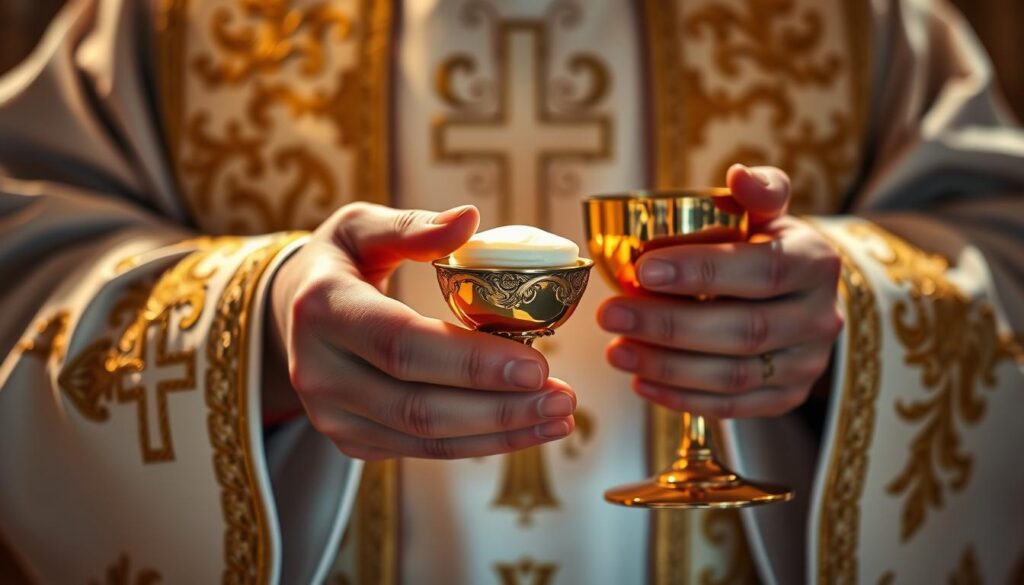
The Trinity, Sacraments, and Redemption
The Trinity reveals God’s nature as three distinct persons sharing one divine essence. This teaching shapes prayers, liturgies, and how believers perceive sacred mysteries. Sunday Mass often begins with the Sign of the Cross – a physical reminder of this triune reality.
Seven sacraments anchor spiritual growth from birth to eternal life. Baptism washes away original sin, while the Eucharist – called the “source and summit” of faith – renews Christ’s sacrifice. During Mass, bread and wine transform completely into his body and blood through transubstantiation.
Redemption flows from Jesus’ crucifixion, offering salvation to all who embrace his teachings. Mary’s veneration as Mother of God underscores her role in this divine plan. Her immaculate conception and assumption into heaven highlight unique privileges within Catholic truth.
Together, these doctrines create a tapestry of belief. They guide personal devotion and collective worship, blending ancient wisdom with enduring relevance for modern seekers.
The Development of Doctrinal Interpretations
Religious teachings aren’t frozen in time—they grow as communities wrestle with life’s big questions. This natural process occurs across faiths, from Buddhism to Baptist congregations. The church approaches doctrinal development like a jeweler polishing a diamond: revealing new facets while preserving its core essence.
How Language Shapes Belief
Take the term “Trinity”—you won’t find it in Scripture, yet it’s central to Christian identity. Early believers needed precise language to describe their experiences of God. Over centuries, theologians crafted definitions that balanced biblical truths with philosophical clarity.
| Doctrinal Term | Century Developed | Impact |
|---|---|---|
| Trinity | 4th | United diverse Christian groups |
| Transubstantiation | 13th | Clarified Eucharist theology |
| Immaculate Conception | 19th | Deepened Marian devotion |
This evolution follows clear patterns. As St. Vincent of Lérins noted in 434 AD:
“True progress means growing in understanding, not changing the message.”
The church uses three safeguards in doctrinal development:
- Scripture as primary foundation
- Consistency with apostolic tradition
- Guidance from authorized teachers
Modern challenges like bioethics show this process in action. By building on ancient wisdom, the church addresses new questions while keeping faith rooted in eternal truths. This living tradition helps believers navigate an ever-changing world.
The Ecclesiastical Structure and Authority
Every thriving organization needs clear leadership – and the world’s oldest continuous institution perfected this over centuries. The Church’s structure combines spiritual authority with practical governance, creating a unique blend of tradition and adaptability.
Guiding Hands: Leadership Roles
The pope serves as both spiritual leader and administrative head. As Bishop of Rome, he succeeds Peter as first among equals in the global bishops’ community. Local bishops govern dioceses – geographic regions averaging 530,000 members each.
This system balances centralized guidance with regional flexibility. The Magisterium (teaching authority) ensures doctrinal consistency across 3,500 dioceses. Bishops collaborate through synods while maintaining autonomy in daily operations.
Decision-Making Through the Ages
Major changes often begin at ecumenical councils. These gatherings of bishops have shaped Church policy since 325 AD. The Roman Curia – essentially the Vatican’s executive branch – implements these decisions through specialized departments:
| Vatican Department | Role | Established |
|---|---|---|
| Congregation for Doctrine | Preserves theological integrity | 1542 |
| Dicastery for Laity | Supports lay ministries | 2016 |
| Council for Economy | Manages financial oversight | 2014 |
This shared authority model lets the current Bishop of Rome maintain unity while dioceses address local needs. From approving saints to funding hospitals, the structure supports both timeless rituals and modern humanitarian work.
Rituals and Sacramental Life in Catholicism
From birth to eternal rest, sacred acts mark key moments in a believer’s journey. These rituals create a spiritual roadmap, blending ancient traditions with personal faith experiences. They transform ordinary actions into encounters with the divine, connecting individuals to a global community.
Overview of the Seven Sacraments
The Church recognizes seven sacraments as channels of divine grace. Baptism welcomes newborns, while Confirmation strengthens teenage commitments. Marriage unites couples, and Anointing supports the ill.
The Eucharist remains central, celebrated weekly as communal nourishment. Through these sacraments, ordinary materials like water and oil become vessels of spiritual transformation.
Liturgical Practices
Seasonal rhythms shape worship through Advent wreaths and Lenten fasts. Sunday Mass follows a structured pattern of readings, prayers, and communion. These liturgical traditions create unity across cultures and generations.
From incense swirls to Easter vigils, sensory elements deepen spiritual connections. This living heritage continues adapting while preserving its core purpose – drawing hearts closer to sacred mysteries.
FAQ
What does "Catholic" mean in historical context?
The term “Catholic” comes from the Greek word katholikos, meaning “universal.” It reflects the belief that the Church, founded by Jesus Christ, is meant for all people and spans across cultures and time. Early followers used it to distinguish their unified faith from regional or splinter groups.
How did the Catholic Church begin?
The Church traces its roots to Jesus’ apostles, particularly Peter, whom Catholics consider the first pope. After Jesus’ resurrection, apostles like Paul spread His teachings across the Roman Empire. Over centuries, councils like Nicaea (AD 325) shaped doctrines, and Rome became a central hub for leadership.
Why is Jesus Christ central to Catholic teachings?
Catholics believe Jesus is both fully divine and human, whose life, death, and resurrection offer salvation. His teachings, like the Sermon on the Mount, and sacraments such as the Eucharist form the foundation of Church practices. His “Great Commission” also inspires evangelization worldwide.
What are core Catholic doctrines?
Key beliefs include the Trinity (Father, Son, Holy Spirit), redemption through Christ’s sacrifice, and the seven sacraments—like Baptism and Communion. The Church also emphasizes Mary’s role as Jesus’ mother and teachings on mercy, justice, and eternal life.
How does the Church handle changes in doctrine?
While core teachings (e.g., the Resurrection) remain unchanged, the Church clarifies doctrines over time through councils, papal encyclicals, and bishops’ guidance. For example, Vatican II (1962–1965) modernized practices like liturgy while preserving tradition.
What role do the pope and bishops play?
The pope, as Bishop of Rome, is seen as Peter’s successor and a unifying leader. Bishops oversee dioceses and work with the pope to uphold teachings. Together with the Magisterium (teaching authority), they ensure doctrinal consistency and address spiritual needs.
Why are sacraments important in Catholic life?
Sacraments like Confirmation and Matrimony are viewed as visible signs of God’s grace. They mark key moments in a believer’s journey, fostering a deeper connection to Christ and the community. The Eucharist, in particular, is central to weekly worship.
How did the Great Commission shape Catholic missions?
Jesus’ command to “make disciples of all nations” (Matthew 28:19) drove early missionaries to spread the Gospel. Today, global outreach—through education, charity, and interfaith dialogue—continues to reflect this mission of sharing faith and serving others.