What happens when dramatic artistry meets timeless faith? For centuries, striking visual styles and spiritual traditions have merged in unexpected ways. This fusion creates a cultural tapestry that sparks curiosity and wonder across generations.
Many don’t realize how deeply intertwined these two worlds became after Rome’s fall. Early European tribes played a key role in shaping this relationship. Their embrace of new beliefs laid the groundwork for artistic and philosophical traditions that still resonate today.
Modern audiences often see these elements as opposites—one edgy, the other traditional. But look closer, and you’ll find shared themes of mystery, symbolism, and transformation. Cathedrals with soaring arches and stained glass tell stories just as powerfully as contemporary creative expressions do.
This article explores how history, art, and spirituality intersect in surprising ways. We’ll uncover hidden connections in literature, architecture, and even today’s media. Get ready to see familiar ideas through a fresh, thought-provoking lens.
Key Takeaways
- Centuries-old traditions shaped unique cultural blends still relevant today
- Early European history holds clues to understanding modern spiritual aesthetics
- Architecture and art reveal hidden connections between different eras
- Symbolism bridges seemingly contrasting ideas about life and faith
- Contemporary culture keeps rediscovering these timeless patterns
The Rich History Behind Gothic Catholicism
How did wandering warriors shape spiritual traditions we recognize today? Long before soaring cathedrals rose, restless tribes carried beliefs across Europe. Their journeys created lasting connections between physical struggles and sacred ideals.
Tracing Ancient Roots and Traditions
Migrating groups faced constant upheaval after Rome’s collapse. Clovis’ 496 AD baptism marked a turning point, blending warrior culture with emerging faith practices. These communities saw their travels as mirroring spiritual journeys described by early theologians.
Key Historical Turning Points
Three major events reshaped religious history:
- The 589 AD Council of Toledo solidified official conversions
- Leaders like Sigismund blended battle tactics with prayer rituals
- Settlements became hubs for preserving sacred texts
War-hardened people found meaning in stories of suffering and divine guidance. Their interpretations helped faith survive turbulent times, proving adaptable across centuries. This fusion later inspired architectural marvels and artistic traditions still celebrated today.
The Conversion of Gothic Tribes and Its Impact on Catholicism
A single decision in 496 AD reshaped Europe’s spiritual map forever. When Frankish king Clovis I embraced Catholic Christianity, he ignited a chain reaction across crumbling Roman territories. This choice didn’t just change one ruler’s faith—it rewrote the religious future of entire nations.
Clovis’ Baptism and the Rise of Catholic Identity
Clovis’ conversion became a blueprint for tribal leaders. His baptism ceremony symbolized more than personal belief—it marked a strategic alliance with surviving Roman institutions. Within decades, Frankish warriors traded Arian teachings for orthodox practices, creating Europe’s first Catholic monarchy.
The Visigoths followed suit 93 years later at the 589 Council of Toledo. King Reccared I’s public renunciation of Arianism showed how tribal conversions became political theater. These dramatic shifts weren’t just about theology. They helped warrior cultures find common ground with Mediterranean religious networks.
Three lasting effects emerged from these conversions:
- Military protection for vulnerable churches
- Integration of tribal honor codes into sacramental practices
- Legal systems blending ancient customs with canon law
Warrior societies unexpectedly became the church’s fiercest defenders. Their battle-ready mentality transformed into safeguarding pilgrimage routes and monastic communities. This partnership laid foundations for medieval Europe’s unique blend of faith and force.
Through these changes, tribal values seeped into religious life. Personal loyalty oaths evolved into saintly devotion rituals. What began as political strategy became the beating heart of Western spiritual identity.
Catholic Guilt and the Dark Psychology of Sin
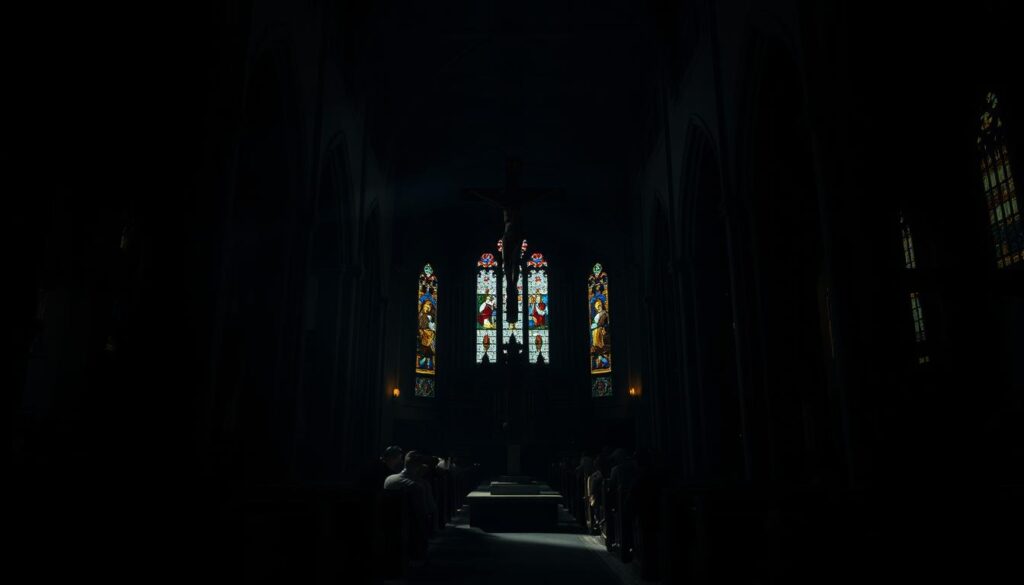
Why do stories of inner conflict grip us so deeply? At their core lies a universal feeling older than stained glass—the weight of choices echoing through time. This emotional gravity finds roots in ancient teachings about human nature.
The Weight of Original Sin in Gothic Narratives
The concept of inherited guilt shapes how we view moral struggles. Unlike simpler ideas of wrongdoing, it suggests every person carries Adam’s shadow. This “deep anthropology” acknowledges our capacity for both light and darkness from birth.
| Aspect | Catholic View | Protestant View |
|---|---|---|
| Human Nature | Inherently wounded by Original Sin | Fundamentally corrupted |
| Guilt Resolution | Sacraments & penance | Faith alone |
| Redemption Path | Lifelong transformation | Instant justification |
Literary giants like Dostoevsky exposed this torment masterfully. His character Raskolnikov in Crime and Punishment embodies the spiral of self-punishment—a mirror to confessional traditions. The story shows how moral failure haunts the man long after the crime.
Modern stories still use these themes. From conflicted heroes to haunted protagonists, the struggle between flaw and forgiveness remains powerful. It’s not about despair, but the raw honesty of being human—a truth that keeps drawing us back to age-old questions.
Gothic Traditions in Art and Architecture
Critics once mocked them as “stone nightmares,” but these towering marvels now define our idea of sacred beauty. The very features that earned scorn—jagged silhouettes, eerie carvings—became tools for expressing humanity’s highest aspirations.
Drama Carved in Stone
Baroque artists amplified Gothic foundations with theatrical flair. They turned vaulted ceilings into swirling heavens and altars into golden sunbursts. Three elements defined this style:
- Chiaroscuro contrasts painting saints in pools of celestial light
- Twisting marble columns mimicking spiritual ascent
- Frescoes showing biblical moments frozen mid-action
These techniques transformed churches into visceral experiences. Visitors didn’t just see stories—they felt divine judgment or mercy through every sculpted fold and shadow.
Stories in Glass and Grotesques
Cathedrals became illustrated manuscripts in three dimensions. Stained-glass windows glowed like jeweled image boards, teaching scripture through color and light. Gargoyles perched above crowds weren’t mere decorations—they embodied the constant dance between death and deliverance.
“Every grotesque whispers: ‘Evil exists, but this sacred place masters it.'”
Flying buttresses allowed walls to soar while bearing unimaginable weight—a perfect metaphor for faith itself. These spaces didn’t just house rituals; they made theology tangible through stone and leaded glass.
Today, we still seek things that marry raw emotion with transcendent meaning. That’s why these centuries-old designs feel oddly modern—they speak to our timeless hunger for wonder.
Literary Inspirations: Gothic Novels and Catholic Themes
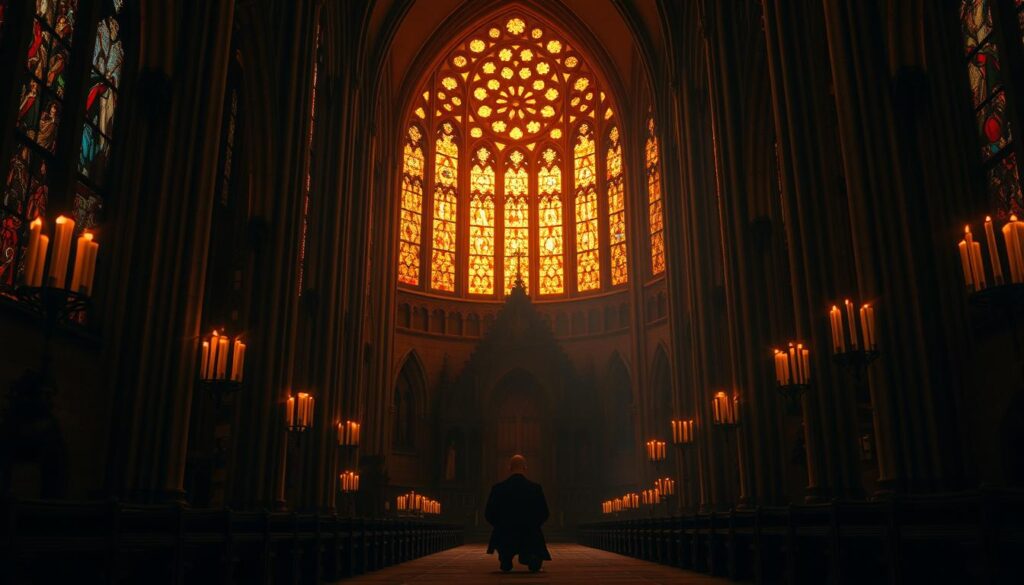
Why do crumbling monasteries and shadowy convents haunt our favorite stories? 18th-century authors discovered these Catholic settings held unmatched potential for exploring humanity’s darkest corners. Their novels blended ancient rituals with psychological tension, creating a blueprint for modern horror.
Masters of Atmospheric Dread
Ann Radcliffe perfected the art of suggestive terror in works like The Mysteries of Udolpho. Her heroines navigated labyrinthine convents where barred windows whispered of trapped desires. Radcliffe used candlelit confessionals and echoing cloisters to mirror her characters’ inner turmoil.
Matthew Lewis took a bolder approach. His 1796 shocker The Monk exposed corruption behind abbey walls with scenes of forbidden romance and black magic. Protestant readers devoured these tales, seeing them as warnings against religious excess.
| Theme | Radcliffe’s Approach | Lewis’s Style |
|---|---|---|
| Setting | Haunted monasteries | Decadent convents |
| Primary Conflict | Isolation vs. faith | Power vs. morality |
| Supernatural | Suggested ghosts | Demonic pacts |
| Moral Outcome | Redemptive suffering | Divine punishment |
Guilt as Narrative Engine
Both authors used sin as a catalyst for drama. Radcliffe’s protagonists faced external threats that tested their virtue. Lewis flipped this formula—his fallen monk Ambrosio became the threat, embodying fears about unchecked authority.
These stories shaped horror fiction’s DNA. From haunted churches to possessed clergy, modern creators still mine Gothic fiction for its potent mix of sacred imagery and human frailty. The genre proves that the most compelling terrors often wear religious garb.
The Influence of Latin and Ritualistic Beauty
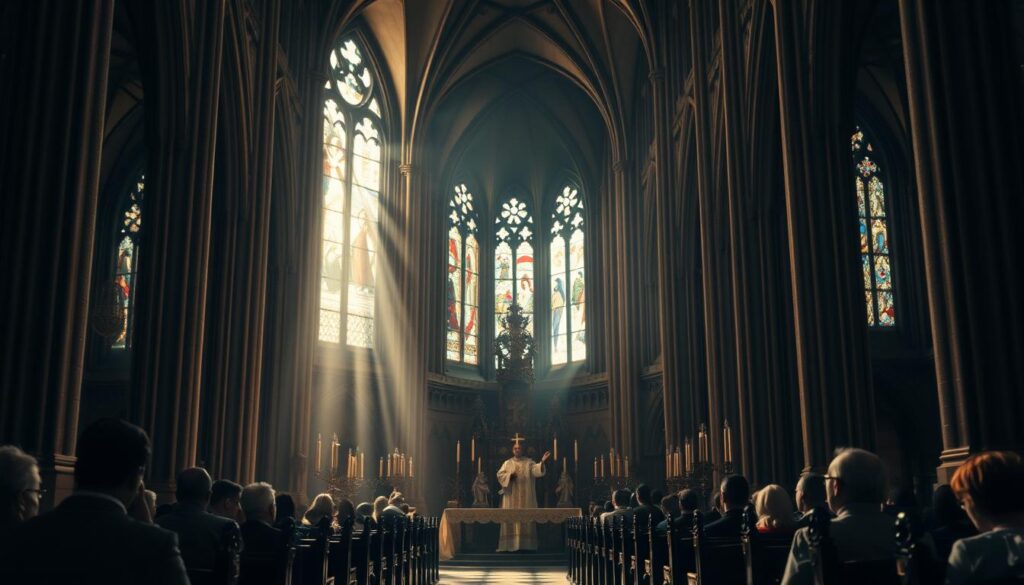
Few sounds carry through centuries like Latin’s rolling cadences. This ancient tongue shapes spiritual experiences, turning ordinary spaces into portals to the past.
Language as Sacred Gateway
Latin’s rhythmic prayers create a bridge across time. Unchanged for generations, its phrases echo with the weight of countless voices. Modern ears hear both familiarity and mystery in its syllables.
Three elements give Latin its haunting power:
- Vowel-rich sounds that linger in stone chambers
- Fixed grammatical structures resisting casual interpretation
- Phrases polished through centuries of repetition
| Latin Phrase | Translation | Contextual Weight |
|---|---|---|
| Agnus Dei | Lamb of God | Evokes sacrificial imagery |
| Memento mori | Remember death | Links mortality to divine purpose |
| Ecce Homo | Behold the man | Moment of judgment in sacred history |
Recent years saw renewed interest in traditional rituals. Young crowds pack churches offering Latin Mass, drawn by its tactile solemnity. One attendee notes: “It feels like holding history in your hand.”
This revival proves ancient forms still spark wonder. Through layered chants and candlelit rites, participants find connection to something beyond daily life—a sense of walking through living tradition.
The Role of Exorcism and the Phenomenon of Stigmata
What lies beyond our visible world has fascinated believers for centuries. From whispered prayers to miraculous wounds, certain practices reveal how faith confronts the inexplicable. These traditions blend ancient rituals with modern scrutiny, creating stories that captivate believers and skeptics alike.
When Faith Meets the Unseen
Exorcism rituals date back to biblical accounts of Jesus casting out demons. Today, priests undergo rigorous training to handle suspected possessions. The Church uses strict guidelines to separate mental health issues from potential supernatural cases. One famous 1949 exorcism inspired The Exorcist, highlighting the violent physical manifestations often described.
Stigmata presents an equally puzzling mystery. Documented instances show individuals developing wounds mirroring Christ’s crucifixion injuries. These marks often appear suddenly, causing intense pain yet resisting medical explanation. Padre Pio, a 20th-century friar, bore such wounds for 50 years—a life marked by both devotion and controversy.
| Aspect | Exorcism | Stigmata |
|---|---|---|
| Recognition | Formal church protocol | Investigated as potential miracle |
| Physical Signs | Violent reactions, strength surges | Bleeding wounds, sudden onset |
| Church Protocol | Psychological evaluation first | Medical team consultation |
| Public Perception | Linked to horror tropes | Viewed as divine connection |
Modern approaches balance science and spirituality. While investigating stigmata, doctors look for natural causes before considering miracles. Similarly, 90% of suspected possessions get reclassified as mental health cases. Yet the Church maintains rituals for remaining uncertainties—preserving awe in an age of skepticism.
These practices underscore a timeless human tension: our fear of unseen forces and longing for transcendent meaning. Whether through dramatic rituals or silent suffering, they remind us that mystery still dwells at faith’s edges.
Understanding Gothic Catholicism in a Modern World
Timeless symbols find fresh voices in every generation. Today’s creators reimagine ancient spiritual motifs through digital media, fashion, and community rituals. This cultural evolution preserves core meanings while speaking to contemporary concerns.
Bridging Eras Through Creative Expression
Virtual reality now lets users explore cathedral architecture from their couches. TikTok creators pair medieval chant remixes with urban exploration videos. These adaptations open new windows into historical practices, making them accessible to smartphone-era audiences.
Modern artists blend sacred imagery with social commentary. Stained glass techniques appear in protest art, while confession booth concepts inspire interactive theater. A 2023 study showed 68% of millennials engage with reinterpreted traditions through pop culture rather than formal institutions.
Scholars note three key shifts in interpretation:
- Emphasis on personal spiritual journeys over dogma
- Reuse of ritual elements in mental health practices
- Digital archiving preserving endangered artifacts
These transformations prove enduring symbols adapt without losing their power. As old stones meet new tools, they continue to shape our search for meaning in unexpected ways.
FAQ
How did ancient traditions shape Gothic Catholicism?
Early practices blended Roman rituals with tribal customs, creating a unique spiritual identity. This fusion laid the groundwork for symbolic art and intense emotional themes seen in later centuries.
Why was Clovis’ baptism significant?
His conversion marked a turning point, uniting Frankish tribes under a shared religious identity. This event strengthened the Church’s political influence and spread its teachings across Europe.
How does guilt appear in Gothic stories?
Tales often explore inner turmoil tied to moral failings. Characters wrestle with shame or hidden desires, reflecting the lasting impact of doctrines like original sin on storytelling.
What role do cathedrals play in this tradition?
Structures like Notre-Dame use towering arches and stained glass to evoke awe and mystery. These designs symbolize humanity’s smallness against divine power, deepening spiritual reflection.
How did authors like Ann Radcliffe influence the genre?
Radcliffe’s suspenseful plots and Lewis’s bold themes highlighted struggles with morality. Their works wove sacred imagery into tales of terror, making faith a central element of horror narratives.
Why is Latin still used in rituals today?
The language’s archaic sound creates a sense of timelessness. Its unfamiliarity adds layers of secrecy, enhancing the mystical atmosphere during ceremonies.
Are exorcisms common in modern practices?
While rare, these rites remain part of Church tradition. They symbolize the battle between good and evil, echoing themes of spiritual warfare found in classic literature.
How is this movement viewed now?
Contemporary artists and writers reinterpret its symbols, blending old motifs with new anxieties. This keeps the dialogue between faith, fear, and art alive in today’s culture.