Imagine a single act that changed the course of religion forever. In 1517, a monk named Martin Luther sparked a revolution by challenging powerful institutions. His bold ideas spread like wildfire, reshaping how millions viewed spirituality and authority.
This movement didn’t just alter religious practices—it transformed politics, education, and daily life. Over centuries, regional leaders and everyday citizens shaped its path. From royal courts to grassroots movements, the story reveals how faith became intertwined with cultural identity.
Today, this legacy remains visible in modern society. Nearly half the population identifies with Protestant traditions, particularly in eastern regions. The church’s structure—uniting diverse denominations under one umbrella—reflects centuries of adaptation and resilience.
You’ll see how conflicts, wars, and social changes tested these beliefs. Yet, the enduring influence of this spiritual awakening still guides communities. Its impact reaches beyond Sunday services, shaping art, ethics, and even political movements worldwide.
Key Takeaways
- A 16th-century religious movement began with one man’s critique of church practices
- Regional leaders and social shifts helped spread new ideas across Europe
- Modern traditions blend multiple denominations into a unified structure
- Cultural identity remains deeply connected to historical religious changes
- Current demographics show a strong presence in eastern regions
- Historical conflicts shaped today’s church organization and values
Historical Roots and the Early Reformation Movements
October 31, 1517, marked a turning point in Christian history. A bold critique of religious practices would soon ripple across Europe, challenging centuries-old traditions.
The Spark That Lit the Fire
Martin Luther’s famous 95 Theses questioned the church’s sale of indulgences. These payments promised forgiveness but clashed with his belief that salvation comes through faith alone. “Why does the pope not empty purgatory for love’s sake?” Luther wrote, challenging the system’s logic.
When Leaders Tried to Bridge the Divide
Thirteen years later, Emperor Charles V called the Diet of Augsburg. Philip Melanchthon took center stage, presenting arguments that emphasized divine grace over human effort. His approach differed from Luther’s fiery style but proved equally impactful.
| Event | Year | Key Figure |
|---|---|---|
| 95 Theses Posted | 1517 | Martin Luther |
| Augsburg Confession | 1530 | Philip Melanchthon |
| Spread to Cities | 1520s | Local Leaders |
The movement gained momentum as towns adopted new teachings. Printers spread pamphlets containing revolutionary ideas, while rulers debated which doctrine to follow. This period reshaped not just churches but entire communities.
“Faith is a living, daring confidence in God’s grace.”
Within fifteen years, what began as theological debate became a cultural earthquake. The stage was set for lasting changes in how people practiced their beliefs and organized society.
The Development of Lutheranism and Doctrinal Shifts
Seven princes and two free towns made history in 1530 by signing a document that unified fractured religious groups. Their bold act created a roadmap for organizing local congregations into structured churches.

The Augsburg Confession and the Formation of Lutheran Churches
The Augsburg Confession became Lutheranism’s defining text. It outlined core beliefs like salvation through faith alone and scripture’s authority. Rulers used it to legally protect their denominations from opposition.
By 1555, this confession gained official recognition. Over 50% of northern territories adopted its teachings. Local churches began training clergy using standardized theology manuals.
Confessional Debates and the Concord Formula
Not everyone agreed on details. Heated debates erupted about Christ’s presence during communion. Some leaders favored symbolic interpretations closer to Calvinist views.
The 1557 Concord Formula settled these disputes. It declared:
“True body and blood of Christ are present in the sacrament.”
This agreement unified two-thirds of Lutheran members under one doctrine. It preserved cultural tradition while allowing regional flexibility. These foundations still shape worship practices today.
Influence on Culture, Politics, and Society
A ruler’s decree could decide your spiritual path—and your home address. The 1555 Treaty of Augsburg introduced a radical idea: “cujus regio, ejus religio” (“whose realm, his religion”). This principle let local leaders pick their territory’s faith, forcing residents to either conform or leave.
Religion and State: The “Cujus Regio, Ejus Religio” Principle
Princes became spiritual CEOs overnight. They appointed pastors, approved hymns, and even set church budgets. Whole regions transformed into religious monocultures—some Lutheran, others Catholic. Neighbors suddenly found themselves divided by invisible faith borders.
This system created unexpected unity within territories. Shared worship styles and holiday traditions strengthened community bonds. But it also planted seeds for future conflicts when rulers changed faiths.
The Impact of the Thirty Years War and Social Change
Religious tensions exploded in 1618. The Thirty Years War turned villages into battlegrounds, killing nearly 20% of Central Europe’s population. Soldiers burned crops, spreading famine and disease. One witness wrote:
“We ate tree bark to survive—even the rats had fled.”
After the war, princes kept their dual role as political and religious leaders. This fusion shaped education systems, welfare programs, and art for centuries. The war’s scars also taught communities to value stability over strict doctrinal purity.
Key Figures in protestantism germany: Influential Reformers and Theologians
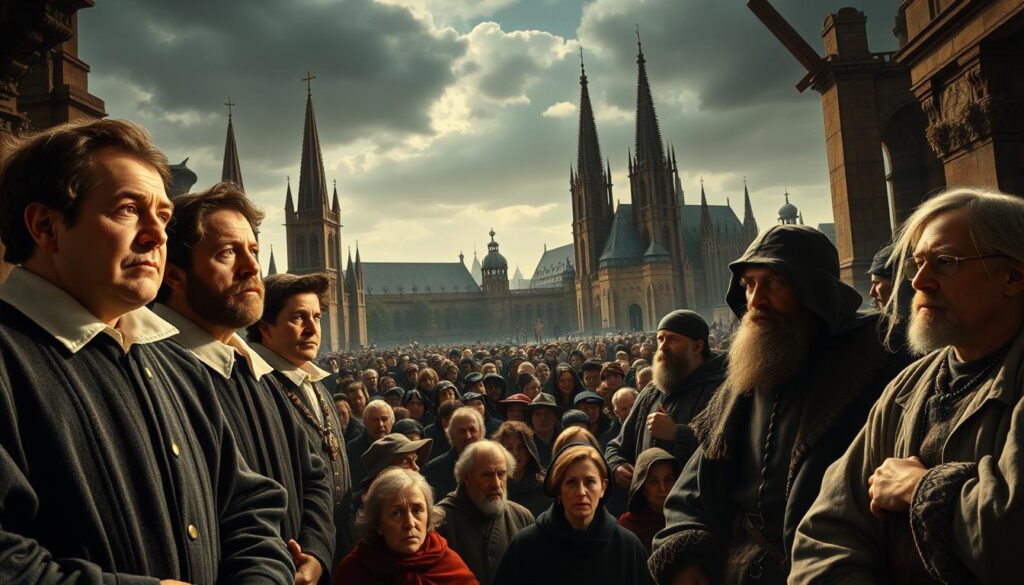
Behind every great movement stand visionaries who shape its path—and ordinary people who defend its soul. Three brilliant minds redefined spiritual practices, while later generations faced unimaginable tests of conviction.
Bridge-Builders of Belief
Philip Melanchthon became Luther’s secret weapon for unity. While his mentor sparked debates, this scholar crafted compromises. His 1530 Augsburg Confession declared: “We cannot obtain grace by our own merits.” This balanced approach kept diverse groups within the same movement.
Swiss thinkers added fresh perspectives. Huldrych Zwingli saw communion as symbolic—a radical shift from traditional views. John Calvin later refined these ideas, influencing churches worldwide. Their debates enriched Protestant beliefs without fracturing the growing community.
When Faith Faced Fire
The 1930s brought terrifying choices. Some church members swapped the cross for swastikas, even placing Hitler’s book on altars. But others risked their life to protect sacred truths.
Dietrich Bonhoeffer’s words still inspire:
“Silence in the face of evil is itself evil.”
He and Martin Niemöller organized the Confessing Church, rejecting Nazi-aligned theology. Their 1934 Barmen Declaration became a spiritual shield, affirming Christ—not political leaders—as the church’s true foundation.
These stories show how reformers across centuries balanced bold ideas with unshakable principles. Their legacy proves that true faith can outlast any war—whether fought with words or weapons.
Modern Transformations: 20th Century to Present Changes
Post-war Europe witnessed faith communities becoming bridges across iron curtains. The Evangelical Church in Germany (EKD) emerged in 1948, uniting three major traditions under one roof. This creative solution helped congregations navigate the continent’s sharpest political divide.
Rebuilding Through Division
When Germany split into East and West, churches faced impossible choices. The EKD’s communication networks collapsed in 1969 as the Iron Curtain hardened. Eight eastern congregations formed their own alliance, preserving spiritual ties despite border walls.
Catalysts for Change
Leipzig’s St. Nicholas Church became freedom’s unlikely headquarters. Weekly peace prayers in the 1980s drew thousands, culminating in the 1989 protests that toppled the Berlin Wall. Today’s EKD spans 23 regional churches, blending diverse denominations while supporting 3 million free-church members.
Modern movements extend beyond Sunday services. The Diakonische Werk agency feeds the hungry, while emergency teams deploy during disasters. These efforts show how historical religion adapts to serve changing societies—proving ancient ideals still shape tomorrow’s solutions.
FAQ
What event is considered the starting point of the Reformation?
A: Martin Luther’s 95 Theses, nailed to the Wittenberg Castle Church door in 1517, challenged Catholic practices like indulgences. This act ignited debates that reshaped religious life across Europe.
How did the Diet of Augsburg influence early church debates?
The 1530 Diet of Augsburg allowed reformers to present their beliefs, like the Augsburg Confession. It became a turning point, formalizing divisions between Catholic and emerging Lutheran traditions.
What was the “Cujus Regio, Ejus Religio” principle?
Established by the 1555 Peace of Augsburg, it let regional rulers choose their territory’s faith—Catholic or Lutheran. This reduced conflict but deepened political-religious ties, shaping Central Europe’s map for centuries.
How did the Thirty Years’ War impact society?
The war (1618–1648) devastated populations and economies. Post-war treaties, like the Peace of Westphalia, expanded religious tolerance but reinforced state control over churches, altering social dynamics.
Who were key reformers besides Martin Luther?
A: Philip Melanchthon systematized Lutheran theology, while Huldrych Zwingli and John Calvin influenced Reformed traditions. Their ideas diversified doctrines and practices across regions.
What role does the EKD play today?
The Evangelical Church in Germany, formed in 1948, unites Lutheran, Reformed, and United churches. It promotes ecumenical dialogue, social justice, and adapts teachings to modern ethical challenges.
How have modern churches addressed social issues?
Many congregations focus on refugee support, climate action, and interfaith cooperation. Groups like the Bread for the World campaign reflect their commitment to global justice and community service.