What if religious teachings could reshape how you experience daily life? Bishop Robert Barron’s acclaimed book offers more than historical facts—it invites readers into a dynamic encounter with sacred truths. This exploration moves beyond rituals and doctrines, revealing how ancient wisdom pulses through modern practices.
The Church isn’t a relic of the past but a vibrant channel for divine connection. Through sacraments, art, and community, believers experience what Barron describes as God’s “enfleshment” in our world. This perspective transforms routine actions into moments of profound meaning.
Unlike standard religious guides, this approach acts as a compass for spiritual growth. It doesn’t just explain beliefs—it shows how they fuel personal transformation. Readers discover connections between theology and everyday life, from stained-glass windows to acts of service.
Key Takeaways
- Barron’s work redefines religious education as an immersive experience
- Catholic teachings extend God’s presence through tangible practices
- Spiritual formation outweighs mere intellectual understanding
- The Church sustains sacred mysteries across generations
- Art and liturgy make divine truths accessible today
Introduction to the Spiritual Journey
Modern culture often celebrates individualism, yet many feel disconnected. Bishop Robert Barron’s book challenges this trend by framing faith as a unifying force. His insights reveal how ancient teachings address today’s deepest hungers for belonging and purpose.
Setting the Stage for a Transformative Experience
Barron contrasts God’s unifying nature with societal forces that fragment communities. “If God is a great gathering force,” he writes, “sin is a scattering power.” This idea reshapes how we view conflicts—from family divisions to global tensions.
The book positions Catholic spirituality as an antidote to modern isolation. While algorithms divide and ideologies polarize, sacraments and service create bridges. This approach doesn’t just explain beliefs—it offers tools for rebuilding fractured relationships.
Contextualizing Catholicism in Today’s World
Amid rising mental health crises and cultural cynicism, the Church stands as a beacon of hope. Barron argues that Christianity’s vision for human destiny—eternal communion with God—outshines fleeting political or philosophical promises.
Consider how Catholic practices counter modern despair. Weekly Mass gathers strangers into a family. Confession heals invisible wounds. These traditions affirm life’s sacredness in a world that often reduces people to data points.
“No program in history has ever made claims as extravagant as Christianity’s.”
This book invites readers to see beauty in commitment. In an age of swipe-left relationships and disposable careers, Catholic teachings offer stability. They remind us that every person carries divine worth—a truth that transforms how we live.
Understanding the Core Tenets of Catholicism
How do ordinary objects become pathways to the divine? This question lies at the center of Catholic teachings. Unlike other Christian traditions that focus on singular aspects, the church weaves together sacraments, scholarship, and service into one tapestry.
Key Beliefs and Doctrines
At its core, the catholic faith sees God’s presence in material nature. Water in baptism, oil in anointing, and bread in communion carry spiritual power. As Bishop Barron’s book notes: “Grace doesn’t float above us—it works through created things.”
Seven sacraments structure Catholic life from birth to death. Each uses physical elements to mark spiritual milestones. This approach honors both body and soul, rejecting divisions between sacred and secular.
Traditions and Practices in Daily Life
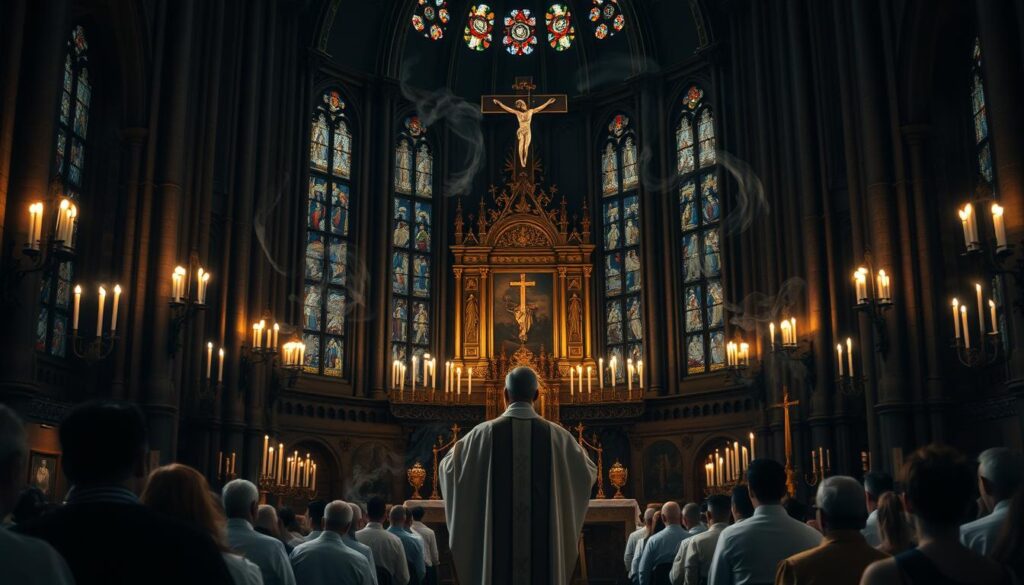
Weekly Mass transforms routine into ritual. Incense engages smell, chant stirs hearing, and stained glass delights sight. These multisensory experiences make abstract truths tangible.
| Practice | Purpose | Modern Impact |
|---|---|---|
| Eucharist | Communal unity | Counteracts digital isolation |
| Confession | Personal renewal | Addresses mental health needs |
| Saints’ feasts | Historical connection | Inspires social activism |
From Gothic cathedrals to parish food banks, Catholic traditions bridge heaven and earth. They remind believers that faith isn’t just believed—it’s lived, touched, and shared.
Embracing catholicism a journey to the heart of the faith
What transforms ancient teachings into a living path? Bishop Robert Barron’s book answers this by framing faith as an intimate relationship. Unlike dry textbooks, his work pulses with invitations to encounter Christ personally—not just study ideas about Him.
An In-Depth Look at the Title
The phrase “journey to the heart” isn’t poetic fluff. Barron uses it to signal a shift from head knowledge to heart transformation. As he writes: “Christianity isn’t a philosophy to master—it’s a Person to meet.” This approach turns sacraments into divine handshakes rather than empty rituals.
Barron digs into Greek terms to reveal hidden depths. Take euangelion (gospel)—originally meaning imperial victory announcements. Early Christians hijacked this word to declare Jesus’ resurrection as history’s true turning point. Similarly, calling Christ Kyrios (Lord) directly challenged Caesar’s authority.
These linguistic insights aren’t academic trivia. They show how the author makes faith visceral. The book argues that real spirituality happens when we let Christ’s presence reshape our priorities, relationships, and politics—just as His first followers did.
“To say ‘Jesus is Lord’ was to dethrone every other power. That’s why it got people killed.”
This journey isn’t about collecting beliefs. It’s about letting divine love rewire your life. Through Mass, prayer, and service, believers don’t just learn about God—they meet Him face-to-face.
Bishop Robert Barron’s Influence and Insights
How does a 2,000-year-old faith resonate in our screen-driven age? Bishop Robert Barron answers through groundbreaking multimedia storytelling. His series combines theological depth with cinematic brilliance, making timeless truths feel urgently modern.
Perspectives on the Incarnation and Liturgy
Bishop Barron’s book and films reveal sacraments as divine encounters. “The liturgy isn’t human invention,” he explains. “It’s our participation in heaven’s rhythm.” This vision comes alive through Mike Leonard’s lens—from Jerusalem’s ancient streets to Mexico City’s bustling parishes.
Visual Storytelling and Multimedia Integration
The series spans 15 countries, showing faith’s universal language. High-definition shots contrast Uganda’s vibrant processions with New York’s silent adoration chapels. These visuals prove Catholic teachings adapt without compromising core truths.
| Location | Cultural Significance | Visual Highlight |
|---|---|---|
| Israel | Biblical roots | Sunrise over Sea of Galilee |
| France | Gothic architecture | Chartres Cathedral’s stained glass |
| Kolkata | Modern service | Mother Teresa’s missionaries |
Bishop Barron’s collaboration with NBC veteran Mike Leonard ensures professional polish. Their work transforms abstract concepts into relatable stories. As the bishop notes: “Beauty disarms—it makes truth irresistible.”
“We’re not just explaining doctrines—we’re inviting people into wonder.”
This multimedia approach meets viewers where they are. Through sights, sounds, and stories, Robert Barron’s book and films make spiritual exploration accessible—and unforgettable.
The Historical and Theological Backdrop of the Faith
How do ancient debates shape today’s beliefs? The Catholic tradition roots its teachings in centuries of careful thought. Early councils tackled big questions about God’s nature and Christ’s identity, creating a foundation that still guides modern practice.
From Early Church Councils to Modern Interpretations
The Council of Ephesus (AD 431) made a bold claim: Mary is Theotokos, meaning “God-bearer.” This wasn’t just about honoring Mary—it protected Jesus’ divine and human unity. As Bishop Barron’s book notes, “Language matters when defining sacred mysteries.”
Thomas Aquinas took a different approach. He taught that we understand God by what He isn’t—a method called negative theology. Instead of boxing God into human ideas, this approach honors His limitless nature.
Catholic thinkers still use these tools. They engage tough arguments about science, suffering, and free will. Through it all, the faith maintains that God’s omnipotence and omniscience work together—like a parent who knows a child’s needs before they’re spoken.
This living tradition keeps theology fresh. As the book shows, ancient councils and medieval scholars aren’t history lessons. They’re maps helping believers navigate modern spiritual questions with timeless wisdom.
Unveiling the Beauty and Mystery of the Liturgy
Have you ever wondered how ancient rituals shape modern spiritual connections? The book reveals how Catholic worship bridges time and space, turning ordinary moments into divine encounters.
The Role of Sacraments and Rituals
Church architecture whispers hidden truths. Many sanctuaries resemble ships, symbolizing the “vessel” carrying believers through life’s storms. This design mirrors the holy spirit’s guidance—steady, purposeful, and life-giving.
Liturgy unfolds like sacred theater. Every gesture and response pulls worshippers into salvation’s story. When congregants say “And with your spirit,” they acknowledge Christ working through the priest, not human effort alone.
“You are indeed holy, O Lord… through your Son our Lord Jesus Christ, by the power of the holy spirit, you give life to all things.”
The Eucharist’s transformation—transubstantiation—shows words’ divine power. Just as God spoke creation into being, Christ’s words at Mass change bread and wine. This mystical union connects believers to His sacrifice intimately.
Rituals also heal body and soul. The Latin sanctus (holy) shares roots with sanus (healthy). Catholic practice rejects splitting physical and spiritual wellness. Through sacraments, both find restoration.
Bishop Barron’s book frames liturgy as heaven touching earth. Every Mass replays salvation’s drama, inviting participants into union christ offers—a bond sealed by the Spirit’s flame.
The Role of Saints and Mystical Figures
Why do certain lives become compasses for millions? Bishop Barron’s book reveals saints as God’s masterpieces—ordinary people transformed by divine love into guides for the faithful. Their stories aren’t ancient history but living proof of holiness thriving in every era.
Profiles of Inspirational Lives
Mother Teresa redefined service by kneeling in Calcutta’s gutters. Her Missionaries of Charity didn’t just feed bodies—they honored Christ in “the distressing disguise of the poor.” This radical charity reshaped global views on human dignity.
Edith Stein’s journey from Jewish philosopher to Carmelite nun shows truth’s unifying power. Her writings fused intellectual rigor with mystical prayer, proving faith and reason dance together. Even in Auschwitz’s darkness, she embodied unshakable hope.
Thomas Merton bridged cloistered prayer and civil rights activism. His journals reveal how silence fuels social change: “Contemplation is life itself, fully awake, fully active.” This monk’s voice still inspires peacebuilders worldwide.
The Impact of Female Saints and Modern Voices
Katharine Drexel’s $20 million inheritance funded schools for marginalized communities—a 19th-century #GirlBoss move. Thérèse of Lisieux’s “Little Way” taught that holiness thrives in daily kindnesses, not grand gestures.
“Saints are God’s answer to the world’s cry for authenticity.”
These women shaped Catholic spirituality through action and example. Their legacies prove sainthood isn’t about perfection—it’s letting divine love rewrite your story, one courageous “yes” at a time.
Multimedia and Global Perspectives on Catholicism
From Jerusalem’s ancient streets to New York’s bustling neighborhoods, Bishop Barron’s series captures faith’s universal heartbeat. This visual odyssey spans six continents, revealing how divine truths take root in diverse soils. Over 1 billion people worldwide share this spiritual heritage—yet each culture adds unique brushstrokes to the masterpiece.
Exploring Diverse Locations and Cultural Stories
Uganda’s vibrant processions pulse with drumbeats echoing medieval European pilgrimages. Mexico City’s street murals mirror Italian Renaissance art’s sacred storytelling. The book connects these dots, showing how local traditions breathe fresh life into ancient practices.
Kolkata’s bustling markets and France’s silent cathedrals both whisper the same truth: divine love speaks every language. Through HD cinematography and personal testimonies, the series proves Catholicism isn’t confined to one place—it’s a living conversation across the world.
Barron’s book serves as a field guide for this expedition. It invites readers to see their own stories within humanity’s grand spiritual mosaic—where every culture’s gifts enrich the whole world.
FAQ
What makes Bishop Robert Barron’s approach to explaining the faith unique?
Bishop Barron combines rich theological insights with relatable storytelling, weaving art, history, and global cultures into his teachings. His work, like the Catholicism series, uses visual media to highlight the faith’s beauty and intellectual depth.
How does the book address the role of saints in spiritual growth?
It profiles figures like Teresa of Ávila and Edith Stein, showing how their lives exemplify virtues like courage and love. Their stories inspire readers to seek deeper connections with God through prayer and service.
Why does Barron emphasize the Incarnation and liturgy?
He views the Incarnation—God becoming human—as central to understanding divine love. Liturgy, through sacraments like the Eucharist, invites believers into a tangible encounter with Christ’s presence.
How does the book tackle modern challenges to religious belief?
By blending timeless teachings with contemporary questions, Barron addresses topics like suffering and science. He argues that faith and reason coexist, offering a compelling vision for meaning in today’s world.
What historical events shape the theological ideas discussed?
From early councils like Nicaea to thinkers like Thomas Aquinas, the book traces how doctrines developed. It highlights how these foundations remain relevant in guiding spiritual practice today.
Are global cultural perspectives included in this exploration?
Yes! Barron’s work visits sacred sites worldwide, showcasing diverse traditions. This global lens reveals how the faith adapts while maintaining unity across cultures and eras.
How does the author present the concept of mystical union with God?
Through figures like St. John of the Cross, Barron illustrates how prayer and self-giving lead to divine intimacy. He frames this union not as abstract but as a transformative, lived experience.
Why are female saints highlighted as influential voices?
Women like Thérèse of Lisieux and Mother Teresa embody the Church’s mission with radical love. Their lives challenge stereotypes and prove holiness transcends cultural or gender boundaries.