Long before the 16th-century religious upheaval, tensions between the English crown and Rome simmered. Disputes over church funds and authority created fertile ground for change. By the 1300s, thinkers like John Wycliffe openly criticized church practices, arguing Scripture—not clergy—should guide faith. His English Bible translation planted early seeds of reform.
Centuries later, Christian humanism reshaped intellectual circles. Scholars like Erasmus taught at Cambridge, emphasizing original biblical texts over tradition. This movement prepared minds for new ideas. When Lutheran writings reached England in the 1520s, they found eager listeners among Cambridge academics.
A group nicknamed “little Germany” became key players. Future leaders like Thomas Cranmer studied these radical concepts secretly. Their work laid foundations for what would become a national transformation, proving religious change wasn’t sudden—but the result of growing influence from thinkers across Europe.
Key Takeaways
- England’s religious shift began centuries before Henry VIII’s break with Rome
- John Wycliffe’s Bible translation challenged church authority in the 1300s
- Christian humanism created intellectual readiness for reform ideas
- Cambridge University served as a hub for early Protestant thought
- Lutheran concepts spread through secret academic networks in the 1520s
Early Foundations: The Prelude to Reformation
Centuries before royal decrees reshaped religious life, bold voices began questioning tradition. These pioneers laid mental groundwork for change through education and accessible texts.
Rebels With Ideas
John Wycliffe sparked controversy in the 1300s by calling out church corruption. His English Bible translation became a dangerous idea—suddenly, ordinary people could read Scripture themselves. This challenged the clergy’s exclusive role as spiritual guides.
Dutch scholar Erasmus took the baton in 1511. During his two years at Cambridge, he taught future leaders to study original Greek texts. “The sun itself isn’t as clear as Christ’s teachings,” he wrote, pushing scholars to rethink old interpretations.
By 1520, Cambridge buzzed with radical ideas. A secret group nicknamed “little Germany” studied Luther’s writings. Members like Thomas Cranmer hid revolutionary plans—they’d later reshape national worship practices while leading the church.
These early reformers proved ideas could be mightier than armies. Through books and classrooms, they built bridges between academic circles and public consciousness. Their quiet work made England’s later religious shifts possible.
Henry VIII’s Divorce and the Schism from Rome
A royal love story turned political earthquake reshaped national identity. What began as personal turmoil between a king and his wife became England’s declaration of independence from foreign religious authority.
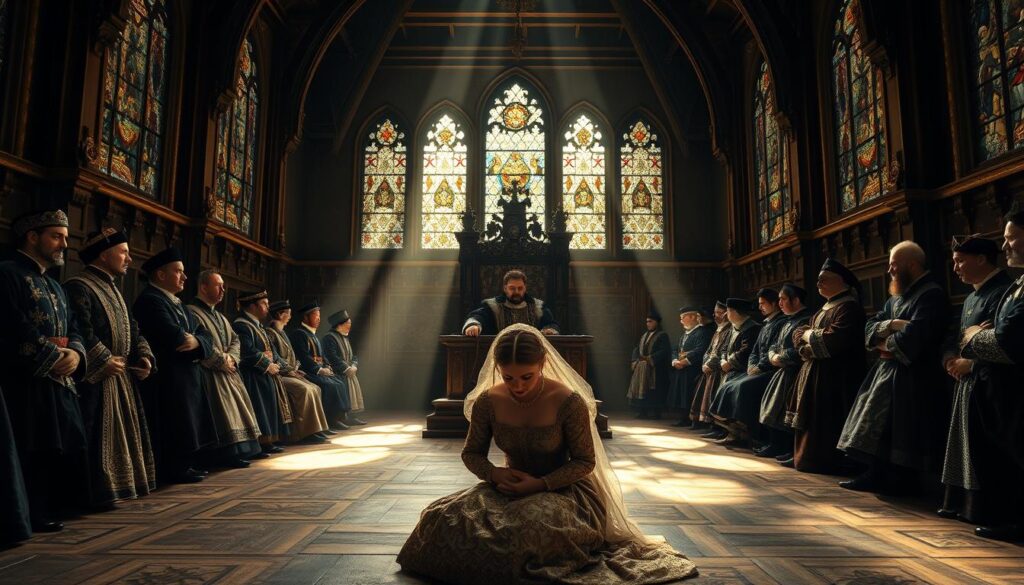
Political and Personal Motivations Behind the Divorce
Henry VIII’s obsession with securing a male heir drove his actions. His 24-year marriage to Catherine Aragon produced just one surviving daughter. “The kingdom needs a son to prevent civil war,” the king argued, haunted by memories of the Wars of the Roses.
When Henry sought to annul his marriage in 1527, he claimed biblical backing. Leviticus 20:21 states: “If a man marries his brother‘s wife, they will die childless.” This interpretation became his legal weapon against papal authority.
Excommunication and its Lasting Consequences
Pope Clement VII faced impossible choices. Approving the divorce risked angering Holy Roman Emperor Charles V – Catherine’s nephew. Delaying tactics lasted seven years until Henry took matters into his own hands.
In 1533, Archbishop Thomas Cranmer declared the marriage invalid. The pope responded by excommunicating Henry, formalizing the separation Rome. This bold move created England’s first national church structure free from Vatican control.
| Event | Date | Impact |
|---|---|---|
| Henry-Catherine wedding | 1509 | Papal-approved union |
| Annulment request | 1527 | Begin 7-year standoff |
| English court divorce | 1533 | National sovereignty claim |
| Excommunication | 1534 | Complete separation Rome |
The king’s remarriage to Anne Boleyn changed more than the royal bedchamber. It sparked constitutional reforms that would define England’s religious path for centuries. By breaking with Rome, Henry created a template for national self-determination that outlasted his six marriages.
Establishing a National Church: The Birth of the Church of England
In 1534, a single law reshaped England’s spiritual landscape forever. Parliament’s Act of Supremacy didn’t just change leadership—it rewrote the rules of faith and power. For the first time, a monarch held divine authority over both state and soul.
The Act of Supremacy and Royal Authority
Henry VIII became the Supreme Head of the Church of England, a title that turned kings into spiritual CEOs. The law stripped the pope of legal status, reducing him to “Bishop of Rome” with no more sway than the Archbishop of Canterbury. Royal appointees now filled church roles, from village priests to cathedral leaders.
Monastic lands became the crown’s piggy bank. Between 1536-1540, over 800 monasteries closed. Gold chalices melted into coins, while farmlands enriched the king’s allies. “Every abbey’s downfall built a nobleman’s fortune,” one observer noted, as centuries of accumulated wealth changed hands.
Resistance carried deadly risks. Former Chancellor Thomas More refused to endorse Henry’s new title, declaring: “No temporal prince may presume to take spiritual jurisdiction.” His 1535 execution shocked Europe but silenced most critics. By 1540, 95% of clergy had sworn loyalty to the crown.
This revolution blended old and new. Sunday services kept familiar rituals, but prayer books now praised the king instead of the pope. The Church of England became a hybrid—Catholic in appearance, royalist at heart—setting the stage for future reforms under Henry’s heirs.
Protestant Reformation Under Edward VI
At just nine years old, Edward Tudor inherited a kingdom divided by faith. The boy king‘s advisors seized this chance to reshape national worship. Archbishop Thomas Cranmer led the charge, crafting tools to unify religious practice across every parish.

Revolution in the Pew
Cranmer’s 1549 Book of Common Prayer changed Sunday mornings forever. For the first time, services flowed in English instead of Latin. “It’s like sunlight breaking through stained glass,” one Londoner wrote, describing how ordinary people finally understood the prayers.
The new prayer book kept familiar rituals but stripped away complex ceremonies. Clergy traded golden robes for simple vestments, though many kept their traditional outfits to comfort older worshippers. Parishioners now received both bread and wine during communion—a radical shift from past practices.
| Feature | 1549 Prayer Book | 1552 Revision |
|---|---|---|
| Language | Poetic English | Simpler phrases |
| Communion | Optional kneeling | Mandatory standing |
| Ceremonies | Partial retention | Full removal |
| Doctrinal Influence | Moderate Reform | Calvinist ideas |
Cranmer didn’t stop there. His 1552 update incorporated suggestions from European reformers like Martin Bucer. The revised text clarified doctrine, removing any hint of Catholic symbolism. These changes laid groundwork for the Forty-Two Articles—a blueprint that later shaped Anglican beliefs.
Edward’s short reign proved pivotal. Though the young son of Henry VIII died at 15, his team’s liturgical reforms created lasting patterns. The Book of Common Prayer‘s elegant phrases still echo in churches worldwide, showing how words can outlive kingdoms.
Mary Tudor’s Catholic Revival and Its Repercussions
In 1553, a monarch’s fervent faith ignited a national crisis of conscience. When Mary Tudor became queen, she vowed to undo decades of religious changes. Her five-year reign became a turning point where personal conviction clashed with public sentiment.
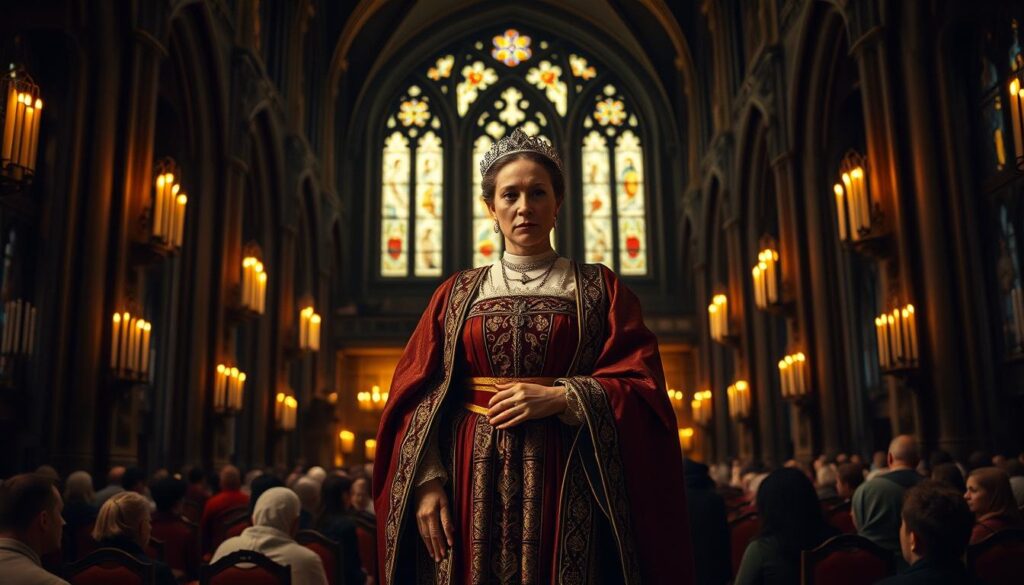
Restoration of Catholic Practices and Impact on Clergy
Mary partnered with Cardinal Reginald Pole to rebuild ties with Rome. Together, they reversed Protestant reforms made during her half-brother’s rule. Over 2,000 clergy members lost their positions for refusing to abandon new practices.
The church courts sentenced nearly 300 reformers to burn at the stake. Among them was Thomas Cranmer, architect of the English prayer book. Witnesses reported his final words: “I have written many things untrue, but now I see the truth.”
These executions shocked communities. Crowds watched reformers die singing hymns, their courage sparking sympathy. What began as intimidation became a rallying cry for Protestant ideals.
Mary’s death in 1558 ended her vision. Without an heir, her Catholic revival lasted only five years. The throne passed to Elizabeth I, setting the stage for lasting religious transformation.
Elizabeth I’s Religious Settlement: The Middle Way
When Elizabeth I took the throne in 1558, she inherited a nation fractured by religious conflict. The 25-year-old queen crafted a brilliant compromise—a via media blending Catholic traditions with reformed theology. Her 1559 Religious Settlement became the cornerstone of the Church of England, ending decades of violent swings between faiths.
The Acts of Supremacy and Uniformity
Parliament’s narrow vote made Elizabeth the Church of England‘s “Supreme Governor,” a title avoiding her father’s confrontational “Head” label. The Archbishop of Canterbury enforced new worship rules through a revised Book of Common Prayer. Churches kept stained glass and robes, but sermons now emphasized Scripture over ceremony.
The Formation of the Thirty-Nine Articles
By 1563, bishops finalized the defining doctrine. These statements rejected papal authority while keeping bishops—a middle ground between Geneva and Rome. The Articles quietly honored Henry VIII’s legacy, stating monarchs hold “chief power” over religious matters.
Elizabeth’s settlement proved durable. Unlike her siblings’ short-lived reforms, this flexible framework guided the church into the next century. Her genius lay in letting people practice faith differently while demanding outward unity—a recipe that stabilized a fractured realm.
FAQ
How did Henry VIII’s divorce lead to England’s split from the Catholic Church?
Henry VIII sought to annul his marriage to Catherine of Aragon to marry Anne Boleyn, but the Pope refused. This led Henry to break ties with Rome, declare himself head of the Church of England through the 1534 Act of Supremacy, and dissolve papal authority in the country.
What role did the Book of Common Prayer play in the Reformation?
Introduced under Edward VI, the Book of Common Prayer standardized worship in English instead of Latin. It simplified rituals and reflected Protestant theology, making religious practices more accessible to ordinary people and distancing the church from Catholic traditions.
Why was Mary Tudor’s reign significant for religion in England?
Mary Tudor reversed Protestant reforms, restored Catholic practices, and persecuted those who opposed her policies. Her harsh tactics earned her the nickname “Bloody Mary” and deepened public resentment toward Catholicism, paving the way for Elizabeth I’s later compromises.
How did Elizabeth I balance Catholic and Protestant beliefs?
Elizabeth’s Religious Settlement blended elements of both faiths to avoid extremism. The Acts of Supremacy and Uniformity reaffirmed the monarch’s leadership over the church while allowing some traditional practices, creating a “Middle Way” that stabilized the nation after decades of turmoil.
What were the long-term effects of the Act of Supremacy?
The 1534 Act established the monarch as the supreme head of the Church of England, shifting power from the Pope to the crown. This centralized authority influenced politics, law, and culture for centuries and laid the foundation for a distinct national religious identity.
How did early reformers like John Wycliffe influence the English Reformation?
Wycliffe’s 14th-century critiques of church corruption and his Bible translation into English inspired later reformers. His ideas challenged papal authority and emphasized personal faith, planting seeds for the Protestant movement that gained momentum under Henry VIII and his successors.