Let’s travel back to a time when faith and courage reshaped Europe’s spiritual landscape. Our story begins in the 16th century, when growing questions about religious practices sparked a revolution that still influences modern Christianity.
At the heart of this shift stood a German monk named Martin Luther. His bold ideas about personal faith and biblical authority challenged long-standing traditions, creating waves that spread far beyond his small town. What started as academic debates soon grew into a full-blown movement for change.
This wasn’t just about theology – it was about freedom. When leaders gathered at the Diet of Speyer in 1529, their protest against rigid control marked a turning point. Their declaration to follow conscience over command gave birth to new ways of practicing faith across Europe.
Key Takeaways
- The Protestant movement began as a 16th-century response to religious practices
- Martin Luther’s teachings emphasized personal faith and direct scripture access
- Key events like the 1529 Diet of Speyer formalized resistance to centralized authority
- Multiple denominations emerged with shared core beliefs but distinct traditions
- This spiritual revolution impacted politics, education, and cultural values worldwide
- Modern Christianity still reflects Reformation-era principles of individual interpretation
Through this journey, you’ll see how passionate debates about grace and tradition created lasting change. We’ll explore how diverse groups united around common ideals while developing unique identities – a legacy that continues to shape spiritual life today.
Origins and Early Influences in the Medieval Church
Long before Luther’s hammer struck, whispers of change echoed through Europe’s spiritual corridors. The 15th century saw growing tension between religious practices and everyday people, as communities questioned why their clergy lived lavishly while demanding tithes from the poor.
Critiques and Reform Efforts in Late Medieval Society
Imagine a time when scholars risked their lives to challenge authority. William of Ockham, a fiery Franciscan thinker, declared Pope John XXII a heretic in the 1320s. His bold stance inspired others to question whether leaders truly served spiritual needs.
By the late 1300s, John Wycliffe shook England by translating the Bible into English. “Every Christian deserves God’s word in their own tongue,” he argued, empowering both king and commoner against ecclesiastical overreach. His followers – called Lollards – became walking libraries, memorizing Scripture to share with illiterate neighbors.
Pre-Reformation Voices: Wycliffe, Hus, and Ockham
Jan Hus paid the ultimate price for reform in 1415. The Czech scholar’s fiery sermons against corrupt practices at Prague University led to his burning at the stake. His dying words?
“Today you roast a goose, but a swan will rise from my ashes.”
| Reformer | Contribution | Impact |
|---|---|---|
| William of Ockham | Challenged papal infallibility | Inspired later critiques of church hierarchy |
| John Wycliffe | Bible translation into vernacular | Empowered laypeople’s access to Scripture |
| Jan Hus | Preached against indulgences | Became martyr symbol for reformers |
| Lorenzo Valla | Exposed forged documents | Undermined papal historical claims |
These figures didn’t just critique – they rebuilt faith from the ground up. Christian humanists like Valla used sharp wit to expose fake relics and forged texts, proving even ancient traditions needed scrutiny. Their courage laid tracks for the coming reform movement that would reshape Christianity.
The Protestant Church Established: Key Figures and Transformative Movements
The 16th century witnessed a spiritual revolution that reshaped how people connected with their faith. At its core stood bold thinkers who dared to reimagine religious life, creating ripples that became tidal waves of change.
From Monk to Movement Leader
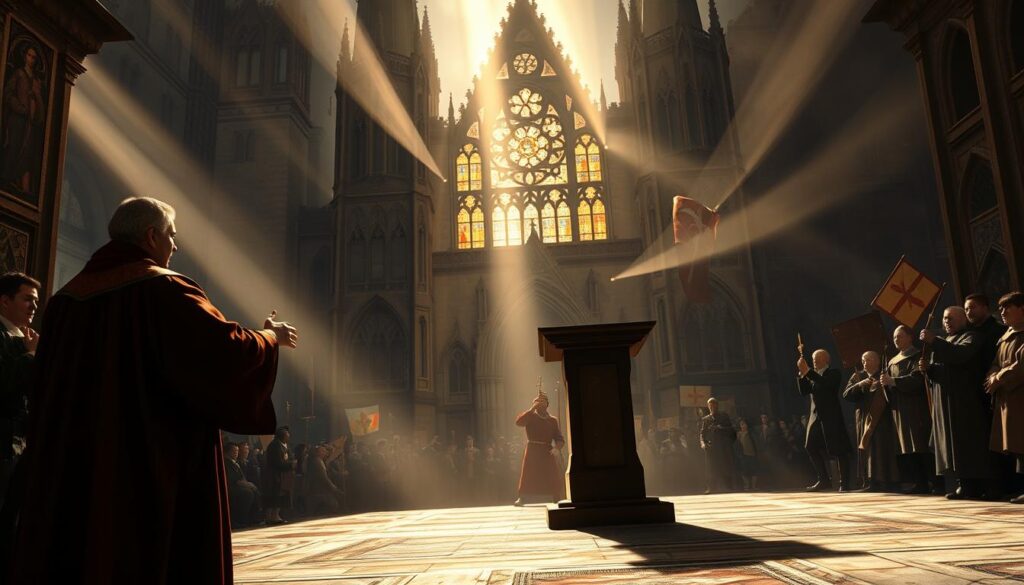
Martin Luther’s journey began with ink-stained fingers and restless questions. While studying Scripture, he realized salvation flowed from grace alone – a radical departure from Roman Catholic teachings. His famous 95 Theses in 1517 sparked debates that reached leaders across Europe.
Pope Leo X excommunicated Luther in 1521, but the ideas spread faster than fire. By 1530, Lutheran communities flourished from Sweden to Finland. “Every believer becomes their own priest,” Luther declared, empowering ordinary worshippers through Bible access.
Reform Across Borders
While Luther challenged Rome, Huldrych Zwingli reimagined worship in Zurich. He stripped churches of ornate decorations, arguing simplicity brought believers closer to God’s word. Meanwhile, John Calvin crafted detailed theological frameworks in Geneva that influenced nations from France to Scotland.
| Reformer | Innovation | Legacy |
|---|---|---|
| Martin Luther | Salvation through faith alone | Lutheran denominations |
| Huldrych Zwingli | Simplified worship services | Reformed Swiss churches |
| John Calvin | Predestination theology | Presbyterian traditions |
| Henry VIII | Political separation from Rome | Church of England |
Political power played its part too. When England’s king broke with papal authority, he created a unique blend of Protestant ideas and traditional rituals. These diverse approaches shared one conviction: spiritual truth belongs to all, not just clergy.
Reformation in Action: Social, Political, and Cultural Shifts
Books became weapons, and monarchs turned theologians in a clash of beliefs. The 16th century’s spiritual upheaval didn’t just alter worship—it rewrote the rules of power, art, and daily life.
Religious Wars, Political Intrigue, and the Influence of Monarchs
When Henry II died in 1559, Protestant nobles joined France’s royal council—a bold move signaling their growing authority. Catherine de’ Medici’s 1562 edict permitting public Reformed worship showed even skeptics couldn’t ignore demands for spiritual freedom. But peace collapsed when armed groups massacred worshippers at Wassy weeks later, igniting decades of conflict.
Cultural Reformation: Shaping Society, Art, and Education
Reformers knew lasting change required reshaping culture. John Calvin’s Geneva became a literacy hub, schools teaching Scripture alongside mathematics. Artists illustrated Luther’s teachings through woodcuts, making complex ideas accessible to all.
The Role of the Printing Press and Global Dissemination
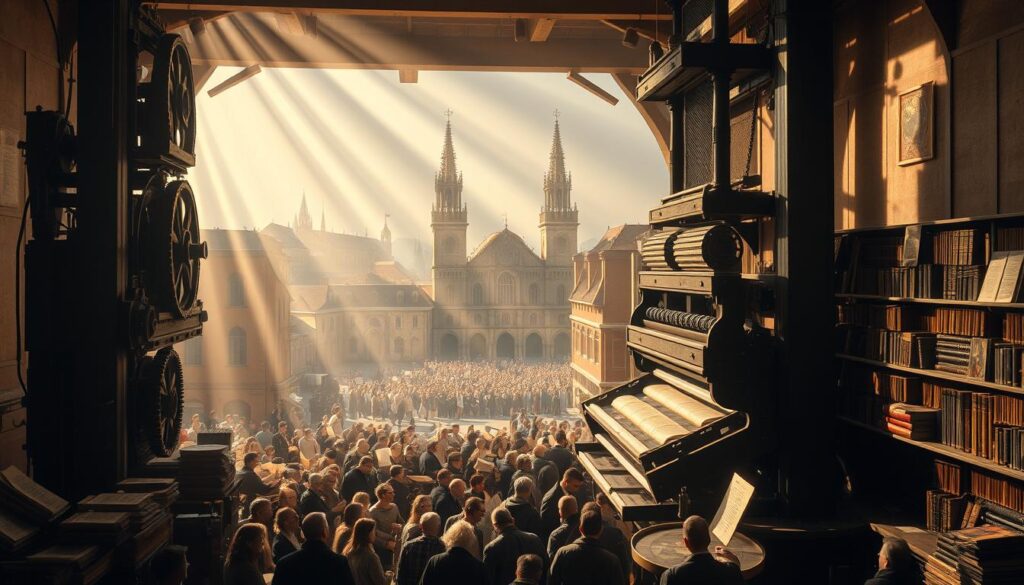
Gutenberg’s invention turbocharged the movement. By 1550, over half a million Lutheran pamphlets circulated Europe. Vernacular Bibles let ordinary people debate theology—a radical shift from Latin-only services. This knowledge revolution laid groundwork for modern education systems.
From 1980s activism to Korean Bible studies today, these principles still shape how societies balance faith and freedom. As Zwingli noted, “True reform plants seeds that outlive the sower.”
Conclusion
What began as a spark in the 16th century ignited a flame that burns today. The Reformation wasn’t about creating one institution but fueling a global movement of diverse communities. From German villages to American cities, these groups shared a commitment to reshaping spiritual life through Scripture and personal conviction.
Over time, this energy birthed countless churches with unique traditions yet united by core principles. The role of everyday people in worship deepened, while debates about faith and state reshaped society’s approach to comfort during loss. Even after religious wars cooled, the drive for reform kept evolving.
Modern protestantism continues adapting ancient truths to new challenges. Its history reminds us that spiritual growth thrives when communities balance tradition with fresh perspectives. As believers worldwide engage with Scripture, the Reformation’s legacy lives in every heart seeking authentic connection.
FAQ
Why were figures like John Wycliffe and Jan Hus significant before the Reformation?
Wycliffe and Hus challenged medieval doctrines, translating scripture into vernacular languages and criticizing church corruption. Their ideas laid groundwork for later reformers like Martin Luther, even though they faced opposition during their lifetimes.
How did Martin Luther’s actions lead to the establishment of Protestant traditions?
Luther’s 95 Theses in 1517 criticized indulgences and papal authority, sparking debates. His translation of the Bible into German and emphasis on faith over works inspired movements that broke from Rome, creating Lutheran and other Reformed branches.
What differentiated John Calvin’s teachings from Luther’s ideas?
Calvin emphasized predestination and a structured church governance. His Institutes of the Christian Religion shaped Reformed theology, while Luther focused on salvation by faith and scripture’s authority without Calvin’s strict doctrinal framework.
How did political leaders influence the spread of Reformation ideas?
Monarchs like Henry VIII in England used reform to assert control, separating from the Catholic Church via the Act of Supremacy. German princes protected Lutherans, while cities like Zurich under Zwingli became hubs for Reformed practices.
What role did the printing press play in the Reformation?
It allowed rapid spread of pamphlets, Bibles, and Luther’s writings. This democratized access to ideas, fueled public debate, and helped reformers bypass traditional church authority to reach broader audiences.
How did the Peace of Westphalia impact religious boundaries in Europe?
The 1648 treaty ended the Thirty Years’ War, letting rulers choose their state’s religion (Catholic, Lutheran, or Calvinist). This cemented the idea of national churches and reduced papal influence over political affairs.
Why did the Church of England emerge separately from other Protestant groups?
Henry VIII’s conflict with the pope over annulments led to the English Reformation. Unlike Lutheran or Calvinist reforms, it retained many Catholic rituals but shifted authority to the monarchy, creating a unique Anglican identity.