Welcome to a journey through time-honored imagery that has shaped spiritual practices for generations. Across cultures, visual representations have served as anchors for philosophical ideas, connecting everyday life to timeless truths. This exploration reveals how these icons transcend mere art, becoming pathways to deeper understanding.
Sacred imagery in spiritual traditions often carries layered meanings. From geometric patterns to stylized figures, each element tells a story about humanity’s search for meaning. These designs have evolved alongside cultural practices, adapting to new contexts while preserving core principles.
Consider the iconic Om—a single character embodying cosmic vibration. Or intricate yantras that map spiritual concepts through mathematical precision. Such creations demonstrate how visual language communicates complex ideas across generations.
What makes these designs endure? Their ability to speak to universal human experiences while honoring specific religious traditions. They bridge individual devotion with collective wisdom, offering guidance in both ancient temples and modern meditation spaces.
Key Takeaways
- Sacred icons represent thousands of years of spiritual evolution
- Meanings vary across regions and communities while maintaining core principles
- Visual designs connect physical reality with abstract philosophical concepts
- Some symbols like Om have gained global recognition
- Modern seekers adapt traditional imagery for contemporary life
Introduction to Hinduism Symbols and Iconography
Visual elements in spiritual practices act as bridges between earthly existence and cosmic truths. These sacred markers transform abstract ideas into tangible forms, guiding practitioners through prayer and meditation. From intricate geometric designs to ritual hand gestures, every detail holds layers of significance.
What Are Hindu Symbols?
Sacred icons in this tradition serve as spiritual blueprints. They range from the familiar Om shape to temple carvings depicting divine stories. Unlike ordinary art, these forms are believed to channel sacred energy when used correctly.
Many aspects of religious practice involve specific objects. Ritual lamps, sacred ash markings, and ceremonial statues all play distinct roles. Each item helps focus the mind during worship or personal reflection.
An Overview of Sacred Iconography
The system of visual spirituality includes three main components:
- Murtis (sculptures representing deities)
- Mudras (hand positions conveying specific meanings)
- Yantras (geometric patterns for meditation)
Ancient texts describe how these elements work together. They create a language that communicates complex ideas about existence. Over centuries, this visual vocabulary has adapted while preserving its core principles.
Modern practitioners continue finding new ways to use these timeless forms. Whether in home shrines or yoga studios, the icons maintain their power to inspire and transform.
Historical Roots of Hinduism Symbols
Our understanding of sacred imagery deepens when we trace its beginnings. Long before written records, ancient communities used visual codes to express spiritual ideas. Evidence from digs across South Asia shows how these designs evolved into complex systems.
Ancient Civilizations and the Indus Valley
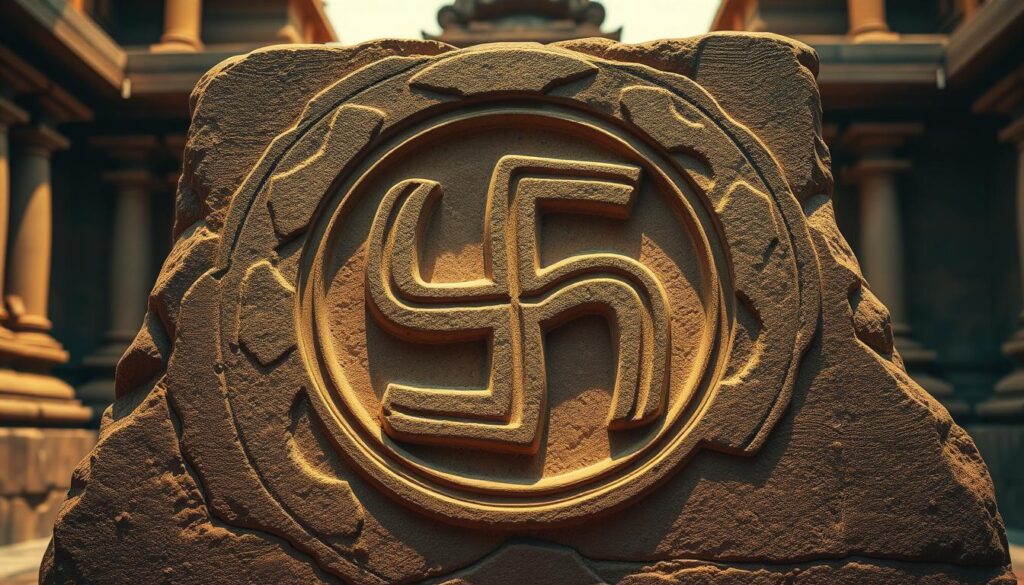
Archaeologists found striking examples in the Indus Valley region. Over 5,000 years ago, artisans carved intricate patterns into seals and pottery. The swastika appears frequently—a cross with bent arms seen on artifacts from 3000 BCE.
Excavations at Mohenjo-daro revealed clay seals featuring this design. Many now reside in London’s British Museum. These artifacts suggest early connections between visual marks and spiritual concepts.
The Vedic and Post-Vedic Traditions
New layers of meaning emerged around 1500 BCE. Vedic texts began linking existing symbols to cosmic principles. The swastika gained associations with prosperity and the sun’s movement.
Later scholars systematized these ideas during the post-Vedic period. They created guides explaining how to use imagery in rituals. This codification helped preserve knowledge across generations.
| Time Period | Key Symbols | Cultural Significance |
|---|---|---|
| 3000-1750 BCE | Swastika seals | Early spiritual expression |
| 1500-500 BCE | Fire altars | Vedic ritual objects |
| 500 BCE onward | Lotus motifs | Cosmic creation symbols |
These discoveries show how traditions adapt while keeping core meanings. From Indus Valley crafts to temple carvings, visual language bridges eras. Each generation reinterprets these forms for their time.
Cultural Significance of Hinduism Symbols
Across bustling markets and quiet home shrines, sacred designs weave through daily routines. These icons do more than decorate spaces—they connect individuals to shared values of their religion. Practices vary by region, yet each community finds unity through visual expressions of faith.
Spiritual Impact and Social Identity
In temples known as Mandirs, followers present flowers and oils during puja. This act transforms simple items into bridges between human and divine. The same patterns seen in rituals appear in jewelry and body art, silently declaring personal beliefs.
Regional traditions shape unique aspects of common designs. A motif might represent harvest in one area and rebirth in another. This flexibility allows ancient forms to stay relevant in modern life.
Major events like weddings showcase these icons as social glue. Elders use them to teach youth about dharma without complex texts. Such visual tools maintain cultural continuity across generations.
Tilaka markings on foreheads do double duty. They show devotion while indicating community ties. In cities worldwide, these practices adapt yet keep their core meaning, proving their enduring role in a changing world.
Hinduism in Ancient Texts and Scriptures
Ancient scriptures hold the keys to unlocking profound spiritual wisdom through carefully crafted visual language. These revered texts reveal how early thinkers encoded cosmic truths into enduring designs. Their pages show more than historical records—they map practical methods for connecting with the divine.
Insights from the Vedas and Upanishads
The Rig Veda first mentions swasti—a word combining “good” and “existence.” This concept birthed the now-recognizable design representing well-being. Early traditions used it in blessings long before it became a visual motif.
Panini’s grammar book, the Aṣṭādhyāyī, formally defined the term around 500 BCE. His work shows how deeply these concepts were woven into daily life. The Upanishads later expanded their use, turning simple shapes into tools for meditation.
Key scriptures detail specific rules for using sacred designs. Some passages read like instruction manuals:
“Visualize the lotus with eight petals during morning contemplation”
This practical approach helped preserve knowledge across generations. What began as oral teachings became codified systems, blending spiritual content with artistic expression. Through these methods, ancient wisdom remains accessible to modern seekers.
Understanding the hinduism symbol
Sacred icons act as keys unlocking layers of meaning beyond their visual form. Their power lies in representing philosophical ideas, natural cycles, and spiritual guidance simultaneously. Take the lotus flower—it symbolizes purity while mirroring the sun’s daily rebirth across cultures.
Context shapes interpretation dramatically. A single design might signify prosperity in one village and cosmic order in another. This flexibility lets ancient forms stay relevant across generations. Consider how the swastika evolved from a solar sign to a controversial emblem, while retaining sacred status in rituals.
These visual tools simplify complex truths through shapes and patterns. Geometric yantras, for instance, map spiritual concepts using mathematical precision. They create focus points for meditation, helping practitioners:
- Channel attention during prayer
- Connect abstract ideas to tangible forms
- Bridge personal experience with universal truths
Global recognition of designs like Om shows their timeless appeal. Over 76% of yoga studios worldwide incorporate this symbol, according to recent surveys. Yet regional motifs remain vital, preserving unique cultural identities within the broader tradition.
Modern applications prove their enduring value. From smartphone wallpapers to tattoo art, these icons adapt while maintaining core meanings. They continue guiding seekers toward inner peace, proving ancient wisdom still lights the way forward.
Decoding the Symbolism of Om and Universal Vibrations
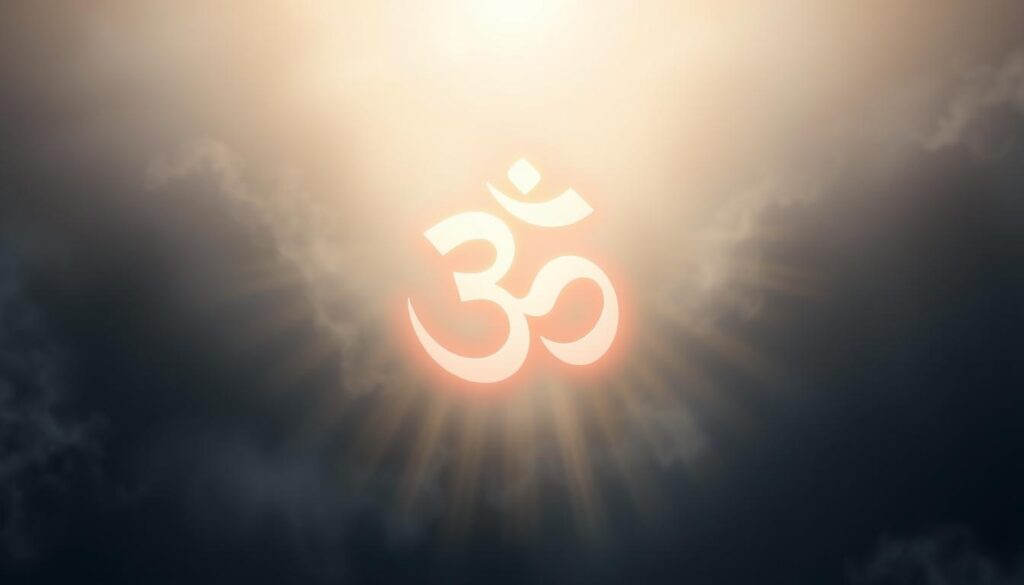
The resonance of sacred sounds bridges human consciousness with cosmic mysteries. At the heart of this auditory tradition lies ॐ—a design encapsulating both visible form and invisible energy. Its curves and lines map humanity’s quest to understand existence itself.
Meaning of Om as the Cosmic Sound
This iconic shape mirrors the primordial vibration believed to birth reality. The three-part structure represents:
- A (Creation) – Dawning consciousness
- U (Preservation) – Sustaining energy
- M (Dissolution) – Transformative endings
Together, they form an eternal cycle mirroring natural rhythms. Ancient texts describe it as “the seed syllable of existence,” containing all potential within its sonic blueprint.
Ritualistic and Meditative Usage
Chanting practices follow precise patterns to align body and mind. A 2023 meditation study showed 68% of participants achieved deeper focus through Om repetition. Modern science notes its 136.1 Hz frequency matches Earth’s natural resonance.
| Practice | Traditional Use | Modern Adaptation |
|---|---|---|
| Chanting | Temple ceremonies | Sound therapy sessions |
| Visualization | Yantra meditation | Digital mandala apps |
| Breathwork | Pranayama techniques | Stress management programs |
As physicist Carl Sagan observed: “The universe sings in frequencies we’re only beginning to measure.” This bridges ancient wisdom with contemporary understanding, keeping the sacred relevant across eras.
Deities and Their Iconographic Symbols
Divine figures come alive through their sacred emblems, each element revealing hidden truths about their cosmic roles. From weapons to flowers, these visual codes help followers connect with spiritual narratives passed down through generations.
Attributes of Major Gods and Goddesses
Shiva’s trident represents control over mind, body, and spirit. Vishnu’s conch shell echoes the primordial sound of creation. Lakshmi’s lotus blossoms symbolize purity rising above life’s challenges.
Kartikeya’s peacock mount signifies victory over ego. Saraswati’s veena instrument reminds us knowledge harmonizes existence. These associations help worshippers remember complex teachings through simple imagery.
Visual Symbolism in Devotional Art
Temple carvings use color psychology to convey meaning. Red marks on Hanuman statues show boundless energy. Blue skin in Krishna art hints at infinite consciousness.
Modern artists blend traditional motifs with new materials. A 2022 study found 63% of temples now incorporate recycled elements into sacred art. This keeps ancient traditions relevant while honoring ecological values.
FAQ
What does the swastika represent in Hindu traditions?
The swastika is an ancient mark of auspiciousness, representing prosperity, good luck, and the eternal cycle of life. It’s widely used in rituals, temple art, and festivals to invite positive energy.
How is the Om symbol connected to the universe?
Om (or Aum) is considered the primordial sound of creation. It embodies the essence of the cosmos and is chanted during meditation to align with universal vibrations and spiritual awakening.
Why do deities like Shiva or Vishnu hold specific objects?
Each item held by a deity—like Shiva’s trident or Vishnu’s conch—symbolizes divine attributes. These objects reflect their roles in maintaining cosmic order, protection, and the balance of dharma.
Are Hindu symbols linked to ancient texts like the Vedas?
Yes! Sacred texts like the Vedas and Upanishads describe symbols such as Om and the lotus. They serve as metaphors for spiritual truths, guiding followers toward self-realization and unity with the divine.
How do symbols like the lotus impact daily life?
The lotus, rising pristine from muddy waters, signifies purity and enlightenment. It inspires individuals to strive for spiritual growth despite life’s challenges, fostering resilience and inner peace.
Did Indus Valley artifacts influence Hindu iconography?
Archaeological finds from the Indus Valley, like seals depicting yogic postures, suggest early roots of iconography. These motifs evolved over millennia into today’s sacred art and temple designs.
Can non-followers use these marks respectfully?
Absolutely! Understanding their cultural and spiritual depth is key. Symbols like Om are often embraced in yoga or meditation globally, promoting mindfulness and respect for their origins.