What shaped the beginnings of the world’s largest Christian denomination? Many point to a pivotal moment in history around AD 30, tied to the life of Jesus Christ. According to tradition, His teachings and the work of His apostles laid the groundwork for what would become a global religion.
The early church grew from small gatherings of believers into a structured institution. Over time, leaders refined its teachings and practices, creating a distinct identity. By the 4th century, it had become central to the Roman Empire’s spiritual life.
This growth wasn’t accidental. The apostles’ missionary efforts, combined with evolving cultural needs, helped spread their message. Today, over 1.3 billion people identify with this faith—a testament to its enduring influence.
Understanding these origins requires looking beyond simple dates. It’s about tracing how beliefs, traditions, and communities intertwined across centuries. Let’s explore how this journey began and what makes it unique.
Key Takeaways
- The roots of the Catholic Church connect to events surrounding Jesus Christ’s life in the 1st century.
- Early Christian communities evolved into a structured institution over hundreds of years.
- Cultural and political shifts in the Roman Empire shaped the church’s development.
- The apostles’ teachings remain central to its theology and practices.
- Modern Catholicism reflects centuries of adaptation while maintaining core traditions.
Historical Landscape of Early Christianity
Imagine living in a world where your beliefs could get you arrested—or worse. For nearly three centuries, followers of Jesus faced this reality under Roman Empire rule. Authorities viewed their gatherings as threats, leading to brutal crackdowns. Yet these challenges forged a resilient identity that outlasted empires.
Context of Persecution and Transformation
From Nero’s fiery reign to Diocletian’s ruthless edicts, early church members risked everything. Martyrs became symbols of faith, inspiring others through their courage. Underground networks developed, sharing scriptures and support across regions.
Everything shifted when Constantine claimed victory in 312 AD, attributing it to Christian divinity. His Edict of Milan (313 AD) granted tolerance—though not official status. This turning point allowed public worship and church construction, ending 280 years of secrecy.
Expansion Amidst Adversity
Persecution oddly fueled growth. Stories of steadfast believers attracted curious people, while missionaries adapted messages to local cultures. By 380 AD, Emperor Theodosius declared Christianity the state religion, cementing its place in Mediterranean life.
Through catacomb meetings and coded symbols, the church laid foundations for global influence. Its survival proves how conviction can reshape history—even when the odds seem impossible.
The Role of Jesus Christ and Apostolic Foundation
How did a small group of followers become architects of a global movement? The answer lies in Jesus Christ’s radical message and the tireless work of His disciples. Their actions after His death transformed scattered believers into a unified spiritual force.
Foundational Teachings in the New Testament
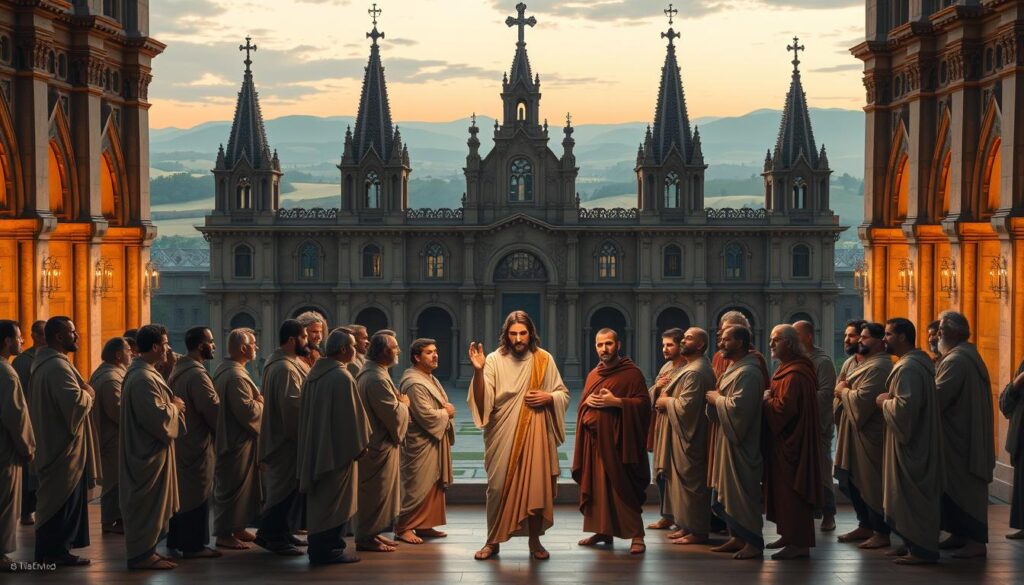
The New Testament captures Jesus’ core principles—love, forgiveness, and redemption. Stories like the Sermon on the Mount shaped early Christian ethics. Paul’s letters to growing churches clarified doctrines, addressing debates about faith versus works.
One pivotal moment occurs in Matthew 16:18, where Jesus tells Peter: “You are Peter, and on this rock I will build my church.” Catholics view this as establishing leadership continuity through apostles.
The Legacy of the Apostles
After Jesus’ death, His disciples faced a critical task: preserving His vision while adapting to new cultures. The Book of Acts shows Peter and Paul debating rules for Gentile converts—a blueprint for inclusive growth.
By creating baptism rituals and communion practices, the apostles gave structure to worship. They also appointed local leaders, ensuring teachings stayed consistent across regions. This framework became the bedrock for later church governance.
Their legacy lives in every Catholic Mass. As one early Christian text states: “Stand firm, hold fast to the traditions you were taught.”
Understanding the Formation of the Early Church
How did scattered groups of believers transform into a cohesive spiritual network? The answer lies in three pillars hidden within ancient texts: shared beliefs, leadership structures, and a commitment to unity. These elements emerged naturally as communities navigated challenges of distance and cultural differences.
The Blueprint in Ancient Texts
New Testament letters reveal surprising organization. Paul’s instructions to Timothy show authority taking shape:
“Guard what has been entrusted to you.”
Similarly, Jude urges readers to
“contend for the faith handed down.”
These passages highlight efforts to preserve core teachings across regions.
The apostles didn’t just preach—they built systems. Local leaders were appointed to oversee worship and resolve disputes. This created consistency in practices like baptism and communion, even as communities adapted to local customs.
By the late 1st century, a pattern emerged. Letters circulated between congregations, reinforcing common ground. Shared meals became sacred rituals. Financial support flowed between cities during famines. These actions wove isolated groups into a tapestry of mutual care.
This organic growth laid the groundwork for later structures. What began as house meetings evolved into a global church with defined roles and traditions. The apostles’ vision of unity amid diversity became its lasting hallmark.
Exploring “catholicism founded”: Key Milestones and Influences
How did a fragmented spiritual movement become a unified global institution? The answer lies in three groundbreaking ideas from a 2nd-century thinker. While early Christians focused on survival, visionaries began crafting systems to preserve their identity across generations.
Defining the Term and Its Historical Context
By 180 AD, Bishop Irenaeus of Lyon proposed a revolutionary framework. He argued true authority came from three sources:
- New Testament scriptures
- Bishops tracing leadership to apostles
- Sacred traditions passed through generations
This “rule of faith” helped standardize practices across regions. The term “catholic”—meaning universal—gained traction as communities embraced shared beliefs. By the 3rd century, this approach distinguished mainstream groups from smaller sects.
Irenaeus’ system gave bishops crucial roles as guardians of doctrine. Episcopal centers in Rome, Antioch, and Alexandria became hubs for resolving disputes. This structure allowed flexibility while maintaining core teachings—a balance that shaped the church’s growth over centuries.
These developments didn’t happen overnight. They emerged through debates, persecutions, and cultural exchanges. The resulting blend of scripture, tradition, and leadership created a foundation that still guides millions today.
Influence of the Roman Empire and Constantine
Power struggles and spiritual revolutions rarely mix—unless you’re Constantine the Great. His reign marked a time when imperial might and religious vision collided, reshaping the church forever. What began as political strategy became a legacy still felt in modern worship spaces.
The Edict of Milan and Changing Times
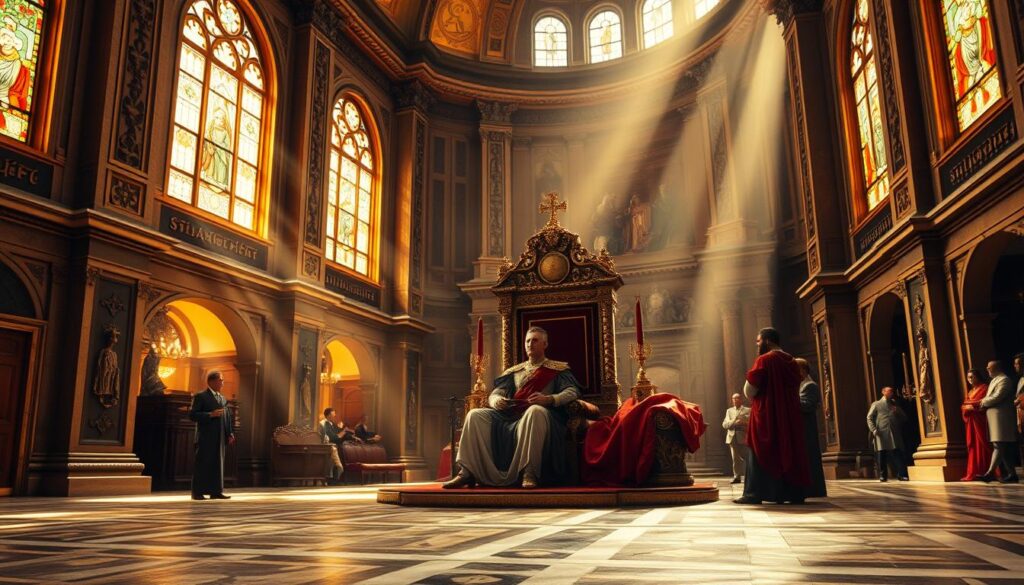
In 313 AD, Constantine did something unheard of: he made Christianity legal across the Roman Empire. This decree didn’t just stop persecution—it turned the church from underground movement to public institution overnight. Suddenly, believers could build grand basilicas instead of hiding in catacombs.
The emperor’s next move proved even bolder. He summoned 300 bishops to the Council of Nicaea in 325 AD. Their goal? Unite squabbling Christian factions under one creed. This meeting produced foundational statements still recited in Roman Catholic services today.
Constantine’s actions sparked three lasting changes:
- Imperial funds flowed into church construction
- Sunday became a state-recognized day of rest
- Christian leaders gained authority in civic matters
By aligning with the church, emperors secured loyalty from growing Christian populations. This partnership laid groundwork for Rome’s later role as the heart of Roman Catholic tradition. As one historian notes: “The cross and the crown became inseparable—for better or worse.”
Pagan Influences and Adaptations in Early Catholicism
Cultural blending often leaves fingerprints on religious traditions. Scholars note that early Roman Catholic practices sometimes mirrored elements from neighboring pagan religions. This intersection sparks debates about adaptation versus authenticity in the development of Christian worship.
Borrowed Rituals and Ceremonies
Critics highlight striking similarities between certain Roman Catholic rituals and ancient pagan practices. The Eucharist’s emphasis on consuming Christ’s body and blood echoes Mithraic “theophagy” rites. One historian observes:
“Ritual meals symbolizing divine union appeared across Mediterranean religions long before Christianity.”
Church leaders argue these parallels reflect shared human symbolism rather than direct borrowing. They maintain the Mass transforms existing cultural traditions into vehicles for Christian truth.
Parallels with Pagan Traditions
Marian devotion draws comparisons to Egyptian goddess Isis worship. Both figures were portrayed as:
- Divine mothers offering protection
- Intercessors between humanity and higher powers
- Symbols of idealized femininity
Similarly, the veneration of saints mirrors the Roman pantheon’s specialized deities. The Roman Catholic Church counters that saints differ fundamentally—they’re not gods but holy examples. As theologian Mark Bonocore notes: “Christianity contextualized familiar concepts to point people toward Christ.”
These discussions reveal how beliefs evolve within cultural contexts. While critics see syncretism, the Church emphasizes purposeful reinterpretation of shared human experiences.
The Evolution of Catholic Doctrine and Tradition
How did early Christian practices grow into a detailed system of rituals and teachings? This journey from New Testament foundations to structured doctrine unfolded over centuries, shaped by cultural shifts and theological debates. Let’s explore how core beliefs took form and gained lasting significance.
Development of Sacraments and Theology
The New Testament mentions baptism and communion but leaves room for interpretation. Early believers gradually expanded these practices into seven sacraments, including confirmation and marriage. By the 12th century, theologians like Peter Lombard formalized this system, linking each ritual to spiritual growth.
Key doctrines emerged through similar processes. For example:
- Papal authority grew from Peter’s symbolic role in Scripture
- Marian devotion blended biblical references with early traditions
- Confession evolved from public admissions to private reconciliations
Church councils played a crucial role. The Council of Trent (1545-1563) declared tradition and Scripture equally vital for faith. This decision addressed reformers’ critiques while preserving practices like saint veneration. As one bishop noted: “Truth flows through two streams—both divine in origin.”
Over time, practices such as indulgences and purgatory gained theological backing. Leaders argued these concepts reflected God’s mercy, even if not explicitly biblical. Today, these beliefs remain central to Catholic identity, demonstrating how tradition adapts while honoring its roots.
Key Figures and Their Impact on Roman Catholicism
History remembers those who shaped worlds. In the Roman Catholic Church, visionary leaders turned challenges into stepping stones for growth. Their decisions still echo through modern worship spaces and global policies.
Contributions of Early Church Leaders
Sixth-century Pope Gregory I revolutionized religious administration. He:
- Standardized liturgical music (Gregorian chant)
- Sent missionaries to Anglo-Saxon England
- Strengthened papal authority over European bishops
As successors to the apostles, these leaders balanced spiritual duties with practical needs. Francis of Assisi later redefined monastic life by embracing poverty. His Friars Minor brought fresh energy while staying within church structures.
Influence of Charlemagne and Other Notables
When Charlemagne knelt before Pope Leo III in 800 AD, it changed everything. The coronation:
- Established popes as political power brokers
- Linked the church to European governance
- Revived Roman imperial imagery through titles like Pontifex Maximus
This partnership between throne and altar shaped medieval Europe. As historian Thomas Noble notes: “Charlemagne didn’t just protect the Roman Catholic Church—he made it indispensable to royal legitimacy.”
Controversies and Debates in Catholic History
Throughout its long history, the Catholic Church has navigated complex debates about its teachings and practices. Critics and supporters alike raise questions about how traditions evolved—and whether they align with early Christian roots. Let’s explore these discussions that continue to shape understanding of the church’s journey.
Debates Over Doctrinal Integrity
Some scholars argue that certain practices, like papal authority, developed over time rather than originating with the apostles. Second Timothy 4:3-4 warns of people turning from truth to myths—a passage critics cite when discussing doctrinal shifts. Defenders counter that core beliefs remain unchanged, supported by ancient writings and archaeological evidence.
Modern Critiques and Historical Rebuttals
Today, questions focus on topics like saint veneration or ritual adaptations. Detractors claim these elements borrow from non-Christian sources. The Catholic Church responds by emphasizing continuity in faith, noting how traditions reflect deeper spiritual truths. Recent discoveries in early Christian texts offer fresh insights, fueling dialogue about authenticity and adaptation.
These debates remind us that history is rarely simple. Whether examining ancient writings or modern critiques, understanding requires balancing reverence with honest inquiry.
FAQ
Did Jesus Christ start the Roman Catholic Church?
Jesus Christ is central to the Church’s teachings, but the Roman Catholic Church developed over centuries. Early Christian communities, led by apostles like Peter and Paul, laid its foundation. Formal structures, like bishops and sacraments, grew later as believers spread across the Roman Empire.
How did the Roman Empire shape Catholicism?
The Roman Empire’s infrastructure helped spread Christianity. Emperor Constantine’s Edict of Milan (AD 313) ended persecution, allowing the faith to thrive. Later, the empire’s decline led the Church to take on political roles, blending spiritual and worldly authority.
Were pagan traditions absorbed into early Catholic practices?
Some rituals, like winter festivals, were adapted to align with Christian teachings. For example, Christmas coincided with pagan solstice celebrations. These adaptations helped converts transition while preserving core beliefs like baptism and the Eucharist.
What role do bishops play in Church history?
Bishops became key leaders after the apostles’ deaths, claiming succession from Peter. They unified doctrine, resolved conflicts, and guided communities. Over time, the Bishop of Rome (the Pope) gained prominence as the Church’s central authority.
When did the New Testament influence Catholic theology?
The New Testament’s writings, like Paul’s letters, shaped early teachings. By the 4th century, Church councils formalized which books were scripture. This canon became the bedrock for sacraments, liturgy, and moral guidelines still used today.
How did Charlemagne impact Roman Catholicism?
Charlemagne, crowned Holy Roman Emperor in AD 800, strengthened ties between the Church and European rulers. He promoted education, standardized liturgy, and defended Christian lands, merging faith with medieval governance.
Why is apostolic succession important?
Apostolic succession—the unbroken line of bishops from the apostles—ensures continuity in teachings and authority. It’s a cornerstone of Catholic identity, linking modern practices to Jesus’ original disciples.
What controversies shaped Catholic doctrine?
Early debates over Christ’s divinity (e.g., Arianism) led to councils like Nicaea (AD 325), which defined core beliefs. Later issues, such as the Reformation, sparked reforms but reaffirmed traditions like the sacraments and papal authority.