Imagine a single day that shook the foundations of spiritual life across continents. On October 31, 1517, a bold act by a German monk ignited a religious movement still felt worldwide. This moment didn’t just challenge church practices—it rewrote the rules of faith and power for generations.
Martin Luther’s famous document, now known as the 95 Theses, questioned long-held traditions. His ideas spread like wildfire, thanks to the newly invented printing press. What began as theological debate soon became a cultural earthquake, reshaping Europe’s history and birthing new forms of worship.
The ripple effects reached far beyond church walls. This movement gave ordinary people tools to interpret scripture themselves. It sparked revolutions in education, politics, and personal belief systems—changes that echo in modern ideas about freedom and self-expression.
Key Takeaways
- A monk’s bold challenge on October 31, 1517, launched a spiritual revolution
- Printed ideas traveled faster than ever, changing how people accessed religious teachings
- New branches of the Christian religion emerged, emphasizing personal faith over tradition
- Power shifted from institutions to individuals in matters of belief
- Modern concepts of religious liberty trace roots to this historical turning point
Overview of the Protestant Reformation
The 16th century witnessed a seismic shift in spiritual thought that reshaped entire nations. As the Roman Catholic Church faced criticism over its practices, thinkers began questioning centuries-old traditions. This wasn’t just about religion—it sparked debates about power, truth, and who gets to interpret sacred texts.
Historical Context and Key Concepts
Europe’s Renaissance era set the stage for change. A growing emphasis on humanism made people rethink their relationship with authority. Scholars argued that salvation came through faith alone (sola fide), challenging the doctrine requiring both belief and church-led rituals.
The printing press became the movement’s engine. For the first time, pamphlets and translated Bibles reached farmers and merchants—not just clergy. This technological leap turned theological debates into public conversations.
Major Milestones at a Glance
Key events unfolded like dominoes across decades:
- A monk’s public critique of indulgences (1517)
- Peasant revolts demanding social justice (1524-25)
- Peace agreements allowing regions to choose their faith (1555)
These moments didn’t just alter church structures—they redefined how societies governed morality. The effects linger in modern debates about personal freedom and institutional power.
Understanding the Protestant Reformation Date
A single act of defiance on an autumn day changed how millions relate to spirituality. While many moments shape history, October 31, 1517, stands out as a turning point that redirected the flow of religious thought.
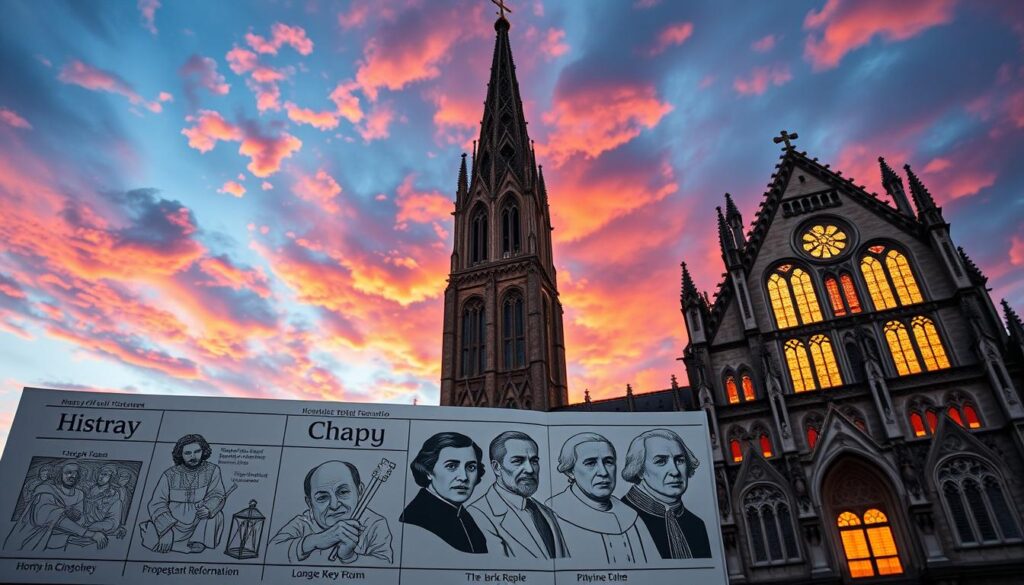
Why This Day Matters in Church History
That crisp fall morning in Wittenberg wasn’t just about posting ideas—it lit a fuse. Luther’s document questioned payments for forgiveness, a practice that troubled ordinary worshippers. His dual role as scholar and monk gave his words unusual authority.
The church door functioned like a public forum. Nailing the theses there invited open discussion, not rebellion. This act sparked debates reaching far beyond academic circles, reshaping how people viewed spiritual leadership.
Building Tensions Before the Breakthrough
Several factors created pressure before 1517:
| Years Before | Key Issue | Impact |
|---|---|---|
| 1490s-1510s | Indulgence sales | Eroded trust in church practices |
| Early 1500s | Scripture accessibility | Increased public theological awareness |
| 1516-1517 | Luther’s research | Exposed contradictions in doctrine |
These developments made the reformation began inevitable. Political leaders saw opportunities to challenge Rome’s power. Everyday believers craved more personal connections with faith.
Modern readers might wonder why this time period matters. The answers lie in how it transformed relationships between individuals, communities, and divine authority—a shift still felt in today’s religious articles and practices.
Key Figures and Events That Shaped the Reformation
Courageous voices emerged across Europe, challenging centuries-old traditions and sparking lasting spiritual change. Three distinct leaders—each with unique motivations—fueled transformations that reshaped religious practice for millions.
Martin Luther and the 95 Theses
A humble monk’s pen sparked an international firestorm. Martin Luther, an Augustinian scholar, distilled his concerns about church practices into 95 arguments. His theses weren’t just academic musings—they gave voice to widespread frustrations about unfair systems.
Luther’s writings spread faster than anyone imagined. Printed translations reached shopkeepers and nobles alike, proving ordinary people craved direct access to spiritual teachings. His translation of scripture into German became a bestseller, empowering believers to interpret faith personally.
Contributions of John Calvin, Henry VIII, and Others
While Luther lit the fuse, other reformers expanded the movement’s reach:
- John Calvin built theological systems emphasizing divine sovereignty
- Henry VIII’s political clash with Rome birthed England’s independent church
- Radical groups like Anabaptists prioritized community over hierarchy
Calvin’s Institutes of the Christian Religion became Protestantism’s textbook. Meanwhile, Henry’s break with papal authority showed how personal and national interests could drive religious change. Together, these ideas created diverse worship traditions still thriving today.
The Impact on the Catholic Church and European Politics
A storm of change swept through Europe’s religious and political institutions. The Roman Catholic Church faced unprecedented scrutiny as reformers exposed flaws in its practices. This pressure sparked both internal renewal and external conflicts that reshaped the continent.
Rebuilding From Within
Church leaders initially struggled to address criticisms effectively. After decades of debate, the Council of Trent (1545-1563) became the turning point. This gathering:
- Clarified official doctrine on salvation and sacraments
- Banned corrupt practices like selling spiritual favors
- Established seminaries for better priest education
“If any one saith that the sacraments are not necessary unto salvation… let him be anathema.”
Power Shifts and Bloody Consequences
New religious divisions created complex alliances. Rulers now chose faiths for their regions, often clashing with neighbors. The resulting conflicts devastated populations:
| Conflict | Duration | Estimated Deaths |
|---|---|---|
| Thirty Years’ War | 1618-1648 | 4.5-8 million |
| French Wars of Religion | 1562-1598 | 2-4 million |
Amid the chaos, positive changes emerged. The Jesuits became education pioneers, founding schools across three continents. Their work helped the Roman Catholic Church regain spiritual influence through learning rather than force.
These turbulent times planted early seeds of religious tolerance. By challenging absolute authority, they paved the way for modern ideas about separating church governance from state power.
Artistic, Cultural, and Social Transformations During the Reformation
A creative explosion reshaped Europe’s spiritual landscape as new beliefs demanded fresh forms of expression. This era birthed masterpieces that still define our understanding of sacred culture, while rewriting rules about who could access divine truth.
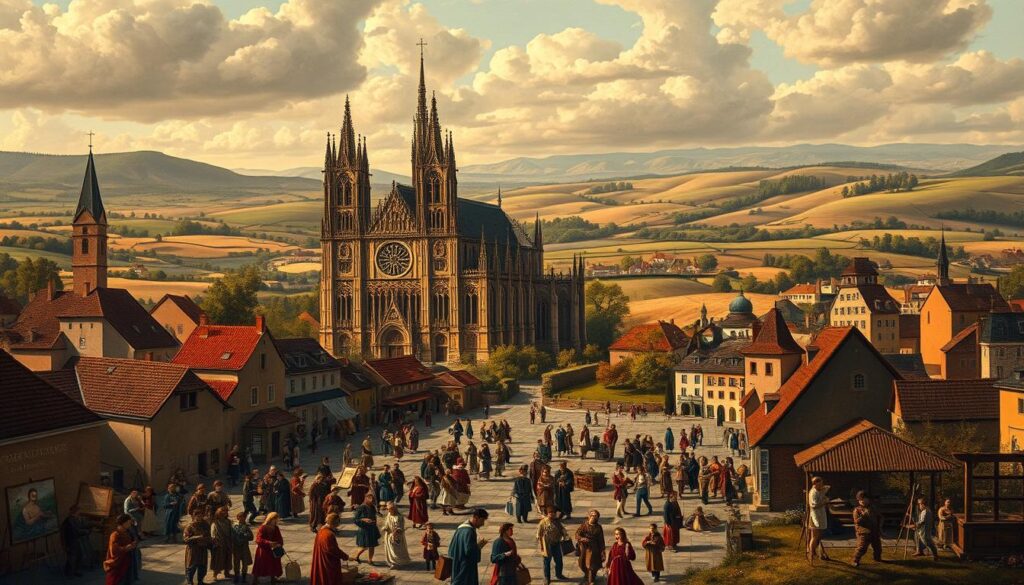
Influence on Art, Music, and Literature
Artists found bold ways to visualize faith. Pieter Paul Rubens painted dramatic biblical scenes that made scripture feel alive. Johann Sebastian Bach later transformed Lutheran hymns into complex harmonies, proving music could be both devotional and revolutionary.
The printing press became truth’s great equalizer. Martin Luther alone produced over 20% of all German-language articles in his peak years. His Bible translation sold 200,000 copies by 1534—a staggering number for the time.
Social Changes and Religious Practices
Sunday services turned participatory. Congregations sang together in common languages rather than watching silent rituals. “Why should the devil have all the good tunes?” Luther quipped while writing hymns everyone could learn.
Literacy rates climbed as people studied translated scriptures. Parents taught children to read using religious texts. This shift created new social expectations—suddenly, farmers could debate theology with nobles.
Artistic styles reflected theological differences. Calvinist communities favored simple whitewashed churches, while Lutherans embraced ornate altars. These choices still shape how different groups experience faith today.
Regional Perspectives: England, Germany, Switzerland, and Beyond
Europe’s spiritual landscape fractured into distinct regional identities as local leaders shaped religious change. While shared ideals of reform united these movements, each region developed unique solutions to age-old questions of faith and governance.
England’s Spiritual Rollercoaster
What began as a royal marriage dispute became a national transformation. When Henry VIII established the Church of England in 1534, he unwittingly launched a century of spiritual whiplash. His daughter Mary’s brutal five-year reign saw Catholic restoration through persecution—earning her the nickname “Bloody Mary.”
Elizabeth I’s 45-year rule brought stability through compromise. Her Book of Common Prayer blended traditional rituals with reformed theology. This liturgical masterpiece gave parishes unified worship texts in English, creating the Anglican tradition’s distinctive voice.
Continental Innovations in Faith
Swiss cities embraced radical changes under Huldrych Zwingli’s leadership. Zurich became a laboratory for reform, removing church art and simplifying services. Meanwhile, German princes secured legal recognition for Lutheranism through the 1555 Peace of Augsburg.
| Region | Key Figure | Lasting Contribution |
|---|---|---|
| England | Elizabeth I | Anglican via Book of Common Prayer |
| Switzerland | Huldrych Zwingli | Radical liturgical simplification |
| Germany | Local Princes | State-controlled Lutheran churches |
“There is one Jesus Christ. The rest are disputes over trifles.”
These regional experiments proved faith could adapt to local cultures. From England’s liturgical balance to Switzerland’s stripped-down services, communities redefined spirituality on their own terms.
Reformation’s Legacy in Modern Christianity
Centuries-old ideas still shape how billions experience spirituality today. The 16th-century movement empowered ordinary people to own their faith, creating ripples that transformed global religious landscapes.
Continuing Influence on Religious Thought and Practice
Modern worship services reflect revolutionary ideas about spiritual access. The concept of “priesthood believers“—that all worshippers can connect directly with divine truth—fuels today’s emphasis on personal Bible study. This shift reshaped both Roman Catholic and Protestant traditions, inspiring reforms like Vatican II’s liturgical updates.
The Evolution of Religious Freedom and Educational Impacts
Colonial America’s experiments in tolerance grew from these roots. Public schools initially formed to teach scripture reading, while universities expanded to explore diverse faith perspectives. Legal protections for conscience rights trace back to early arguments against enforced uniformity.
From megachurch services to interfaith dialogues, the priesthood believers ideal lives on. Even the Roman Catholic Church now encourages lay participation—proof that ancient debates still mold modern spiritual journeys.
FAQ
When did the Protestant Reformation officially begin?
The movement is widely linked to October 31, 1517, when Martin Luther published his 95 Theses, challenging practices like indulgences in the Roman Catholic Church.
How did Henry VIII’s role differ from reformers like Luther or Calvin?
While Luther and Calvin focused on doctrine, Henry VIII’s break with Rome centered on authority—rejecting papal control to form the Church of England and secure his marriage rights.
What role did the printing press play in spreading Reformation ideas?
It allowed texts like Luther’s writings and Calvin’s Institutes of the Christian Religion to circulate widely, fueling debates and uniting supporters across Europe.
Why did the Peace of Augsburg matter for religious freedom?
This 1555 agreement let German rulers choose between Catholicism or Lutheranism, marking a step toward state-sanctioned religious choice—though limited to those two options.
How did the Catholic Church respond to the Reformation?
Through the Council of Trent (1545–1563), it reaffirmed doctrines like papal authority and addressed corruption while launching the Counter-Reformation to reclaim influence.
What social changes emerged from the Reformation?
Emphasis on literacy (to read scripture), shifts in marriage views, and the priesthood of all believers challenged traditional hierarchies, reshaping daily life and worship.
How did England’s Reformation differ from Switzerland’s?
Under Henry VIII and Elizabeth I, England’s split was politically driven, while Swiss reformers like Zwingli and Calvin focused on doctrinal purity and communal governance.
What lasting impacts did the Reformation have on education?
It spurred schools for lay education and Bible study, with figures like Calvin advocating universal literacy to deepen personal faith and understanding.
Did the Reformation influence art and culture?
Yes! It shifted art from lavish religious imagery to simpler themes, while hymns in local languages—like Luther’s—made worship more accessible to ordinary people.
How does the Reformation affect modern Christianity?
It laid groundwork for denominations like Lutheranism and Presbyterianism, emphasized individual faith, and inspired later movements for religious freedom and human rights.