Let’s explore a moment that reshaped religious history forever. Imagine a single act sparking changes that would ripple across continents and centuries. This story begins with a bold challenge to established norms—one that still influences faith practices today.
On October 31, 1517, a German monk named Martin Luther nailed his 95 Theses to a church door. This wasn’t just a protest—it was a call for transparency and reform. His ideas spread like wildfire, thanks to the newly invented printing press.
Why did this moment ignite such dramatic change? Europe was ready. People questioned authority, and rulers sought independence from centralized power. Religious practices had become disconnected from everyday lives, creating fertile ground for new ideas.
The movement’s timeline stretches across generations. While 1517 marks its explosive start, historians debate its conclusion. Some point to the 1555 Peace of Augsburg, others to the 1648 Treaty of Westphalia. Each milestone reflects shifting alliances and evolving beliefs.
Key Takeaways
- October 31, 1517, is widely recognized as the spark that launched a religious revolution
- Martin Luther’s actions challenged long-standing traditions and inspired widespread reform
- Social, political, and technological factors created the perfect conditions for change
- The movement led to the permanent split between Catholic and Protestant traditions
- Its effects continue to shape modern religious diversity and cultural values
Historical Context and Medieval Precursors
Long before Luther’s famous act, Europe simmered with ideas challenging religious authority. Visionary thinkers laid groundwork for change through bold actions and writings. Their efforts created fertile soil for new beliefs to take root.
Early Reform Movements and Precursors
Jan Hus, a fiery Czech priest, demanded church reforms decades before Luther. He translated scripture into everyday language and rejected paid forgiveness certificates. “Truth conquers all things,” he declared before being burned for heresy in 1415.
| Pre-Reformer | Contribution | Legacy |
|---|---|---|
| John Wycliffe | First English Bible translation | Inspired vernacular scripture movements |
| Waldensians | Rejected papal authority | Promoted direct Bible interpretation |
| Jan Hus | Condemned indulgences | Inspired Luther’s later protests |
Impact of the Black Death and Social Change
The 14th-century plague killed millions, shaking trust in institutions. Survivors questioned why faith leaders couldn’t stop the suffering. This crisis made people rethink their relationship with spiritual matters.
Art from this period shows skeletons dancing—a reminder that death came unexpectedly. People sought personal connections with divine forces rather than relying solely on rituals. These shifts prepared society for radical religious ideas about individual salvation.
By Luther’s time, many craved belief systems reflecting their daily struggles. The stage was set for doctrines emphasizing personal faith over traditional structures.
The Role of the Printing Press in Spreading Reformation Ideas
New technology often changes history—but few inventions shook the world like Gutenberg’s movable type. When words could travel faster than ever, entire belief systems transformed. This machine didn’t just print pages—it rewrote spiritual futures.
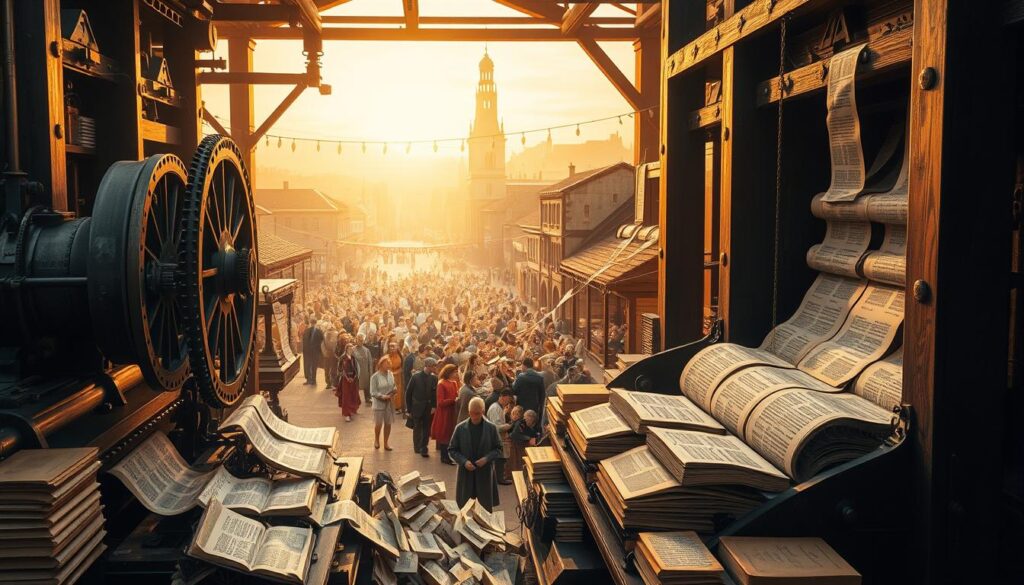
Before 1450, religious texts took months to copy by hand. The printing press changed everything. Suddenly, pamphlets could reach thousands in weeks. Luther’s writings became bestsellers—his works outsold all other reformers combined during critical years.
Common people held translated Bibles for the first time. No longer dependent on Latin-speaking clergy, families debated scripture at home. “Why should priests decide what God means?” became a rallying cry printed on cheap paper.
Printed debates spread like 16th-century tweets. Woodcut cartoons mocked church leaders while catchy hymns taught new doctrines. Authorities couldn’t burn books fast enough—each suppression sparked more presses churning forbidden texts.
This wasn’t just about religion. It reshaped how ideas moved. Farmers debated theology. Women read psalms aloud. The church’s gatekeeping power crumbled as ink-stained pages built new communities of faith.
Key Reformers and Their Contributions
Behind every revolution stand visionary leaders—meet the minds that rewrote religious history. While earlier critics challenged church practices, two figures emerged as architects of lasting change. Their writings became blueprints for new forms of worship that prioritized personal faith.
Martin Luther and his 95 Theses
An Augustinian monk turned fiery lecturer, Luther transformed academic debate into public rebellion. His 1517 document attacking indulgences—certificates sold as spiritual shortcuts—asked tough questions: “Why does the pope’s wealth exceed that of common believers?” University connections helped spread his theses beyond Wittenberg’s church doors.
Calvin and the Reformed Tradition
Twenty years later, John Calvin organized Protestant ideas into a comprehensive system. His Institutes of the Christian Religion became Protestantism’s textbook, explaining doctrines like predestination clearly. Working from Basel and Geneva, he shaped Reformed church practices emphasizing scripture over tradition.
Other voices added crucial notes to this chorus. Huldrych Zwingli reformed Swiss worship by removing icons, while Philipp Melanchthon systematized Lutheran teachings. Together, they proved that spiritual renewal could take many forms—all rooted in personal connection with divine truth.
Influential Events of the Reformation Era
History turned on pivotal moments that transformed religious thought across Europe. One defining clash occurred in 1521 when Martin Luther stood before political and religious leaders at the Diet of Worms. Faced with demands to abandon his ideas, he famously declared: “Here I stand. I cannot do otherwise.”
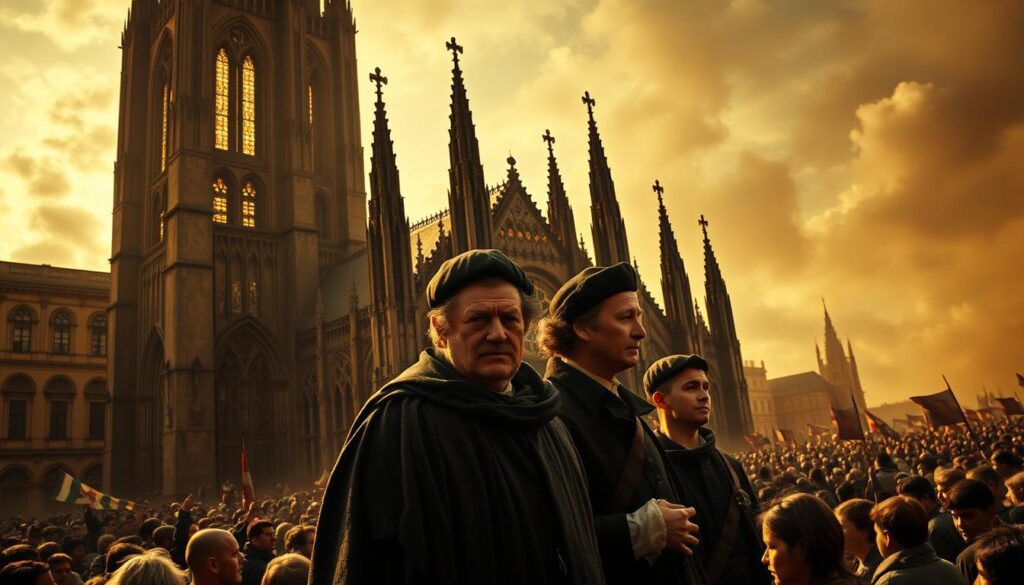
This bold stance led to his excommunication, cementing the split from Rome. Meanwhile, Swiss churches heard new voices. Ulrich Zwingli began preaching radical changes in Zurich as early as 1519—starting a parallel movement emphasizing scripture over tradition.
Geneva became a living laboratory in 1541 when John Calvin reshaped its social structure. His Reformed theology influenced everything from education to laws, proving religious ideas could organize entire communities.
The mid-1520s brought turmoil during the Peasants’ War. Rebels demanding fair treatment looked to Luther for support, but his harsh criticism of their methods revealed tensions between spiritual reform and social revolution.
Each event sparked others like falling dominos. Local disputes grew into international conflicts, reshaping borders and beliefs. By the late 1500s, Europe’s religious landscape bore little resemblance to its medieval past.
The Protestant Reformation Date: Uncovering the Start
Picture a crisp autumn morning in a small German town. A determined monk approaches a church door, hammer in hand. His actions that day would alter Christianity forever.

Martin Luther’s 95 Theses in 1517
On October 31, Luther presented arguments against indulgences – certificates sold as spiritual shortcuts. His document questioned church fundraising practices, asking: “Why should wealthy leaders profit from people’s fears?”
The castle church door served as a public bulletin board. Luther intended academic debate, but printers had other plans. Within weeks, translated copies appeared in markets from Paris to Prague.
Three key ideas fueled the fire:
- Salvation through faith rather than payments
- Scripture’s authority over church traditions
- The right of believers to question leaders
This moment created lasting divisions in Christian practice. What began as local criticism became a blueprint for new forms of worship. The movement’s effects still shape how millions connect with their faith today.
Examining the Theological Shifts in Reformation Thought
Imagine rewriting the rules of faith with pen and parchment. Religious thinkers of the 16th century did just that, introducing radical doctrine that changed how people connected with spirituality. At the heart of this transformation lay a simple yet explosive idea: salvation through grace alone.
Justification by Faith and the Five Solas
Martin Luther’s concept of “justification by faith” flipped traditional teachings. Instead of earning divine favor through rituals, believers needed only trust in Christ’s sacrifice. This priesthood of all believers concept let ordinary people approach spirituality without intermediaries.
John Calvin expanded these ideas in his Institutes of the Christian Religion. He outlined five core principles—the Solas—that became Protestantism’s foundation:
Scripture alone, faith alone, grace alone, Christ alone, and glory to God alone.
These shifts reshaped Christian religion practices worldwide. Good works became expressions of gratitude rather than spiritual transactions. Churches focused less on hierarchy and more on personal relationships with the divine—a legacy still shaping modern faith communities.
FAQ
When did the Protestant Reformation officially begin?
The movement is widely linked to Martin Luther posting his 95 Theses on October 31, 1517. This act challenged the Catholic Church’s practices, sparking widespread debate.
Were there earlier efforts to reform the Church before Luther?
Yes! Figures like John Wycliffe and Jan Hus criticized Church corruption in the 14th and 15th centuries. Their ideas laid groundwork but lacked tools like the printing press to spread widely.
How did technology influence the spread of Reformation ideas?
The printing press, invented by Johannes Gutenberg, let reformers share writings quickly. Pamphlets, Bibles in local languages, and Luther’s works reached masses, fueling change across Europe.
What role did John Calvin play in the Reformation?
Calvin expanded Reformed theology through his book Institutes of the Christian Religion. He emphasized God’s sovereignty and shaped communities in Geneva, influencing later denominations like Presbyterians.
How did the Catholic Church respond to these challenges?
The Council of Trent (1545–1563) addressed criticisms by reaffirming doctrines, banning indulgences, and improving clergy education. This Counter-Reformation aimed to renew the Church’s spiritual authority.
What were the “Five Solas” and why did they matter?
These core beliefs—Scripture alone, faith alone, grace alone, Christ alone, glory to God alone—rejected medieval practices. They framed salvation as a gift from God, not earned through rituals or works.
Did the Reformation lead to political conflicts?
Absolutely. Tensions between rulers supporting reform and those loyal to Rome erupted in wars like the Thirty Years’ War (1618–1648). These conflicts reshaped Europe’s religious and political landscape.
How did the Reformation affect everyday worship practices?
Services shifted to local languages instead of Latin. The Book of Common Prayer in England and hymns written by Luther made faith more accessible. Congregational singing became central to Protestant worship.