Step into a world where ancient spirituality intertwines with modern devotion. Across this diverse nation, millions practice a faith rooted in traditions stretching back nearly two millennia. With over 23 million followers, this community forms Asia’s second-largest Christian population, blending global religious practices with local cultural richness.
Historical records trace this faith’s origins to 52 CE, when Saint Thomas the Apostle reportedly arrived on India’s southwestern coast. Today, three distinct church traditions—Latin, Syro-Malabar, and Syro-Malankara—coexist across 174 dioceses. From Kerala’s palm-fringed churches to Delhi’s urban parishes, each region adds unique flavors to shared beliefs.
Beyond worship spaces, this community drives social progress through 10,000+ educational institutions and healthcare centers. Their efforts bridge gaps in rural development while preserving cultural identity through art, festivals, and multilingual liturgy. This harmonious fusion of Eastern and Western traditions creates a spiritual experience unlike any other.
Key Takeaways
- Over 23 million followers make this one of Asia’s largest Christian communities
- Three church traditions operate across 174 dioceses and 10,701 parishes
- Roots date back to the 1st century, with continuous practice for 1,970+ years
- Distinctive blend of Eastern and Western liturgical traditions thrives nationwide
- Operates thousands of schools, hospitals, and social service organizations
- Cultural integration creates unique devotional art and multilingual practices
Overview of the Indian Catholic Landscape
India’s Catholic community paints a vivid picture of faith thriving in diversity. With 23 million followers, they form nearly half the country’s Christian population. Though just 1.57% of the total population, their impact stretches far beyond numbers.
Southern states showcase the strongest presence. In Kerala, 18.6% of people identify as Christian, while Goa boasts 26%. Tamil Nadu follows with 6%. These regions host centuries-old churches alongside modern institutions.
| State | Christian Population | Key Features |
|---|---|---|
| Kerala | 18.6% | Ancient Syrian Christian roots |
| Goa | 26% | Portuguese colonial heritage sites |
| Tamil Nadu | 6% | Growing urban parishes |
The Catholic Church operates 20% of private schools and 30% of medical centers nationwide. From Mumbai slums to tribal northeast villages, their services reach all faiths.
Three unique traditions coexist under one structure: 174 dioceses manage 10,701 parishes. Latin rites blend European influences, while Syro-Malabar and Syro-Malankara practices preserve Eastern roots. This harmony defines India’s Catholic identity.
Historical Journey of Catholicism in India
Long before Europe embraced Christianity, the shores of modern-day Kerala witnessed the birth of a spiritual legacy. In 52 AD, Saint Thomas the Apostle arrived at Muziris, a bustling port town. His groundbreaking work laid the foundation for communities that still thrive today.
The early believers, called Nasrani, blended apostolic teachings with local customs. They created vibrant traditions—like using oil lamps in worship—that felt familiar yet faith-filled. By the fourth century, Persian bishops began guiding these groups, linking them to global Christian networks.
| Century | Key Development | Cultural Impact |
|---|---|---|
| 1st | Saint Thomas’s arrival | First Christian settlements |
| 4th | Persian leadership begins | Eastern liturgical practices |
| 8th | Local kingdom alliances | Protected religious freedom |
Over 1,900 years, these communities adapted to shifting rulers—from Hindu dynasties to Mughal emperors. Remarkably, their faith remained unbroken. When Portuguese missionaries arrived centuries later, they found established churches, not empty spiritual ground.
This enduring history makes India home to one of Earth’s oldest Christian traditions. From ancient palm-leaf manuscripts to modern-day festivals, the Nasrani legacy continues shaping the country’s spiritual landscape.
Early Christian Encounters in India
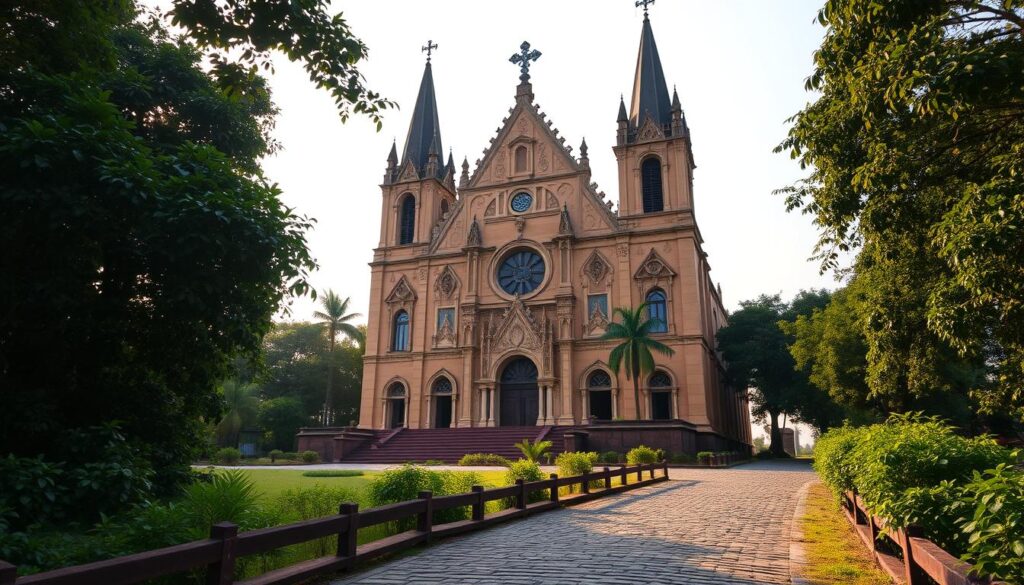
Centuries before European missionaries set foot on Indian soil, vibrant Christian communities were already flourishing along its coasts. These groups traced their spiritual roots to the groundbreaking work of Saint Thomas the Apostle, who arrived in 52 CE. His journey established seven churches across coastal regions, creating Asia’s first Christian networks outside Roman influence.
Apostle Thomas and the Formation of Early Communities
Local traditions describe how Thomas adapted his teachings to resonate with existing cultures. Communities blended Eastern Syriac liturgy with regional practices, developing a unique identity over time. By the 8th century, their growing number led to recognition as a metropolitan province under Patriarch Ishoyab III—a rare honor for non-European believers.
The Synod of Diamper and East Syriac Traditions
Everything changed in June 1599 when Portuguese missionaries convened the Synod of Diamper. Seeking to consolidate Latin power, Archbishop Menezes imposed reforms that altered ancient practices. Traditional East Syriac rituals faced suppression, sparking resistance from communities fiercely proud of their 1,500-year heritage.
Though the synod created divisions, it couldn’t erase centuries of spiritual resilience. Today, these early encounters remind us how faith adapts while preserving its core—a lesson etched into India’s coastal churches and timeless traditions.
Impact of Portuguese Missionaries on Catholic Expansion
When Portuguese ships first touched Indian shores in 1498, they brought more than trade goods. Vasco da Gama’s sea route discovery opened floodgates for religious transformation. Missionaries arrived with a dual mandate—spread faith and secure colonial influence.
Arrival of Vasco da Gama and Initial Encounters
The 16th century saw European powers rewrite spiritual maps. Portuguese missionaries quickly established bases along western coasts. Their work created both alliances and clashes with existing Saint Thomas Christians.
Early encounters revealed cultural divides. While local believers used Syriac rituals, newcomers pushed Latin traditions. This tension shaped church administration for generations.
Establishment of Iconic Churches like Santhome
Nothing symbolizes Portuguese legacy better than Chennai’s Santhome Basilica. Built over Saint Thomas’ tomb in 1523, it became a spiritual magnet. Francis Xavier spent months here in 1545, fueling devotion through his ministry.
Rebuilt in 1896 with Gothic spires, the church blends European design with local materials. Its evolution from humble chapel to grand basilica mirrors missionary ambitions. As one traveler noted: “These stone walls whisper centuries of prayers and power struggles.”
Through churches and colonial policies, Portugal left an indelible mark. Their efforts fused spiritual zeal with political strategy, creating foundations that still shape worship today.
Evolution of Catholic Structures and Dioceses
Imagine a spiritual network spanning continents before modern travel existed. In 1329, the Diocese of Quilon became Asia’s first Roman Catholic diocese—a bold move showing the church’s long-term vision. This small coastal region laid groundwork for what would become one of the world’s most complex religious administrations.
Goa transformed into a powerhouse by 1557, governing territories from South Africa to China. Its rise reflected Portuguese ambitions: “We didn’t just build ships—we built systems to sustain faith across oceans,” noted historian Maria Fernandes. Three key developments shaped this growth:
| Year | Event | Impact |
|---|---|---|
| 1329 | Quilon diocese established | First permanent Catholic structure |
| 1534 | Goa becomes suffragan see | Links African/Asian territories |
| 1944 | Bishops Conference forms | Unites regional leadership |
The church’s work balancing colonial power with local needs created unique solutions. By 2023, 174 dioceses coordinate activities through 30 provinces—a system born from centuries of adaptation. This structure lets diverse traditions thrive while sharing resources.
Modern governance took shape when bishops first met in 1944. Their conference became vital for addressing challenges like education access and interfaith dialogue. Today, these leaders prove centralized systems can respect regional differences—a lesson many organizations study.
Diversity within Indian Catholic Denominations
India’s spiritual mosaic shines through its Catholic community, where three distinct rites coexist under one universal faith. 78.3% follow Latin traditions, while 19.7% practice Syro-Malabar customs, and 2% belong to the Syro-Malankara Church. This blend creates a living tapestry of worship styles across Kerala and beyond.
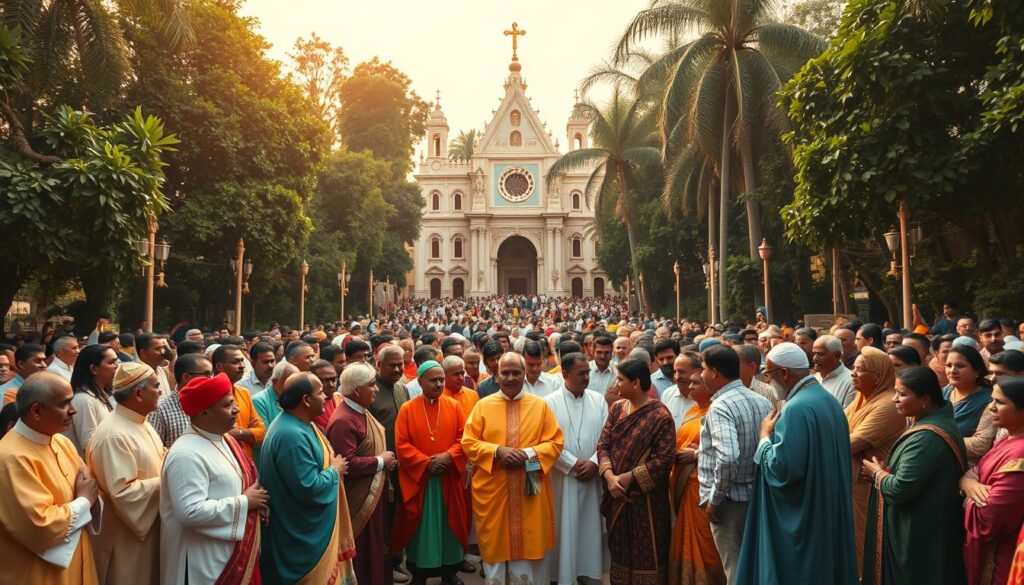
Latin Rite Influence and Global Connections
The Latin Church traces its roots to 16th-century Portuguese missionaries. Their Roman liturgical practices—like Mass in local languages—forge strong ties with the global catholic church. Today, this rite operates 7,000+ parishes, making it the largest part of India’s Catholic world.
Syro-Malabar and Syro-Malankara Traditions
Ancient East Syriac rituals thrive in the Syro-Malabar Catholic Church, preserving traditions from Saint Thomas’s era. Their vibrant liturgy uses Malayalam and incense during worship. Meanwhile, the Syro-Malankara Church blends Syrian Orthodox heritage with Catholic communion, adopting elements like elaborate processions.
| Rite | Followers | Origin | Unique Feature |
|---|---|---|---|
| Latin | 78.3% | Portuguese missions | Global liturgical alignment |
| Syro-Malabar | 19.7% | 1st-century traditions | East Syriac chants |
| Syro-Malankara | 2.0% | 1930s reunion | Syro-Antiochian rites |
Though members freely attend each other’s services, most stay within their birth tradition. This harmony of ancient and modern practices shows how faith adapts while keeping its core alive.
Fusion of Catholic and Indian Cultural Practices
Faith in this diverse nation wears many vibrant hues, blending traditions into something uniquely beautiful. Communities seamlessly weave local customs into their spiritual lives, creating worship styles that feel both familiar and fresh.
Ritual Harmony Across Beliefs
Morning rituals often reveal this cultural crossroads. Families light oil lamps—a Hindu symbol of wisdom—beside Christian icons. Churches drape deities in flower garlands, mirroring temple practices. These shared gestures build bridges between faiths.
Festivals showcase creative fusions. Christmas processions feature kolam floor art designs, while Easter meals include regional spices. Such adaptations make religion feel like home, connecting ancient roots to modern life.
This spiritual blend strengthens community bonds. Over 70% of parishes incorporate local music or dance into services. As one worshiper shared: “Our practices honor tradition while celebrating what unites all people.” This harmony turns places of worship into cultural crossroads that uplift the entire country.
FAQ
How did St. Francis Xavier influence Catholic growth in India?
St. Francis Xavier played a key role in spreading the faith through missionary work along India’s west coast. His efforts established schools and churches, strengthening ties between local communities and global Catholic networks.
What distinguishes the Syro-Malabar Church from other Catholic traditions?
The Syro-Malabar Catholic Church follows East Syriac rites, blending ancient Indian cultural practices with liturgical traditions. It’s one of two Eastern Catholic Churches in India, reflecting centuries of localized worship styles.
How did Portuguese rule shape Catholic history here?
Portuguese explorers like Vasco da Gama introduced Latin Rite practices, building iconic structures such as Santhome Basilica in Chennai. Their arrival also led to clashes with existing Christian communities over religious authority.
Are Hindu customs part of Indian Catholic worship?
Yes! Many parishes incorporate rituals like oil lamps, flower offerings, or bhajan-style hymns into Mass. This fusion creates a unique spiritual identity rooted in both faiths’ cultural heritage.
What role do Catholic schools play in modern India?
Institutions like Loyola College and St. Xavier’s schools prioritize education and social upliftment. They serve students of all religions, fostering interfaith dialogue while maintaining strong academic reputations.
How many Catholics live in India today?
Roughly 20 million Catholics form 1.5% of the population. Major communities thrive in Kerala, Goa, Tamil Nadu, and metropolitan cities like Mumbai, where dioceses actively engage in charity and advocacy work.
Why is the Synod of Diamper significant?
The 1599 synod standardized practices among Kerala’s Christians under Portuguese oversight. While it unified liturgical rules, it also sparked tensions with older East Syriac traditions still preserved today.