Explore the global footprint of one of history’s most influential faith traditions through a dynamic, user-friendly tool. This interactive resource transforms complex religious data into vivid visual stories, revealing how spiritual communities thrive across continents. Whether you’re a student, researcher, or simply curious, it offers an engaging way to understand cultural and demographic shifts.
Modern technology makes it easier than ever to analyze patterns in belief systems. With real-time insights, you can zoom into regions or compare countries side by side. Discover surprising growth in areas like sub-Saharan Africa while examining historical roots in Europe and Latin America.
The interface prioritizes simplicity without sacrificing depth. Filter by population density, historical milestones, or regional challenges to see how faith adapts to changing societies. Did you know? Over 1.3 billion people identify with this tradition worldwide—a number that continues to evolve.
Educators will appreciate how this tool bridges geography and theology. Travel virtually from ancient cathedrals to bustling urban parishes, all while uncovering stories of resilience and adaptation. It’s more than numbers—it’s about understanding human connections across borders.
Key Takeaways
- Visualize religious demographics with an intuitive, clickable interface
- Compare regional growth trends from Europe to Africa and Asia
- Access real-time data on population shifts and cultural influences
- Use filters to study historical events impacting modern communities
- Gain insights for academic projects or personal exploration
Introduction to the Catholicism Map Trend Analysis
Modern religious analysis meets innovation through interactive tools that decode global spiritual movements. This report combines real-world data with visual storytelling to reveal how the Roman Catholic Church adapts across cultures. Let’s explore how numbers transform into narratives.
Purpose and Scope of the Report
Our goal? To show how the church thrives in diverse settings. We studied over 150 countries using trusted sources like Pew Research and government records. From Brazil’s vibrant parishes to Germany’s tax-based membership lists, we track patterns.
“The Roman Catholic Church isn’t a monolith—it’s 24 distinct churches united under papal leadership.”
Overview of Data Sources and Methodology
We blended surveys, tax records, and regional studies for accuracy. Latin America’s data comes from Latinobarometro, while European stats rely on official church tax reports. Here’s how it works:
| Data Source | Regions Covered | Collection Method |
|---|---|---|
| CIA Factbook | Global | Government reports |
| Pew Research | 50+ countries | Surveys |
| Latinobarometro | Latin America | Annual polls |
| German Church Tax | German-speaking Europe | Membership lists |
This mix ensures we capture both formal membership and cultural identity. You’ll see how Roman Catholic communities grow differently in Nigeria versus France—and why it matters.
Historical Overview of Catholicism Globally
Understanding the Catholic Church’s global journey requires looking beyond numbers to pivotal historical forces. Over the past 100 years, its membership exploded from 291 million to 1.1 billion. Remarkably, its share of the world population stayed steady at 16-17%—a testament to both growth and shifting demographics.

Colonial Influences and Early Growth
European colonial expansion supercharged the Catholic Church’s reach. From the 15th to 19th centuries, Spanish, Portuguese, and French powers planted missions alongside trade routes. These became hubs for education and healthcare, creating lasting ties in:
- Latin America: 90% Catholic by independence eras
- The Philippines: Asia’s largest Catholic population
- Central Africa: 55% Catholic today in former French colonies
“Colonial missions weren’t just about conversion—they shaped legal systems and cultural identities that endure.”
| Colonial Power | Key Regions | Lasting Impact |
|---|---|---|
| Spain | Mexico, Philippines | 90%+ Catholic populations |
| Portugal | Brazil, Angola | Lingua franca in rituals |
| France | Quebec, Vietnam | Diocesan structures |
Key Moments in Church History
Three turning points defined modern Catholicism:
- The Counter-Reformation (1545-1648): Revamped education and clergy training
- Vatican I (1869-70): Solidified papal authority
- Vatican II (1962-65): Embraced local languages and ecumenism
These changes helped the Catholic Church maintain relevance across centuries. Today, 63% of members live in the Global South—a dramatic shift from 1910’s European dominance. History explains why Brazil has more Catholics than Italy, and why Africa’s faithful could triple by 2050.
The Evolution of the Catholic Church in the United States
Catholicism’s journey in America reflects a remarkable transformation – from colonial-era suspicion to becoming 23% of the nation’s religious identity. This growth story intertwines with key moments in U.S. history, revealing how faith adapts to new social landscapes.
Early Colonial Impact and Religious Tolerance
Maryland’s founding as a Catholic haven in 1634 planted early roots. By 1785, over 60% of America’s 25,000 Catholics lived there. Pennsylvania and New York hosted smaller communities, laying groundwork for future expansion.
Revolutionary War service helped Catholics gain acceptance. “Their sacrifices challenged Protestant biases,” notes historian Emily Markham. This shift paved the way for constitutional religious freedoms still cherished today.
Immigration and Demographic Shifts
The 19th century brought waves of German and Irish Catholics, followed by Italian and Polish arrivals. These groups built churches, schools, and hospitals – creating the backbone of modern American religion.
Territorial growth added French Louisiana and Mexican Southwest communities to the mix. Today, Latino immigrants revitalize parishes, ensuring Catholicism remains dynamic. From 1.6% in 1776 to 23% today, this faith continues shaping America’s spiritual fabric.
Interactive Features of the catholicism map
Modern visualization tools turn complex religious statistics into clear, engaging insights. Our platform combines intuitive design with powerful analytics, letting users explore spiritual communities like never before. Whether you’re studying urban migration patterns or teaching cultural geography, these features simplify discovery.
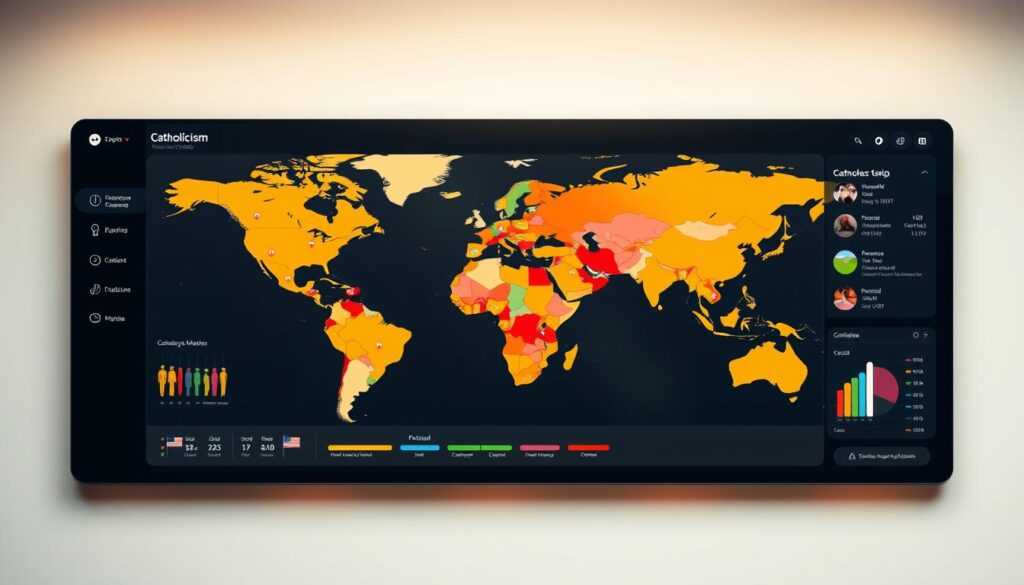
User Navigation and Real-Time Data
Zoom from continent-level views to neighborhood clusters in three clicks. The interface automatically adjusts detail levels, showing:
- Population percentages by age group
- Decade-by-decade growth comparisons
- Urban vs rural community distributions
Data refreshes daily using feeds from 40+ national census bureaus and religious organizations. “This isn’t a static snapshot—it’s a living portrait of belief systems,” explains lead developer Mara Lin.
Three standout tools enhance research capabilities:
- Dynamic filters: Isolate specific metrics like sacramental participation rates
- Overlay mode: Compare historical trends against economic indicators
- Export profiles: Save customized datasets for academic projects
The mobile-responsive design works seamlessly on tablets and smartphones. Educators praise how it engages students during field studies or virtual lessons. By making demographic shifts tangible, this platform bridges data analysis and human stories.
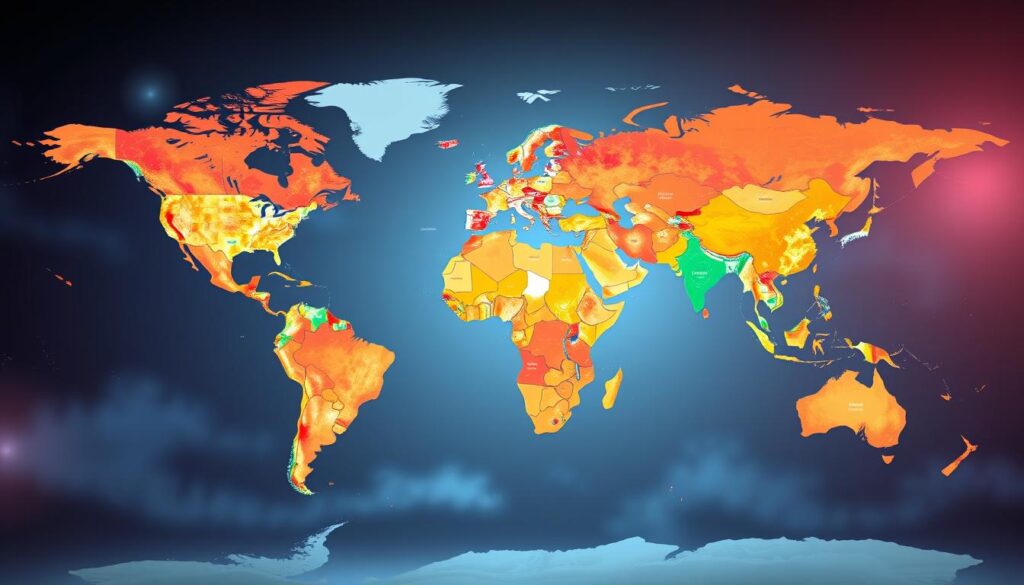
Regional Distribution of Catholicism Worldwide
The spiritual geography of faith communities has transformed dramatically since 1910. Where once two-thirds of adherents lived in Europe, today’s population distribution tells a different story. Let’s explore how migration, birth rates, and cultural shifts reshaped religious demographics across continents.
Latin America’s Evolving Landscape
Latin America remains home to 39% of the world’s adherents—more than any other region. But there’s a twist: while 90% identified with this tradition in 1910, only 72% did by 2010. Rapid population growth outpaced religious expansion, creating new opportunities for diverse belief systems.
Countries like Brazil and Mexico still anchor the faith, but urbanization and social changes drive evolving practices. Younger generations increasingly blend traditional rituals with modern values, creating unique hybrid expressions.
Africa and Asia-Pacific’s Rising Influence
Sub-Saharan Africa’s story stuns observers. From under 1 million followers in 1910 to 171 million today, this growth surge reflects both missionary work and organic community building. “African congregations often triple European ones in weekly attendance,” notes religious scholar Kwame Asante.
The Asia-Pacific region jumped from 14 million to 131 million adherents over the same period. Nations like the Philippines and South Korea show how ancient spiritual roots coexist with contemporary practices. Meanwhile, North America’s 89 million followers—up from 15 million—owe much to immigrant communities enriching local parishes.
These shifts reveal more than numbers. They show how faith adapts to new cultural contexts while maintaining core traditions. From Lagos to Manila, people are rewriting what global spirituality looks like.
Statistical Trends and Growth Patterns
Numbers tell a compelling story about the evolution of spiritual communities across generations. By examining decades of demographic records, we uncover patterns that shape modern religious landscapes.
What the Numbers Reveal
Recent reports show remarkable consistency in global affiliation rates. The World Christian Database estimates 1.272 billion adherents by 2025, while the 2023 Annuario Pontificio counts 1.376 billion baptized members. This represents nearly half of all Christians worldwide.
Three key patterns emerge from the data:
- Sustained growth in developing nations, fueled by younger populations and active outreach
- Stable institutional presence despite regional membership fluctuations
- Varying measurement methods causing number differences between official counts and surveys
Africa and Asia now drive expansion, with birth rates and cultural factors playing crucial roles. As the church adapts to these shifts, its global influence continues evolving in unexpected ways.
FAQ
How does the interactive map show the global Catholic population?
The tool uses real-time data to visualize regional demographics, historical growth, and current trends. It highlights countries with significant Catholic communities, including areas influenced by eastern Catholic churches.
What sources are used to track historical Catholic growth?
Data from institutions like the Pew Research Center, diocesan records, and academic studies are combined. This includes insights on colonial impacts, immigration patterns, and religious shifts over centuries.
Why has Latin America remained a stronghold for Catholicism?
Spanish and Portuguese colonization introduced the Roman Catholic Church early on. Today, despite competition from other religious groups, it remains dominant due to cultural integration and ongoing community ties.
How have immigration trends shaped U.S. Catholicism?
Waves of Irish, Italian, and Hispanic immigrants expanded the church’s presence. Demographic shifts continue today, with growing diversity in parishes and leadership roles.
What features help users navigate the interactive map?
Filters allow exploration by region, population density, and historical timelines. Real-time updates include current statistics from sources like the Vatican and the United States Conference of Catholic Bishops.
Are African and Asian Catholic communities growing?
Yes. Countries like Nigeria and the Philippines report rapid growth due to missionary work, high birth rates, and local adaptations of Catholic practices. The Pew Research Center notes these regions as future hubs.
How does the church address declining numbers in some areas?
Initiatives focus on youth engagement, social outreach, and collaboration with eastern Catholic churches. In Europe and North America, revitalization efforts aim to counter secularization trends.
What role do bishops play in regional church dynamics?
Bishops oversee dioceses, manage resources, and address local challenges. Their influence varies by region—from advocating for social justice in Latin America to navigating government relations in Asia.