The question of whether Anglicans believe baptism is necessary for salvation is a complex one, rooted in the traditions and teachings of the Anglican Church.
The Anglican formularies maintain an Augustinian view of the sacraments, comprising two parts: the outward sign and the inward grace. This perspective is reflected in the Articles of Religion and the Book of Common Prayer, which provide insight into the Anglican understanding of baptism.
The Anglican Church’s stance on baptism and salvation is multifaceted, and this article aims to explore the nuances of this topic.
Key Takeaways
- The Anglican Church has a distinct view on baptism and salvation.
- The sacraments are considered to have two parts: outward sign and inward grace.
- The Articles of Religion and Book of Common Prayer are key to understanding Anglican beliefs.
- Baptism is considered a crucial aspect of the Christian faith in Anglicanism.
- The relationship between baptism and salvation is complex and multifaceted.
Understanding Baptism in Anglicanism
Within Anglicanism, baptism is regarded as a vital rite that symbolizes regeneration and incorporation into the Christian community. This understanding is rooted in the Anglican faith’s emphasis on sacraments as means of grace.
Overview of Anglican Beliefs
The Anglican perspective on baptism is deeply intertwined with their broader theological beliefs. Baptism is seen as a sign of regeneration, whereby individuals are grafted into the Church. According to the Articles of Religion, Baptism is ‘a sign of regeneration… whereby… they that receive Baptism rightly are grafted into the Church’. This highlights the sacrament’s role in initiating believers into the Christian community.
Key aspects of Anglican beliefs regarding baptism include:
- The sacramental nature of baptism, emphasizing its role in conveying spiritual grace.
- The importance of baptism as a rite of initiation into the Christian faith.
- The understanding of baptism as a symbol of regeneration and new life in Christ.
Historical Context of Baptism
The historical context of baptism in Anglicanism is traced back to the early Christian Church and the practices of the apostolic era. The ritual of baptism has evolved over centuries, influenced by various theological debates and ecclesiastical practices.
The Reformation period significantly shaped Anglican baptismal theology, with the Church of England defining baptism as a sacrament that is not merely a symbolic act but a means of grace. This understanding is reflected in the Anglican liturgy and catechisms, which emphasize the role of baptism in salvation.
The historical development of baptism in Anglicanism underscores its importance in the life of the Church and individual believers. It represents a pivotal moment in a person’s journey of faith, marking their incorporation into the community of believers.
The Role of Baptism in Salvation
The role of baptism in salvation is a complex issue within Anglicanism, reflecting a spectrum of beliefs. This complexity stems from the diverse interpretations of baptism’s significance and its relationship to salvation.
Different Views Within Anglicanism
Anglicanism encompasses a broad theological spectrum, ranging from high church to low church traditions. This diversity influences how baptism is understood in relation to salvation.
In the high church tradition, baptism is often seen as a sacrament that conveys spiritual regeneration. This view is supported by the Prayer Book Catechism, which states that baptism is ‘a death unto sin, and a new birth unto righteousness’.
Conversely, in the low church or evangelical Anglican tradition, the emphasis is on personal conversion and faith. While baptism is still considered important, it is not necessarily seen as a prerequisite for salvation.
| Tradition | View on Baptism and Salvation |
|---|---|
| High Church | Baptism is sacramental, conveying spiritual regeneration. |
| Low Church/Evangelical | Baptism is important but not a prerequisite for salvation; personal conversion is key. |
The Sacramental Nature of Baptism
The sacramental nature of baptism is a central aspect of Anglican theology. Baptism is understood as a means of grace, where God’s grace is conveyed through the sacrament.
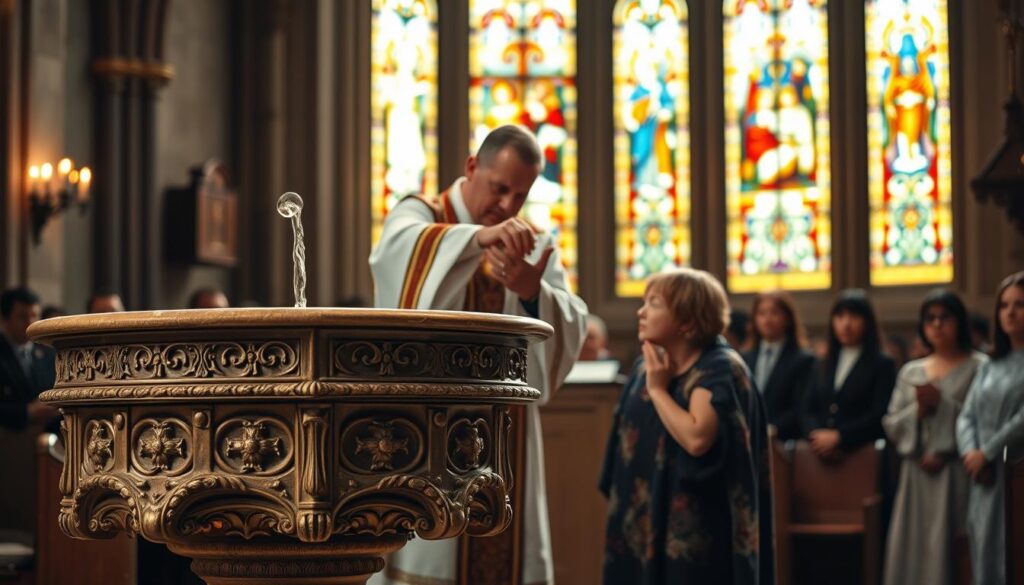
The Book of Common Prayer outlines the baptismal rite, emphasizing the importance of baptism in the life of a Christian. It is seen as a rite of initiation into the Christian community and a step in the journey towards salvation.
The significance of baptism in Anglican faith is thus deeply rooted in its sacramental nature and its role in the broader context of salvation.
Baptism and Scripture
The biblical narrative is essential to understanding the Anglican view on baptism and its necessity for salvation. Anglicans rely heavily on scripture to inform their beliefs about baptism, drawing on various passages to understand its significance.
Key Biblical Passages
Several biblical passages are pivotal in shaping the Anglican understanding of baptism. One of the most significant is John 3:5, where Jesus says, “unless one is born of water and the Spirit, he cannot enter the kingdom of God.” This verse is often cited to emphasize the importance of baptism in the process of salvation.
Another crucial passage is Matthew 28:19, where Jesus commands his disciples to “go therefore and make disciples of all nations, baptizing them in the name of the Father and of the Son and of the Holy Spirit.” This verse underscores the role of baptism in the initiation of new believers into the Christian community.
Interpretations of Baptismal Teachings
Anglicans interpret these biblical passages in the context of their broader theological tradition. The sacramental nature of baptism is a key aspect of Anglican belief, with many viewing baptism as a means of grace through which God’s love and forgiveness are conveyed to the individual.
The importance of baptism in Anglican belief is further highlighted by its connection to the concept of regeneration. As the Bible states, baptism is not merely a symbolic act but is closely tied to the spiritual rebirth of the individual. This understanding is rooted in passages like Titus 3:5, which mentions “the washing of regeneration and renewal of the Holy Spirit.”
In conclusion, the Anglican belief in baptism is deeply rooted in scripture, with key biblical passages providing the foundation for understanding its role in salvation. The sacramental nature of baptism and its connection to spiritual regeneration underscore its significance within the Anglican tradition.
Anglicans and Denominational Differences
Anglicanism has its own unique understanding of baptism’s role in salvation, differing from Catholic and Protestant views. This distinct perspective is rooted in the Anglican tradition, which seeks to balance various theological elements.
Comparisons with Other Christian Traditions
The Anglican view on baptism is shaped by its historical and theological context. Unlike some Protestant denominations, Anglicans believe in the sacramental nature of baptism, where the act is considered a means of grace. However, Anglicanism also diverges from Catholicism in its understanding of baptismal regeneration.
Key differences between Anglican, Catholic, and Protestant views on baptism include:
| Denomination | View on Baptism | Salvation Understanding |
|---|---|---|
| Anglican | Sacramental, means of grace | Baptismal regeneration, with an emphasis on faith |
| Catholic | Necessary for salvation, sacrament of initiation | Baptismal regeneration, sacramental grace |
| Protestant | Varies; some see it as symbolic, others as a sacrament | Faith alone for salvation; baptism as an outward sign |
How Anglicans Differ from Catholics and Protestants
Anglicans differ from Catholics in their understanding of baptismal regeneration, with Anglicans emphasizing the importance of faith alongside the sacrament. Compared to some Protestant denominations, Anglicans place a stronger emphasis on the sacramental nature of baptism.
The nuances of Anglican theology allow for a broad interpretation of baptism’s role in salvation, making it distinct from both Catholic and Protestant traditions.

In conclusion, the Anglican perspective on baptism and salvation is characterized by its unique blend of sacramental and faith-oriented beliefs, distinguishing it within the broader Christian landscape.
The Process of Baptism in Anglican Churches
In Anglican churches, the process of baptism is a meaningful ritual that welcomes individuals into the Christian community. This sacrament is practiced in various forms, accommodating the diverse needs of its congregation.
The Anglican Church practices both infant and adult baptism, reflecting its inclusive approach to faith. While infant baptism is more common, adult baptism is also significant, especially for those converting to Anglicanism or being baptized later in life.
Infant vs. Adult Baptism
Infant baptism is a traditional practice where parents or guardians commit to raising the child in the Christian faith. This form of baptism emphasizes the community’s role in supporting the child’s spiritual development.
Adult baptism, on the other hand, involves individuals who have made a personal decision to follow Christianity. This form of baptism is often seen as a public declaration of faith, symbolizing the individual’s commitment to their spiritual journey.

The Ritual and Significance
The ritual of baptism in Anglican churches typically involves water as a symbol of purification and renewal. The ceremony includes prayers, readings from Scripture, and the act of baptism, which can be performed through sprinkling, pouring, or immersion.
The significance of baptism lies in its representation of spiritual rebirth and the individual’s or family’s commitment to their faith. It is a moment of joy and celebration within the community, marking an important step in one’s Christian journey.
In conclusion, the process of baptism in Anglican churches is a multifaceted and meaningful practice that encompasses both infant and adult baptism. Its significance is deeply rooted in the Anglican doctrine on baptism and salvation, highlighting the importance of baptism in Anglican belief.
The Importance of Faith and Works
In Anglican theology, the interplay between faith, works, and sacraments is crucial for understanding the path to salvation. This complex relationship is rooted in the belief that faith is not merely a passive acceptance of doctrine but an active engagement with God’s grace.
Relation of Faith to Baptism
Faith is considered a fundamental aspect of the baptismal process. Anglicans believe that baptism is not just a ritual but a sacrament that embodies the grace of God. This sacramental understanding means that baptism is seen as a means of grace, where faith is nurtured and strengthened. The Book of Common Prayer, a foundational text in Anglicanism, outlines the significance of baptism in the context of faith, emphasizing the role of the Holy Spirit in illuminating the believer’s understanding and commitment.
The relationship between faith and baptism is reciprocal. On one hand, faith is a prerequisite for baptism, as it represents the individual’s response to God’s initiative. On the other hand, baptism is believed to strengthen and nourish faith, providing a foundation for a lifelong journey of spiritual growth and service.
The Role of Grace in Salvation
Grace is a pivotal concept in Anglican theology, particularly in discussions about salvation. The Anglican perspective emphasizes that salvation is a gift from God, received through faith and nurtured by grace. Baptism is seen as a critical moment in this process, where God’s grace is conferred upon the individual, initiating or deepening their relationship with Him.
The role of works in this context is understood as a natural outflow of faith and a response to God’s grace. Good works are considered a manifestation of the believer’s faith, demonstrating their commitment to living out their baptismal vows. This understanding underscores the importance of living a virtuous life, not as a means to earn salvation, but as a reflection of the transformative power of God’s grace in the believer’s life.
In conclusion, the Anglican belief system intricately weaves together faith, works, and sacraments, including baptism, to form a comprehensive understanding of salvation. This holistic approach emphasizes the importance of both faith and works, grounded in the grace of God, as essential elements of the Christian life.
Perspectives from Anglican Leaders
Anglican theologians and church authorities have offered a range of perspectives on baptism, underscoring its importance in the Anglican faith. The role of baptism in salvation is a complex issue, with various leaders and theologians contributing to the ongoing discussion.
Quotes from Notable Theologians
Notable Anglican theologians have shared insightful views on baptism. For instance,
“Baptism is not just a ritual; it’s a sacrament that signifies our union with Christ and our commitment to follow Him,”
as stated by a prominent theologian. Such quotes highlight the sacramental nature of baptism in Anglicanism.
Another significant perspective comes from Richard Hooker, an influential Anglican theologian, who emphasized the importance of baptism in the context of salvation. His works continue to influence Anglican thought on the subject.
Statements from Church Authorities
Church authorities within the Anglican Communion have also made significant statements regarding baptism. For example, the Anglican Catechism explains that baptism is a sacrament of initiation into the Christian faith, emphasizing its role in the process of salvation.
A comparative analysis of statements from various Anglican church authorities reveals a consensus on the significance of baptism, though there are nuances in interpretation.
| Authority | Statement on Baptism |
|---|---|
| Anglican Catechism | Baptism is a sacrament of initiation into the Christian faith. |
| Episcopal Church | Baptism is a fundamental aspect of Christian discipleship. |
| Church of England | Baptism signifies our union with Christ and our commitment to follow Him. |
The diverse perspectives from Anglican leaders and theologians underscore the complexity and richness of the Anglican faith’s understanding of baptism. By examining these views, one can gain a deeper understanding of the role baptism plays in Anglican salvation beliefs.
Contemporary Anglican Views on Baptism
In contemporary Anglicanism, the understanding of baptism is being reshaped by ongoing theological discussions and societal changes. As the Anglican Communion navigates the complexities of the modern world, the significance and practice of baptism continue to evolve.
Trends in Modern Anglicanism
Modern Anglicanism is characterized by a diverse range of beliefs and practices regarding baptism. Some trends include a renewed emphasis on the sacramental nature of baptism, as well as a growing recognition of the importance of personal faith in the baptismal process.
The Anglican doctrine on baptism and salvation remains a central aspect of the faith, with many Anglicans affirming the necessity of baptism for salvation while also acknowledging the role of grace and faith.
“Baptism is not just a ritual; it is a sacrament that signifies our adoption into God’s family.” –
The Impact of Cultural Changes
Cultural changes have significantly impacted Anglican views on baptism. As societal norms and values shift, the church is adapting its teachings and practices to remain relevant.
| Cultural Influence | Impact on Baptism |
|---|---|
| Increased diversity | More inclusive baptismal practices |
| Secularization | Re-emphasis on the spiritual significance of baptism |
| Changing family structures | Adaptation in baptismal rites for diverse family contexts |
The importance of baptism in Anglican belief is being reaffirmed in the face of cultural change, with many Anglicans seeing it as a vital part of their Christian identity.
As the Anglican Communion continues to grapple with the implications of cultural change, the Anglican perspective on baptism and salvation will likely continue to evolve, reflecting both the traditional aspects of the faith and the contemporary context.
Conclusion: Baptism’s Role in Anglican Salvation Beliefs
The Anglican understanding of baptism is complex and multifaceted, reflecting the diversity of the Anglican tradition. Throughout this article, we have explored the various perspectives on whether Anglicans believe baptism is necessary for salvation.
Key Findings
The significance of baptism in Anglican faith is rooted in its sacramental nature and biblical foundations. While there are different views within Anglicanism regarding the role of baptism in salvation, it is generally considered a vital aspect of the Christian life.
Anglicans believe that baptism is a means of receiving God’s grace, and its significance is not limited to the act itself but extends to the lifelong journey of faith. The question of whether baptism is necessary for salvation remains a matter of debate among Anglicans, with some affirming its necessity and others emphasizing the importance of faith and works.
Final Reflections
In conclusion, the Anglican belief on baptism for salvation is a rich and nuanced topic. Understanding the significance of baptism in Anglican faith can foster greater appreciation for the tradition’s depth and diversity. As Anglicans continue to grapple with the meaning and importance of baptism, it remains a vital aspect of their spiritual practice and identity.
FAQ
Do Anglicans believe baptism is necessary for salvation?
Anglicans have varying views on the necessity of baptism for salvation, but generally, they believe that baptism is a sacrament that initiates a person into the Christian faith and is a means of receiving God’s grace.
What is the Anglican view on the sacramental nature of baptism?
Anglicans believe that baptism is a sacrament that conveys spiritual grace and is a means of initiating a person into the Christian faith, but the understanding of its sacramental nature can vary within the Anglican community.
How do Anglicans interpret biblical passages related to baptism?
Anglicans interpret biblical passages related to baptism, such as Matthew 28:19 and Romans 6:3-4, as emphasizing the importance of baptism as a symbol of faith and a means of receiving God’s grace, but the interpretation can vary depending on the specific passage and context.
What is the difference between infant and adult baptism in Anglican churches?
Anglican churches practice both infant and adult baptism, with infant baptism being seen as a means of initiating a child into the Christian faith and adult baptism being seen as a public declaration of faith, but both are considered valid forms of baptism.
How does the Anglican view on baptism compare to Catholic and Protestant views?
The Anglican view on baptism is distinct from Catholic and Protestant views, as it combines elements of both traditions, emphasizing the sacramental nature of baptism while also allowing for a range of interpretations and practices.
What is the role of faith and works in Anglican theology, and how does it relate to baptism?
Anglicans believe that faith and works are essential components of the Christian life, and that baptism is a means of initiating a person into this life, but the relationship between faith, works, and baptism can be understood in different ways within the Anglican community.
What do Anglican leaders and theologians say about baptism and salvation?
Anglican leaders and theologians have offered a range of perspectives on baptism and salvation, emphasizing the importance of baptism as a sacrament while also acknowledging the complexity of the relationship between baptism and salvation.
How are contemporary Anglican views on baptism evolving?
Contemporary Anglican views on baptism are evolving in response to cultural changes and theological debates, with some Anglicans emphasizing the importance of baptism as a sacrament, while others are re-examining the practice and significance of baptism in light of modern contexts.
What is the significance of baptism in Anglican faith and practice?
Baptism is considered a significant sacrament in Anglican faith and practice, as it initiates a person into the Christian faith and is a means of receiving God’s grace, but its significance can be understood in different ways within the Anglican community.
Is baptism necessary for salvation in Anglicanism?
The question of whether baptism is necessary for salvation is a matter of debate within Anglicanism, with some Anglicans believing that baptism is necessary, while others see it as a means of grace that is not necessarily required for salvation.