The concept of hell is a complex and multifaceted topic within Christian theology. For Episcopalians, the idea of hell is closely tied to the concept of human free will, where individuals have the capacity to accept or reject God.
Understanding the Episcopal Church’s perspective on hell requires an exploration of their theological views on sin, redemption, and the afterlife. The Episcopal Church’s beliefs are rooted in a rich tradition that emphasizes the importance of personal choice and the consequences of one’s actions.
In essence, the Episcopal Church’s stance on hell reflects a nuanced understanding of God’s justice and mercy. By examining their beliefs, we can gain insight into the significance of hell within Episcopalian theology.
Key Takeaways
- Episcopalians believe in human free will, which influences their understanding of hell.
- The Episcopal Church’s views on hell are shaped by their theological perspectives on sin and redemption.
- The concept of hell is complex and multifaceted within Episcopalian theology.
- The Episcopal Church emphasizes the importance of personal choice and its consequences.
- Their beliefs on hell reflect a nuanced understanding of God’s justice and mercy.
Understanding Hell in Episcopalian Theology
The concept of hell within Episcopalian theology is rooted in a deep analysis of scripture and tradition. This foundation shapes the various interpretations and understandings of hell within the Episcopalian community.
The Nature of Hell
The Episcopalian theology of hell is characterized by a range of perspectives. Some view hell as a state of eternal separation from God, while others see it as a realm of punishment and suffering. This diversity reflects the complexity of biblical teachings on the subject.
Key to understanding the nature of hell in Episcopalian theology is the consideration of scriptural references and historical theological debates. The Episcopal Church encourages a nuanced exploration of these sources.
Differing Interpretations
Within Episcopalianism, there are several interpretations regarding hell. Some of the main views include:
- The belief in eternal punishment, where the souls of the unrepentant are eternally damned.
- The concept of annihilationism, where the unrepentant are ultimately destroyed rather than eternally punished.
- The understanding of hell as a temporary state before eventual reconciliation with God.
These differing interpretations highlight the diversity within Episcopalian theology and the ongoing dialogue about the nature of hell.
Scriptural Foundations
The Episcopalian understanding of hell is deeply rooted in scriptural teachings. Passages from the Bible, such as those found in the Gospels and Revelation, provide the foundation for various interpretations of hell.
For instance, the Gospel of Matthew contains references to hell as a place of outer darkness and eternal fire. These images are often cited in discussions about the nature of hell within Episcopalian theology.
By examining these scriptural foundations, Episcopalians can gain a deeper understanding of the theological significance of hell and its relevance to contemporary faith.
Historical Perspectives on Hell
Understanding hell through the lens of Episcopalian history offers insights into how beliefs about the afterlife have developed. The Episcopalian tradition, rooted in Christianity, has a rich history that spans centuries, influencing its views on hell.
Early Church Views
The early Christian Church laid the groundwork for later Christian traditions, including the Episcopalian views on hell. The concept of hell was largely influenced by biblical interpretations and the writings of early Church Fathers. The notion of hell as a place of punishment or separation from God was a common theme. The early Church’s understanding of hell was not uniform, with various interpretations emerging over time.
Reformation Influences
The Reformation had a significant impact on the development of Episcopalian theology, including its views on hell. The Episcopal Church, being part of the Anglican Communion, was influenced by the theological debates of the Reformation era. The Reformers’ emphasis on scripture and justification by faith alone shaped the Episcopalian understanding of sin, redemption, and the afterlife. This period saw a reevaluation of traditional beliefs about hell, with some Reformers questioning the prevailing views.
Modern Episcopalian Thought
In modern times, the Episcopalian Church continues to grapple with the concept of hell, reflecting a diversity of thought within the tradition. While some Episcopalians adhere to traditional views of hell as a place of eternal punishment, others interpret hell more symbolically or as a state of being separated from God’s love. The Episcopal Church’s openness to theological inquiry and its emphasis on individual conscience allow for a range of beliefs about hell. This diversity reflects the Church’s commitment to fostering a deeper understanding of faith and its implications for daily life.
The historical development of Episcopalian beliefs about hell underscores the complexity and richness of Christian theology. By examining the evolution of thought on this topic, Episcopalians can gain a deeper understanding of their faith and its relevance to contemporary issues.
The Concept of Sin and Redemption
Understanding the Episcopalian view of sin and redemption is crucial to grasping their theological stance on hell and salvation. The Episcopalian faith emphasizes the importance of comprehending sin and the path to redemption through Jesus Christ.
Original Sin in Episcopalian Belief
The concept of original sin is rooted in the biblical story of Adam and Eve. Episcopalians believe that original sin refers to the inherent tendency towards sin that humanity inherits from Adam’s disobedience. However, the Episcopal Church does not dogmatically define the nature or consequences of original sin, allowing for a range of interpretations.
The Book of Common Prayer reflects this nuanced understanding, stating, “We have followed too much the devices and desires of our own hearts… and there is no health in us.” This acknowledgment of human frailty underscores the need for redemption.
The Role of Jesus Christ
Jesus Christ is central to the Episcopalian understanding of redemption. Through his life, death, and resurrection, Jesus provides the means for humanity’s salvation. Episcopalians believe that faith in Jesus Christ is essential for forgiveness and reconciliation with God.
The significance of Jesus’ role is highlighted in the Eucharist, a sacrament in which Episcopalians believe they receive spiritual nourishment and grace through the bread and wine, symbols of Christ’s body and blood.
Grace and Forgiveness
Grace and forgiveness are fundamental to Episcopalian theology. Episcopalians believe that God’s grace is freely given and that forgiveness is available through faith in Jesus Christ and participation in the sacraments.
| Aspect | Description |
|---|---|
| Original Sin | Inherent tendency towards sin inherited from Adam’s disobedience |
| Role of Jesus Christ | Provides salvation through his life, death, and resurrection |
| Grace and Forgiveness | Freely given by God, available through faith and sacraments |
The Episcopalian understanding of sin and redemption is thus deeply intertwined with their beliefs about hell and the afterlife, emphasizing the importance of faith, grace, and forgiveness.
The Episcopalian View of Afterlife
Episcopalians hold diverse perspectives on the afterlife, reflecting a broad spectrum of theological thought. This diversity is rooted in the Church’s commitment to scripture, tradition, and reason.

Heaven and Hell: A Duality
The concepts of heaven and hell are central to the Christian understanding of the afterlife. In Episcopalian theology, these concepts are often seen as a duality, representing the ultimate destinations of the soul. Heaven is typically understood as a realm of eternal joy and communion with God, while hell is viewed as a state of separation from God’s love.
“The vision of God is the ultimate hope of Christians,” as one Episcopalian theologian notes, highlighting the aspirational nature of heavenly existence. Conversely, hell is often described in terms of the absence of divine presence, rather than a place of active punishment.
Annihilationism vs. Eternal Punishment
A significant debate within Episcopalian circles concerns the nature of hell, particularly whether it involves eternal punishment or annihilationism—the belief that the unrepentant are ultimately annihilated rather than tormented forever. This debate reflects broader Christian discussions about the character of God and the fate of the unrepentant.
“The Episcopal Church does not have an official stance on annihilationism versus eternal punishment, reflecting its theological diversity.”
Purgatory: Acceptance or Rejection?
The concept of purgatory, a doctrine more commonly associated with Roman Catholicism, has a complex status within Episcopalian thought. While not officially part of Episcopalian doctrine, some Episcopalians find value in the idea of a purifying process after death, akin to purgatory.
The Episcopal Church’s Book of Common Prayer includes prayers for the dead, which some interpret as suggesting a belief in a post-mortem purifying process. However, the Church’s official stance remains nuanced, leaving room for individual interpretation.
The Role of Doubt and Inquiry
The Episcopalian faith is characterized by a profound acceptance of doubt and inquiry, particularly when it comes to complex theological concepts like hell. This openness reflects a mature and thoughtful engagement with faith, acknowledging that questioning and seeking understanding are integral parts of spiritual growth.
Encouraging Questions about Hell
The Episcopal Church encourages its adherents to ask questions about hell and other theological concepts. This encouragement is rooted in the belief that faith should be a thoughtful and informed commitment. By exploring the depths of their beliefs, Episcopalians can develop a more nuanced understanding of hell and its implications for their lives.
- Exploring the nature of hell and its significance in Christian theology
- Understanding the various interpretations of hell within the Episcopalian tradition
- Examining the relationship between hell and other Christian doctrines, such as salvation and grace
The Importance of Individual Belief
Individual belief is highly valued within the Episcopalian tradition. The church recognizes that personal faith is a journey, and individuals may come to different conclusions about theological issues, including the concept of hell. This emphasis on individual belief fosters a diverse and inclusive community, where various perspectives are respected and encouraged.
“The Episcopal Church has a long history of embracing inquiry and valuing individual conscience, allowing for a rich tapestry of beliefs within the community.”
The Episcopal Church’s Openness
The Episcopal Church’s openness to doubt and inquiry is a defining characteristic of its approach to faith. This openness is not limited to individual believers but is also reflected in the church’s official stance on various theological issues. By embracing a range of perspectives, the Episcopal Church creates a welcoming environment for those seeking to deepen their understanding of their faith.
In conclusion, the role of doubt and inquiry within Episcopalianism highlights the church’s commitment to fostering a thoughtful and engaged faith community. By encouraging questions, valuing individual belief, and maintaining an openness to various perspectives, the Episcopal Church provides a nurturing environment for spiritual growth and exploration.
The Influence of Scripture on Beliefs
Understanding the Episcopalian view of hell requires examining the scriptural foundations that underpin their eschatology. Scripture plays a crucial role in shaping Episcopalian beliefs about hell, with key passages influencing their understanding of the afterlife.
Key Biblical Passages
The Episcopalian perspective on hell is informed by several key biblical passages. For instance, the parable of the rich man and Lazarus in Luke 16:19-31 is often cited to discuss the concept of hell and the afterlife. Additionally, passages from the Psalms and the Prophets provide imagery and themes that are used to describe hell.
Some of the most influential passages include:
- The teachings of Jesus on judgment and the afterlife, found in the Gospels.
- The descriptions of the final judgment in the Book of Revelation.
- The prophetic warnings about the consequences of sin in the Old Testament.
The Gospel and Eschatology
The gospel message is central to Episcopalian eschatology, emphasizing the hope of salvation and the promise of eternal life. The resurrection of Jesus Christ is seen as a victory over death and hell, offering believers a path to redemption.
Episcopalians believe that the gospel teaches about God’s love and mercy, which are fundamental in understanding the nature of hell and the afterlife. This belief is rooted in the understanding that God’s ultimate desire is not to condemn but to save and redeem.
Interpreting Revelations
The Book of Revelation is a significant source for eschatological beliefs in the Episcopalian tradition. Its vivid imagery and prophetic language are interpreted in various ways, contributing to the diversity of beliefs about hell and the end times.
Some Episcopalians interpret Revelation literally, seeing it as a prophecy of the end times and the final judgment. Others interpret it more symbolically, understanding its imagery as a representation of spiritual realities rather than physical events.
The interpretation of Revelation, along with other biblical passages, shapes the Episcopalian understanding of hell and the afterlife, influencing their beliefs about the nature of God and the ultimate destiny of humanity.
The Relationship Between Faith and Works
Faith and works are not separate entities in Episcopalian belief; rather, they are complementary aspects of a devout life. This understanding is rooted in the Episcopalian interpretation of Christian teachings, emphasizing both the importance of faith in achieving salvation and the role of good works as a manifestation of that faith.
Salvation through Faith
The Episcopalian Church teaches that salvation comes through faith in Jesus Christ. This core belief is grounded in the understanding that faith is a gift from God, and it is through faith that individuals are justified and reconciled to God. The Book of Common Prayer and the Episcopal Catechism reinforce this principle, highlighting the significance of faith as the foundation of the Christian life.
As stated in the Episcopal Catechism, “Faith is a personal response to God’s revelation, involving trust, obedience, and a commitment to follow Jesus Christ.” This definition underscores the active nature of faith, which is not merely a passive belief but a dynamic commitment that guides one’s actions and decisions.
The Ethics of Episcopalian Belief
The ethical dimensions of Episcopalian belief are deeply connected to the understanding of faith and works. The Church emphasizes the importance of living a virtuous life, characterized by love, compassion, and justice. Episcopalians are encouraged to engage in acts of service and to work towards the betterment of society, reflecting their faith through tangible actions.
The ethical teachings of the Episcopal Church are guided by the principles of loving God and loving one’s neighbor. This is reflected in their support for various social justice initiatives and community service programs. By living out their faith through works, Episcopalians embody the teachings of Christ and contribute to the building of a more just and compassionate world.
Love as a Guiding Principle
At the heart of Episcopalian ethics and practice is the principle of love. Love is seen as a fundamental aspect of God’s nature and a guiding principle for human behavior. The Episcopal Church teaches that love is not limited to personal relationships but extends to the broader community and the world at large.
This understanding is reflected in the Church’s stance on various social issues, where love and compassion are advocated for in addressing the needs of the marginalized and the vulnerable. Through acts of love and kindness, Episcopalians live out their faith, demonstrating the transformative power of God’s love in their lives.
| Aspect | Description | Guiding Principle |
|---|---|---|
| Faith | Personal response to God’s revelation | Trust and Obedience |
| Works | Manifestation of faith through actions | Love and Service |
| Ethics | Guided by love for God and neighbor | Justice and Compassion |
The Community’s Role in Belief
Within the Episcopalian faith, the community plays a crucial role in shaping beliefs regarding hell and the afterlife. The Episcopalian community’s influence is multifaceted, involving church creeds, worship practices, and fellowship.
Church Creeds and Statements
The Episcopalian Church uses various creeds and statements to guide its beliefs and practices. These documents, such as the Baptismal Covenant, outline the core beliefs of the community, including understandings of sin, redemption, and the afterlife.
- The Apostles’ Creed, recited during Sunday services, affirms beliefs in Christ’s descent into hell and resurrection.
- The Book of Common Prayer contains prayers and liturgies that reflect the community’s beliefs about the afterlife.
Shaping Beliefs Through Worship
Worship practices in the Episcopalian Church significantly shape individual beliefs about hell. Through liturgy and sacraments, the community reinforces its theology.
The celebration of the Eucharist, for example, is central to Episcopalian worship and is believed to bring participants into communion with Christ and the heavenly host.
The Importance of Fellowship
Fellowship within the Episcopalian community provides support and guidance for individuals in understanding complex theological concepts like hell.
“Let us consider how we may spur one another on towards love and good deeds, not giving up meeting together, as some are in the habit of doing, but encouraging one another.”
This scripture highlights the importance of communal worship and mutual encouragement in shaping beliefs.
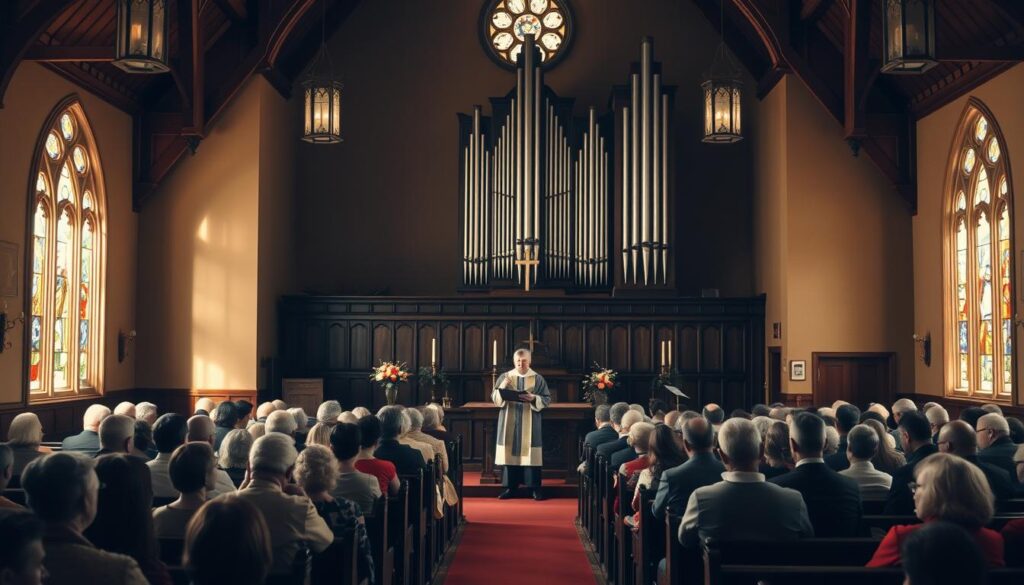
The Episcopalian community’s role in shaping beliefs about hell is a dynamic process involving creeds, worship, and fellowship. Through these elements, individuals within the community come to understand and deepen their faith.
Contemporary Challenges to Traditional Beliefs
The Episcopalian views on hell are facing contemporary challenges that are reshaping traditional understandings. As the world becomes increasingly interconnected, the Episcopal Church is confronted with diverse perspectives that challenge its long-held beliefs about the afterlife.
Modern Reinterpretations of Hell
In recent years, there has been a growing trend within the Episcopalian community to reinterpret traditional beliefs about hell. Some Episcopalians now view hell not as a place of eternal punishment, but rather as a state of being that is separated from God’s love. This reinterpretation is influenced by a more nuanced understanding of scripture and a desire to reconcile traditional teachings with modern values.
Cultural Perspectives on Afterlife
Cultural influences also play a significant role in shaping Episcopalian beliefs about the afterlife. As the Episcopal Church becomes more global, it is exposed to various cultural perspectives on death and the afterlife. For instance, some cultures view the afterlife as a continuation of earthly life, while others see it as a completely separate realm. These diverse perspectives encourage Episcopalians to think critically about their beliefs and to consider alternative understandings of hell.
The Impact of Science and Reason
The advancement of science and reason has also led to a reevaluation of traditional Episcopalian beliefs about hell. Some Episcopalians argue that scientific discoveries and rational inquiry can complement faith, leading to a more informed understanding of the afterlife. This perspective encourages Episcopalians to engage with contemporary knowledge and to integrate it into their theological reflections.
In conclusion, the Episcopalian understanding of hell is being reshaped by contemporary challenges, including modern reinterpretations, cultural influences, and the impact of science and reason. As the Episcopal Church continues to evolve, it is likely that its views on hell will also continue to adapt, reflecting a more nuanced and diverse understanding of the afterlife.
Episcopal Leadership and Doctrine
Episcopal leadership, comprising bishops and clergy, significantly influences the church’s teachings on various theological concepts, including hell. The Episcopal Church’s doctrine is shaped by a complex interplay of tradition, scripture, and the guidance of its leaders.

The Influence of Bishops and Clergy
Bishops and clergy play a crucial role in interpreting and communicating the Episcopal Church’s teachings. Through sermons, pastoral care, and educational programs, they help shape the understanding of complex theological issues among the congregation. Their influence extends to guiding discussions around sensitive topics like hell, ensuring that the church’s stance is presented in a compassionate and informed manner.
The clergy’s role is not only to convey the church’s official doctrine but also to provide pastoral support, acknowledging the diversity of beliefs within the congregation. This balance between teaching and pastoral care is essential in maintaining a vibrant and inclusive faith community.
The Role of General Conventions
The General Convention, the Episcopal Church’s governing body, meets every three years to discuss and decide on matters of doctrine, discipline, and worship. These conventions provide a forum for debating and refining the church’s teachings, including its perspective on hell. Decisions made during these conventions can lead to changes in doctrine or the way it is presented to the faithful.
Through resolutions and canonical changes, the General Convention can significantly impact the church’s stance on various issues. This process ensures that the Episcopal Church remains a dynamic institution, capable of responding to contemporary challenges while remaining rooted in its traditions.
Evolving Teachings on Hell
The Episcopal Church’s teachings on hell have evolved over time, influenced by changing societal values, advancements in theological scholarship, and the insights of its leadership. While traditional views on hell have been part of the church’s doctrine, there is an ongoing dialogue about the interpretation of these teachings in the modern context.
As the church continues to grapple with complex theological questions, its leadership remains committed to guiding the faithful through these discussions. The evolving nature of the church’s teachings on hell reflects a broader effort to make faith relevant and meaningful in contemporary society.
Comparative Beliefs within Christianity
Understanding the Episcopalian perspective on hell requires a comparative analysis with other Christian faiths. The Episcopalian Church’s beliefs about hell are shaped by its unique interpretation of scripture and tradition, which can be compared and contrasted with those of other Christian denominations.
Episcopalians vs. Other Denominations
The Episcopalian Church’s doctrine on hell is distinct from other Christian denominations. For instance, some conservative Christian denominations view hell as a place of eternal punishment, whereas the Episcopalian Church leans towards a more inclusive and less judgmental perspective.
Key differences: Unlike some fundamentalist Christian denominations, the Episcopalian Church does not emphasize hell as a central tenet of its theology. Instead, it focuses on the love and mercy of God, leaving the specifics of hell somewhat open to individual interpretation.
Exploring Similarities and Differences
Despite differences, there are also similarities between Episcopalian beliefs about hell and those of other Christian denominations. Many Christian faiths share a belief in the importance of scripture in understanding the afterlife.
- The Episcopalian Church and some other mainline Protestant denominations share a more nuanced view of hell, often interpreting it in a more metaphorical or less literal sense.
- In contrast, more conservative denominations tend to adhere to a literal interpretation of hell as described in certain biblical passages.
Dialogue with Other Faiths
Engaging in dialogue with other Christian denominations, as well as with other faiths, can enrich the understanding of Episcopalian beliefs about hell. This interfaith dialogue can highlight common values and differences, fostering a more inclusive and compassionate community.
By exploring the diverse perspectives on hell within Christianity and beyond, the Episcopalian Church can continue to refine its doctrine, guided by the principles of love, forgiveness, and understanding.
Finding Hope Amidst Fear
Episcopalians navigating the complexities of hell and afterlife find solace in the understanding that their beliefs are rooted in a broader theological context. The Episcopal understanding of hell is not isolated but is intertwined with the concepts of God’s love and mercy.
Comfort in Uncertainty
The uncertainties surrounding hell can be daunting, yet Episcopalians are encouraged to find comfort in the face of the unknown. This comfort stems from a deep-seated belief in a benevolent God who seeks the salvation of all.
God’s Love and Mercy
At the heart of Episcopalian belief is the conviction that God’s love and mercy are paramount. This understanding shapes their perspective on hell, emphasizing the hope of redemption over fear of punishment.
Living a Faithful Life
What do Episcopalians believe about hell? They believe that their faith should guide them towards a life of love, compassion, and service. This belief in turn fosters a community that values mercy and forgiveness, reflecting the Episcopal understanding of hell as part of a larger narrative of salvation.
FAQ
What do Episcopalians believe about hell?
Episcopalians have varying beliefs about hell, ranging from traditional views of eternal punishment to more modern interpretations such as annihilationism. The Episcopal Church encourages individual inquiry and does not impose a single doctrine on hell.
How does the Episcopal Church view the concept of sin and redemption?
The Episcopal Church teaches that original sin is a condition that separates humanity from God, but through Jesus Christ, humanity is offered redemption. Episcopalians believe in the importance of grace and forgiveness in their theology.
What is the Episcopalian understanding of the afterlife?
Episcopalians believe in a duality of heaven and hell, with some interpreting hell as a state of eternal punishment and others as annihilation. The church also acknowledges the concept of purgatory, although its acceptance varies among Episcopalians.
How does scripture influence Episcopalian beliefs about hell?
Scripture plays a significant role in shaping Episcopalian beliefs about hell, with key biblical passages and the gospel influencing their eschatology. Episcopalians interpret revelations in various ways, contributing to the diversity of beliefs within the church.
What is the relationship between faith and works in Episcopalian theology?
Episcopalians believe in salvation through faith, but also emphasize the importance of works and living a life guided by love. The church teaches that faith and works are interconnected, with ethical living being a crucial aspect of Episcopalian belief.
How does the Episcopalian community influence individual beliefs about hell?
The Episcopalian community plays a significant role in shaping individual beliefs through church creeds, worship practices, and fellowship. The church’s openness to inquiry and diversity of thought also contributes to the development of individual understanding.
What are the contemporary challenges to traditional Episcopalian beliefs about hell?
Contemporary challenges include modern reinterpretations of hell, cultural perspectives on the afterlife, and the impact of science and reason on traditional beliefs. The Episcopal Church continues to navigate these challenges, seeking to balance tradition with modern understanding.
How does Episcopal leadership shape doctrine and teachings on hell?
Episcopal leadership, including bishops, clergy, and General Conventions, plays a role in shaping doctrine and teachings on hell. The church’s leadership influences the development of Episcopalian theology, while also allowing for diversity of thought and individual interpretation.
How do Episcopalian beliefs about hell compare to those of other Christian denominations?
Episcopalian beliefs about hell share similarities with other Christian denominations, but also have distinct differences. The Episcopal Church values dialogue with other faiths, recognizing the diversity of Christian thought and the importance of ecumenical understanding.
How do Episcopalians find hope amidst the uncertainties and fears associated with hell?
Episcopalians find hope in the comfort of God’s love and mercy, as well as the importance of living a faithful life. The church emphasizes the value of faith, love, and compassion, providing a framework for navigating the complexities of eschatology.