How did spiritual beliefs shape nations? For centuries, some communities blended religious authority with political power in ways that still impact modern governance. This journey through time reveals how certain groups sought to create societies guided by their interpretation of divine will.
The concept merges church leadership with civil rule, distinct from secular governments. Unlike other faith-based systems, it specifically roots laws and social norms in Protestant Christian teachings. As Martin Luther once noted: “Having been made righteous, we do righteous deeds” – a philosophy that influenced early attempts to build holy communities.
This approach emerged during the Reformation as both strict and adaptable. While promoting traditional values, its economic policies varied widely between denominations. From radical reformers to mainstream movements, each group redefined how religion interacted with daily life and governance.
Key Takeaways
- Blends religious principles with governmental authority
- Originated during 16th-century Reformation movements
- Economic practices differed between denominations
- Influenced modern debates about faith in public life
- Martin Luther’s teachings shaped early concepts
Historical Foundations and Early Influences
What happens when a monk’s pen shakes an empire? In 1517, Martin Luther sparked a revolution by challenging the Roman Catholic Church’s practices. His famous 95 Theses questioned indulgences and reshaped Europe’s spiritual landscape.
Contextualizing the Reformation
The 16th century was ripe for change. Many felt the church had strayed from its core teachings. Luther’s ideas spread like wildfire through pamphlets and sermons, reaching far beyond academic circles.
Martin Luther’s Impact and the 95 Theses
Luther didn’t just debate theology – he redefined power structures. His “Five Solas” emphasized scripture over papal authority, declaring: “Faith alone makes someone just.” This radical thinking gave rulers new ways to govern through faith.
After Luther’s excommunication, Protestant leaders emerged across Europe. Nordic kingdoms and England became testing grounds for blending worship with statecraft. These experiments shaped political systems for generations, proving ideas could outlast their creators.
Creation and the Rise of Theocratic Models
When religious reform reshapes politics, what new systems emerge? After Luther’s ideas spread, leaders across the Holy Roman Empire faced a pressing question: How could spiritual principles guide daily governance? Thinkers began crafting blueprints for societies where belief and power worked hand-in-hand.
Early Protestant Thought and Theological Shifts
The move from ritual-focused practices to personal faith changed everything. As reformer Martin Bucer argued: “A godly society requires both pure hearts and orderly streets.” This tension led to creative solutions for merging spiritual ideals with practical rule.
Three distinct approaches emerged during this period:
| Leader | Core Idea | Governing Style |
|---|---|---|
| Luther | Scripture as ultimate authority | Rulers protect true faith |
| Zwingli | Moral purity through law | City councils enforce codes |
| Bucer | Church-state collaboration | Shared civic responsibility |
Mountain villages often chose flexible systems that respected local customs. Busy trading cities preferred strict moral codes to maintain order. These experiments showed that successful governance required balancing theology with real-world needs – a lesson that would shape future movements.
Münster: The Radical Theocratic Experiment
What happens when a city tries to build heaven on earth? In 1533 Münster became ground zero for one of history’s most daring social overhauls. Anabaptist leaders Jan Matthys and John of Leiden seized control, promising a society reborn through strict biblical law.
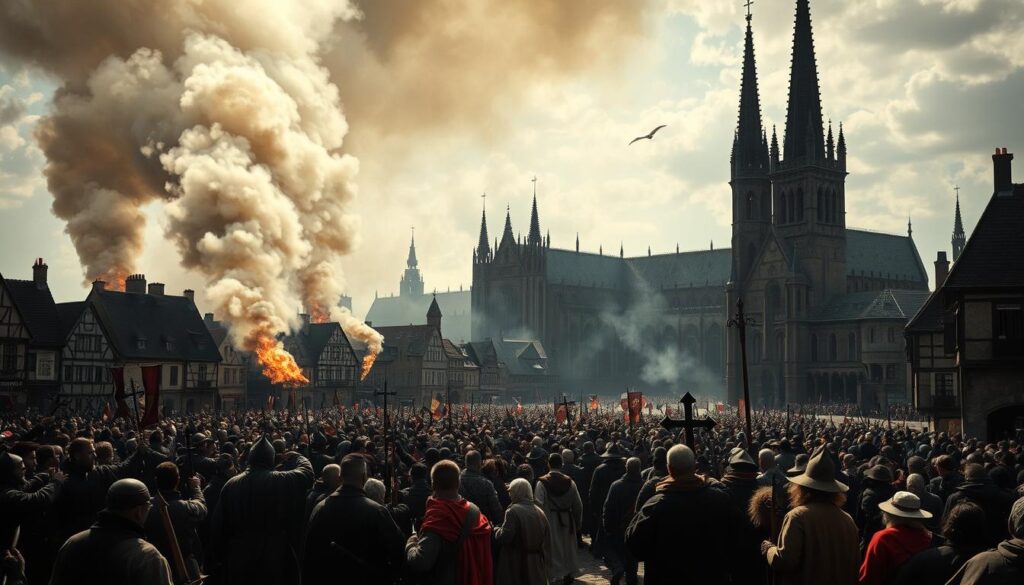
Anabaptist Communism and Its Consequences
The reformers erased private wealth overnight. Coins vanished from markets as “all things became common property” – a bold move that drew both idealists and desperate people. Their radical vision extended beyond economics:
| Aspect | Policy | Impact |
|---|---|---|
| Economy | No private property | Shared resources |
| Law | Ten Commandments enforced | Harsh penalties |
| Leadership | Prophetic rule | Public executions |
Disobeying any commandment meant death. When Matthys died in battle, Leiden crowned himself king – marrying 16 women to fulfill his vision of biblical royalty.
Legacy of Jan Matthys and John of Leiden
The experiment collapsed in 1535 after Bishop Franz von Waldeck’s siege starved the city into surrender. Three iron cages still hang from Münster’s church tower, holding the rebels’ remains as warnings.
This case shows how quickly utopian dreams can unravel. Even though their state lasted just 18 months, it influenced later religious movements seeking perfect order. The Münster story reminds us that translating faith into law requires balancing ideals with human nature – a lesson that echoes through time.
Geneva and Zurich: Debating Theocratic Governance
How do you balance faith with freedom in a city’s laws? Switzerland’s 16th-century cities became laboratories for testing religious authority. While leaders claimed to separate church and state, their actions often blurred these lines.
Calvin’s Geneva and Moral Enforcement
John Calvin’s Geneva presents a puzzle. He wrote about keeping church and state distinct, yet the Consistory – a council of pastors and elders – held remarkable power. This group monitored citizens like neighborhood watch teams, enforcing strict codes:
- Sunday labor bans enforced with fines
- Fashion police checking sleeve lengths
- Public shaming for “lewd” song lyrics
One rebel learned the hard way. When poet Jacques Gruet criticized Calvin’s rules, authorities executed him for blasphemy. As historian E. William Monter noted: “Geneva’s streets became morality classrooms.”
The Controversy over Zurich’s Theocratic Nature
Was Zwingli’s Zurich truly a faith-ruled city? Unlike Geneva’s overt control, Zurich’s council maintained final authority. Yet religious leaders heavily influenced laws about marriage, education, and public behavior.
Modern scholars remain divided. Some argue Zurich created a state-guided church system rather than pure theocracy. Others point to Zwingli’s 1523 mandate requiring biblical law as civic code – a textbook theocratic move.
These Swiss experiments show how easily spiritual ideals could shape secular power. Their legacy? A roadmap for balancing divine commands with human complexity.
Anglican Caesaropapism and Royal Control of Faith
How did a king’s personal crisis reshape national faith? When Henry VIII broke from Rome in 1534, he didn’t just create a new church – he forged a revolutionary system where monarchs held divine authority over both crown and altar. This bold move redefined England’s spiritual and political landscape for centuries.

Henry VIII’s Break and the Acts of Supremacy
The 1534 Act declared the king “Supreme Head of the Church of England,” merging sacred and secular power. But this wasn’t just about Henry’s marriages. As historian Diarmaid MacCulloch notes: “The English Reformation began as political theater, but became constitutional reality.”
Three key changes emerged:
- Royal control over church property and income
- English Bible translations replacing Latin texts
- Clergy swearing loyalty to the crown first
The Evolution of Church-State Roles
Mary I’s brief Catholic restoration (1553-1558) proved how fragile these changes were. Her violent attempts to undo reforms earned the nickname “Bloody Mary.” Elizabeth I’s 1559 settlement brought stability through compromise.
The new queen became “Supreme Governor” rather than “Head” – a title still used today. This clever wording respected theological concerns while maintaining royal oversight. Over years, this model influenced other countries through England’s growing global reach.
Unlike European systems where clergy led religion, England’s approach kept power with the throne. This unique state-church fusion remains part of Britain’s constitutional history, showing how one ruler’s decision can echo through time.
The Holy Experiment: Quakers in Pennsylvania
Can a colony thrive on peace and equality? William Penn answered this with America’s boldest social test. In 1681, the Quaker leader transformed a 29-million-acre land grant into a radical vision where rights and faith coexisted. Unlike New England’s strict settlements, Pennsylvania welcomed diverse beliefs through what Penn called “a holy experiment in brotherly love.”
William Penn’s Ideals of Tolerance and Freedom
Penn’s Frame of Government broke norms. It guaranteed voting rights to all male landowners – Quaker or not – and banned forced military service. As he declared: “Liberty without obedience is confusion, and obedience without liberty is slavery.” His constitution became a blueprint for balancing freedom with order.
The colony attracted persecuted groups like Mennonites and Huguenots. Schools opened to both genders, and Native Americans received fair land treaties. This approach shocked European observers accustomed to religious wars.
Balancing Economic Interests with Faith-Based Governance
Penn faced tough choices. To fund his ideals, he marketed Pennsylvania as “the best poor man’s country,” drawing 8,000 settlers by 1685. But prosperity brought conflicts:
| Principle | Practice |
|---|---|
| Nonviolence | Armed frontier disputes |
| Equality | Slaveholding common |
| Simplicity | Luxury imports grew |
By 1718, Quakers became minorities in their own colony. Political power shifted to non-Quaker settlers demanding secular laws. Though the experiment faded, its core ideas shaped America’s experience with religious pluralism – proving faith could guide without controlling every aspect of life.
Modern Reflections on “protestant theocracy” in State Governance
How do ancient faith traditions shape modern laws? Across Europe and beyond, several nations maintain official ties to Protestant Christianity while balancing contemporary values. These connections often reflect cultural heritage more than strict religious rule.
States Upholding Protestant Identity
England’s Anglican Church still crowns monarchs, while Nordic countries like Norway fund Lutheran ministries through taxes. Scotland’s Presbyterian roots influence education policies, and Tuvalu’s Calvinist principles guide environmental stewardship. These states show how historical faith can coexist with pluralistic society.
Denmark offers a revealing case. Its constitution requires monarchs to follow the Lutheran faith, yet daily governance remains secular. As one Copenhagen resident noted: “Our churches are full on Sundays, but parliament debates climate change, not theology.”
This blend of tradition and modernity raises questions. Can symbolic religious ties strengthen national identity without limiting freedoms? Iceland’s recent shift to fund multiple faiths equally suggests new models are emerging. The legacy of early reformers lives on – not in strict theocracies, but in countries wrestling with how faith informs shared values today.
FAQ
How did Martin Luther’s 95 Theses challenge existing church authority?
Martin Luther’s 95 Theses criticized practices like indulgences, arguing that salvation came through faith—not transactions. This undermined the Roman Catholic Church’s control, sparking debates about individual conscience versus institutional power.
What made Münster’s Anabaptist experiment so radical?
Led by Jan Matthys and John of Leiden, Münster combined religious fervor with communal ownership of property. Their attempt to create a “New Jerusalem” clashed with political rulers, leading to violent suppression and lasting warnings about mixing zealotry with governance.
How did Calvin’s Geneva enforce moral behavior?
Calvin established strict moral codes, policed by church elders. Activities like dancing or swearing faced penalties, blending spiritual discipline with civic law. This model influenced later ideas about religion’s role in shaping public ethics.
Was Henry VIII’s Anglican Church a form of theocracy?
While Henry VIII’s Acts of Supremacy placed him as head of the church, it prioritized royal power over theological purity. This “Caesaropapism” focused on political control rather than creating a fully faith-driven state.
How did William Penn blend faith and governance in Pennsylvania?
Penn’s “Holy Experiment” promoted Quaker values like tolerance while allowing economic freedom. His framework avoided forced conformity, showing how faith-inspired ideals could coexist with pluralism—a contrast to stricter theocratic models.
Do modern states still enforce Protestant identity?
Some nations, like England with its Anglican Church, retain symbolic ties. However, secular governance and religious diversity have largely replaced enforced doctrinal unity, reflecting shifts toward individual rights and multiculturalism.