In 1517, a single act of defiance changed religious history forever. A German monk named Martin Luther nailed his 95 Theses to a church door in Wittenberg. This bold move questioned long-standing practices of the Catholic Church and ignited a spiritual revolution across Europe.
What began as a critique of indulgences grew into a continent-wide movement. Reformers challenged traditional authority, sparking debates about faith, power, and individual conscience. New religious ideas spread rapidly thanks to the printing press, reaching people from commoners to kings.
The ripple effects transformed politics, culture, and society. Rulers used these reforms to assert independence from Rome, while everyday believers gained access to scriptures in their own languages. This shift created lasting divisions within Christianity and shaped modern concepts of religious freedom.
Key Takeaways
- The movement began with Martin Luther’s public challenge to church practices in 1517
- Printing technology helped revolutionary ideas spread faster than ever before
- Religious changes became entangled with political power struggles
- New Christian denominations emerged across Europe and later in America
- The reforms permanently altered relationships between governments and religious institutions
Introduction to the Protestant Reformation Timeline
Long before Luther’s bold move, seeds of change were already planted in Christian Europe. While 1517 marks the official start with the Ninety-five Theses, earlier voices like John Wycliffe had questioned church authority centuries prior. This wasn’t a sudden explosion but a simmering revolution finally reaching its boiling point.
- Growing calls for spiritual renewal among everyday believers
- Political leaders seeking independence from Rome’s influence
- New technologies spreading ideas faster than ever before
What makes this period unique is how local grievances became a continental movement. A German monk’s protest against indulgences resonated with Swiss farmers and English nobles alike. As one reformer noted: “Truth travels best when carried by many hands”.
The church’s response shaped modern Christianity more than any single reformer. Bans on vernacular Bibles backfired, creating demand for personal scripture access. Failed compromises led to permanent divisions, proving institutional power couldn’t contain grassroots spiritual hunger.
This chronological journey reveals patterns still relevant today – how ideas spread, institutions adapt, and individuals reshape societies. By tracing these connections, we understand why 16th-century debates about faith still influence global culture.
The Early Foundations of the Reformation
Centuries before religious upheaval reshaped Europe, visionaries dared to challenge established norms. These early voices laid critical groundwork for sweeping changes in spiritual practice and authority.

Roots of Religious Resistance
John Wycliffe sparked quiet revolutions in 14th-century England. His radical De civili dominio condemned church wealth, arguing: “No man can serve two masters – God and gold.” Followers called Lollards risked their lives sharing handwritten Bible passages in English taverns and markets.
Wycliffe’s translation work made Scripture accessible to ordinary folks. This broke the clergy’s monopoly on biblical interpretation. Authorities responded harshly – burning books and executing dissenters under new heresy laws.
Blueprint for Change
Three key principles defined these early movements:
- Scripture as ultimate religious authority
- Rejection of church materialism
- Empowerment of lay believers
| Aspect | Traditional View | Wycliffe’s Challenge |
|---|---|---|
| Scripture Access | Latin-only for clergy | Vernacular translations |
| Church Wealth | Sacred property | Moral corruption |
| Religious Authority | Pope-centered | Bible-centered |
These ideas survived underground for generations. When printing presses emerged, they found fertile ground. The hunger for personal faith experiences shown by early reformers never truly faded – it simply awaited its moment.
Political and Social Catalysts Leading to Reform
Fourteenth-century Europe faced storms of chaos that reshaped society’s fabric. A series of disasters cracked old power structures, creating space for new ideas to take root.
When Death Reshaped Society
The Black Death (1348-1350) wiped out 33% of Europe’s population. Whole villages vanished, leaving survivors questioning why church leaders couldn’t stop the suffering. As one chronicler wrote: “Graveyards filled faster than priests could pray.”
Three key changes emerged:
- Labor shortages broke feudal systems
- Common people gained bargaining power
- Traditional explanations of divine punishment rang hollow
Rebellion and Religious Doubt
Decades later, the Peasants’ Revolt (1381) fused economic anger with spiritual demands. Protesters quoted radical thinkers like John Wycliffe while attacking tax collectors. Their banners declared: “When Adam delved and Eve span, who was then the gentleman?”
| Aspect | Pre-Plague | Post-Plague |
|---|---|---|
| Social Structure | Fixed hierarchies | Fluid class lines |
| Religious Trust | Unquestioned | Eroded |
| Economic Systems | Feudal obligations | Wage negotiations |
These years of crisis made Europeans rethink every authority. When institutions failed during dark times, alternative voices found eager listeners. The stage was set for deeper challenges to spiritual and worldly power.
Martin Luther and the Catalyst of the 95 Theses
A university professor’s classroom debate questions unexpectedly reshaped Christianity. On October 31, 1517, Martin Luther nailed ninety-five arguments to Wittenberg’s Castle Church door. Though common for academic discussions, this act became history’s most famous memo board post.
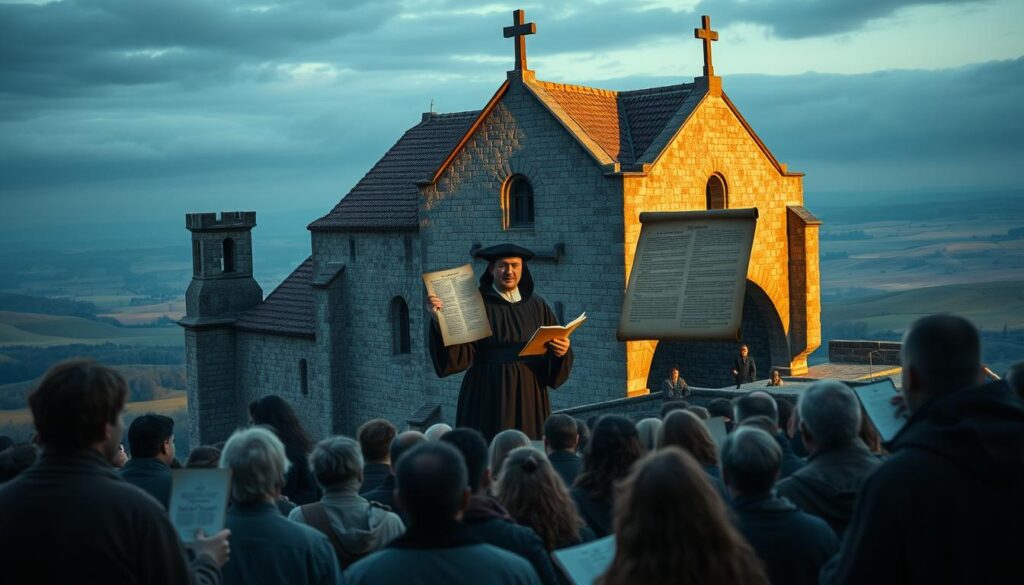
The Significance of Wittenberg and the Ninety-Five Theses
Luther’s Disputation on the Power of Indulgences targeted a specific Catholic Church practice. He argued against selling forgiveness certificates, stating: “As soon as the coin in the coffer rings, the soul from purgatory springs.” This critique questioned both financial policies and spiritual authority.
Three revolutionary ideas stood out:
- Salvation through faith rather than payments
- Scripture’s supremacy over church traditions
- Every believer’s right to interpret religious texts
The theses spread like wildfire through Gutenberg’s printing presses. Within weeks, German translations reached farmers and princes alike. What began as theological debate became a cultural earthquake.
Church leaders initially dismissed Luther as “a drunken German.” But his refusal to recant in 1521 cemented the split. The doctrine of justification by faith alone redefined Christianity’s core message, proving ideas could outpower institutions.
The Rise of Church England and Religious Change
England’s religious landscape shifted dramatically when royal needs collided with papal authority. In 1534, Henry VIII broke from Rome after the Pope refused his marriage annulment. This personal crisis birthed the Church of England, blending old rituals with new ideas.
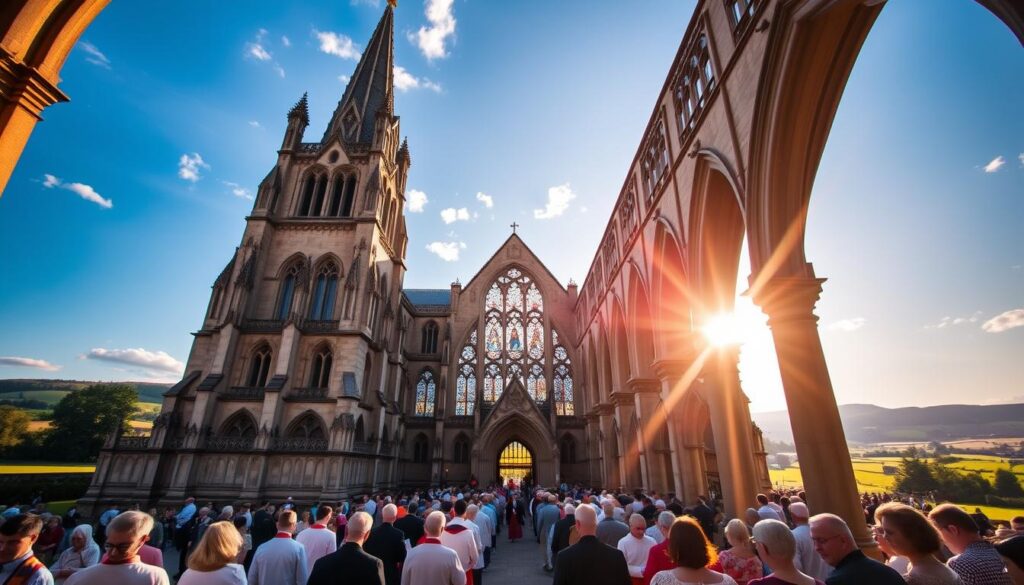
Unlike continental movements driven by theology, England’s reform sprang from political chess. The king declared himself Supreme Head through the Act of Supremacy, quipping: “No foreign power shall command English souls.” Bishops kept their robes, but Rome lost its grip.
This hybrid church walked a careful line:
- Kept stained glass and priestly vestments
- Rejected papal authority but kept hierarchy
- Translated liturgy into English while preserving ceremony
| Practice | Catholic Tradition | Anglican Adaptation |
|---|---|---|
| Leadership | Pope in Rome | English monarch |
| Scripture | Latin Vulgate | Vernacular translations |
| Sacraments | Seven rituals | Redefined importance |
The establishment showed how rulers could reshape faith for state goals. By keeping familiar rituals, the Church of England eased transitions for common worshippers. This middle path became its lasting trademark – neither fully Roman nor radically Reformed.
Understanding the protestant reformation timeline in England
What happens when a king’s personal life reshapes a nation’s faith? Between 1527 and 1603, England’s spiritual identity transformed through royal decisions that blended politics with divine authority. This history shows how marriage disputes and power struggles became catalysts for lasting religious change.
Henry VIII’s quest to annul his marriage sparked constitutional changes that echoed across Wales and England. The Church of England emerged not from theological debates, but through parliamentary acts like the 1534 Supremacy Law. As one advisor noted: “The crown now wears two hats – one earthly, one heavenly.”
Four monarchs left distinct marks on this journey:
- Henry VIII severed Rome’s authority while keeping Catholic rituals
- Edward VI introduced Protestant worship practices
- Mary I temporarily restored Catholic traditions
- Elizabeth I crafted a middle path blending old and new
Monasteries dissolved, English Bibles appeared in churches, and ordinary people faced shifting rules about worship. The Church of England‘s evolution created a unique identity – ornate ceremonies met Reformed theology, satisfying neither Rome nor Geneva completely.
This 76-year timeline reveals how faith became a tool of statecraft. Each ruler’s death brought policy reversals, leaving citizens scrambling to adapt. By Elizabeth’s reign, the Church of England had become a national institution that still shapes religious life today.
Henry VIII’s Role in the English Reformation
Personal royal drama reshaped national faith when Henry VIII turned marital troubles into constitutional revolution. The king’s obsession with securing a male heir created England’s unique path toward religious independence.
Annulment Controversies and Royal Supremacy
King Henry married Catherine of Aragon in 1509, but their surviving child Mary threatened Tudor stability. By 1527, the monarch sought an annulment through church courts. When Pope Clement VII refused, Henry took matters into his own hands.
Three parliamentary acts changed everything:
- 1533 Statute in Restraint of Appeals blocked foreign judgments
- 1534 Act of Succession invalidated Henry’s first marriage
- First Act of Supremacy (1534) made the king “Supreme Head”
Break with the Catholic Church
Henry’s 1535 title addition – “of the Church of England” – marked complete separation from Rome. While keeping Catholic rituals, the monarch now controlled religious authority.
| Aspect | Before 1534 | After 1534 |
|---|---|---|
| Religious Leader | Pope | English Monarch |
| Marriage Laws | Church-controlled | State-controlled |
| Church Wealth | Rome-directed | Crown-confiscated |
This power grab had lasting effects. Monasteries closed, English Bibles appeared, and commoners faced new loyalties. Henry proved personal motives could rewrite national spiritual identity overnight.
The Continental Influence: Calvin, Zwingli, and Reformed Theology
Across the English Channel, revolutionary ideas reshaped religious thought in unexpected ways. While England’s break from Rome began as political theater, continental thinkers gave it deeper spiritual meaning. Their works became guidebooks for believers seeking alternatives to Roman Catholic traditions.
Key Theological Shifts with John Calvin
John Calvin redefined Christian theology with his 1536 masterwork, Institutes of the Christian Religion. This systematic approach explained complex doctrines in clear terms. His emphasis on God’s sovereignty and predestination appealed to English reformers tired of ritual-heavy worship.
Ulrich Zwingli and the Swiss Model
In Zurich, Ulrich Zwingli took reform further than Luther. He stripped churches of statues and organs, arguing: “What the eye doesn’t see, the heart doesn’t crave.” His focus on scripture over symbols influenced English Puritans who wanted simpler services.
These continental ideas transformed England’s religious landscape. Calvin’s theology dominated during Edward VI’s reign, while Zwingli’s practices shaped underground movements. Together, they proved spiritual renewal could cross borders and outlast kings.
FAQ
How did Henry VIII’s actions shape the Church of England?
Henry VIII’s break with the Roman Catholic Church over his desire to annul his marriage led to the Act of Supremacy in 1534. This established the monarch as head of the Church of England, shifting religious authority away from the Pope and laying the groundwork for doctrinal reforms.
What role did Wittenberg play in the Reformation?
Wittenberg became a focal point when Martin Luther, a theology professor there, publicly challenged Catholic practices by posting his Ninety-Five Theses in 1517. This act sparked debates across Europe and accelerated calls for institutional change.
How did John Calvin’s ideas differ from earlier reformers?
Calvin emphasized predestination and a structured approach to church governance. His teachings in Geneva influenced Reformed churches, focusing on strict moral discipline and a community-led model distinct from Luther’s emphasis on individual faith.
Why did the Black Death influence religious reforms?
The plague’s devastation in the 14th century eroded trust in traditional institutions, including the Catholic Church. Survivors questioned existing power structures, creating fertile ground for critiques of corruption and demands for spiritual renewal.
What were the Lollards’ contributions to early reform efforts?
Followers of John Wycliffe, known as Lollards, criticized church wealth and promoted vernacular Bible access. Their ideas laid early groundwork for challenging clerical authority, though they faced suppression until later movements revived similar themes.
How did Ulrich Zwingli impact Swiss religious practices?
Zwingli rejected rituals like fasting and elaborate sacraments, advocating for simpler worship rooted in Scripture. His reforms in Zurich emphasized communal interpretation of the Bible, influencing later Anabaptist and Reformed traditions.